


Career Articles
Capgemini Exceller Technical Assessment 2026: AI + Technical - Best Guide
Cognizant GenC Elevate Exam Pattern & Syllabus for Freshers 2026 - Best Guide
Capgemini Exceller Placement Papers and Solutions 2026 - Best Guide
How to Pass the Accenture Recruitment Process 2026/27: The Complete Guide


Get In Touch For Details! Request More Information
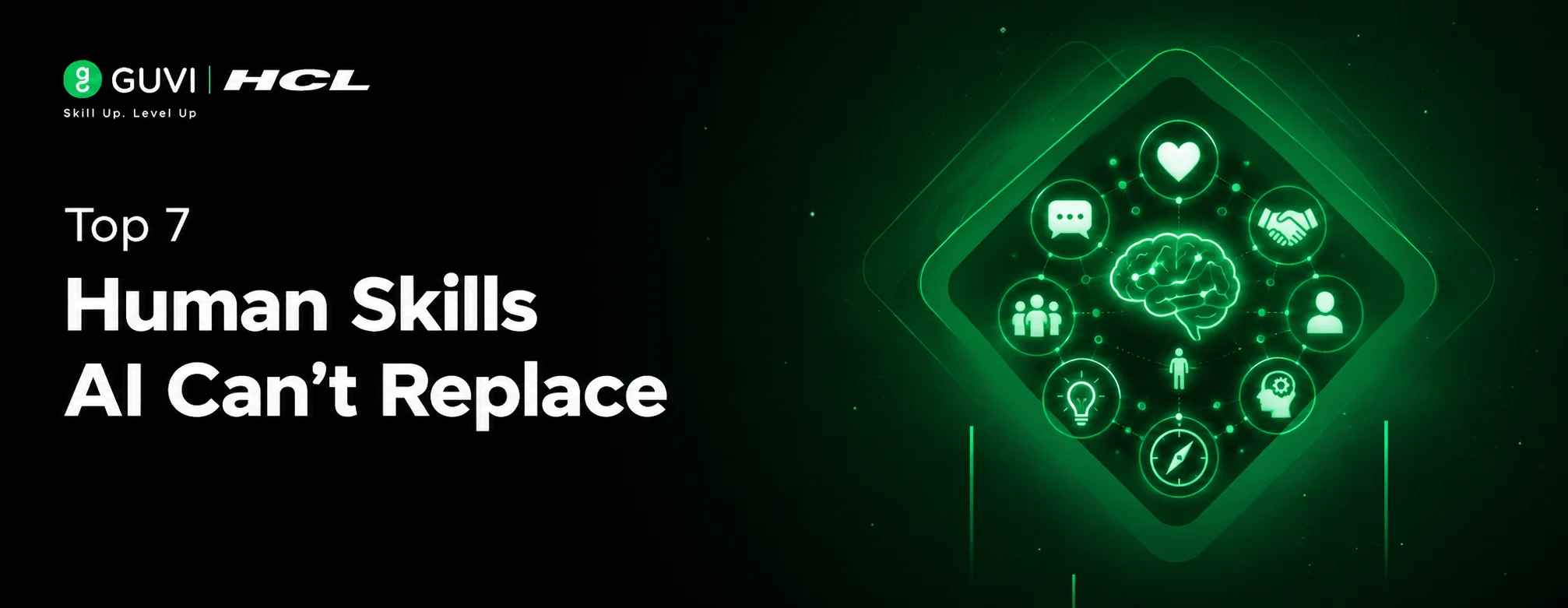
Table of contents
- TL;DR Summary
- Introduction
- What Are Human Skills AI Can’t Replace?
- Why These Skills Matter Now
- AI vs Human Skills: What’s the Real Difference?
- AI Is Fast, Humans Are Context-Aware
- AI Predicts, Humans Decide
- 7 Human Skills That AI Can’t Replace
- Critical Thinking
- Emotional Intelligence
- Creativity
- Communication Skills
- Leadership Skills
- Adaptability and Learning Agility
- Ethical Judgment
- Human Skills vs AI Skills
- How to Build Human Skills for the Future of Work
- Build Critical Thinking With Better Questions
- Build Emotional Intelligence Through Reflection
- Build Communication Skills With Practice
- Build Leadership Skills Before You Become a Manager
- Salary and Career Benefits of Human Skills
- Workplace Scenarios Where Human Skills Matter
- Business Analysis in Banking
- Healthcare Operations
- Retail and Customer Experience
- Common Mistakes to Avoid
- Thinking Soft Skills Are Less Important Than Technical Skills
- Using AI Without Critical Thinking
- Confusing Communication With Good English
- Waiting for a Leadership Title
- Ignoring Emotional Intelligence in Remote Work
- Conclusion
- FAQs
- What are the top human skills AI can’t replace?
- Why are human skills important in the AI era?
- Can AI replace soft skills?
- What is the difference between AI vs human skills?
- Is critical thinking still useful when AI gives answers?
- How can I improve communication skills for the future of work?
- Which careers need emotional intelligence the most?
- Are leadership skills only for managers?
- How do human skills help business analysts?
- What is the best way to stay relevant in the AI-driven future of work?
TL;DR Summary
Human skills AI can’t replace are the abilities that depend on judgment, empathy, context, creativity, trust, and ethical decision-making. While AI can automate tasks, summarize data, and speed up workflows, it cannot fully understand human emotions, manage conflict, lead people, or take responsibility for complex decisions. The most valuable future-ready skills include critical thinking, emotional intelligence, creativity, communication skills, leadership skills, adaptability, and ethical judgment. In the future of work, your strongest advantage will be learning how to combine AI tools with human insight.
Introduction
Human skills AI can’t replace are becoming career-defining because companies no longer need people only to “do tasks”; they need people who can think, communicate, decide, collaborate, and lead through change.
AI can write reports, analyze datasets, generate ideas, and automate repetitive work. But it still struggles with empathy, judgment, ethical responsibility, deep context, and human trust.
That is why the future of work is not simply “AI replacing people.” It is “people with strong human skills using AI better than people without them.”
The World Economic Forum reports that 39% of workers’ existing skill sets may be transformed or become outdated between 2025 and 2030, while analytical thinking remains the most sought-after core skill among employers.
What Are Human Skills AI Can’t Replace?
Human skills AI can’t replace are the personal, social, cognitive, and leadership abilities that require human judgment, emotional awareness, lived experience, moral reasoning, and contextual understanding. These skills help people solve unclear problems, build trust, communicate meaningfully, and make responsible decisions in situations where there is no perfect algorithm.
In simple terms, AI can support your work, but it cannot become fully human on your behalf.
Why These Skills Matter Now
AI is changing how work gets done, but it is also increasing the value of people who can ask better questions, verify outputs, and understand human impact.
For example, a business analyst can use AI to summarize customer feedback. But deciding which customer pain point matters most, explaining it to stakeholders, and turning it into a business decision still requires human judgment.
Microsoft and LinkedIn’s 2024 Work Trend Index found that 75% of knowledge workers use AI at work, while 66% of leaders said they would not hire someone without AI skills.
That means the winning combination is not “human vs AI.” It is human skills plus AI fluency.
AI vs Human Skills: What’s the Real Difference?
AI is excellent at processing patterns, generating text, summarizing information, and automating repeatable tasks. Human skills are stronger in areas that involve ambiguity, emotions, ethics, persuasion, collaboration, and responsibility.
This distinction matters because most modern roles are becoming hybrid. You may use AI for speed, but you still need human skills for quality, trust, and impact.
AI Is Fast, Humans Are Context-Aware
AI can process a thousand customer reviews in seconds. But it may not understand cultural nuance, sarcasm, urgency, or business consequences the way a trained professional can.
A human professional can connect the data with business goals, customer emotions, team limitations, and long-term brand trust.
AI Predicts, Humans Decide
AI can suggest what is likely. Humans decide what is right.
In healthcare, finance, education, HR, and product management, the final decision often affects people directly. That is where ethics, accountability, and empathy become essential.
7 Human Skills That AI Can’t Replace
The human skills AI can’t replace are not “nice-to-have” extras anymore. They are career protection skills, especially in roles where decisions, customers, teams, and business outcomes matter.
Here are the most important ones to build.
1. Critical Thinking
Critical thinking is the ability to question information, evaluate evidence, identify assumptions, and make reasoned decisions. In the AI era, this skill helps you avoid blindly accepting AI-generated answers.
For example, if AI gives you a sales forecast, critical thinking helps you ask:
- Is the data reliable?
- What assumptions were used?
- What market changes are missing?
- What risk does this recommendation create?
The World Economic Forum found that analytical thinking is considered essential by seven out of ten companies in 2025.
2. Emotional Intelligence
Emotional intelligence is the ability to understand your emotions, read others’ emotions, respond with empathy, and build healthy relationships.
AI can detect sentiment in text, but it cannot genuinely care, comfort, negotiate, or repair trust.
In a workplace, emotional intelligence helps you:
- Handle difficult feedback
- Resolve team conflicts
- Support stressed colleagues
- Build customer confidence
- Lead with empathy during change
3. Creativity
Creativity is not just making something artistic. It is the ability to connect ideas, imagine new possibilities, and solve problems in original ways.
AI can generate options based on existing patterns. Humans can redefine the problem itself.
For example, AI might suggest ten campaign headlines. A creative marketer can understand the audience’s fear, aspiration, humor, and cultural mood to choose or reshape the idea that truly connects.
4. Communication Skills
Communication skills help you explain ideas clearly, listen actively, persuade stakeholders, and adapt your message to different audiences.
AI can draft an email, but it cannot fully understand office politics, client hesitation, team morale, or the exact moment when silence is better than speaking.
Strong communication skills help you:
- Present insights clearly
- Ask better questions
- Run productive meetings
- Write sharper reports
- Influence decisions without confusion
5. Leadership Skills
Leadership skills are about guiding people toward a goal, especially when the path is uncertain.
AI can help managers track performance or summarize project updates. But it cannot inspire trust, handle resistance, mentor someone through self-doubt, or take moral responsibility for a tough call.
Leadership in the future of work will depend on clarity, empathy, accountability, and decision-making under uncertainty.
6. Adaptability and Learning Agility
Adaptability is the ability to stay useful when tools, roles, and business models change.
This matters because AI tools will continue to evolve. The tool you learn today may change tomorrow, but your ability to learn, unlearn, and apply knowledge will remain valuable.
The World Economic Forum states that 59 out of every 100 workers may need training by 2030.
7. Ethical Judgment
Ethical judgment is the ability to decide what should be done, not just what can be done.
AI can recommend actions based on data, but humans must think about fairness, privacy, bias, harm, and accountability.
For example, if an AI model recommends rejecting loan applications from a certain customer segment, a human must investigate whether the model is reinforcing unfair bias.
Human Skills vs AI Skills
Both AI skills and human skills matter. The goal is not to choose one side, but to understand where each one adds value.
| Skill Area | AI Is Strong At | Humans Are Strong At |
| Data processing | Finding patterns quickly | Understanding business context |
| Writing | Drafting, summarizing, formatting | Persuasion, tone, relationship impact |
| Problem-solving | Suggesting likely solutions | Defining the right problem |
| Creativity | Generating many ideas | Choosing meaningful, original ideas |
| Communication | Producing structured text | Listening, empathy, negotiation |
| Leadership | Tracking performance signals | Inspiring, mentoring, resolving conflict |
| Decision-making | Predicting outcomes | Ethical judgment and accountability |
How to Build Human Skills for the Future of Work
Human skills improve with deliberate practice. You do not build them by reading definitions; you build them by using them in real situations.
Start small and connect each skill to your current role, studies, projects, or job search.
Build Critical Thinking With Better Questions
Before accepting any answer, ask: “What evidence supports this?”
When using AI, ask it to show assumptions, compare alternatives, and list limitations. Then verify the answer with your own reasoning.
Build Emotional Intelligence Through Reflection
After a difficult conversation, reflect on what you felt, what the other person may have felt, and what could have been handled better.
This builds self-awareness and empathy over time.
Build Communication Skills With Practice
Take one complex idea and explain it in three formats:
- A one-line summary
- A short email
- A stakeholder presentation
This exercise trains clarity, structure, and audience awareness.

Build Leadership Skills Before You Become a Manager
Leadership does not begin with a title. You can practice leadership by owning a task, helping a peer, improving a process, or speaking up with a solution.
Managers notice people who reduce confusion and increase trust.
Salary and Career Benefits of Human Skills
Human skills can directly improve career growth because they make you useful beyond execution. They help you move into roles that require analysis, decision-making, stakeholder management, and leadership.
For example, business analyst roles depend heavily on communication, critical thinking, problem-solving, and stakeholder management. Indeed India reports the average business analyst salary in India at about ₹9.17 lakh per year, based on salaries updated in July 2026.
| Human Skill | Career Benefit | Example Role |
| Critical thinking | Better decisions and fewer errors | Business Analyst |
| Communication skills | Stronger stakeholder influence | Product Manager |
| Emotional intelligence | Better team and client relationships | HR Specialist |
| Creativity | Stronger problem-solving and innovation | UX Designer |
| Leadership skills | Faster growth into ownership roles | Team Lead |
| Ethical judgment | More trust in sensitive decisions | Data Analyst |
Skill gaps are considered the biggest barrier to business transformation by 63% of employers surveyed in the World Economic Forum’s Future of Jobs Report 2025.
Workplace Scenarios Where Human Skills Matter
Human skills become most visible when the situation is messy, emotional, uncertain, or high-stakes. These are the moments where AI can assist, but people must lead.
Business Analysis in Banking
A banking team may use AI to detect patterns in customer complaints. But a business analyst must decide whether the issue is a product bug, a communication gap, or a trust problem.
The analyst then explains the issue to product, compliance, and customer support teams in a way each team can act on.
Healthcare Operations
AI can help hospitals predict patient flow. But healthcare administrators still need emotional intelligence and ethical judgment when communicating delays, prioritizing care, or handling sensitive patient concerns.
The data may guide action, but humans manage the consequences.
Retail and Customer Experience
An eCommerce company can use AI to analyze abandoned carts. But a human team must understand whether customers are leaving because of price, poor trust signals, confusing UX, or weak communication.
Creativity and empathy help convert insights into better experiences.
Common Mistakes to Avoid
Many learners misunderstand human skills because they sound simple. In reality, they take consistent practice and honest feedback.
Here are the mistakes that can slow your growth.
Thinking Soft Skills Are Less Important Than Technical Skills
Many learners focus only on tools, certifications, and software. Those are important, but they are not enough when roles involve clients, teams, or decisions.
If you cannot explain your work clearly, handle feedback, or solve ambiguous problems, your technical skills may not create a visible impact. Strong soft skills help your technical knowledge travel across teams.
Using AI Without Critical Thinking
AI can sound confident even when it is incomplete or wrong. Blindly copying AI outputs can lead to poor decisions, weak reports, or factual errors.
Always review AI-generated content for logic, accuracy, missing context, and audience fit. Your judgment is the quality filter that makes AI useful.
Confusing Communication With Good English
Communication skills are not just about grammar or vocabulary. They are about clarity, listening, structure, timing, and empathy.
A simple explanation that helps stakeholders decide is better than a complex explanation that sounds impressive but creates confusion. Good communication reduces friction.
Waiting for a Leadership Title
Some professionals think leadership begins only after they become managers. That mindset delays growth.
You can show leadership by taking ownership, helping others, documenting processes, resolving blockers, and making work easier for the team. Leadership skills are built before the promotion.
Ignoring Emotional Intelligence in Remote Work
Remote and hybrid work can make messages feel colder or more transactional. Without emotional intelligence, small misunderstandings can become trust issues.
Use clearer updates, acknowledge concerns, and avoid assuming tone in written messages. Human connection needs more intention when teams work through screens.
Conclusion
Human skills AI can’t replace will define career growth in the future of work. AI can speed up tasks, but people still bring judgment, empathy, creativity, ethics, communication, and leadership to complex situations. The smartest career move is not to compete with AI. It is to use AI confidently while becoming more human in how you think, decide, and collaborate. Start by improving one skill this week: ask better questions, explain one idea more clearly, or take ownership of a small problem.
If you want to build a career where AI tools support your decisions instead of replacing your value, start strengthening your analytical thinking, stakeholder communication, and business problem-solving skills. The HCL GUVI Business Analyst Course can help you learn these skills through a structured, career-focused path designed for practical workplace readiness.
FAQs
1. What are the top human skills AI can’t replace?
The top human skills AI can’t replace include critical thinking, emotional intelligence, creativity, communication skills, leadership skills, adaptability, and ethical judgment.
2. Why are human skills important in the AI era?
Human skills are important because AI can process information, but humans provide context, empathy, responsibility, and judgment. These abilities are essential in decision-making and collaboration.
3. Can AI replace soft skills?
AI can support some soft-skill-related tasks, such as drafting messages or analyzing sentiment. But it cannot fully replace trust-building, empathy, conflict resolution, or leadership.
4. What is the difference between AI vs human skills?
AI skills help you use tools and automate tasks. Human skills help you understand people, solve unclear problems, communicate decisions, and act responsibly.
5. Is critical thinking still useful when AI gives answers?
Yes. Critical thinking is more important because AI outputs need verification. You must check assumptions, identify errors, compare options, and decide what is relevant.
6. How can I improve communication skills for the future of work?
Practice explaining complex ideas simply, listen actively, ask clarifying questions, and adapt your message to your audience. Written and verbal communication both matter.
7. Which careers need emotional intelligence the most?
Careers in business analysis, management, HR, healthcare, customer success, sales, teaching, UX design, and leadership depend strongly on emotional intelligence.
8. Are leadership skills only for managers?
No. Leadership skills are useful at every career level. You show leadership when you take ownership, support others, solve problems, and create clarity.
9. How do human skills help business analysts?
Business analysts use human skills to understand stakeholder needs, ask better questions, resolve ambiguity, communicate insights, and convert data into business decisions.
10. What is the best way to stay relevant in the AI-driven future of work?
Build a combination of AI literacy and human skills. Learn to use AI tools, but also strengthen critical thinking, creativity, communication, and adaptability.
Success Stories










Did you enjoy this article?