


Career Articles
Capgemini Exceller Technical Assessment 2026: AI + Technical - Best Guide
Cognizant GenC Elevate Exam Pattern & Syllabus for Freshers 2026 - Best Guide
Capgemini Exceller Placement Papers and Solutions 2026 - Best Guide
How to Pass the Accenture Recruitment Process 2026/27: The Complete Guide


Get In Touch For Details! Request More Information
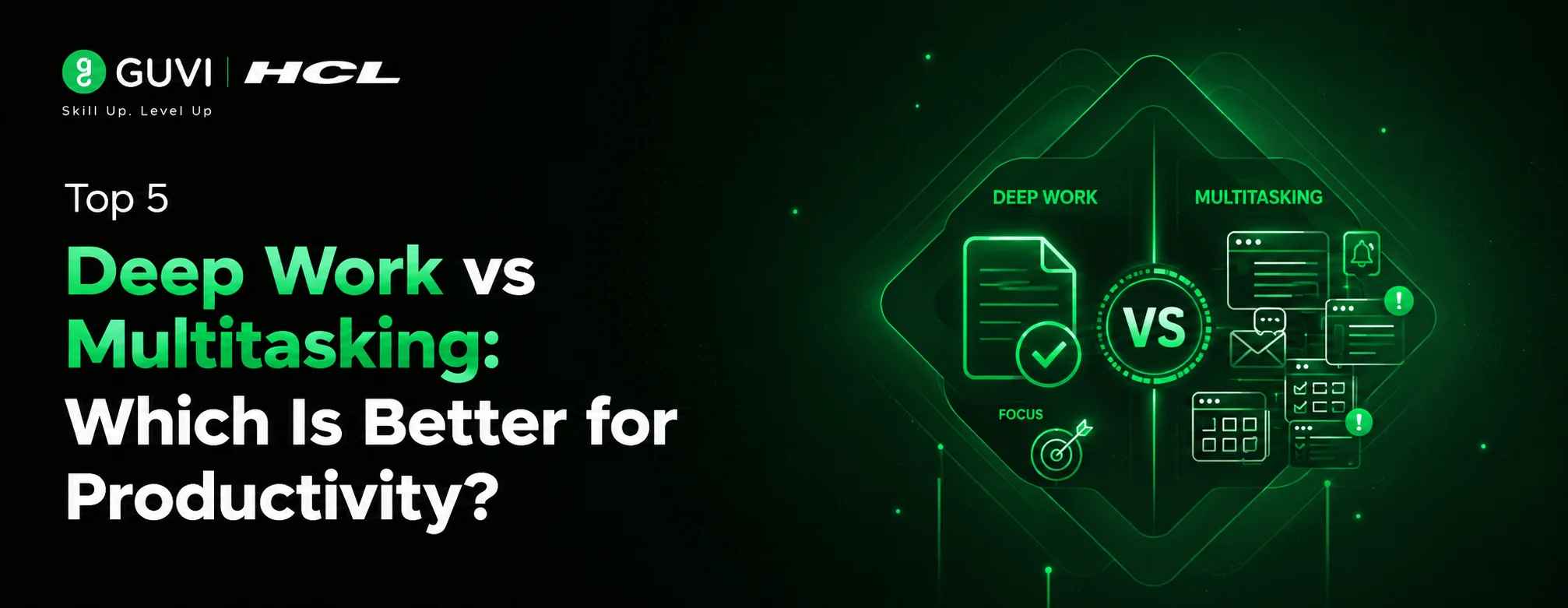
Deep Work vs Multitasking: Which Is Better for Productivity?
Aug 04, 2026 5 Min Read 246 Views
(Last Updated)
Table of contents
- TL;DR Summary
- Introduction
- What Is Deep Work?
- Deep Work Benefits for Professionals
- When Should You Use Deep Work?
- What Is Multitasking?
- Why Multitasking Feels Productive
- When Can Multitasking Work?
- Deep Work vs Multitasking: Key Differences
- Deep Work vs Multitasking for Complex Tasks
- Deep Work vs Multitasking for Routine Tasks
- Which Is Better for Focus at Work?
- A Simple Time Management Model
- Practical Productivity Techniques to Improve Concentration
- Use Time Blocking
- Batch Communication
- Create a Shutdown List
- Use the 90-Minute Focus Sprint
- Define the Output Before You Start
- High-Focus Use Cases Across Industries
- Business Analytics Team in an E-Commerce Company
- Product Team in a SaaS Company
- Learning Scenario for Career Switchers
- Common Mistakes to Avoid
- Mistake 1: Treating Every Task as Urgent
- Mistake 2: Starting Deep Work Without a Clear Goal
- Mistake 3: Keeping Notifications On
- Mistake 4: Confusing Busy Work With Productive Work
- Mistake 5: Trying to Do Deep Work All Day
- Frequently Asked Questions
- What is the main difference between deep work and multitasking?
- Deep work vs multitasking: which is better?
- Can multitasking improve productivity?
- How can I improve concentration at work?
- What are the biggest deep work benefits?
- Is deep work useful for students and career switchers?
- How long should a deep work session be?
- What are the best productivity techniques for deep work?
- Does deep work mean avoiding teamwork?
TL;DR Summary
Deep work vs multitasking is a clear productivity debate: deep work is better for complex, creative, analytical, and high-value tasks, while multitasking only works for low-risk routine activities. Deep work helps you improve concentration, reduce errors, and complete meaningful work faster. Multitasking feels productive, but frequent task switching can reduce focus and increase mental fatigue. The best approach is to schedule distraction free work blocks for important tasks and reserve multitasking for simple admin work.
Introduction
Deep work vs multitasking matters because most professionals are busy all day but still struggle to finish meaningful work. Microsoft’s 2023 Work Trend Index found that 68% of employees say they do not have enough uninterrupted focus time during the workday.
That means the real problem is not a lack of effort. It is a lack of protected attention.
If your day is filled with Slack messages, meetings, email checks, browser tabs, and “quick” context switches, multitasking may be quietly reducing your output. Deep work helps you protect your best mental energy for the work that actually moves your career forward.
What Is Deep Work?
Deep work is the practice of focusing on one cognitively demanding task without distractions for a fixed period of time. It helps you produce high-quality work, solve complex problems, and build valuable skills faster because your attention is fully committed to one outcome.
In simple terms, deep work means doing one important task with full focus.
Deep Work Benefits for Professionals
Deep work benefits anyone who handles problem-solving, analysis, writing, coding, design, planning, learning, or decision-making.
It is especially useful when you need to:
- Analyze business data
- Write reports or proposals
- Build dashboards
- Learn a new technical skill
- Prepare for interviews
- Solve customer or product problems
- Create strategy documents
Microsoft’s research also shows that the average Microsoft 365 user spends 57% of their time communicating and only 43% creating, which shows how easily modern work shifts away from focused output.
When Should You Use Deep Work?
Use deep work when the task needs thinking, accuracy, creativity, or judgment.
For example, a business analyst creating a customer churn dashboard should not keep checking messages every five minutes. A better approach is to block 90 minutes, silence notifications, define the dashboard goal, and work only on that task.
That is distraction free work in action.
What Is Multitasking?
Multitasking is the attempt to handle two or more tasks at the same time or switch between them rapidly. It can include replying to emails during meetings, checking messages while writing a report, or jumping between multiple projects within the same hour.
For light tasks, multitasking may feel manageable.
But for knowledge work, most multitasking is actually task switching. Your brain is not doing everything at once. It is moving attention back and forth, and every switch has a cost.
Why Multitasking Feels Productive
Multitasking gives you a sense of movement.
You reply to messages, open documents, attend calls, update trackers, and answer questions. The problem is that activity is not the same as progress.
Asana’s 2023 Anatomy of Work Global Index found that knowledge workers spend 58% of their day on “work about work,” such as coordination, status updates, and searching for information, instead of skilled strategic work.
When Can Multitasking Work?
Multitasking works only when tasks are simple, familiar, and low-risk.
For example:
- Listening to a podcast while walking
- Organizing files while waiting for a download
- Running a routine report while checking a checklist
- Folding laundry while listening to an audiobook
But it is not ideal for analysis, writing, coding, learning, or decision-making.
Deep Work vs Multitasking: Key Differences
This deep work vs multitasking comparison shows a simple rule: use deep work for high-value tasks and multitasking only for low-focus tasks.
| Factor | Deep Work | Multitasking |
| Best for | Complex, creative, analytical work | Simple, repetitive tasks |
| Attention style | Single-task focus | Rapid task switching |
| Output quality | Higher accuracy and depth | Higher risk of errors |
| Energy use | Intense but purposeful | Draining over time |
| Time management impact | Helps protect priority work | Can fragment the day |
| Best example | Creating a dashboard, strategy, or report | Sorting files while downloading data |
| Career value | Builds expertise and visible outcomes | Helps manage small tasks |
Deep Work vs Multitasking for Complex Tasks
Deep work is better for complex tasks because it reduces attention residue.
When you keep switching between a spreadsheet, chat window, meeting, and browser tab, your mind carries unfinished thoughts from each task. This makes it harder to improve concentration and think clearly.
The American Psychological Association notes that mental blocks from switching tasks can cost as much as 40% of someone’s productive time.
Deep Work vs Multitasking for Routine Tasks
Multitasking can be acceptable for routine tasks when the cost of error is low.
For example, a marketing executive may batch simple tasks such as renaming files, arranging folders, or checking campaign links. These do not require deep reasoning.
But writing the campaign strategy, analyzing user behavior, or preparing a performance report should be done in deep work mode.
Which Is Better for Focus at Work?
Deep work is better for focus at work because it protects your attention from constant interruption. Multitasking may help you respond quickly, but it often reduces the quality of thinking required for meaningful workplace output.
The better question is not “Should I never multitask?”
The better question is: “Which tasks deserve my full attention?”
A Simple Time Management Model
Try this daily structure:
| Time Block | Work Type | Example |
| 9:30 AM – 11:00 AM | Deep work | Analysis, writing, dashboarding, coding |
| 11:00 AM – 11:30 AM | Communication | Email, Slack, status updates |
| 12:00 PM – 1:00 PM | Deep work | Problem-solving or learning |
| 3:00 PM – 3:30 PM | Admin multitasking | File updates, trackers, approvals |
| 4:00 PM – 4:30 PM | Planning | Next-day priorities |
This method improves focus at work because every task has a place instead of competing for attention all day.
Practical Productivity Techniques to Improve Concentration
You do not need a perfect routine to start deep work. You need a repeatable system that makes distraction free work easier.
Start with small changes and build consistency.
1. Use Time Blocking
Time blocking means assigning fixed time slots for specific tasks.
Instead of writing “finish report” on your to-do list, schedule “10 AM to 11:30 AM: draft report summary.” This gives your brain a clear boundary.
2. Batch Communication
Do not check email or chat every few minutes.
Batch them into two or three windows per day. This reduces context switching and protects your high-energy hours.
3. Create a Shutdown List
Before starting deep work, write down all small tasks that are pulling your attention.
This tells your brain, “I will handle these later.” It is a simple way to reduce mental noise.
4. Use the 90-Minute Focus Sprint
Pick one task, set a 90-minute timer, and remove all distractions.
During the sprint:
- Keep only the required tabs open
- Put your phone away
- Turn off notifications
- Keep water nearby
- Write down distractions instead of acting on them
5. Define the Output Before You Start
A deep work session should have a clear finish line.

For example:
- “Complete the first draft”
- “Clean 500 rows of data”
- “Create three dashboard charts”
- “Summarize five customer pain points”
Clear outputs improve concentration because your attention has a target.
High-Focus Use Cases Across Industries
Deep work becomes more powerful when you connect it to real workplace scenarios. These examples show how professionals can use productivity techniques in practical settings.
Business Analytics Team in an E-Commerce Company
Imagine a business analyst at an e-commerce company studying why cart abandonment increased during a festival sale.
Multitasking would mean checking emails, replying to messages, attending calls, and looking at dashboards in between. The analyst may stay busy but miss the actual pattern.
Deep work would mean blocking 90 minutes to study funnel data, payment failure logs, product categories, and customer segments. This focused approach is more likely to reveal whether the issue came from pricing, checkout friction, delivery estimates, or payment failures.
Product Team in a SaaS Company
A SaaS product manager reviewing user feedback needs deep work to identify recurring themes.
If they multitask during this process, they may only capture surface-level complaints. But with distraction free work, they can group feedback into usability issues, onboarding gaps, pricing concerns, and feature requests.
This leads to better roadmap decisions.
Learning Scenario for Career Switchers
If you are learning business analytics, data science, or programming, deep work is your career accelerator.
Watching lessons while checking messages may feel efficient, but it weakens retention. A better method is to study one concept, practice it immediately, take notes, and revise the next day.
That is how you convert learning time into job-ready skill.
The biggest productivity problem is not always laziness; it is often fragmented attention. When your calendar, inbox, chat tools, and browser tabs compete all day, your brain never gets enough space for deep work.
Common Mistakes to Avoid
Mistake 1: Treating Every Task as Urgent
Many professionals multitask because everything feels urgent. A message appears, a meeting invite arrives, and a small request interrupts the main task.
The fix is to separate urgent from important. Not every notification deserves an instant response. Protect your deep work blocks for tasks that affect outcomes, decisions, clients, or learning progress.
Mistake 2: Starting Deep Work Without a Clear Goal
Sitting quietly for two hours is not automatically deep work. If you do not define the output, your mind may drift between tabs, notes, and half-formed ideas.
Before you begin, write one clear goal. For example, “complete the executive summary” or “analyze customer drop-off by region.” A clear goal gives your focus a direction.
Mistake 3: Keeping Notifications On
Notifications are small interruptions with large consequences. Even if you do not respond, your attention shifts for a moment, and that shift breaks momentum.
Turn off non-essential alerts during focus blocks. Inform your team about your availability windows. This makes distraction free work more realistic in a collaborative workplace.
Mistake 4: Confusing Busy Work With Productive Work
Updating trackers, replying to emails, and attending meetings can make your day look full. But these tasks may not create meaningful progress.
Review your day by asking, “What did I complete that improved the result?” This question helps you prioritize deep work benefits over shallow activity.
Mistake 5: Trying to Do Deep Work All Day
Deep work is powerful, but it is mentally demanding. You cannot stay in intense focus for eight straight hours.
Start with one or two deep work blocks per day. Use the rest of the day for meetings, communication, review, and admin tasks. Sustainable focus beats unrealistic routines.
Conclusion
Deep work vs multitasking is not about rejecting every small task. It is about choosing the right mode for the right work. Deep work is better for learning, analysis, writing, coding, decision-making, and any task where quality matters. Multitasking is useful only for simple, low-risk activities. If you want to improve concentration, start with one distraction free work block each day, batch communication, and define your output before you begin. Your next step is simple: protect your best attention for your most valuable work.
If your goal is to build stronger analytical thinking, structured problem-solving, and workplace decision-making skills, explore HCL GUVI’s AI-Powered Business Analytics Course. It can help you apply focused learning to practical business scenarios, dashboards, analytics workflows, and career-ready projects.
Frequently Asked Questions
1. What is the main difference between deep work and multitasking?
Deep work means focusing on one demanding task without distractions. Multitasking means handling multiple tasks at once or switching between them quickly.
2. Deep work vs multitasking: which is better?
Deep work is better for complex, creative, and analytical tasks. Multitasking is only useful for simple, repetitive, and low-risk activities.
3. Can multitasking improve productivity?
Multitasking can help with basic admin work, but it usually reduces productivity for tasks that need focus, memory, or decision-making.
4. How can I improve concentration at work?
You can improve concentration by time blocking, turning off notifications, batching communication, keeping fewer tabs open, and setting one clear goal per work session.
5. What are the biggest deep work benefits?
The biggest deep work benefits include better focus, higher-quality output, faster learning, fewer errors, and stronger problem-solving ability.
6. Is deep work useful for students and career switchers?
Yes. Deep work helps learners understand difficult concepts, practice consistently, and retain knowledge better than distracted study sessions.
7. How long should a deep work session be?
Beginners can start with 45–60 minutes. As focus improves, 90-minute sessions work well for demanding tasks.
8. What are the best productivity techniques for deep work?
The best productivity techniques include time blocking, Pomodoro sessions, notification control, task batching, focus sprints, and daily priority planning.
9. Does deep work mean avoiding teamwork?
No. Deep work means protecting focus time for individual high-value tasks. Teamwork still matters, but it should be planned around focused work instead of constantly interrupting it.
Success Stories









Did you enjoy this article?