


Artificial Intelligence and Machine Learning Articles
Claude for Habit Tracking and Accountability
How to Use Claude to Learn a New Skill Faster


Get In Touch For Details! Request More Information
Using Claude to Prepare for Difficult Conversations
Aug 13, 2026 5 Min Read 36 Views
(Last Updated)
Most people avoid difficult conversations not because they do not know the conversation needs to happen but because they do not know how to start it, what to say when it gets tense, or how to stay focused on the outcome they need when emotions take over. Claude difficult conversations preparation gives you a structured way to think through all of these dimensions before you are in the room, so the conversation itself becomes execution of a plan rather than improvisation under pressure.
Table of contents
- Quick TL;DR
- What Claude Helps With in Difficult Conversation Preparation
- The 6-Step Framework for Preparing for Any Difficult Conversation
- Step 1: Clarify What You Actually Need from the Conversation
- Step 2: Build the Other Person's Perspective
- Step 3: Draft Your Opening Statement
- Step 4: Prepare for Likely Responses and Pushback
- Step 5: Define What You Will and Will Not Accept
- Step 6: Post-Conversation Reflection
- Managing Your Own Body Language and Tone
- Conclusion
- FAQs
- What is Claude used for in difficult conversation preparation?
- Can Claude help with both professional and personal difficult conversations?
- How do I make sure Claude's suggested language sounds like me?
- What is the most important preparation step before a difficult conversation?
- Can Claude help me if I am on the receiving end of a difficult conversation?
- How do I handle it when the conversation goes completely differently than I prepared for?
Quick TL;DR
Claude to Prepare for Difficult Conversations involves using Claude to think through, structure, and rehearse challenging interpersonal exchanges before they happen, whether that is a performance conversation with a team member, a salary negotiation, a conflict resolution discussion, or a boundary-setting conversation with a colleague or family member. Claude helps you clarify your goal, anticipate the other person’s perspective, identify emotional triggers, and prepare specific language so you enter the conversation with clarity and confidence rather than anxiety and improvisation.
What Claude Helps With in Difficult Conversation Preparation
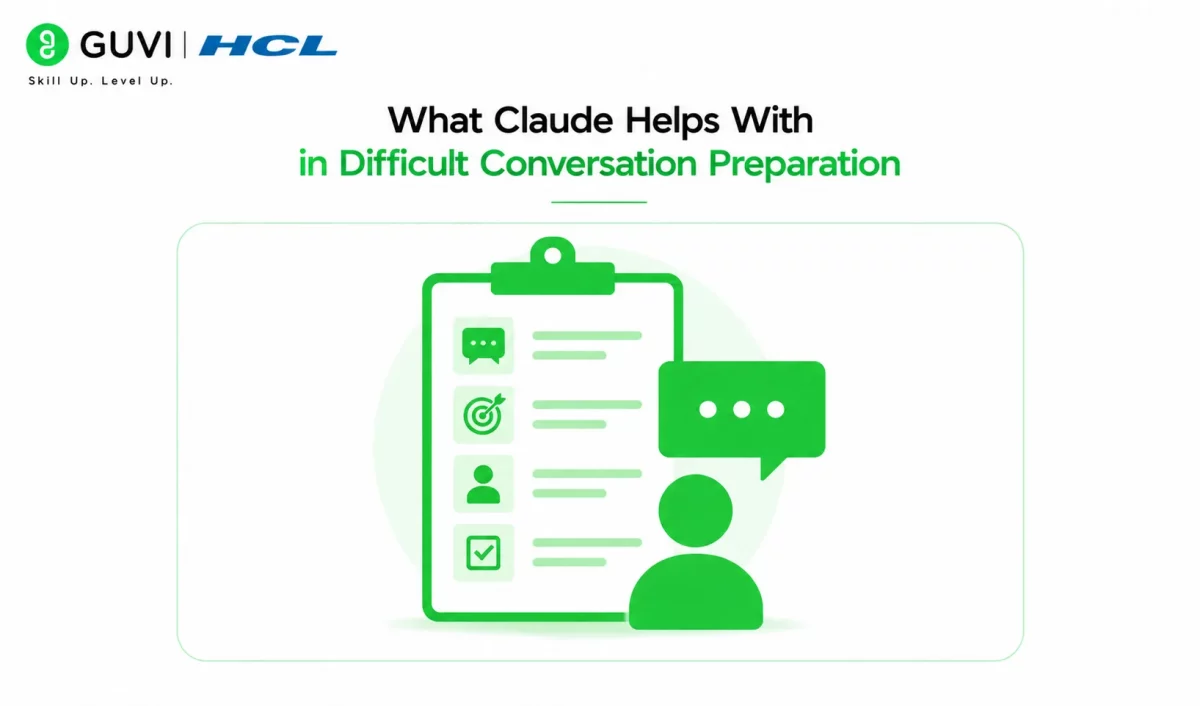
| Preparation Task | What Claude Does |
| Goal clarification | Helps you identify what you actually need from the conversation |
| Perspective-taking | Articulates the other person’s likely viewpoint and concerns |
| Opening statement | Drafts a clear, non-accusatory way to begin the conversation |
| Trigger identification | Surfaces the emotional responses most likely to derail you |
| Response preparation | Prepares language for likely pushback or defensive reactions |
| Boundary setting | Helps articulate limits clearly without aggression |
| Outcome definition | Clarifies what success looks like so you can recognize it |
Read More: Multi-Turn Conversation Management with Claude API
The 6-Step Framework for Preparing for Any Difficult Conversation
Step 1: Clarify What You Actually Need from the Conversation
The most common reason difficult conversations fail is that the person initiating them has not clearly defined what they need from the exchange. Venting feels like having the conversation but produces no outcome. Claude helps you separate emotional processing from goal setting before you speak.
Help me clarify what I need from a difficult conversation I need to have.

Situation: [Describe the situation in 3–5 sentences]
The other person: [Their role and your relationship to them]
What triggered this conversation needing to happen: [Specific incident or pattern]
What I feel about this situation: [Your honest emotional response]
What I think I want: [Your initial sense of the goal]

Based on this, help me identify:
1. The difference between what I want emotionally and what I need practically
2. The specific outcome that would make this conversation successful
3. What I am willing to accept as a partial outcome
4. What outcome would make this conversation a failure
5. Whether this conversation is the right venue for what I need,
   or whether a different approach would work better
The final question, whether this conversation is the right venue, is one most preparation frameworks skip. Sometimes the right answer is a written message, a mediated discussion, or a structural change that does not require a direct confrontation at all.
Want to build the communication and analytical skills that create professional credibility and leadership effectiveness? Explore HCL GUVI’s Business Analytics Course, designed to help you develop the structured thinking and clear communication modern professional roles demand.

Step 2: Build the Other Person’s Perspective
Entering a difficult conversation without genuinely understanding the other person’s likely viewpoint is the single most common preparation failure. It produces conversations where both parties feel unheard because neither has considered the exchange from the other side.
Help me understand the other person's likely perspective in this conversation.

Their role and our relationship: [Describe]
What they know about the situation: [What they are aware of]
What they may not know: [Information or context they likely lack]
Their likely priorities and pressures: [What matters most to them professionally or personally]
How they have responded to similar situations before: [If you know]
What they might be afraid this conversation is about: [Their likely anxiety]

Based on this, tell me:
1. What their most likely opening position will be
2. What concerns they will want addressed to feel heard
3. What they probably need from this conversation that they may not say directly
4. Where our interests actually overlap even if our positions seem opposed
5. The framing most likely to make them receptive rather than defensive
The overlapping interests question is the most strategically valuable output because most difficult conversations have more common ground than either party recognizes at the start, and finding it early changes the dynamic from adversarial to collaborative.
Step 3: Draft Your Opening Statement
How you open a difficult conversation determines the emotional register of everything that follows. A poor opening triggers defensiveness immediately. Claude AI helps you draft an opening that is direct without being accusatory, specific without being attacking, and focused on the outcome rather than the grievance.
Write an opening statement for this difficult conversation.

Conversation goal: [What you need to achieve]
The other person: [Their role]
The issue: [What needs to be addressed]
Tone I want to set: [Collaborative / Direct / Firm / Empathetic]

The opening should:
- State the purpose of the conversation in the first sentence
- Acknowledge the other person's perspective before stating your own
- Avoid blame language, accusatory framing, or generalized character judgments
- Be under 60 words so it lands clearly before the other person reacts
- End with an invitation for their response, not a statement that closes discussion

Give me three opening options with different tones so I can choose
the one that feels most authentic to how I actually speak.
Generating three options at different tones prevents the common mistake of using Claude’s first output verbatim in a voice that does not sound like you, which makes the opening feel scripted rather than genuine.
A study in the Journal of Applied Psychology found that managers who prepared structured talking points before performance conversations produced significantly better outcomes on both performance improvement and relationship preservation than those relying on general communication skills alone. Preparation quality, not skill level, was the strongest predictor of outcomes.
Step 4: Prepare for Likely Responses and Pushback
The moment most people lose control of a difficult conversation is when they receive an unexpected or emotionally charged response and have no prepared language to keep the discussion on track. Claude helps you anticipate and prepare for the responses most likely to derail you.
Help me prepare for difficult responses in this conversation.

My opening and core message: [Summarize what you plan to say]
The other person's likely emotional state going in: [Anxious / Defensive / Angry / Dismissive]

Generate the 5 most likely responses or pushback statements
I might receive and for each provide:
1. The likely emotional driver behind their response
2. What they actually need in that moment to feel heard
3. Specific language I can use to acknowledge their response
   without abandoning my position
4. How to redirect the conversation back to the core issue
   if they try to change the subject

Also identify the one response that would most likely cause me
to react emotionally rather than strategically, and give me
specific language for that scenario specifically.
The final instruction, identifying your own emotional trigger scenario, is what separates thorough preparation from superficial planning. The conversation will hit your trigger point and you need language ready for exactly that moment.
Step 5: Define What You Will and Will Not Accept
Difficult conversations frequently drift into agreements you did not intend to make because the pressure to end the discomfort feels greater than the importance of the outcome. Claude helps you define your boundaries before the conversation so you do not negotiate them away under pressure.
Help me define my limits for this conversation.

What I am trying to achieve: [Core goal]
What I am willing to compromise on: [Where flexibility is genuinely possible]
What I am not willing to compromise on: [Non-negotiable outcomes]
What I will do if the conversation reaches an impasse: [Your alternative if agreement is not reached]

Provide:
1. A clear statement of my non-negotiable position I can use in the conversation
2. Language for declining a proposed solution that does not meet my minimum requirement
   without closing the conversation entirely
3. Language for ending the conversation if it becomes unproductive
4. What I should say to buy time if I need to think before responding
   to an unexpected proposal
The buy time language is consistently the most useful output for people who tend to agree to things under social pressure and regret it afterward.
The NeuroLeadership Institute found that perceived social threats including difficult conversations activate the same brain response as physical danger. Preparation with specific language reduces this threat response by giving the brain a scripted path forward rather than an open-ended social threat to navigate in real time.
Step 6: Post-Conversation Reflection
After a difficult conversation, structured reflection helps you extract learning and decide on next steps rather than ruminating on what went wrong or assuming everything is resolved when it may not be.
Help me reflect on a difficult conversation I just had.

What I planned to achieve: [Original goal]
What actually happened: [Brief summary of the exchange]
What I said that worked well: [Moments you felt effective]
What I said that did not land as intended: [Moments that went sideways]
The outcome: [What was agreed, unresolved, or changed]
How the other person seemed to leave the conversation: [Their apparent state]

Tell me:
1. Whether the outcome meets, partially meets, or misses my original goal
2. What the conversation revealed about the other person's perspective
   that I did not anticipate
3. Whether any follow-up action or communication is needed
4. One specific thing to do differently in the next similar conversation
Managing Your Own Body Language and Tone
Preparation often focuses entirely on words, but delivery frequently undermines even well-chosen language. Describe your tendencies under stress, such as speaking faster, avoiding eye contact, or softening firm statements with nervous qualifiers, and Claude can suggest specific adjustments to keep your delivery aligned with your message.
This matters most in the opening moments, when the other person is reading your tone as closely as your words to gauge how the conversation will go.
Conclusion
Claude difficult conversations preparation works because it separates the emotional processing layer from the strategic planning layer before you are in the room, giving you clarity on your goal, understanding of the other person’s perspective, and specific language for the moments most likely to derail you.
Use the goal clarification and perspective-taking prompts before every significant difficult conversation, even when you feel prepared, because the act of writing out the other person’s likely perspective almost always surfaces something you had not considered.
FAQs
What is Claude used for in difficult conversation preparation?
Clarifying goals, building the other person’s perspective, drafting opening statements, preparing responses to pushback, defining non-negotiable limits, and reflecting on outcomes after the conversation.
Can Claude help with both professional and personal difficult conversations?
Yes. The framework applies to performance conversations, salary negotiations, conflict resolution, boundary-setting with family members, and any exchange where the stakes feel high enough to prepare for.
How do I make sure Claude’s suggested language sounds like me?
Always ask for three options at different tones and rewrite the option closest to your voice in your own words. Scripted language that does not sound like you undermines credibility in the conversation itself.
What is the most important preparation step before a difficult conversation?
Clarifying the difference between what you want emotionally and what you need practically. Most difficult conversations fail because the initiator conflates venting with goal-setting and enters without a clear definition of success.
Can Claude help me if I am on the receiving end of a difficult conversation?
Yes. Describe the conversation you expect to receive and Claude helps you identify your likely emotional responses, prepare grounded replies, and define what you need from the exchange on your side.
How do I handle it when the conversation goes completely differently than I prepared for?
Use the buy time language Claude prepares in Step 5: phrases like “let me think about that before I respond” or “I want to make sure I understand what you are saying” give you space to regroup without appearing unprepared.
Success Stories

About the Author
HCL GUVI
This article was selected and published as part of the HCL GUVI AI Blogathon 2026, an initiative designed to encourage students, AI enthusiasts, and aspiring tech writers to simplify complex AI concepts through impactful technical content. The contest recognized high-quality, original, and insightful AI-focused blogs, with selected authors receiving publication opportunities on the HCL GUVI blog platform along with official author credits and recognition.
View all posts by HCL GUVI
Connect with me @






Did you enjoy this article?