


Artificial Intelligence and Machine Learning Articles
Using Claude to Prepare for Difficult Conversations
Claude for Habit Tracking and Accountability


Get In Touch For Details! Request More Information
Using Claude to Critique and Improve Your Own Writing
Aug 13, 2026 4 Min Read 34 Views
(Last Updated)
Most writers either skip self-editing entirely due to time pressure or struggle to evaluate their own work objectively because proximity to the content makes blind spots invisible. Claude to critique solves both problems by giving writers an always-available editorial voice that reads their work fresh, identifies specific weaknesses, and suggests concrete improvements without the delay of waiting for a human editor.
Table of contents
- Quick TL;DR
- What Claude Evaluates in Writing Feedback Sessions
- Setting Up a Writing Critique Session
- Getting Structural Feedback First
- Getting Tone and Voice Feedback
- Getting Clarity and Concision Feedback
- Getting Audience Alignment Feedback
- Acting on Claude's Feedback
- Conclusion
- FAQs
- What is Claude writing feedback?
- How is Claude writing feedback different from grammar tools like Grammarly?
- Should I ask Claude to rewrite my writing or just critique it?
- How do I get specific feedback instead of general comments?
- Can Claude give feedback on creative writing as well as professional writing?
- What writing dimension should I always address first?
Quick TL;DR
Claude writing feedback refers to using Claude as a structured editorial critic to identify weaknesses, inconsistencies, and improvement opportunities in your own writing before it reaches an editor, client, or publisher. Unlike basic grammar tools, Claude evaluates argument structure, tone consistency, clarity, pacing, and audience alignment simultaneously, providing actionable feedback across multiple dimensions in a single session.
What Claude Evaluates in Writing Feedback Sessions
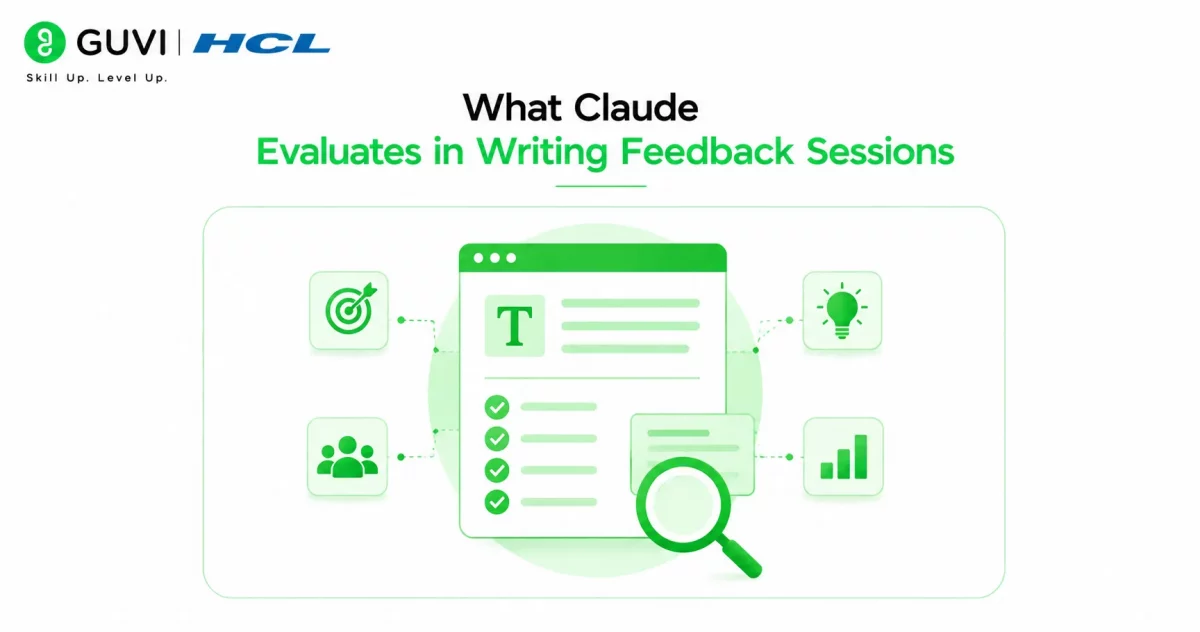
| Feedback Dimension | What Claude Assesses |
| Argument structure | Whether the logic flows, builds, and lands clearly |
| Clarity and concision | Sentences that are too long, vague, or redundant |
| Tone consistency | Voice shifts between sections or paragraphs |
| Audience alignment | Whether the content matches the reader’s knowledge and expectations |
| Opening and closing strength | Whether the hook earns attention and the ending lands with impact |
| Specificity | Generic claims that could appear in any piece on this topic |
| Pacing | Sections that drag or rush relative to their importance |
Want to build the writing and communication skills that create professional credibility and career opportunities? Explore HCL GUVI’s Business Analytics Course, designed to help you develop the structured thinking and clear communication modern professional roles demand.
Setting Up a Writing Critique Session
The quality of Claude’s feedback depends on how clearly you establish the context, audience, and standard you are writing to before asking for critique. Vague requests produce vague feedback.
Start every critique session with a context brief:
I want detailed writing feedback on the piece below.

Content type: [blog post / email / proposal / essay / report / social post]
Intended audience: [Who will read this and their knowledge level]
Goal of the piece: [What you want the reader to think, feel, or do]
Tone I am aiming for: [3 adjectives]
Where it will be published or sent: [Context]
My main concern about this draft: [What you already suspect is weak]

Please read the full piece before giving any feedback.
Do not rewrite anything yet. Give me a structured critique first.

[paste your writing here]
The instruction to read before giving feedback and to critique before rewriting keeps Claude in the editorial role rather than jumping to fixes before you understand what is actually wrong.
Read More: How to Build AI Apps with Claude and Share Them Easily
Getting Structural Feedback First
Structural feedback should always come before sentence-level feedback. Fixing prose in a poorly structured piece wastes editing time because reorganization will disrupt the sentences anyway.
Evaluate the structure of this piece only. Do not comment on
sentence quality, word choice, or tone yet.

Tell me:
1. Does the opening establish the stakes or hook clearly enough
   in the first paragraph?
2. Does the argument or narrative build logically from section to section?
3. Is there any section that feels out of place or would work better
   elsewhere in the piece?
4. Where does the piece lose momentum or drag?
5. Does the closing land with enough weight relative to what the
   piece promises in the opening?

Be specific. Reference the actual sections or paragraphs
you are commenting on, not general observations.
The final instruction, referencing specific sections rather than general observations, is what separates actionable structural feedback from editorial generalities that tell you nothing you could not have guessed yourself.

Getting Tone and Voice Feedback
Tone inconsistency is one of the hardest writing problems to self-diagnose because writers rarely notice when their voice shifts between sections written at different times or energy levels.
Evaluate the tone and voice of this piece.

The tone I am aiming for: [describe]
The audience: [describe]

Tell me:
1. Does the tone stay consistent throughout or does it shift
   between sections? If it shifts, identify exactly where.
2. Are there any sentences or paragraphs that sound significantly
   more formal, casual, or corporate than the rest?
3. Does the voice feel like a specific person with a point of view,
   or does it feel generic and interchangeable?
4. Identify the 3 sentences that feel most off-voice and explain why.

Do not rewrite anything. List the issues with specific line references.
Getting Clarity and Concision Feedback
Clarity feedback from Claude is most useful when you ask it to identify specific problems rather than make broad judgments about readability.
Review this piece for clarity and concision only.

Identify:
1. The 3 most confusing sentences and explain what makes them unclear
2. Any paragraph that makes the same point twice in different words
3. Sentences over 25 words that could be split without losing meaning
4. Any jargon or assumed knowledge that the target audience
   [describe audience] may not have
5. Filler phrases that add length without adding meaning
   (e.g. "it is worth noting", "in today's world", "needless to say")

List each issue with the specific sentence or phrase,
not a general comment about the section.Writers who received dimension-focused feedback, separate critiques for structure, clarity, and argument, improved significantly more than those receiving holistic feedback all at once, according to the Journal of Writing Research. Claude’s ability to deliver targeted critiques for each writing dimension mirrors this proven methodology.
Getting Audience Alignment Feedback
Audience alignment is the dimension most writers overlook because they write from their own perspective rather than the reader’s. Claude can evaluate whether the content actually serves the stated audience.
Evaluate whether this piece is well-aligned to its intended audience.

Intended audience: [describe in detail]
Their knowledge level: [beginner / intermediate / expert]
What they want from this piece: [inform / persuade / instruct / entertain]

Tell me:
1. Are there sections that assume too much or too little
   knowledge for this audience?
2. Does the piece address what the audience actually cares about
   or what the writer wants to say?
3. Are there moments where the writer's perspective dominates
   in a way that loses the reader?
4. Does the piece give the audience something they could not get
from a generic article on this topic?Professional editors distinguish between developmental editing for structure, line editing for clarity and style, and copy editing for grammar, deliberately kept as separate passes because each requires a different reading lens. Replicating this three-pass structure in Claude writing feedback sessions produces editorial quality closer to professional publishing standards.
Acting on Claude’s Feedback
Receiving feedback is only half the process. Acting on it effectively requires a decision framework for which issues to fix and in which order.
Based on the feedback you just gave me, help me prioritize.

List the issues in order of impact on the reader experience,
from most critical to least critical. For each issue indicate:
- Whether it requires structural reorganization, rewriting,
  or minor editing
- Approximately how much of the piece is affected
- Whether fixing it might create new issues elsewhere

Then give me a suggested editing sequence: what to fix first,
second, and third for maximum improvement with minimum rework.
This prioritization step prevents the common mistake of spending editing time on minor word-level issues while more significant structural or tonal problems remain unaddressed.
Conclusion
Claude writing feedback is most valuable when you structure critique sessions the way professional editors work, evaluating structure before prose, separating tone from clarity, and identifying issues before attempting fixes.
Use the context brief at the start of every critique session, work through structural and tonal feedback before sentence-level edits, and use the prioritization prompt to sequence your revisions efficiently.
FAQs
What is Claude writing feedback?
Using Claude as a structured editorial critic to identify weaknesses in argument structure, tone, clarity, and audience alignment before your writing reaches its intended reader.
How is Claude writing feedback different from grammar tools like Grammarly?
Grammar tools check surface-level correctness. Claude evaluates argument structure, tone consistency, pacing, specificity, and audience alignment, the deeper writing dimensions that determine whether a piece actually works.
Should I ask Claude to rewrite my writing or just critique it?
Start with critique only. Understanding what is wrong and why produces better revision decisions than accepting Claude’s rewrites without knowing the reasoning behind them.
How do I get specific feedback instead of general comments?
Always ask Claude to reference specific sentences, paragraphs, or sections rather than making general observations. The prompts in this guide all include this instruction explicitly.
Can Claude give feedback on creative writing as well as professional writing?
Yes. Adjust the audience and goal description in the context brief to reflect the creative intent and target reader. Claude evaluates fiction and creative non-fiction against narrative and stylistic criteria when briefed appropriately.
What writing dimension should I always address first?
Structure. Fixing sentence-level issues in a poorly structured piece wastes editing time because reorganization disrupts the prose anyway. Always confirm the structure works before refining individual sentences.
Success Stories

About the Author
HCL GUVI
This article was selected and published as part of the HCL GUVI AI Blogathon 2026, an initiative designed to encourage students, AI enthusiasts, and aspiring tech writers to simplify complex AI concepts through impactful technical content. The contest recognized high-quality, original, and insightful AI-focused blogs, with selected authors receiving publication opportunities on the HCL GUVI blog platform along with official author credits and recognition.
View all posts by HCL GUVI
Connect with me @











Did you enjoy this article?