


Artificial Intelligence and Machine Learning Articles
Using Claude to Prepare for Difficult Conversations
Claude for Habit Tracking and Accountability


Get In Touch For Details! Request More Information
How to Use Claude for Debate Prep: Both Sides
Aug 13, 2026 3 Min Read 32 Views
(Last Updated)
Preparing for debates requires researching evidence, understanding opposing viewpoints, organizing arguments, and anticipating counterarguments. Claude for Debate prep helps users explore multiple perspectives, strengthen reasoning, summarize research, and build balanced arguments for academic, business, and professional discussions.
Table of contents
- TL;DR
- Direct Answer Box
- Benefits of Using Claude for Debate Preparation
- How to Use Claude for Debate Preparation
- Step 1: Define the Debate Topic
- Step 2: Gather Reliable Background Information
- Step 3: Build Arguments for Both Sides
- Step 4: Generate Counterarguments
- Step 5: Evaluate the Strength of Arguments
- Step 6: Practice the Debate
- Step 7: Continuously Improve Your Debate Skills
- Claude Prompts for Debate Preparation
- Analyze Both Sides of a Debate
- Generate Counterarguments
- Evaluate an Argument
- Summarize Research
- Prepare Opening Statements
- Practice Cross-Examination
- Compare Evidence
- Improve My Argument
- Debate Tasks You Can Automate with Claude
- Tasks Claude Should Not Replace
- Best Practices for Using Claude for Debate Preparation
- Conclusion
- FAQs
- How can Claude help with debate preparation?
- Can Claude argue both sides of a debate?
- Can Claude generate counterarguments?
- Should I verify Claude's debate content?
- What are the benefits of using Claude for debate preparation?
- Can Claude replace independent research?
- What are the best practices for using Claude for debate preparation?
TL;DR
- Claude helps prepare balanced arguments by analyzing both sides of a debate.
- AI can organize evidence, generate counterarguments, and identify logical gaps.
- Considering multiple perspectives leads to stronger reasoning and better decisions.
- Human judgment is essential when evaluating arguments and evidence.
- Debate preparation improves through research, refinement, and practice.
📚 Data Point: Recent research on generative AI shows that large language models can support reasoning, research, summarization, and structured argument development, making them valuable tools for education and professional knowledge work when combined with human verification.
Source: Anthropic Documentation
Direct Answer Box
| Claude helps users prepare for debates by researching topics, presenting balanced arguments, generating counterarguments, organizing evidence, and identifying strengths and weaknesses in different viewpoints. It supports critical thinking but should be used alongside independent research and human evaluation. |
Benefits of Using Claude for Debate Preparation
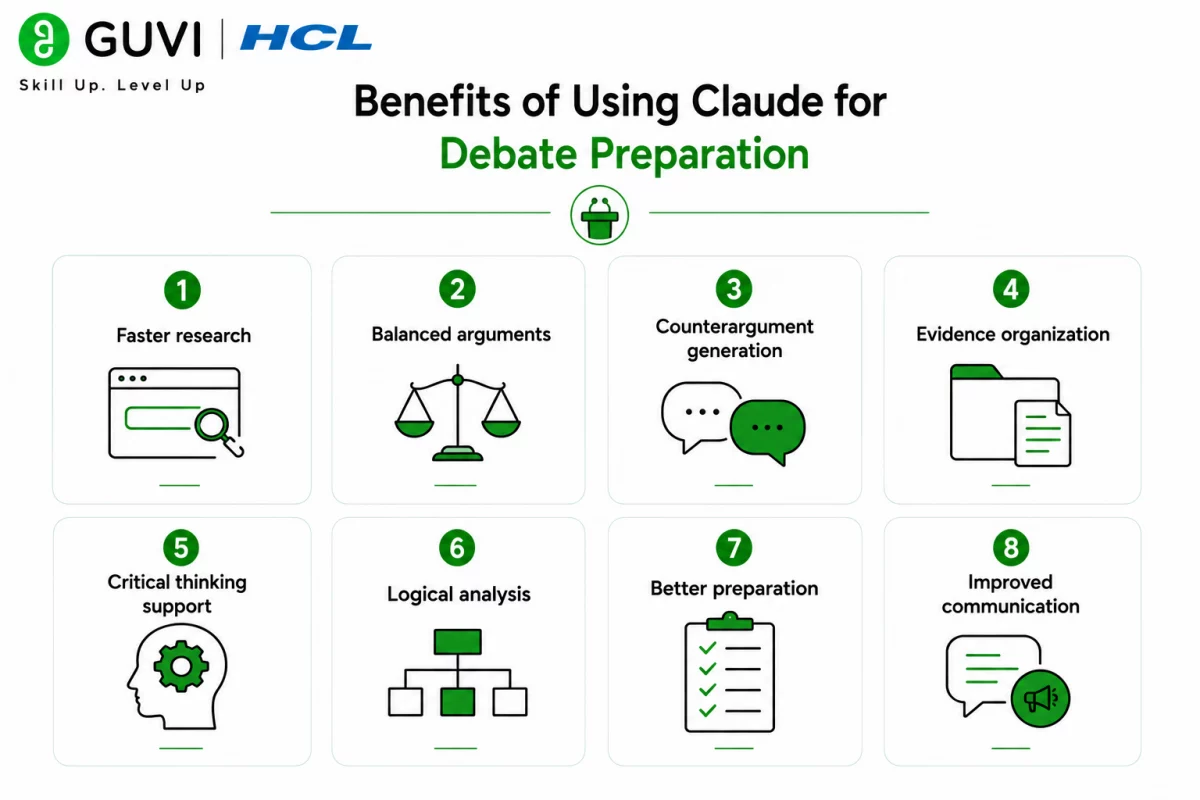
Effective debate preparation requires understanding every side of an issue rather than defending only one position. Claude helps users organize information, compare viewpoints, and strengthen arguments through structured analysis.
Key benefits include:
- Faster research
- Balanced arguments
- Counterargument generation
- Evidence organization
- Critical thinking support
- Logical analysis
- Better preparation
- Improved communication
How to Use Claude for Debate Preparation
Step 1: Define the Debate Topic
Start by clearly defining the debate question or motion. A specific topic helps Claude generate focused arguments and relevant supporting information.
Define:
- Debate topic
- Debate format
- Target audience
- Objective
- Scope
Step 2: Gather Reliable Background Information
Provide Claude with credible sources or ask him to organize publicly available information before building arguments.
Include:
- Research papers
- News articles
- Reports
- Statistics
- Expert opinions
- Historical context
Step 3: Build Arguments for Both Sides
Ask Claude to present balanced arguments supporting and opposing the topic instead of focusing on only one position.
Compare:
- Supporting arguments
- Opposing arguments
- Key evidence
- Advantages
- Disadvantages
- Real-world examples
Step 4: Generate Counterarguments
Strong debates require anticipating opposing viewpoints. Ask Claude to identify weaknesses in your position and suggest effective rebuttals.
Review:
- Counterarguments
- Common objections
- Weak assumptions
- Supporting evidence
- Rebuttal strategies
- Alternative viewpoints
Step 5: Evaluate the Strength of Arguments
Review the quality of each argument by considering evidence, logic, and credibility rather than persuasion alone.
Evaluate:
- Evidence quality
- Logical consistency
- Source credibility
- Bias
- Relevance
- Practical impact
Step 6: Practice the Debate
Use Claude to simulate debate scenarios, ask challenging questions, or role-play the opposing side to improve confidence and preparation.
Practice:
- Opening statements
- Cross-examination
- Rebuttals
- Closing arguments
- Audience questions
- Time-limited responses

Step 7: Continuously Improve Your Debate Skills
Strong debating comes from continuous learning and practice. Review your arguments, identify weak points, refine supporting evidence, and practice responding to different viewpoints. Professionals and students looking to strengthen analytical reasoning, prompt engineering, and AI-assisted research can build these skills through HCL GUVI’s Artificial Intelligence and Machine Learning Course.
Many students, researchers, and professionals use AI to explore opposing viewpoints before making decisions. Examining multiple perspectives can reduce bias, strengthen reasoning, and improve the quality of discussions and presentations.
Claude Prompts for Debate Preparation
Use prompts like these to prepare stronger, well-balanced arguments:
Analyze Both Sides of a Debate
“Present the strongest arguments for and against [debate topic] using credible evidence and logical reasoning.”
Generate Counterarguments
“Act as the opposing side and challenge my argument. Identify weak points and suggest possible rebuttals.”
Evaluate an Argument
“Review this argument for logical fallacies, unsupported claims, bias, and areas that need stronger evidence.”
Summarize Research
“Summarize the key findings from these sources and explain how they support both sides of the debate.”
Prepare Opening Statements
“Write persuasive opening statements for both the affirmative and negative sides of [topic].”
Practice Cross-Examination
“Generate ten challenging cross-examination questions about [topic] and suggest strong responses.”
Compare Evidence
“Compare the evidence supporting both sides of this debate and identify which arguments are better supported.”
Improve My Argument
“Review my debate speech and recommend improvements for clarity, logic, evidence, and persuasiveness.”
Using structured prompts helps Claude generate more balanced, evidence-based, and well-organized debate preparation materials.
Debate Tasks You Can Automate with Claude
Claude can support many research and debate preparation tasks.
Claude can help with:
- Topic research
- Argument generation
- Counterargument development
- Evidence summaries
- Debate outlines
- Speech drafting
- Cross-examination questions
- Logical analysis
- Research summaries
- Fact organization
- Presentation preparation
- Discussion planning
The HCL GUVI’s Artificial Intelligence eBook introduces practical Artificial Intelligence concepts, prompt engineering, research workflows, and real-world AI applications. It demonstrates how AI supports productivity across education, research, business, and professional communication.
Tasks Claude Should Not Replace
Claude is a valuable debate assistant, but important judgments should remain with people.
Claude should not replace:
- Independent research
- Fact verification
- Expert opinion
- Legal advice
- Academic integrity
- Conclusions
- Ethical judgment
- Human critical thinking
- Personal opinion
While Claude can organize information and generate balanced arguments, users should independently verify evidence and develop their own conclusions.
⚠️ Warning: Claude can generate persuasive arguments for multiple viewpoints, but persuasive language does not guarantee factual accuracy. Always verify statistics, quotations, research findings, and cited evidence before using them in academic, professional, or public debates.
Best Practices for Using Claude for Debate Preparation
Follow these best practices to improve debate preparation:
- Define a clear debate topic.
- Research credible sources.
- Explore both sides equally.
- Ask for counterarguments.
- Verify facts and evidence.
- Practice rebuttals.
- Refine arguments through multiple iterations.
- Develop your own conclusions.
Conclusion
Claude helps users prepare for debates by organizing research, presenting balanced viewpoints, generating counterarguments, and refining arguments through structured analysis. Combined with independent research and human judgment, AI can strengthen critical thinking, communication, and evidence-based decision-making.
FAQs
1. How can Claude help with debate preparation?
Claude can research topics, generate arguments for both sides, organize evidence, create rebuttals, and simulate debate scenarios.
2. Can Claude argue both sides of a debate?
Yes. Claude can present balanced arguments supporting and opposing a topic, helping users understand multiple perspectives.
3. Can Claude generate counterarguments?
Yes. Claude can identify weaknesses in an argument, generate counterarguments, and suggest effective rebuttals.
4. Should I verify Claude’s debate content?
Yes. Always verify facts, statistics, quotations, and research sources before using AI-generated material in debates or academic work.
5. What are the benefits of using Claude for debate preparation?
Key benefits include faster research, stronger arguments, balanced perspectives, organized evidence, improved critical thinking, and better preparation.
6. Can Claude replace independent research?
No. Claude supports research and analysis, but users should independently verify evidence and develop their own conclusions.
7. What are the best practices for using Claude for debate preparation?
Define a clear topic, research reliable sources, explore both sides, verify evidence, practice rebuttals, refine arguments, and use Claude to support—not replace—critical thinking.
Success Stories

About the Author
HCL GUVI
This article was selected and published as part of the HCL GUVI AI Blogathon 2026, an initiative designed to encourage students, AI enthusiasts, and aspiring tech writers to simplify complex AI concepts through impactful technical content. The contest recognized high-quality, original, and insightful AI-focused blogs, with selected authors receiving publication opportunities on the HCL GUVI blog platform along with official author credits and recognition.
View all posts by HCL GUVI
Connect with me @











Did you enjoy this article?