


Artificial Intelligence and Machine Learning Articles
Using Claude to Prepare for Difficult Conversations
How to Use Claude to Learn a New Skill Faster


Get In Touch For Details! Request More Information

Claude for Habit Tracking and Accountability
Aug 13, 2026 5 Min Read 38 Views
(Last Updated)
Most habit tracking fails not because people lack motivation but because they lack a feedback loop that helps them understand why a habit is working or breaking down before the streak is already lost. Claude habit tracker workflows create this feedback loop by giving you a thinking partner that engages with your specific situation, asks diagnostic questions, and helps you adjust your approach based on what is actually happening rather than generic advice.
Table of contents
- Quick TL;DR
- What Claude Does in a Habit Tracking Workflow
- The 5-Step Framework for Building Habits That Stick With Claude
- Step 1: Designing Your Habit System with Claude
- Step 2: Setting Up Your Weekly Check-In Structure
- Step 3: Running a Weekly Check-In with Claude
- Step 4: Diagnosing and Recovering from Broken Streaks
- Step 5: Monthly Reflection and Habit Adjustment
- Handling Multiple Competing Habits
- Conclusion
- FAQs
- What is Claude used for in habit tracking?
- How is Claude different from a habit tracking app?
- How often should I check in with Claude about my habits?
- What should I do when I break a habit streak?
- Can Claude remember my habit system across multiple sessions?
- How do I know when to increase or decrease my habit targets?
- Can Claude help with habit stacking?
Quick TL;DR
Claude habit tracker workflows help individuals build, monitor, and maintain personal habits by using Claude as a structured accountability partner that reviews progress, identifies patterns, adjusts plans, and provides honest feedback without judgment. Unlike passive habit tracking apps that only log data, Claude actively engages with your progress, asks the right questions, and helps you diagnose why habits are sticking or failing.
What Claude Does in a Habit Tracking Workflow
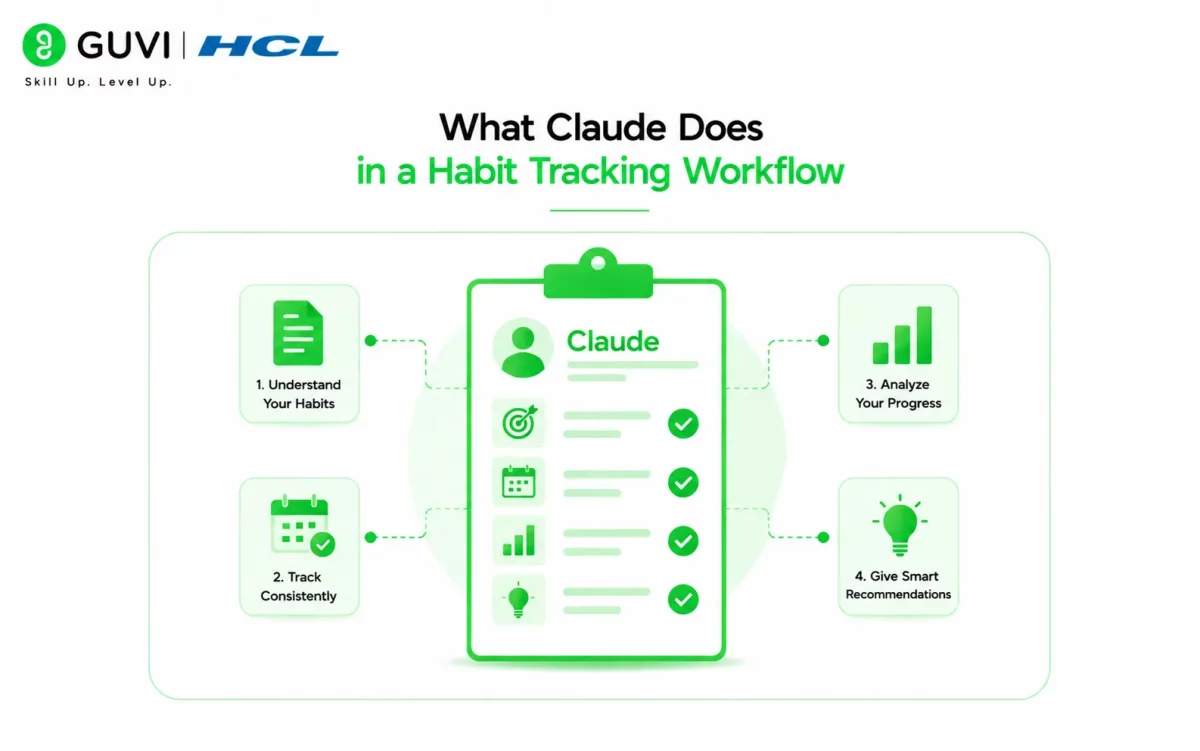
| Task | What Claude Does |
| Habit design | Helps structure new habits with triggers, actions, and rewards |
| Progress review | Analyzes check-in data to identify patterns and obstacles |
| Streak recovery | Diagnoses why a habit broke down and adjusts the plan |
| Accountability check-ins | Asks structured questions to surface what is and is not working |
| Habit stacking | Suggests how to attach new habits to existing routines |
| Goal adjustment | Recommends scaling habits up or down based on consistency data |
| Reflection prompts | Generates weekly and monthly review questions tailored to your habits |
Read More: What’s New in Claude: Turning Claude into Your Thinking Partner
The 5-Step Framework for Building Habits That Stick With Claude
Step 1: Designing Your Habit System with Claude
Most habits fail at the design stage because they are too vague, too ambitious, or not anchored to an existing routine. Claude helps you design habits that are specific, achievable, and structurally sound before you start tracking.
Help me design a habit system for this goal.

Goal: [What you want to achieve or change]
Current situation: [What your daily routine looks like now]
Past attempts: [What you have tried before and why it did not stick]
Available time: [When and how much time you realistically have]
Energy levels: [When you have highest energy during the day]
Biggest obstacle: [What has stopped you before]

For each habit I should build, provide:
1. Specific habit definition (exact action, duration, frequency)
2. Trigger: what existing routine this habit attaches to
3. Minimum viable version for low-energy days
4. Success metric: how I will know I did it
5. Why this habit design addresses my stated obstacle
The minimum viable version is the most important design element. A habit system without a minimum viable version collapses on the first difficult day because the only option is full execution or nothing.
Want to build the analytical and productivity skills to track, measure, and improve performance systematically in your professional and personal life? Explore HCL GUVI’s Business Analytics Course, designed to help you develop the data-driven thinking that turns information into consistent improvement.
Step 2: Setting Up Your Weekly Check-In Structure
Consistency in habit tracking comes from a predictable check-in rhythm, not daily logging anxiety. Claude works best as a weekly accountability partner with a structured review format you repeat every week.
I want to use you as my weekly habit accountability partner.
Every week I will check in with my progress and I want you to
ask me the same structured questions each time.

My habits:
1. [Habit name, target frequency, minimum viable version]
2. [Habit name, target frequency, minimum viable version]
3. [Habit name, target frequency, minimum viable version]

My goal for this habit system: [Longer-term outcome]
My check-in day: [Which day of the week]

Each week when I check in, ask me:
1. How many times did I complete each habit this week?
2. Which habit felt easiest and why?
3. Which habit felt hardest and what got in the way?
4. Did I use the minimum viable version for any habit? When and why?
5. What is one thing I want to do differently next week?

After I answer, give me: a pattern observation, one specific suggestion,
and an honest assessment of whether my current approach is working.
Pasting this setup prompt into a Claude Project preserves the habit context across every check-in session without re-explaining your system each week.
BJ Fogg’s Tiny Habits research at Stanford found that the most reliable predictor of long-term habit success is structural design, specifically whether the habit is anchored to an existing behavior, small enough to succeed on low-energy days, and followed by a positive feeling. Motivation and willpower ranked significantly lower as predictors.

Step 3: Running a Weekly Check-In with Claude
The weekly check-in is where Claude’s value as an accountability partner is highest. Bring your honest data and let Claude do the analysis and feedback.
A sample check-in exchange:
Weekly check-in for [date].

Exercise habit (target: 4x per week): Completed 2 times.
Reading habit (target: 30 min daily): Completed 5 out of 7 days.
Journaling habit (target: daily): Completed 3 out of 7 days.

Easiest: Reading. I do it right after dinner and it feels automatic now.
Hardest: Exercise. Missed Monday and Thursday because I was tired after work.
Minimum viable version used: Journaling on Wednesday, wrote only 3 sentences.
One thing to change: I want to move exercise to mornings but I am not sure
how to make that work with my current schedule.
Claude AI responds with a pattern observation (exercise is an energy timing problem, not a motivation problem), a specific suggestion (morning habit anchor point based on your existing routine), and an honest assessment of which habits are on track versus at risk of dropping.
Step 4: Diagnosing and Recovering from Broken Streaks
Streak breaks are where most habit systems collapse permanently. Claude helps you diagnose what actually caused the break rather than defaulting to self-blame and adjusts the system rather than just motivating you to try harder.
I broke my [habit name] streak. Help me diagnose what happened
and decide whether to adjust the habit or my approach.

The habit: [Exact definition and target frequency]
How long the streak lasted: [Duration]
When it broke: [Specific situation or day]
What was happening that week: [Context: workload, travel, stress, schedule change]
What I told myself at the time: [Your internal reasoning for skipping]
Have I broken this habit before: [Yes / No, and under similar circumstances?]

Based on this, tell me:
1. Is this a design problem (habit is too hard or poorly anchored)?
2. Is this a context problem (specific situation that can be planned for)?
3. Is this a motivation problem (the goal itself needs revisiting)?
4. What specific adjustment would make this habit more resilient?
This diagnostic framework separates habit design failures from motivation failures, which is the distinction that actually determines whether changing the system or changing your mindset is the right response.
Research by Phillippa Lally found that habit formation takes an average of 66 days, not the commonly cited 21 days, with a range of 18 to 254 days depending on the person and habit complexity. This explains why most habit systems fail within the first month before automaticity has been reached.
Step 5: Monthly Reflection and Habit Adjustment
Monthly reviews are where you adjust habit targets based on actual consistency data rather than optimistic planning. Claude generates a structured monthly review tailored to your specific habit system.
Run a monthly habit review for [month].

Here is my consistency data for the month:
[Paste your weekly check-in summaries or raw completion data]

For each habit assess:
1. Completion rate as a percentage of target
2. Whether this rate indicates the habit is established,
   developing, or at risk
3. Whether the current target should stay the same,
   increase, or decrease based on the data
4. The single most important change to make next month

Then give me an overall assessment:
- Which habit is my strongest asset right now
- Which habit needs the most structural attention
- Whether my habit load is sustainable or needs reduction
- One specific focus for next month
Handling Multiple Competing Habits
When you are building several habits at once, Claude can help you identify which ones are complementary and which are silently competing for the same limited willpower or time slot.
Describe your full habit list along with your energy patterns throughout the day, and Claude will flag any habits stacked in conflict, such as two effortful habits scheduled back-to-back. This prevents the common failure mode where adding a new habit accidentally causes an existing, stable habit to collapse.
Conclusion
Claude habit tracker workflows work because they replace passive logging with active diagnosis, giving you a thinking partner that engages with your specific situation rather than a dashboard that shows you data you already know.
Set up your habit system and weekly check-in structure in a Claude Project so the context persists across every session, commit to a consistent check-in day each week, and treat the monthly review as a planning meeting rather than a performance review.
FAQs
What is Claude used for in habit tracking?
Designing habit systems, running weekly accountability check-ins, diagnosing broken streaks, adjusting habit targets based on consistency data, and running monthly progress reviews.
How is Claude different from a habit tracking app?
Apps log data passively. Claude actively engages with your progress, asks diagnostic questions, identifies why habits are working or failing, and suggests specific adjustments based on your actual situation.
How often should I check in with Claude about my habits?
Weekly check-ins produce the best results, frequent enough to catch problems early but not so frequent that logging becomes another habit to maintain.
What should I do when I break a habit streak?
Use the streak recovery prompt to diagnose whether the break was a design problem, context problem, or motivation problem. Adjust the system based on the diagnosis rather than simply trying harder with the same approach.
Can Claude remember my habit system across multiple sessions?
Claude does not retain memory between separate conversations by default. Store your habit setup prompt in a Claude Project or paste it at the start of each check-in session to maintain continuity.
How do I know when to increase or decrease my habit targets?
Use the monthly review prompt to assess completion rates. A habit completed above 80 percent of target consistently is ready to increase. Below 60 percent consistently signals the target or design needs adjustment.
Can Claude help with habit stacking?
Yes. Describe your existing daily routines and the new habits you want to build and Claude identifies natural anchor points where new behaviors can attach to established ones with minimal friction.
Success Stories

About the Author
HCL GUVI
This article was selected and published as part of the HCL GUVI AI Blogathon 2026, an initiative designed to encourage students, AI enthusiasts, and aspiring tech writers to simplify complex AI concepts through impactful technical content. The contest recognized high-quality, original, and insightful AI-focused blogs, with selected authors receiving publication opportunities on the HCL GUVI blog platform along with official author credits and recognition.
View all posts by HCL GUVI
Connect with me @












Did you enjoy this article?