


Business Analytics Articles
Using Claude for Personalized Content at Scale
How to Use Claude for YouTube Script writing


Get In Touch For Details! Request More Information
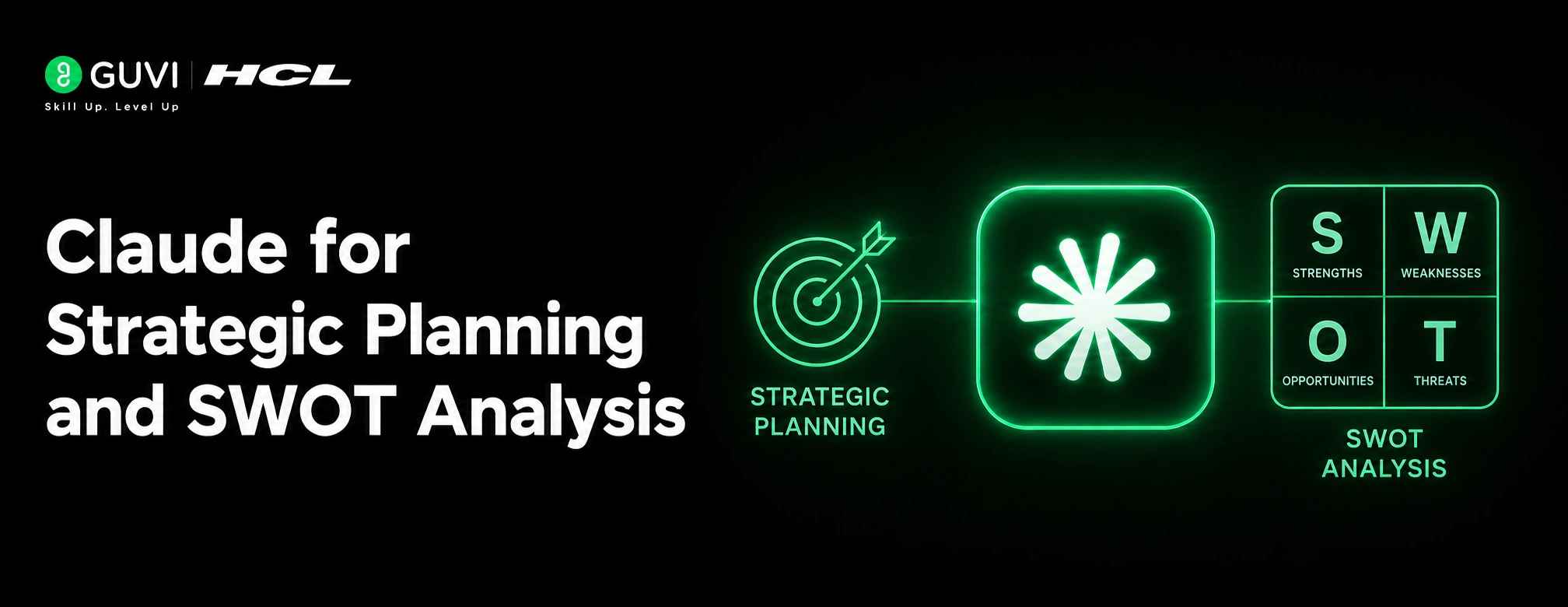
Claude for Strategic Planning and SWOT Analysis
Aug 06, 2026 3 Min Read 546 Views
(Last Updated)
Claude is a practical tool for strategic planning because it can synthesize company context, competitive signals, market pressure, and internal constraints into one structured view. That makes it helpful when you need a fast but thoughtful first pass at a SWOT analysis.
Table of contents
- TL;DR Summary
- What Claude Does Well
- Strengths of Claude for Strategy
- How To Build a Better SWOT
- Step 1: Give Clear Context
- Step 2: Ask for 5–7 Items Per Quadrant
- Step 3: Cross-Link The Quadrants
- Strategic Planning With Claude
- Build, Defend, Pivot
- Add Owners And Metrics
- Comparison Table
- Why Claude Is Useful In Planning
- Common Mistakes
- Generic Inputs
- Too Much Trust
- No Prioritization
- Real-World Example
- What To Ask Claude For
- What To Do Next
- Conclusion
- FAQs
- What is Claude good for in strategic planning?
- What makes a SWOT analysis useful?
- Should I use Claude with real company data?
- What should I ask Claude to include?
- What is the biggest mistake people make?
TL;DR Summary
- Claude is useful for strategic planning because it can organize large amounts of business context into a usable decision framework.
- A good SWOT analysis should not stop at four boxes; it should lead to concrete strategic actions.
- Claude works best when you ask for internal factors, external factors, and cross-links between them.
- The strongest outputs include priorities, owners, and next steps.
- You should treat Claude as a strategy assistant, not a replacement for leadership judgment.
What Claude Does Well
Claude is strong at organizing complexity. If you give it enough context, it can help you identify what is working, what is holding you back, where growth may come from, and what external risks matter most.
Strengths of Claude for Strategy
Claude is especially good at:
- Summarizing large inputs.
- Grouping similar ideas.
- Turning raw notes into strategic themes.
- Cross-referencing internal and external factors.
- Drafting a decision-ready strategy memo.
This makes it useful for founders, product leaders, and operations teams who need a structured view quickly. It is less useful when you give it vague goals and expect it to “figure out strategy” on its own.
How To Build a Better SWOT
A weak SWOT is just a list. A strong SWOT tells you what to do next. Claude can help most when you ask it to move beyond categorization and into strategy.
Step 1: Give Clear Context
Start with the business, the market, and the goal. For example, tell Claude whether you are planning a launch, entering a market, improving retention, or evaluating a product line.
The more specific the context, the more useful the output. If you only say “do a SWOT,” Claude will usually give generic results.
Step 2: Ask for 5–7 Items Per Quadrant
A good SWOT should include enough detail to be useful without becoming bloated. Asking for 5–7 items per quadrant usually creates a better balance than a tiny list or a huge one.
You want Claude to identify:
- Strengths.
- Weaknesses.
- Opportunities.
- Threats.
This gives you a full strategic picture instead of a shallow summary.
Step 3: Cross-Link The Quadrants
The real value comes when Claude connects the boxes. Ask it to identify which strengths can capture opportunities, which weaknesses are exposed by threats, and where the business should defend, build, or pivot.
That turns the SWOT into an action tool. Without cross-linking, the analysis is descriptive but not very useful.
Strategic Planning With Claude

Claude is not just for SWOT. It can also help turn the analysis into a broader strategic plan. That means moving from insight to execution.
1. Build, Defend, Pivot
A useful strategy lens is:
- Build where strengths meet opportunities.
- Defend where strengths face threats.
- Fix where weaknesses block opportunities.
- Reduce risk where weaknesses meet threats.
This simple logic helps the team prioritize. It also makes the output easier for leadership to discuss.
2. Add Owners And Metrics
A strategy is much stronger when it includes responsibility and measurement. Claude can help draft actions, but you should ask for owners, timelines, and success metrics.
For example:
- Action: Improve onboarding.
- Owner: Product team.
- Metric: Activation rate.
- Timeline: Next 60 days.
That turns a SWOT into something operational.
You can use Claude as a dedicated strategy partner by creating a “Strategy” project with your business context, market data, and competitor notes so it generates SWOT analyses that are specific, not generic.
Comparison Table
| Approach | What it gives you | Best use case | Limitation |
| Basic SWOT | Four lists of strengths, weaknesses, opportunities, and threats | Fast overview | Often too generic |
| SWOT plus cross-links | Strategic relationships between the four quadrants | Decision support | Still needs prioritization |
| SWOT plus action plan | Recommendations, owners, and metrics | Real execution planning | Requires better input and review |
Why Claude Is Useful In Planning
Claude is helpful because strategic planning often fails at the synthesis stage. Teams usually have enough information already; they just need it organized in a way that helps them decide.

Claude can reduce the burden of sorting through:
- Internal notes.
- Competitive observations.
- Customer feedback.
- Market signals.
- Leadership assumptions.
That does not make the answer automatically correct. It makes the starting point faster and easier to work with.
Common Mistakes
The biggest mistake is treating SWOT as the final output. A list of boxes is not strategy unless it leads to a decision.
1. Generic Inputs
If you give Claude no company context, you will get generic analysis. The more concrete the business situation, the more useful the strategy.
2. Too Much Trust
Claude can help you think, but it should not replace actual leadership judgment. Human review is still necessary, especially when the stakes are high.
3. No Prioritization
A long SWOT with no ranking is hard to use. Ask Claude to prioritize the top 3 to 5 items in each category or to rank the recommendations by impact and effort.
⚠️ Warning: Do not use SWOT output as if it were evidence on its own. It is a decision support tool, not proof.
Real-World Example
- When teams use Claude well, the best results often come from using real internal notes, competitive observations, and customer feedback instead of abstract prompts.
- In practice, that usually produces a SWOT that is more specific and easier to act on.
- For example, a product team can feed Claude release notes, customer complaints, sales objections, and competitor comparisons.
- Claude then organizes those inputs into a strategic view that highlights where the product is strong, where it is weak, and what the next move should be.
- That is much better than a generic “AI SWOT.” It reflects the actual business.
Use Claude to turn data into sharper strategy, faster SWOTs, and clearer decisions. Build those skills with HCL GUVI’s Complete Business Analytics Professional Program.
What To Ask Claude For
If you want better output, ask for more than just a matrix. Ask Claude to include:
- Key assumptions.
- Strategic implications.
- Priority recommendations.
- Risks of inaction.
- Near-term actions.
This makes the analysis far more useful for planning meetings. It also helps leadership see what matters most.
What To Do Next
Start with one business question, such as “How should we position this product in the next quarter?” Then give Claude real context and ask for a SWOT plus strategic recommendations.
After that, review the output with your team, refine the assumptions, and turn the top insights into action items. That is the point where SWOT becomes planning.
Conclusion
Claude is valuable for strategic planning when you use it to structure thinking, not replace it. It can help you build a clearer SWOT analysis, connect that analysis to action, and turn business context into decisions.
The strongest approach is simple: give Claude real inputs, ask for cross-linked insights, and end with priorities, owners, and metrics. That is what makes the output useful.
FAQs
1. What is Claude good for in strategic planning?
Claude is good at organizing business context, summarizing internal and external factors, and turning them into a clear SWOT analysis.
2. What makes a SWOT analysis useful?
A useful SWOT analysis connects the four quadrants to actual decisions, priorities, and next steps.
3. Should I use Claude with real company data?
Yes, real context makes the analysis much more accurate and relevant than generic prompts.
4. What should I ask Claude to include?
Ask for strengths, weaknesses, opportunities, threats, cross-links, priorities, and recommended actions.
5. What is the biggest mistake people make?
They stop at the SWOT matrix and never turn the findings into strategy.
Success Stories

About the Author
HCL GUVI
This article was selected and published as part of the HCL GUVI AI Blogathon 2026, an initiative designed to encourage students, AI enthusiasts, and aspiring tech writers to simplify complex AI concepts through impactful technical content. The contest recognized high-quality, original, and insightful AI-focused blogs, with selected authors receiving publication opportunities on the HCL GUVI blog platform along with official author credits and recognition.
View all posts by HCL GUVI
Connect with me @












Did you enjoy this article?