


Artificial Intelligence and Machine Learning Articles
AI/ML Skills Gap 2026: Why Companies Can't Find Job-Ready Talent
20 AI/ML Interview Questions Recruiters Can Use Without a Tech Background - Best Guide
How Industry-Backed AI/ML Bootcamps Are Changing the AI/ML Hiring Pipeline - Best Guide 2026
From IT Support to AI Engineer: A Realistic Career Switch Guide 2026

Get In Touch For Details! Request More Information
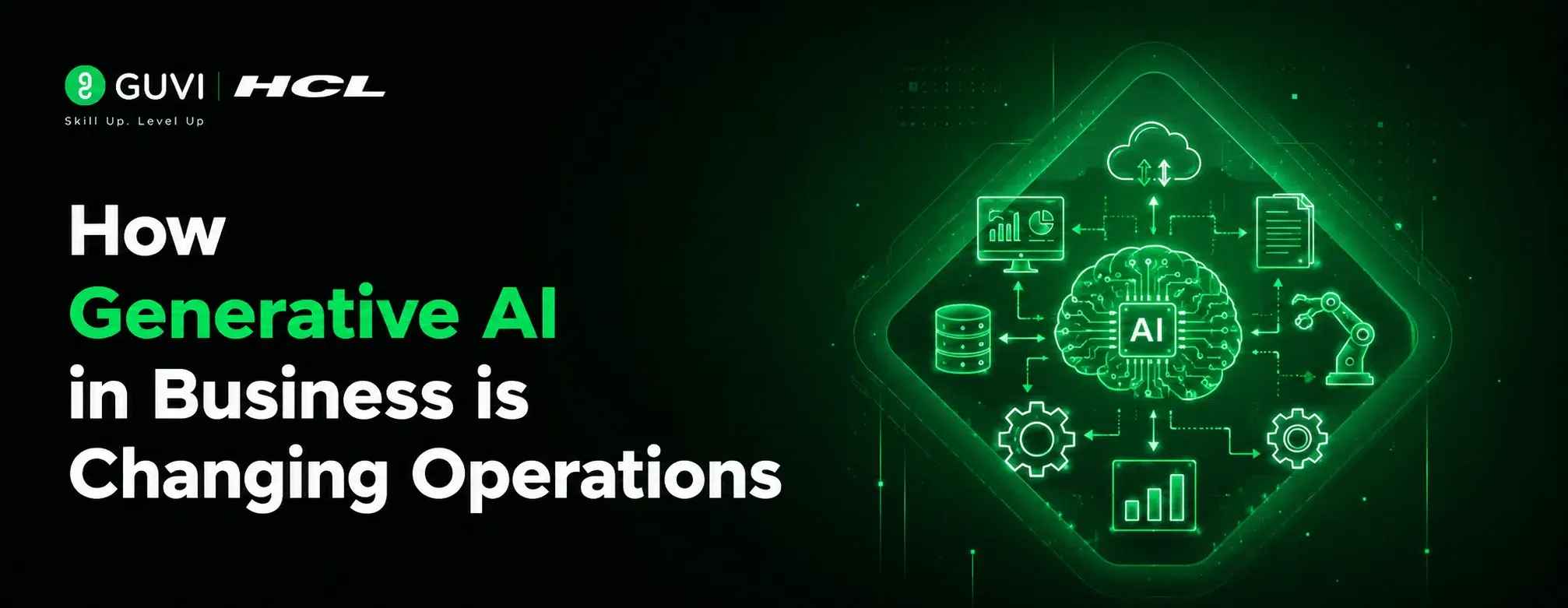
How Generative AI in Business is Changing Operations
Jul 23, 2026 6 Min Read 442 Views
(Last Updated)
Table of contents
- TL;DR Summary
- Introduction
- What is Generative AI in Business?
- Why is Generative AI Important for Business Operations?
- Key Statistics You Should Know
- Top Generative AI Applications in Business Operations
- Customer Support Automation
- Marketing and Sales Enablement
- HR and Recruitment Operations
- Finance and Reporting
- IT, Software, and Internal Knowledge Management
- Generative AI vs Traditional Automation
- Which One Should You Use?
- How to Implement AI Workflow Automation
- Step 1: Pick One High-Impact Workflow
- Step 2: Define the Success Metric
- Step 3: Add Human Review
- Step 4: Connect AI to Trusted Data
- Step 5: Train Teams to Use AI Responsibly
- Benefits of Generative AI in Business
- Key Business Benefits
- Career and Salary Impact
- Industry Use Cases: How Businesses Apply Generative AI
- Retail
- Banking and Finance
- Healthcare
- Manufacturing
- Common Mistakes Businesses Make with Generative AI
- Starting Without a Business Problem
- Ignoring Data Quality
- Removing Human Review Too Early
- Measuring Usage Instead of Outcomes
- Skipping Employee Training
- Wrapping Up
- Frequently Asked Questions
- What is Generative AI in Business?
- How is generative AI used in business operations?
- What are the best AI business use cases?
- Is generative AI better than traditional automation?
- Can small businesses use generative AI?
- What skills are needed to work with enterprise AI?
- Is business automation with AI safe?
- Will generative AI replace business operations jobs?
TL;DR Summary
Generative AI in business refers to using AI systems that can create text, code, summaries, reports, images, workflows, and recommendations to improve business operations. It is changing customer support, HR, sales, marketing, finance, supply chain, product development, and IT operations. The biggest benefits come when companies redesign workflows, train teams, protect data, and measure business outcomes instead of simply adding AI tools.
Introduction
Generative AI in business is no longer a future trend. It is already helping teams write faster, serve customers better, automate routine work, analyse data, and make decisions with more context.
The shift is simple: businesses are moving from “using AI as a tool” to “building AI into daily workflows.” McKinsey’s 2025 global survey found that 88% of organizations report regular AI use in at least one business function, while generative AI use has reached 79% in surveyed organizations.
What is Generative AI in Business?
Generative AI in business means using AI models to create, summarise, analyse, and automate business content or decisions across departments. Unlike traditional software that follows fixed rules, generative AI can draft emails, generate reports, answer questions, create process documentation, write code, and support decision-making using business data.
In simple terms, it helps teams reduce repetitive work and focus on higher-value tasks.
Why is Generative AI Important for Business Operations?
AI in business operations matters because most teams spend hours on manual, repetitive, and communication-heavy work.
For example, a customer support team may manually answer similar queries every day. With generative AI, the system can suggest responses, summarise past tickets, detect customer intent, and route complex issues to the right person.
This does not remove the human role. It improves speed, consistency, and decision quality.
Also Read : Everything You Need To Know About Generative AI
Key Statistics You Should Know
| Data Points | What It Means for Businesses |
| 88% of surveyed organizations use AI regularly in at least one business function | AI adoption is now mainstream, not experimental. |
| Generative AI adoption reached 79% in McKinsey’s 2025 survey | GenAI is becoming part of business workflows. |
| Deloitte reported that 62% of Indian enterprises use AI at scale in product development and 56% in strategy and operations | India is moving quickly from pilots to operational AI. |
| PwC found that jobs requiring AI skills carry a 56% wage premium on average | AI skills are becoming career accelerators. |
| IBM found that 72% of surveyed CEOs see proprietary data as key to unlocking generative AI value | Data quality is central to enterprise AI success. |
Top Generative AI Applications in Business Operations
Generative AI applications are most useful when they solve a clear operational problem. The goal is not to “add AI everywhere,” but to identify workflows where speed, accuracy, and scale matter.
1. Customer Support Automation
Generative AI for business is widely used in customer support because support teams handle high-volume, repetitive queries.
Common use cases include:
- Drafting email and chat replies
- Summarising customer history
- Creating knowledge base articles
- Detecting sentiment and urgency
- Routing tickets to the right team
For example, an eCommerce company can use AI workflow automation to identify refund requests, generate response drafts, and escalate only complex complaints to human agents.
2. Marketing and Sales Enablement
Marketing teams use generative AI to create campaign ideas, ad copies, product descriptions, social media captions, email sequences, and audience-specific messaging.
Sales teams use it to summarise calls, personalise proposals, prepare follow-up emails, and analyse lead intent.
A B2B SaaS sales team, for instance, can use enterprise AI to generate account-specific pitch notes based on CRM data, website activity, and past conversations.
3. HR and Recruitment Operations
HR teams can use business automation with AI to screen resumes, draft job descriptions, create onboarding documents, answer employee FAQs, and summarise interview feedback.
This helps recruiters spend more time on candidate conversations and less time on repetitive documentation.
4. Finance and Reporting
Finance teams use generative AI to summarise invoices, draft audit notes, explain variance reports, create financial commentary, and detect unusual patterns.
However, finance use cases need strong human review because accuracy, compliance, and audit trails are critical.
One of the quirkiest early GenAI moments happened in 2018, when an AI-generated portrait called Edmond de Belamy sold at Christie’s for $432,500. It was created using a Generative Adversarial Network, proving that generative AI was making headlines in art long before it became a daily business tool.
5. IT, Software, and Internal Knowledge Management
IT teams use generative AI to write code snippets, generate test cases, summarise logs, create documentation, troubleshoot tickets, and support internal helpdesks.
For large organizations, one of the most valuable AI business use cases is an internal knowledge assistant. Employees can ask questions like, “What is the travel reimbursement process?” or “Where is the latest product pricing policy?” and get instant answers from approved documents.
Generative AI vs Traditional Automation
Traditional automation follows fixed steps. Generative AI can understand context, generate responses, and adapt to different inputs.
| Feature | Traditional Automation | Generative AI in Business |
| Works best for | Rule-based tasks | Language, content, decisions, and knowledge tasks |
| Input type | Structured data | Structured and unstructured data |
| Output | Fixed result | Drafts, summaries, recommendations, responses |
| Flexibility | Low to medium | High |
| Example | Auto-sending invoice reminders | Generating invoice summaries and payment risk notes |
Which One Should You Use?
Use traditional automation when the task is predictable and rule-based.
Use generative AI when the task involves language, reasoning, summarisation, interpretation, or personalisation.
The best business transformation with AI often combines both.
How to Implement AI Workflow Automation
Successful AI workflow automation starts with a business problem, not with a tool. Many companies fail because they launch AI pilots without redesigning the actual workflow.
Step 1: Pick One High-Impact Workflow
Start with a workflow that is repetitive, measurable, and painful.
Good starting points include:
- Customer support ticket summaries
- Sales email personalisation
- HR onboarding documents
- Finance report commentary
- Internal policy search
- Meeting summaries and action items
Step 2: Define the Success Metric
Before using AI, decide what success looks like.
Examples:
- Reduce ticket handling time by 30%
- Cut report preparation time from 3 hours to 45 minutes
- Improve first-response speed
- Reduce manual documentation errors
- Increase sales follow-up consistency
Step 3: Add Human Review
Generative AI should support business decisions, not blindly replace them.
Use human review for:
- Legal content
- Finance reports
- Customer escalations
- Hiring decisions
- Compliance-sensitive communication
Step 4: Connect AI to Trusted Data
Enterprise AI works best when connected to clean, approved, and updated business data.
IBM’s 2025 CEO study found that 68% of surveyed CEOs consider enterprise-wide data architecture critical for cross-functional collaboration, and 72% see proprietary data as key to unlocking generative AI value.
Step 5: Train Teams to Use AI Responsibly
Employees need to know how to prompt, validate outputs, protect sensitive data, and identify hallucinations.
This is where AI literacy becomes an operational skill, not just a technical skill.
Benefits of Generative AI in Business
Generative AI for business creates value when it improves productivity, quality, speed, or decision-making.

Key Business Benefits
| Benefit | Practical Impact |
| Faster execution | Teams complete drafts, summaries, and reports quickly |
| Lower repetitive workload | Employees spend less time on manual tasks |
| Better customer experience | Faster and more consistent responses |
| Improved decision support | Leaders get faster insights from business data |
| Scalable knowledge access | Employees find internal information faster |
| Stronger innovation | Teams can prototype ideas and campaigns quickly |
Career and Salary Impact
Generative AI is also changing career expectations.
PwC’s 2025 Global AI Jobs Barometer found that roles requiring AI skills offer an average 56% wage premium over similar roles without AI skills.
That means professionals who understand AI tools, workflows, data handling, and business use cases can stand out in operations, marketing, HR, finance, analytics, product, and IT roles.
Industry Use Cases: How Businesses Apply Generative AI
Retail
A retail brand can use generative AI to create product descriptions, analyse customer reviews, forecast campaign themes, and help support agents answer delivery questions faster.
Banking and Finance
A bank can use enterprise AI to summarise loan documents, detect missing information, assist relationship managers, and generate compliance-friendly customer communication.
Healthcare
A healthcare provider can use AI to summarize patient queries, generate appointment instructions, and support administrative documentation. Human review remains essential because healthcare communication is sensitive.
Manufacturing
A manufacturing company can use AI in business operations to summarise maintenance logs, draft safety reports, and generate procurement notes from supplier data.
The word “generative” in generative AI simply means the AI can create something new, but the idea is older than most people think. Early chatbot experiments like ELIZA were built in the 1960s, decades before today’s AI tools started writing emails, reports, code, and business summaries.
Common Mistakes Businesses Make with Generative AI
Generative AI applications can create real value, but only when implemented carefully. These mistakes are common when businesses move too quickly without aligning AI with people, processes, and measurable outcomes.
1. Starting Without a Business Problem
Buying AI tools without a clear use case leads to scattered pilots and low adoption.
Start with one measurable operational challenge, such as reducing ticket response time or speeding up report creation. This keeps the AI initiative focused on business impact instead of tool experimentation.
2. Ignoring Data Quality
Poor data leads to poor AI outputs. Clean, updated, and governed data is essential.
Before deploying enterprise AI, review where the data comes from, who owns it, and how often it is updated. Outdated policy documents, duplicate records, or incomplete customer data can weaken even the best AI workflow automation.
3. Removing Human Review Too Early
AI can generate confident but incorrect answers. Critical workflows need human oversight.
Keep human approval in areas like finance, legal, healthcare, hiring, and customer escalations. This helps businesses balance speed with accountability, accuracy, and compliance.
4. Measuring Usage Instead of Outcomes
High AI usage does not always mean business impact. Track time saved, errors reduced, revenue influenced, or customer satisfaction improved.
For example, instead of only tracking how many employees use an AI tool, measure whether it reduces turnaround time, improves first-contact resolution, or increases sales follow-up quality.
5. Skipping Employee Training
Teams need practical AI skills. Without training, employees may misuse tools, expose sensitive data, or overtrust outputs.
Train employees on prompt writing, data privacy, output validation, and responsible AI usage. When people understand both the strengths and limits of generative AI for business, adoption becomes safer and more effective.
Wrapping Up
Generative AI in business is changing operations by making workflows faster, smarter, and more scalable. The real advantage does not come from using AI randomly. It comes from identifying the right use cases, connecting AI to trusted data, training teams, and measuring outcomes.
For professionals, this is the right time to build practical AI skills. For businesses, this is the right time to move from isolated experiments to responsible, workflow-driven AI adoption.
As generative AI becomes part of everyday business operations, learning how to use it practically can give you a strong edge across roles. You can explore HCL GUVI’s Generative AI course to build hands-on skills in prompts, tools, workflows, and real-world AI applications.
And if you want to connect AI insights with business decision-making, process improvement, and stakeholder communication, HCL GUVI’s Business Analytics Course can help you build the practical foundation you need to work at the intersection of data, operations, and strategy. Plus, get access to 1000+network of hiring partners, an expert faculty and hands-on learning experience while learning in your native language!
Frequently Asked Questions
1. What is Generative AI in Business?
Generative AI in business is the use of AI tools to create, summarise, analyse, and automate business content or workflows. It helps teams improve productivity across support, sales, HR, finance, marketing, and IT.
2. How is generative AI used in business operations?
Generative AI is used for customer support replies, report summaries, sales emails, HR documentation, finance commentary, coding support, and internal knowledge search.
3. What are the best AI business use cases?
The best AI business use cases are repetitive, high-volume, measurable workflows such as support ticket handling, proposal drafting, employee onboarding, policy search, and report generation.
4. Is generative AI better than traditional automation?
Generative AI is better for language, content, summarisation, and decision-support tasks. Traditional automation is better for fixed, rule-based workflows.
5. Can small businesses use generative AI?
Yes. Small businesses can use generative AI for social media content, customer replies, invoices, email drafts, product descriptions, and basic analytics without large enterprise systems.
6. What skills are needed to work with enterprise AI?
You need prompt writing, data awareness, workflow thinking, domain knowledge, basic AI concepts, validation skills, and responsible AI practices.
7. Is business automation with AI safe?
It can be safe when companies use approved tools, protect sensitive data, review outputs, define access controls, and monitor accuracy.
8. Will generative AI replace business operations jobs?
Generative AI is more likely to change tasks than replace entire roles. Professionals who learn AI workflow automation can move into higher-value work involving analysis, strategy, and decision-making.
Success Stories





Did you enjoy this article?