


Career Articles
Capgemini Exceller Technical Assessment 2026: AI + Technical - Best Guide
Cognizant GenC Elevate Exam Pattern & Syllabus for Freshers 2026 - Best Guide
Capgemini Exceller Placement Papers and Solutions 2026 - Best Guide
How to Pass the Accenture Recruitment Process 2026/27: The Complete Guide


Get In Touch For Details! Request More Information
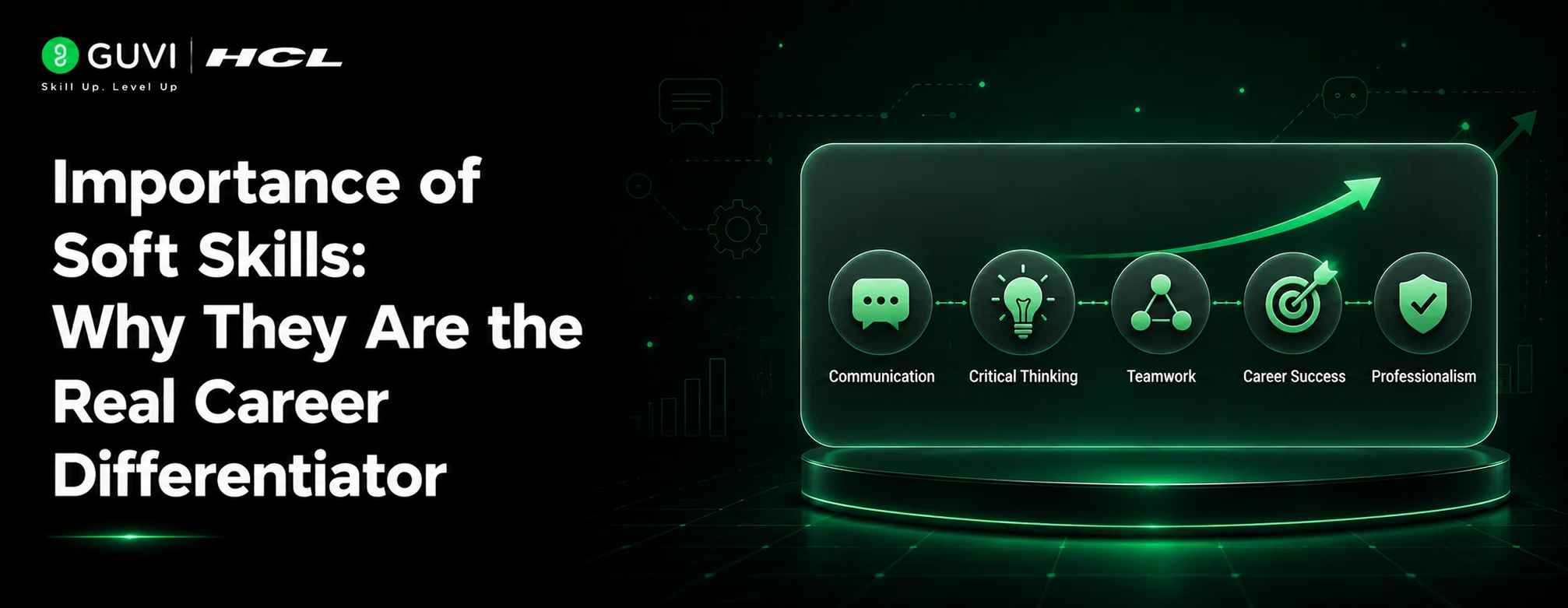
Importance of Soft Skills in 2026: Why They Are the Real Career Differentiator
Jul 20, 2026 10 Min Read 495 Views
(Last Updated)
Table of contents
- TL;DR
- What Does the Importance of Soft Skills Mean in 2026?
- Technical Skills vs Soft Skills: What Is the Difference?
- Are Technical Skills Really Becoming Commoditised?
- What is actually becoming commoditised?
- Why Are Soft Skills Becoming the Real Differentiator?
- AI increases the need for human judgement
- Modern work crosses functional boundaries
- Skills-based hiring is growing
- Senior roles depend on influence
- Technical knowledge changes faster
- What Does the 85/15 Rule Say About the Importance of Soft Skills?
- Which Soft Skills Matter Most in 2026?
- Communication
- Critical Thinking and Problem-Solving
- Adaptability
- Emotional Intelligence
- Teamwork and Collaboration
- Ownership and Professionalism
- Leadership Without Authority
- How Do Soft Skills Create Value in Technical Roles?
- Software development example
- Data analytics example
- Customer-support example
- Engineering team example
- How Do Employers Assess Soft Skills?
- Behavioural interviews
- Group discussions and collaborative assignments
- Projects and internships
- Skills-based interviews
- References and workplace reputation
- How Can You Develop Soft Skills Practically?
- Step 1: Choose one specific behaviour
- Step 2: Practise it in a low-risk setting
- Step 3: Request focused feedback
- Step 4: Reflect on the outcome
- Step 5: Repeat at a higher level
- A simple 30-day practice plan
- How Can You Demonstrate Soft Skills to Employers?
- On your resume
- In your project portfolio
- During interviews
- During group activities
- Common Mistakes When Developing Soft Skills
- Treating soft skills as personality traits
- Using soft skills as a substitute for technical competence
- Listing skills without evidence
- Confusing agreement with collaboration
- Practising only in comfortable situations
- Strengthen Your Interpersonal Skills With HCL GUVI
- Conclusion
- FAQs
- Why are soft skills important in 2026?
- Are soft skills more important than technical skills?
- What are the most important soft skills for technology professionals?
- Can soft skills be learned?
- How do employers test soft skills during interviews?
- How can freshers show soft skills without work experience?
- Should soft skills be listed on a resume?
- Why do soft skills matter in coding and data roles?
- What is the fastest way to improve workplace communication?
TL;DR
The importance of soft skills is rising because technical execution is becoming easier to learn, standardize, and support with AI. Technical expertise remains essential, especially for complex work, but it no longer differentiates candidates on its own. Employers increasingly value people who can understand unclear problems, communicate with different stakeholders, question unreliable output, adapt to change, resolve disagreements, and take responsibility for results. The strongest professionals combine both skill sets: technical knowledge helps them produce the work, while communication, judgement, teamwork, and leadership help them turn that work into a useful business outcome.
The importance of soft skills is increasing as access to technical knowledge, automation, templates, and AI-assisted execution becomes more widespread.
Employers still need people who can code, analyse data, design systems, manage finances, or operate specialised tools. However, those abilities create limited value when the employee misunderstands the problem, communicates poorly, ignores risks, or cannot work with others.
This is why communication, judgement, adaptability, collaboration, and ownership increasingly influence who gets hired, trusted with larger responsibilities, and promoted.
The real career advantage in 2026 is not choosing soft skills instead of technical skills. It is learning how to combine both and to learn the importance of soft skills more.
What Does the Importance of Soft Skills Mean in 2026?
Importance of soft skills means Soft skills are the behavioral, interpersonal, and thinking abilities that influence how you perform work with other people.
They include communication, teamwork, adaptability, critical thinking, emotional intelligence, conflict management, professionalism, and leadership.
These skills affect whether you can:
- Understand what another person needs
- Explain a complex idea clearly
- Ask useful questions
- Identify unreliable information
- Manage disagreement professionally
- Adapt when requirements change
- Give and receive feedback
- Coordinate work across teams
- Take responsibility for an outcome
Soft skills are sometimes called human skills, professional skills, transferable skills, or power skills.
The term “soft” can be misleading. A difficult stakeholder conversation, production incident, client escalation, or team conflict often requires more judgement and discipline than a predictable technical task.
Technical Skills vs Soft Skills: What Is the Difference?
Technical and soft skills perform different functions. Most roles require both.
| Factor | Technical Skills | Soft Skills |
| Main purpose | Help you complete specialised tasks | Help you understand, coordinate, and improve work |
| Examples | Programming, accounting, cloud computing, data analysis | Communication, judgement, teamwork, adaptability |
| How they are learned | Courses, certifications, practice, projects | Practice, feedback, observation, reflection |
| How they are assessed | Tests, assignments, portfolios, demonstrations | Behavioural interviews, group work, references, workplace results |
| Transferability | Often linked to a role, tool, or industry | Transferable across roles and industries |
| Change over time | Must be updated as tools and methods change | Develop over time and apply across changing situations |
| Role in hiring | Shows whether you can perform key tasks | Shows how effectively you can contribute within the organisation |
| Role in promotion | Builds professional credibility | Supports influence, mentoring, decision-making, and leadership |
| AI exposure | Some routine execution can be assisted or automated | Often becomes more important when human review is required |
| Main risk when missing | Work may be technically incorrect | Work may be misunderstood, rejected, delayed, or misapplied |
Technical skills and soft skills are not substitutes. Importance of soft skills are as necessary as technical.
A developer cannot solve a production problem through communication alone. However, strong coding ability will not prevent failure when the developer misunderstands the requirement, ignores security concerns, or cannot explain a risk to the product team.
The stronger professional uses technical expertise to produce a solution and soft skills to ensure that the solution addresses the correct problem.
Are Technical Skills Really Becoming Commoditised?
Technical skills are becoming commoditised only in a limited sense.
Basic knowledge and routine execution are easier to access because learners can use online courses, open-source libraries, documentation, reusable components, no-code tools, and AI assistance.
A beginner can now create a first draft of code, a spreadsheet formula, a design layout, or a business report much faster than before.
However, advanced technical expertise remains difficult to replace.
Designing secure architecture, debugging distributed systems, interpreting unusual clinical data, conducting a reliable financial audit, or making a production system resilient still requires deep knowledge and experience.
What is actually becoming commoditised?
The following areas are becoming easier to reproduce:
- Standard first drafts
- Basic code structures
- Repetitive documentation
- Common spreadsheet calculations
- Simple data summaries
- Template-based designs
- Routine customer responses
- Easily searchable technical explanations
The scarce value is shifting towards:
- Defining the right problem
- Choosing between competing solutions
- Understanding business and user context
- Detecting hidden risks
- Reviewing generated output
- Handling unusual cases
- Coordinating implementation
- Explaining trade-offs
- Taking responsibility for the result
While importance of soft skills has increased, technical skills still matter because they help you perform the core work of a role. However, they create greater value when combined with creative thinking, adaptability, clear communication, leadership, and a willingness to keep learning.
As tools and workflows change, employers need people who can update their knowledge, work through uncertainty, collaborate with different teams, and apply technical expertise to real business problems.
The evidence therefore does not support replacing technical learning with personality development.
The stronger conclusion is that technical competence is becoming a baseline in more roles, while importance of soft skills has increased and therefore, separate professionals who can execute tasks from those who can create wider value.
Why Are Soft Skills Becoming the Real Differentiator?
Important of Soft skills is rising as soft skills become differentiators when several candidates can demonstrate similar technical capabilities.
An employer may interview ten candidates who know Python, Java, Excel, Figma, AWS, or Power BI. The hiring decision may then depend on who understands the business problem, communicates clearly, listens carefully, handles uncertainty, and accepts feedback, which has increase the importance of soft skills.
AI increases the need for human judgement
AI can produce plausible answers quickly, but someone must decide whether the result is accurate, relevant, safe, and suitable.
That requires critical thinking.
For example, an analyst using an AI-generated summary must still check the data, question unsupported conclusions, and explain whether the result is meaningful for the business.
Modern work crosses functional boundaries
Most important projects require several teams.
A software product may involve developers, designers, testers, product managers, marketers, legal reviewers, sales teams, and customer-support specialists.
Even excellent technical work can fail when:
- Teams interpret the requirement differently
- Risks are not escalated
- Decisions are not documented
- Feedback is treated defensively
- Stakeholders are excluded
- Deadlines are communicated too late
Workplace communication turns individual expertise into coordinated delivery.
Skills-based hiring is growing
Employers are increasingly evaluating what candidates can demonstrate rather than relying only on qualifications or academic scores, this has increased the importance of soft skills.
More employers are looking beyond degrees and job titles to understand what a candidate can actually do.
This makes interviews, projects, work samples, internships, and practical assessments more important because they give employers direct evidence of communication, problem-solving, teamwork, and role-specific ability.
This shift increases the importance of evidence.
Writing “good communicator” on a resume has little value. Explaining how you resolved unclear requirements, presented findings, or coordinated a team gives the employer something to evaluate.
Senior roles depend on influence
Individual contributors can often succeed through strong execution during the early stages of a career.
As responsibility increases, professionals must make decisions, mentor others, negotiate priorities, give feedback, manage disagreements, and communicate with clients or senior leaders.
These responsibilities require leadership skills even when the person does not hold a management title.
Technical knowledge changes faster
A specific framework, platform, or process may lose relevance.
Adaptability helps you transfer your existing knowledge to a different tool or situation.
A professional who can learn, ask questions, accept corrections, and remain effective during change is more resilient than someone whose confidence depends on one familiar workflow.
The National Association of Colleges and Employers found that communication, teamwork, professionalism, and critical thinking were among the most important career-readiness skills for new graduates in 2026. Employers rated graduates relatively well in teamwork but identified greater room for improvement in communication, professionalism, and critical thinking.
What Does the 85/15 Rule Say About the Importance of Soft Skills?
The 85/15 rule is a frequently cited career principle suggesting that 85% of job success comes from interpersonal and people skills, while technical knowledge accounts for the remaining 15%.
The 85/15 rule is best understood as a career principle rather than an exact formula.
Its main message is that technical knowledge may help you perform a role, but long-term success also depends heavily on communication, teamwork, judgement, adaptability, and the way you work with other people.
This distinction matters because the 85/15 split should not be treated as a precise measurement of career success in 2026. The original research came from a different labour market, focused on engineering education, and cannot represent every modern profession.
Still, the principle captures an important career pattern. Technical skills may help you qualify for a role, but long-term performance also depends on how well you communicate, collaborate, solve unfamiliar problems, manage relationships, and take responsibility.
A technically skilled employee who cannot understand stakeholder needs or work constructively with a team may struggle to create business value. A strong communicator without the required technical competence will face a different limitation.
The practical lesson is not that soft skills contribute exactly 85% to every career. It is that technical ability alone rarely determines hiring, workplace trust, promotion, leadership, or long-term career growth.
Which Soft Skills Matter Most in 2026?
The most valuable soft skills are the ones that improve decisions, relationships, and outcomes.
For role-specific examples, explore the most important soft skills for tech professionals and how they appear in code reviews, team projects, deadlines, feedback, and cross-functional work.
1. Communication
Communication is the ability to transfer meaning clearly.
It includes writing, speaking, listening, questioning, documenting decisions, adapting your message, and confirming that others understood it.
Strong workplace communication means you can:
- Explain technical information without unnecessary jargon
- Write a clear status update
- Ask for clarification early
- Summarise a discussion accurately
- Raise a risk without creating panic
- Present a recommendation with supporting evidence
Communication is not about speaking continuously or using impressive words. It is about helping the other person understand what matters.
A particularly valuable workplace skill is learning to communicate technical concepts to non-technical stakeholders by focusing on the outcome, timeline, risk, and decision instead of unnecessary technical detail.
2. Critical Thinking and Problem-Solving
Critical thinking helps you assess information before acting on it.
It involves identifying assumptions, comparing options, checking evidence, considering consequences, and recognising when information is incomplete.
A strong problem-solver does not immediately begin building.
They first ask:
- What is the actual problem?
- Who is affected?
- What evidence supports this conclusion?
- Which constraints matter?
- What could fail?
- How will success be measured?
3. Adaptability
Adaptability is the ability to remain useful when tools, priorities, teams, or conditions change.
It does not mean agreeing with every change.
An adaptable professional learns the new requirement, identifies its impact, updates the plan, and communicates what must change.
Leadership, adaptability, and resilience are becoming more valuable because modern workplaces change quickly.
Professionals are often expected to guide others, stay effective when priorities shift, and make calm decisions during uncertainty. These abilities help teams continue working well even when tools, processes, or business needs change.
4. Emotional Intelligence
Emotional intelligence at work involves recognising emotions, managing your reactions, understanding how others may interpret a situation, and responding constructively.
It becomes visible when you:
- Remain calm during pressure
- Receive criticism without becoming defensive
- Notice when a teammate needs support
- Handle disagreement without making it personal
- Adjust your approach for different people
- Deliver difficult feedback respectfully
Emotional intelligence does not mean avoiding conflict. It helps you handle necessary conflict without damaging the working relationship.
5. Teamwork and Collaboration
Teamwork is not simply completing your assigned portion.
It involves sharing information, supporting collective priorities, respecting expertise, communicating dependencies, and helping the team reach a common outcome.
Strong collaborators:
- Clarify responsibilities
- Keep others informed
- Ask for help before delays grow
- Give credit fairly
- Challenge ideas respectfully
- Document decisions
- Support teammates without taking over their work
These habits become even more important in distributed teams, where strong remote work and asynchronous communication skills help colleagues share updates, protect focus time, document decisions, and work across different schedules.
6. Ownership and Professionalism
Ownership means accepting responsibility for the quality and completion of your work.
It includes meeting commitments, communicating delays, correcting mistakes, protecting confidential information, and following through without repeated reminders.
Professionalism is not formality. It is reliable.
7. Leadership Without Authority
Leadership can be demonstrated before becoming a manager, which shows the importance of soft skills.
You show leadership when you create clarity, coordinate action, support others, improve a process, or help a team make a difficult decision.
The most useful leadership qualities include:
- Initiative
- Fairness
- Accountability
- Decision-making
- Conflict management
- Coaching
- Strategic thinking
- Calmness during uncertainty
How Do Soft Skills Create Value in Technical Roles?
Importance of soft skills become easier to understand when connected to real work.

Software development example
An Indian SaaS company is preparing a payment feature for release.
The developer’s technical responsibility is to build and test the integration. The wider responsibility includes clarifying failure scenarios, discussing security concerns, updating the product manager, coordinating with testing, and explaining what happens when a payment is delayed.
The developer’s communication and judgement reduce the chance of releasing a technically working feature that creates a poor customer experience.
Data analytics example
A GCC analytics team receives a request to identify why customer cancellations increased.
The analyst can write queries and build dashboards. However, the valuable contribution begins when the analyst questions the definition of cancellation, checks whether recent data is complete, separates correlation from causation, and explains the findings to a business manager. This shows the importance of soft skills.
Technical analysis produces numbers. Critical thinking and communication make the numbers useful.
Customer-support example
A support associate receives an automatically suggested response for an angry customer.
The employee must decide whether the response addresses the actual complaint, whether a refund policy applies, and whether the issue should be escalated.
Empathy, product knowledge, judgement, and clear writing determine the quality of the final response.
Engineering team example
Two engineers disagree about whether to release a feature or delay it for additional testing.
A productive discussion focuses on evidence, customer impact, probability of failure, rollback options, and deadlines.
Conflict-resolution skills help the team challenge the decision without turning the disagreement into a personal dispute.
Project managers provide another clear example of why both skill sets matter. Understanding technical skills for project managers helps them plan timelines, risks, tools, and resources, while communication and leadership help them align people and keep delivery on track.
How Do Employers Assess Soft Skills?
Employers rarely accept a list of soft skills without evidence.
They assess behaviour through several stages of hiring.
Behavioural interviews
Behavioral questions ask how you handled a real situation.
Examples include:
- Tell me about a disagreement within your team.
- Describe a time when a requirement was unclear.
- How did you respond to critical feedback?
- Tell me about a mistake you made.
- Explain a situation where priorities changed suddenly.
The employer looks for the situation, your behaviour, your reasoning, and the result.
Technical employers may also use situational questions, group exercises, presentations, and real-world scenarios to assess soft skills in full-stack developers, including communication, flexibility, teamwork, accountability, and problem-solving.
Group discussions and collaborative assignments
These activities reveal whether you listen, interrupt, include others, explain your thinking, manage time, and move the group towards a decision.
Speaking the most does not necessarily demonstrate leadership.
Projects and internships
A project can demonstrate teamwork, ownership, adaptability, and problem-solving when you explain:
- Your role
- The decisions you made
- A difficulty you faced
- How you responded to feedback
- How the team divided work
- What changed during development
- What outcome you achieved
Skills-based interviews
According to the National Association of Colleges and Employers’ Job Outlook 2026 survey, employers applied skills-based hiring most often during interviews, at 87%, and candidate screening, at 65%. More than 80% also highlighted the key skills required when creating job descriptions.
Candidates should therefore study behavior-related terms in the job description, not only technical keywords and should be aware of the importance of soft skills.
References and workplace reputation
Managers and colleagues often remember whether you were dependable, collaborative, open to feedback, and clear under pressure.
Technical success may win recognition for one project. Professional behaviour builds long-term trust.
How Can You Develop Soft Skills Practically?
Soft skills improve through deliberate behavior, feedback, and repetition.
Reading about communication is useful, but development happens when you practise it in real situations.
Step 1: Choose one specific behaviour
Do not begin with a broad goal such as “improve communication.”
Choose something observable:
- Send clearer project updates
- Stop interrupting during meetings
- Ask clarifying questions before starting
- Summarise decisions at the end of discussions
- Give feedback using specific examples
- Escalate risks earlier
A specific behaviour can be practised and measured.
Step 2: Practise it in a low-risk setting
Use college projects, team meetings, volunteer work, hackathons, internships, or internal assignments.
For example, volunteer to summarise the next project meeting. Ask the team whether your summary captured the decision, owner, deadline, and next action.
Step 3: Request focused feedback
Avoid asking, “How are my soft skills?”
Ask:
- Was my explanation clear?
- Did I provide enough context?
- What part of the presentation was confusing?
- Did I listen before offering a solution?
- How could I handle that disagreement better?
Focused questions produce useful feedback.
Step 4: Reflect on the outcome
After an important interaction, write down:
- What happened
- What you intended
- How the other person responded
- What worked
- What you would change
- What you will try next time
Reflection helps convert experience into learning.
Step 5: Repeat at a higher level
Once you can write a clear update, practise presenting it.
Once you can handle a small disagreement, practise facilitating a decision between several people.
Soft skills grow through progressively more difficult situations.
A simple 30-day practice plan
| Week | Skill Focus | Practice Activity | Evidence |
| Week 1 | Active listening | Paraphrase key points before responding | Fewer clarification errors |
| Week 2 | Written communication | Send concise updates with actions and deadlines | Faster stakeholder responses |
| Week 3 | Feedback | Ask one peer for specific feedback | One documented improvement |
| Week 4 | Adaptability | Handle a changed requirement and revise the plan | Updated plan and outcome |
The goal is not to become perfect in 30 days. It is to build a repeatable development habit.
How Can You Demonstrate Soft Skills to Employers?
Importance of soft skills to demonstrate to Employers need proof, not labels.
On your resume
Avoid:
Strong communication and teamwork skills.
Use:
Coordinated a four-member project team, documented weekly decisions, and delivered the final application two days before the submission deadline.
Avoid:
Excellent problem-solving abilities.
Use:
Identified a duplicate-data issue in the reporting workflow and added validation checks that reduced manual corrections.
The stronger bullet shows the behaviour and its result.
In your project portfolio
Include:
- Your exact responsibility
- A decision you made
- A problem you resolved
- Feedback you applied
- A change in scope
- A conflict or dependency you managed
- The final outcome
This helps employers evaluate how you work, not only what you built.
Alongside explaining teamwork and decision-making, learn how to showcase technical skills in your portfolio through relevant projects, clear descriptions, problem-solving stories, and evidence of your personal contribution.
During interviews
Importance of soft skills during interviews is visible through:
- Explain the situation.
- Describe your responsibility.
- State the action you personally took.
- Explain why you chose that action.
- Share the result.
- Mention what you learned.
Keep the focus on your behaviour rather than giving a long description of the team.
You can also improve your technical interview skills by practising structured problem-solving, explaining your reasoning aloud, and responding calmly when your first approach needs to change.
During group activities
Importance of soft skills can be demonstrated:
- Inviting quieter participants to contribute
- Keeping the discussion focused
- Building on useful ideas
- Questioning respectfully
- Summarising agreements
- Helping the group reach a decision
Do not attempt to appear like a leader by controlling every part of the conversation.
According to the National Association of Colleges and Employers’ Job Outlook 2026 Spring Update, more than 40% of surveyed employers said graduates’ skills were very closely aligned with their hiring needs, while 56% considered them partially aligned. Most employers also wanted candidates to demonstrate their skills through specific examples rather than simply list them on a resume.
Common Mistakes When Developing Soft Skills
1. Treating soft skills as personality traits
Introversion does not prevent clear communication or leadership.
Fix: Focus on learnable behaviours such as listening, preparation, documentation, feedback, and conflict management.
2. Using soft skills as a substitute for technical competence
Confidence cannot compensate for an inability to perform the work.
Fix: Build sufficient technical depth and use soft skills to apply that expertise effectively.
3. Listing skills without evidence
Terms such as leadership, communication, and teamwork are easy to claim.
Fix: Connect each skill with a project, decision, responsibility, or measurable outcome.
4. Confusing agreement with collaboration
A good team member does not agree with every idea.
Fix: Challenge decisions respectfully, present evidence, and support the final team decision once it is made.
5. Practising only in comfortable situations
Soft skills appear strongest when pressure, uncertainty, disagreement, or change is present.
Fix: Take on responsibilities that require stakeholder communication, feedback, coordination, or decision-making.
Strengthen Your Interpersonal Skills With HCL GUVI
Understanding the importance of soft skills is only the first step. You also need regular practice to improve how you communicate, listen, collaborate, respond to feedback, and handle workplace relationships.
The HCL GUVI Developing Interpersonal Skills Course offers structured, self-paced learning focused on communication, adaptability, teamwork, and relationship-building.
Combine the course with team projects, presentations, internships, and workplace assignments so you can apply these skills in real situations rather than simply listing them on your resume.
Conclusion
The importance of soft skills is growing because technical knowledge alone cannot guarantee that work solves the right problem or creates the intended result. AI, reusable tools, and accessible learning resources make some forms of execution faster, but they also increase the need for judgement, communication, adaptability, collaboration, and accountability. Technical skills remain the foundation of professional credibility. Soft skills help you apply that expertise across teams, customers, and changing business situations. Develop both together. Learn the technical requirements of your role, then practise explaining decisions, receiving feedback, resolving problems, and taking ownership of outcomes.
FAQs
1. Why are soft skills important in 2026?
The importance of soft skills is increasing because employers need people who can communicate, evaluate information, adapt to changing workflows, collaborate, and take responsibility for AI-assisted or technical output.
2. Are soft skills more important than technical skills?
Neither skill set is universally more important. Technical skills help you perform specialised work, while soft skills determine how effectively you apply, explain, coordinate, and improve that work.
3. What are the most important soft skills for technology professionals?
Communication, critical thinking, adaptability, teamwork, emotional intelligence, ownership, conflict management, and leadership are particularly valuable in technology roles.
4. Can soft skills be learned?
Yes. Soft skills improve through deliberate practice, feedback, reflection, mentoring, group work, presentations, and progressively more difficult workplace responsibilities.
5. How do employers test soft skills during interviews?
Employers use behavioural questions, group discussions, situational exercises, work samples, internships, and reference checks to assess how candidates communicate, solve problems, respond to feedback, and work with others.
6. How can freshers show soft skills without work experience?
Freshers can use academic projects, internships, volunteering, hackathons, clubs, presentations, and team assignments to demonstrate communication, teamwork, ownership, and problem-solving.
7. Should soft skills be listed on a resume?
Soft skills can be mentioned, but they are stronger when demonstrated through achievement-based bullets. Explain what you did, how you worked with others, and what result you achieved.
8. Why do soft skills matter in coding and data roles?
Developers and analysts must clarify requirements, explain findings, review risks, work with stakeholders, handle feedback, and make decisions when the technical answer is not obvious.
9. What is the fastest way to improve workplace communication?
Choose one observable behaviour, such as writing clearer updates or asking better questions. Practise it regularly and request specific feedback from a peer, mentor, or manager.
Success Stories

About the Author
Reemsha Khan
Always been a storyteller at heart. Now, I turn complex topics into simple, easy-to-understand stories through content. Hope you find it helpful.
View all posts by Reemsha Khan
Connect with me @














Did you enjoy this article?