


Career Articles
Capgemini Exceller Technical Assessment 2026: AI + Technical - Best Guide
Cognizant GenC Elevate Exam Pattern & Syllabus for Freshers 2026 - Best Guide
Capgemini Exceller Placement Papers and Solutions 2026 - Best Guide
How to Pass the Accenture Recruitment Process 2026/27: The Complete Guide


Get In Touch For Details! Request More Information

Variable Pay, Bonuses & ESOPs Explained for Tech Freshers
Sep 02, 2026 5 Min Read 506 Views
(Last Updated)
A tech fresher’s first offer letter can look exciting at first glance. The CTC may look high, the joining bonus may sound attractive, and ESOPs may make the package feel even bigger.
The real question is simple: how much will you actually receive, and how much depends on conditions? Many freshers compare only the total CTC number. That can lead to confusion after joining because variable pay, bonuses, ESOPs, PF, gratuity, insurance, and taxes affect the actual monthly in-hand salary.
This blog explains variable pay, bonuses, and ESOPs in simple terms so tech freshers can read offer letters better, compare salary packages correctly, and avoid common compensation mistakes.
Table of contents
- TL;DR
- What Is Variable Pay in a Tech Offer Letter?
- Why Variable Pay Matters for Tech Freshers
- Types of Variable Pay Freshers May See
- Performance-Based Variable Pay
- Company Performance Variable Pay
- Team-Based Variable Pay
- Discretionary Variable Pay
- What Are Bonuses in a Tech Job Offer?
- Common Types of Bonuses in Tech Jobs
- Joining Bonus
- Performance Bonus
- Retention Bonus
- Project Bonus
- Annual Bonus
- What Are ESOPs?
- How ESOPs Work
- Grant
- Vesting
- Exercise
- Sale or Exit
- Simple ESOP Example for Freshers
- ESOP Terms Every Tech Fresher Should Understand
- Grant Date
- Vesting Period
- Cliff
- Exercise Price
- Fair Market Value
- Exercise Window
- Liquidity Event
- Variable Pay vs Bonus vs ESOPs
- How These Components Affect Your In-Hand Salary
- Questions to Ask HR Before Accepting the Offer
- For Variable Pay
- For Bonuses
- For ESOPs
- Conclusion
- FAQs
- What is variable pay in a tech fresher salary?
- Is variable pay included in monthly salary?
- Are ESOPs useful for freshers?
- Is a joining bonus part of CTC?
TL;DR
- Variable pay is not always guaranteed. Bonuses may come with conditions such as joining, performance, retention, or repayment clauses.
- ESOPs are not direct cash salary. They become valuable only when the company grows and the shares can be sold.
- Always compare fixed pay before comparing total CTC.
- Read vesting period, bonus terms, variable pay percentage, and exit conditions carefully.
- Freshers should calculate monthly in-hand salary before accepting any tech job offer.
What Is Variable Pay in a Tech Offer Letter?
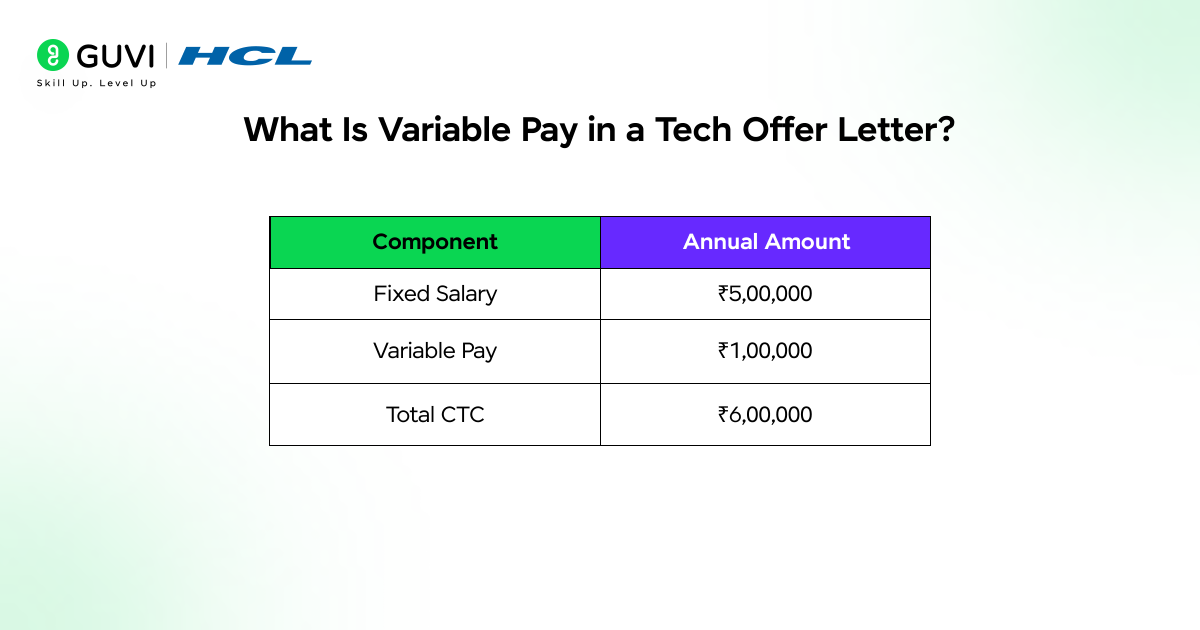
Variable pay is the part of your salary that depends on performance, company results, team targets, or role-based goals. It is often included in CTC, but it may not be paid every month.
For example, your offer letter may show:
| Component | Annual Amount |
| Fixed Salary | ₹5,00,000 |
| Variable Pay | ₹1,00,000 |
| Total CTC | ₹6,00,000 |
The offer may look like ₹6 LPA. Your guaranteed salary may still be closer to ₹5 LPA before deductions.
Variable pay is common in software development, data science, digital marketing, sales, customer success, product support, and business roles. Tech freshers must check whether this amount is guaranteed, performance-based, or completely discretionary.
Why Variable Pay Matters for Tech Freshers
Variable pay matters because it changes how you understand your real salary. A high CTC with a large variable component may give a lower monthly income than a slightly smaller CTC with stronger fixed pay.
For example:
| Offer | Fixed Pay | Variable Pay | Total CTC |
| Offer A | ₹4.8 LPA | ₹1.2 LPA | ₹6 LPA |
| Offer B | ₹5.5 LPA | ₹30,000 | ₹5.8 LPA |
Offer A looks higher on paper. Offer B may give better monthly stability because the fixed pay is higher. Freshers should not reject or accept an offer based only on the headline CTC. The fixed salary, variable pay terms, deductions, location, learning scope, and growth path matter more.
Types of Variable Pay Freshers May See
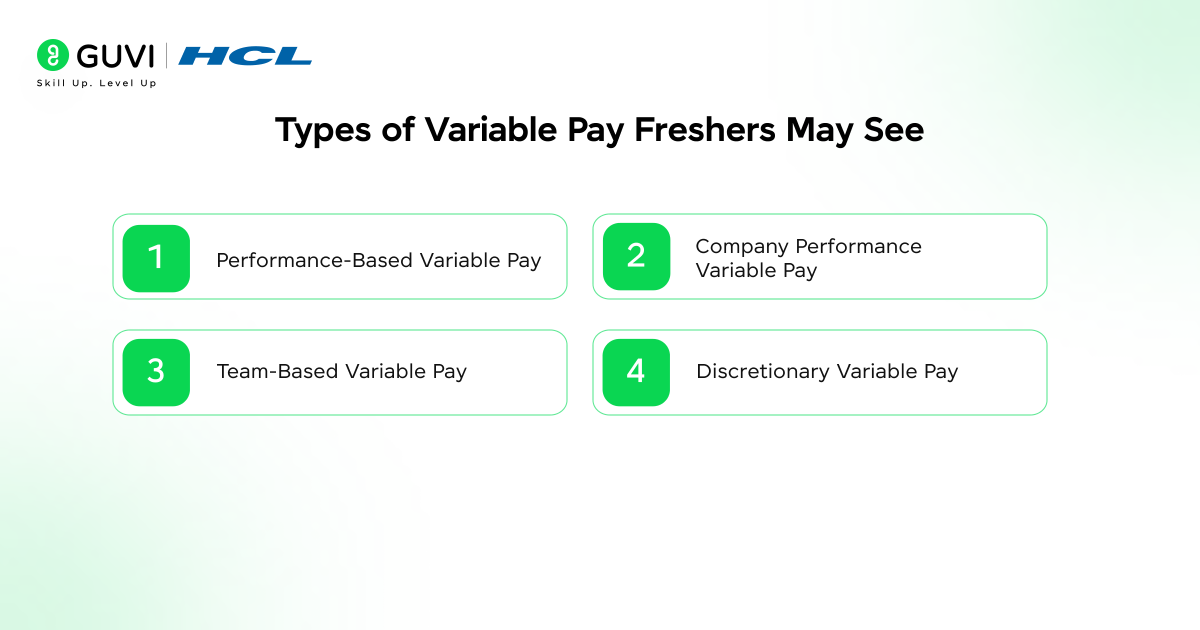
1. Performance-Based Variable Pay
Performance-based variable pay depends on your individual output. A software developer may be evaluated on code quality, sprint delivery, bug resolution, documentation, and team contribution.
A digital marketing fresher may be evaluated on traffic growth, campaign execution, lead quality, content performance, or reporting accuracy.
2. Company Performance Variable Pay
Some companies pay variable salaries only when the company performs well. Even if your personal performance is strong, the payout may reduce when the company misses its targets.
3. Team-Based Variable Pay
Team-based variable pay depends on group performance. This is common in sales, support, operations, consulting, and project delivery teams.
4. Discretionary Variable Pay
Discretionary variable pay depends on management approval. The company may mention a target amount, but the actual payout can be lower.
Freshers should ask HR whether the variable pay is guaranteed, target-based, or discretionary.
Variable pay payouts vary sharply by performance. Top talent earns 120-150% of target variable pay, while average performers get only 60-80%.
What Are Bonuses in a Tech Job Offer?
A bonus is an additional amount paid apart from regular salary. It may be offered at joining, after completing a target, after staying for a certain period, or after an annual performance review.
Bonuses can make an offer look attractive, but every bonus has terms. Tech freshers should read the conditions before treating it as confirmed income.
Understand salary, bonuses, ESOPs, and offer letters better with HCL GUVI’s Interview Preparation Course. Build HR interview confidence, communication skills, and career-readiness strategies for smarter job decisions.
Common Types of Bonuses in Tech Jobs
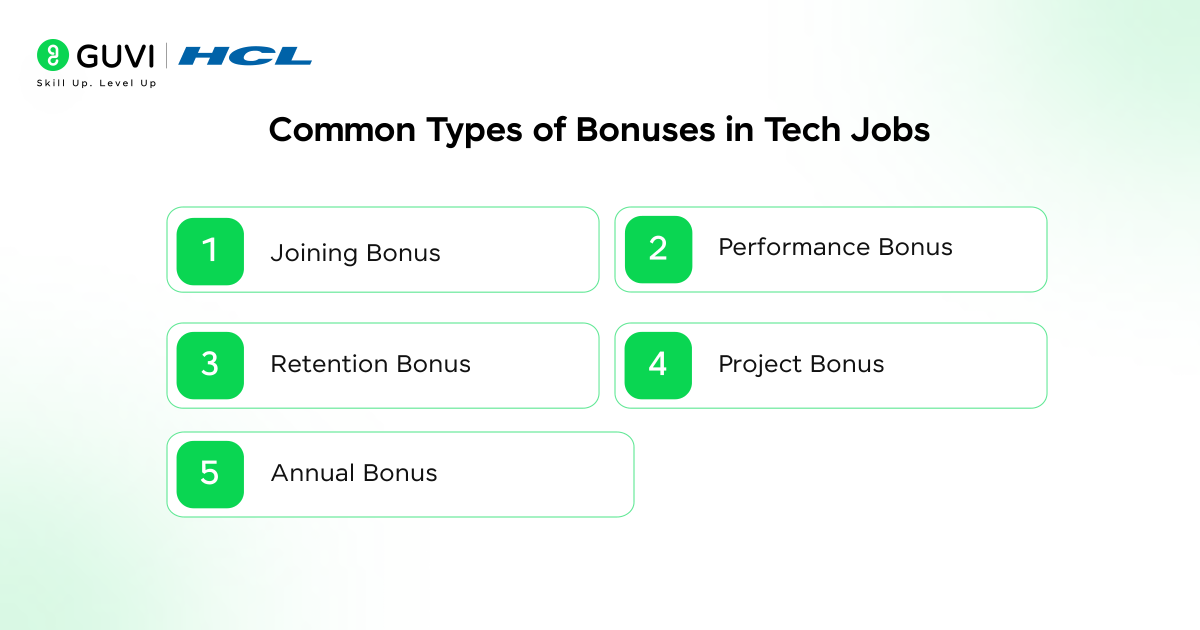
1. Joining Bonus
A joining bonus is paid when you join the company. It may be paid with your first salary or after completing a few months.
Some companies add a clawback clause. This means you may need to return the bonus if you leave before a fixed period, such as 12 months.
Example: You receive a ₹50,000 joining bonus. The offer letter says you must repay it if you leave within one year. In this case, the bonus is useful, but it also creates a short-term retention condition.
2. Performance Bonus
A performance bonus depends on your annual review, target achievement, manager feedback, or business performance. It is not always guaranteed.
A fresher in a software developer role may receive a bonus after delivering projects well, reducing bugs, learning new tools, or supporting important releases.
3. Retention Bonus
A retention bonus is paid to encourage employees to stay with the company. It may be paid after completing a specific period.
Example: A company may offer ₹75,000 after completing 18 months. You may lose this bonus if you leave earlier.
4. Project Bonus
Some companies offer project bonuses after successful delivery. This can happen in consulting, IT services, product launches, implementation projects, or client-facing work.
5. Annual Bonus
Annual bonus is usually linked to company policy. It may be paid once a year after appraisal or financial year closure.
Nearly 65% of BFSI firms now enforce 2–3 year clawback periods on bonuses. That joining bonus may come with strings longer than you think.
What Are ESOPs?
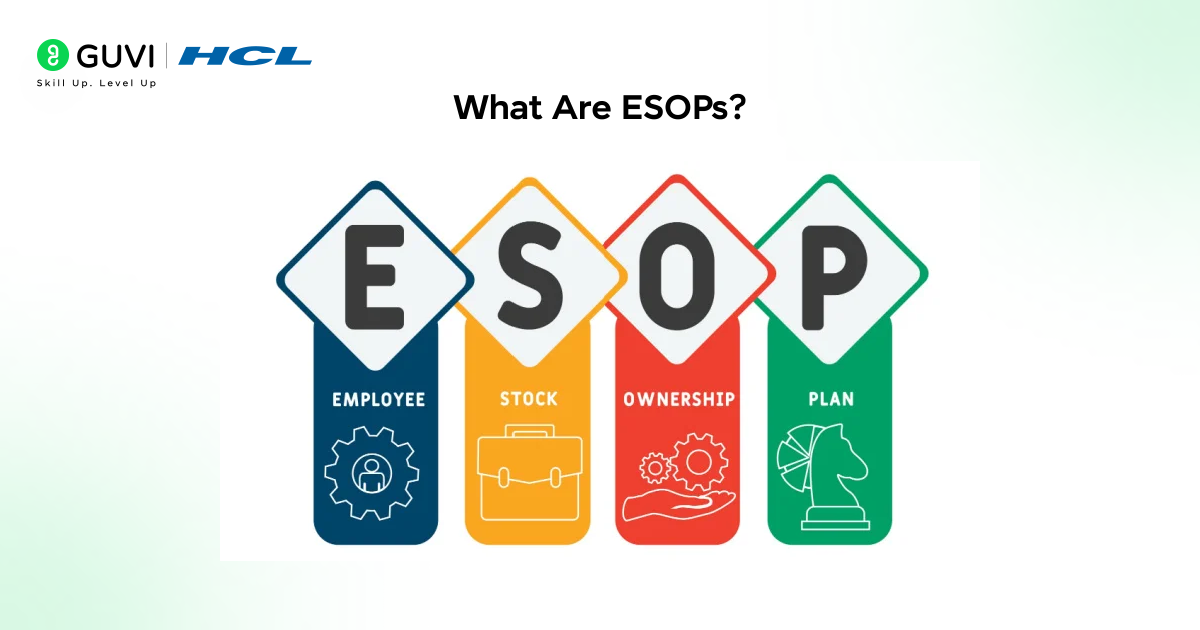
ESOP stands for Employee Stock Option Plan. It gives employees the right to buy company shares at a fixed price in the future.
ESOPs are common in startups, product companies, SaaS companies, fintech firms, AI companies, and growing tech businesses. They are used to reward employees and make them part of the company’s long-term growth.
ESOPs are not the same as cash salary. They do not always give immediate money. They become valuable only when the company grows, the shares gain value, and you get a chance to sell them.
How ESOPs Work
ESOPs usually follow four stages:
1. Grant
The company grants you stock options. This means you receive the right to buy shares later. You do not own the shares immediately.

Example:
The company grants you 1,000 options at an exercise price of ₹100 per share.
2. Vesting
Vesting means you earn the right to exercise your options over time. A common vesting schedule is four years with a one-year cliff.
This means you may receive the first portion after completing one year. The remaining options may vest monthly, quarterly, or yearly.
3. Exercise
Exercise means you buy the shares at the exercise price. You need to pay money to convert options into shares.
Example:
You exercise 1,000 options at ₹100 each. You pay ₹1,00,000 to buy the shares.
4. Sale or Exit
You make real money only when you sell the shares. This may happen during a company buyback, acquisition, IPO, or secondary sale.
In private startups, selling ESOP shares can be difficult because there may be no open market.
Simple ESOP Example for Freshers
Assume a startup gives you 1,000 ESOPs.
| Detail | Value |
| Number of options | 1,000 |
| Exercise price | ₹100 |
| Future share value | ₹500 |
| Potential gain per share | ₹400 |
| Potential gross value | ₹4,00,000 |
This looks attractive. But it is only potential value. You must check:
- Can you exercise the options?
- Can you afford the exercise cost?
- Can you sell the shares later?
- What happens if you leave early?
- What tax applies when you exercise and sell?
A fresher should never treat ESOP value as a guaranteed take-home salary.
About 28% of organizations now run quarterly variable pay cycles instead of annual ones. Ask HR about your payout frequency before signing.
ESOP Terms Every Tech Fresher Should Understand
1. Grant Date
The grant date is the date when the company gives you stock options.
2. Vesting Period
The vesting period is the time you must stay before earning ownership rights over options.
3. Cliff
A cliff is the minimum period before your first ESOP portion vests. A one-year cliff means you get no vested options if you leave before completing one year.
4. Exercise Price
Exercise price is the price you pay to buy each share after vesting.
5. Fair Market Value
Fair market value is the estimated value of each share at a specific time.
6. Exercise Window
Exercise window is the time given to exercise vested options after resignation, termination, or exit.
7. Liquidity Event
A liquidity event is when you can sell shares and convert ESOP value into money. This may happen during an IPO, acquisition, or company buyback.
Variable Pay vs Bonus vs ESOPs
| Component | Cash or Non-Cash | Immediate Benefit | Risk Level | Best Way to Read It |
| Fixed Pay | Cash | Yes | Low | Guaranteed salary before deductions |
| Variable Pay | Cash | Maybe | Medium | Depends on performance or policy |
| Bonus | Cash | Maybe | Medium | Check conditions and repayment clauses |
| ESOPs | Equity option | No | High | Potential future value, not monthly salary |
How These Components Affect Your In-Hand Salary
Your in-hand salary depends mostly on fixed monthly pay. Variable pay, bonus, and ESOPs may not come every month.
Assume your CTC is ₹8 LPA.
| Component | Annual Amount |
| Fixed Pay | ₹5,60,000 |
| Variable Pay | ₹1,00,000 |
| Joining Bonus | ₹50,000 |
| Employer PF | ₹28,800 |
| Gratuity | ₹26,900 |
| Insurance and Benefits | ₹34,300 |
| Total CTC | ₹8,00,000 |
Your monthly salary will not be ₹66,666. It will be lower because some components are annual, conditional, deferred, or non-cash. Freshers should calculate monthly in-hand salary using only monthly fixed pay first. Then they should separately understand variable pay, bonuses, and benefits.
Questions to Ask HR Before Accepting the Offer
For Variable Pay
- Is the variable pay guaranteed?
- What is the payout frequency?
- What percentage of employees receive full variable pay?
- What metrics decide the payout?
- Can the amount reduce based on company performance?
For Bonuses
- When will the bonus be paid?
- Is there any repayment clause?
- What happens if I leave before one year?
- Is the bonus part of CTC or extra?
- Will tax be deducted from the bonus?
For ESOPs
- What is the grant size?
- What is the vesting schedule?
- What is the exercise price?
- What is the latest fair market value?
- What is the exercise window after resignation?
- Is there any buyback history?
- What happens to unvested options if I leave?
Conclusion
Variable pay, bonuses, and ESOPs can make a tech offer look attractive. But freshers must understand what is guaranteed, what is conditional, and what is only potential future value. Fixed pay decides your monthly stability. Variable pay depends on performance or company policy. Bonuses may come with conditions. ESOPs may create wealth later, but they are not direct salary.
A smart fresher does not compare only CTC. They compare fixed pay, in-hand salary, payout terms, ESOP rules, learning scope, and long-term career growth. Understanding these details helps you accept better offers, avoid salary confusion, and start your tech career with confidence.
FAQs
What is variable pay in a tech fresher salary?
Variable pay is the performance-based part of your salary. It may depend on individual performance, company results, team targets, or manager ratings. It is usually part of CTC, but it may not be fully guaranteed.
Is variable pay included in monthly salary?
Variable pay is usually not included in regular monthly salary. It may be paid quarterly, half-yearly, or annually based on company policy. Freshers should ask HR about the payout cycle before accepting the offer.
Are ESOPs useful for freshers?
ESOPs can be useful when the company grows and provides a chance to sell shares later. However, ESOPs are not guaranteed cash. Freshers should understand vesting, exercise price, tax, and exit options before valuing ESOPs.
Is a joining bonus part of CTC?
Many companies include joining bonus in CTC. Some joining bonuses also have repayment clauses. This means you may need to return the amount if you leave before a specific period.
Success Stories

About the Author
Vaishali
I'm a seasoned writer with four years of experience across technical, non-technical, and just about every genre or niche you can imagine. Adaptable and curious, I enjoy exploring new topics and making information engaging and easy to understand. Fueled by a steady stream of tea, I approach each project with creativity, reliability, and genuine enthusiasm for storytelling.
View all posts by Vaishali
Connect with me @















Did you enjoy this article?