


Python Articles
Go vs Python for Forward Deployed Engineering Workloads
Python for Forward Deployed Engineers: What You Actually Need to Know
Freelancing as a Python Developer: Getting Your First Client


Get In Touch For Details! Request More Information

Probability shows up everywhere: weather forecasts, dice games, exam predictions, and even deciding whether to bring an umbrella. Most people have an intuitive sense of “likely” and “unlikely,” but turning that intuition into something you can actually calculate is where probability becomes genuinely useful. The good news is that the foundations are simpler than they look once you see a few clear examples.
Table of contents
- TL;DRSummary
- What Is Probability?
- Theoretical vs Experimental Probability
- Independent vs Dependent Events
- Mutually Exclusive vs Non-Mutually Exclusive Events
- The Addition Rule
- Complementary Events and the Complement Rule
- The Multiplication Rule
- A Quick Reference Table
- Why This Matters Beyond the Classroom
- Conclusion
- FAQs
- What is probability in simple terms?
- What is the difference between theoretical and experimental probability?
- What is a sample space in probability?
- What are independent and dependent events?
- What are mutually exclusive events?
- What is the complement rule in probability?
- Why is probability important in real life?
TL;DR Summary
- Probability measures how likely an event is to occur, using values between 0 (impossible) and 1 (certain).
- Key concepts such as sample space, independent events, and complementary events form the foundation of probability calculations.
- The addition, multiplication, and complement rules help solve real-world probability problems ranging from games and weather forecasts to finance and risk analysis.
Understand probability basics, events, outcomes, and key concepts for data science. Learn probability fundamentals with HCL GUVI’s Probability & Statistics for Data Science Course. Start learning probability here
What Is Probability?
Probability is a numerical measure between 0 and 1 that quantifies how likely an event is to occur. A probability of 0 means the event is impossible; a probability of 1 means it’s certain. Everything else falls somewhere in between, usually expressed as a fraction, decimal, or percentage.
Theoretical vs Experimental Probability
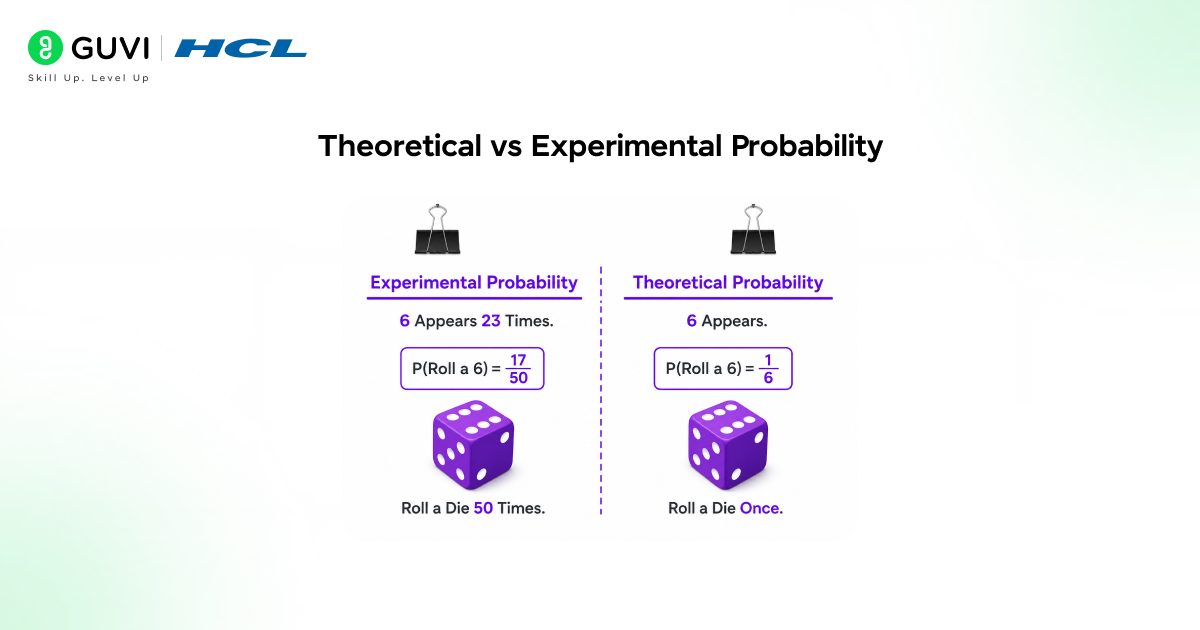
- Definition of theoretical probability
- Theoretical probability is the chance calculated purely from math: short-run variation vs long-run average.
- Single trials (or a few trials) can deviate a lot from the theoretical expectation: roll six dice once and you might see 0 or 3 sixes, both possible. As you repeat the experiment many times, the observed average moves closer to the theoretical value.
- Law of large numbers explained
- The law of large numbers says that as the number of repetitions grows, the sample average converges toward the theoretical probability.
- That’s why rolling six dice 10,000 times will produce an average near 1/6 per die, even if individual runs vary widely.
- Practical takeaway: “should” vs reality
- When someone says a result “should” happen, they usually mean the theoretical expectation.
- Reality can and does differ, especially over small sample sizes, so don’t assume short-term outcomes prove the underlying probability is wrong.
Independent vs Dependent Events
Experimental probability is what actually happens when you run the experiment. Roll six dice for real, count how many 6s you get, and that’s your experimental result which is often noticeably different from the theoretical prediction, especially with small numbers of trials.
The gap between theoretical and experimental probability narrows a
Another foundational distinction is whether one event affects the probability of another.
- Independent events
- These don’t influence each other at all. Roll a die and get a 6 the next roll still has exactly a 1/6 chance of being a 6. The previous outcome changes nothing about the next one.
- Flipping a coin and rolling a die are independent events too: the coin flip has zero effect on what the die shows.
- Dependent events
- These are different the outcome of one event changes the probability of the next. Picture a deck of 20 cards with one specific card you want.
- The first draw gives you a 1/20 chance. If you don’t draw it and don’t replace the card, your next draw is now 1/19 slightly better, because there’s one fewer card in the deck and the target card is still in there.
- This distinction has a practical implication beyond pure math: with independent events, you have no way to influence the outcome; you simply take your chances each time.
- With dependent events, repeated actions (like drawing and not replacing cards) can shift the odds in your favor over time, because each unsuccessful draw narrows the field of remaining possibilities.
Mutually Exclusive vs Non-Mutually Exclusive Events

Two events are mutually exclusive when they cannot happen at the same time there’s no overlap between them at all.
- MUTUALLY EXCLUSIVE
Rolling a 3 and rolling a 5 on the same die roll are mutually exclusive a single roll can’t be both. Heads and tails on one coin flip are mutually exclusive too.
- NON-MUTUALLY EXCLUSIVE
Non-mutually exclusive events can happen together. Rolling an even number and rolling a number greater than 3 are not mutually exclusive, because rolling a 4 satisfies both conditions at once.
This distinction directly affects how you calculate the probability of “A or B” happening which brings us to the addition rule.
The Addition Rule
- The addition rule calculates the probability that at least one of two events occurs.
- For any two events: P(A or B) = P(A) + P(B) − P(A and B)
- You subtract the overlap to avoid counting it twice. If A and B are mutually exclusive, there is no overlap, so the formula simplifies to:
- P(A or B) = P(A) + P(B)
- Example: the probability of rolling either a 3 or a 5 on one die is 1/6 + 1/6 = 2/6 = 1/3, since the two events share no outcomes.
- But for non-mutually exclusive events like rolling an even number or a number greater than 3 you must subtract the shared outcome (rolling a 4, which satisfies both) to avoid double-counting it.
Complementary Events and the Complement Rule
- A complementary event is the exact opposite of a given event; together, they cover every possible outcome with zero overlap.
- If A is “rolling a 4,” then A’ (read as “not A”) is “rolling anything other than a 4.” Since these two outcomes together make up the entire sample space, their probabilities must add up to exactly 1:
- P(A) + P(A’) = 1, which rearranges to P(A’) = 1 − P(A)
- This rule becomes genuinely useful when the event you want is complicated to calculate directly, but its complement is much simpler.
- A common example: finding the probability of rolling at least one 6 across several dice is messy to calculate directly, but finding the probability of rolling zero 6s (the complement) is much more straightforward than subtracting that result from 1.
Understand probability basics, events, outcomes, and key concepts for data science. Learn probability fundamentals with HCL GUVI’s Probability & Statistics for Data Science Course. Start learning probability here

The Multiplication Rule
- The multiplication rule calculates the probability of two events both occurring.
- For independent events: P(A and B) = P(A) × P(B)
- Example: the probability of flipping heads and then rolling a 6 is (1/2) × (1/6) = 1/12, since the two events don’t influence each other.
- For dependent events, you need conditional probability the probability of B given that A has already happened, written P(B|A):
- P(A and B) = P(A) × P(B|A)
- Drawing two cards from a deck without replacement is the classic example. The probability of drawing a heart, then drawing another heart, depends on the fact that the first heart is no longer in the deck for the second draw.
Probability theory forms the foundation of modern fields such as artificial intelligence, machine learning, data science, and the insurance industry. Even everyday weather forecasts rely on probability models to estimate the likelihood of rain, storms, and other events by analyzing historical patterns alongside real-time atmospheric data, helping people make informed decisions despite uncertainty.
A Quick Reference Table
| Concept | What It Means | Key Formula |
| Sample space | All possible outcomes | — |
| Independent events | One doesn’t affect the other | P(A and B) = P(A) × P(B) |
| Dependent events | One changes the other’s odds | P(A and B) = P(A) × P(B|A) |
| Mutually exclusive | Cannot happen together | P(A or B) = P(A) + P(B) |
| Non-mutually exclusive | Can happen together | P(A or B) = P(A) + P(B) − P(A and B) |
| Complementary events | Cover the whole sample space | P(A) + P(A’) = 1 |
Why This Matters Beyond the Classroom
- Probability isn’t just an academic exercise it shapes decisions everywhere. Weather forecasts use probability to express confidence in a prediction.
- Insurance companies price policies based on the probability of claims.
- Game designers balance dice-based games by calculating exactly how often certain outcomes should occur, and players who understand theoretical versus experimental probability make better in-the-moment decisions rather than assuming “I’m due for a good roll.”
- Understanding these basics also protects you from common reasoning mistakes like assuming that because a coin landed on heads five times in a row, tails is somehow “due” next. Independent events don’t work that way: the sixth flip is still exactly 50/50, no matter what came before.
Conclusion
Probability starts with two simple ideas the sample space and an event and builds from there into rules that let you calculate almost anything: the addition rule for “or,” the multiplication rule for “and,” and the complement rule for “not.”
Understanding whether events are independent or dependent, and mutually exclusive or not, determines which formula applies. Once these basics are solid, more advanced topics like conditional probability and probability distributions become a natural next step rather than a confusing leap.
FAQs
1. What is probability in simple terms?
Probability is a mathematical measure of how likely an event is to happen. It ranges from 0 to 1, where 0 means an event is impossible and 1 means it is guaranteed to occur.
2. What is the difference between theoretical and experimental probability?
Theoretical probability is calculated using mathematical reasoning before an experiment is performed. Experimental probability is based on actual results observed after conducting the experiment. Over many trials, experimental results tend to move closer to theoretical predictions.
3. What is a sample space in probability?
A sample space is the complete set of all possible outcomes of an experiment. For example, when rolling a six-sided die, the sample space is {1, 2, 3, 4, 5, 6}.
4. What are independent and dependent events?
Independent events do not affect each other’s probabilities. For example, flipping a coin and rolling a die are independent events. Dependent events occur when the outcome of one event changes the probability of another, such as drawing cards from a deck without replacement.
5. What are mutually exclusive events?
Mutually exclusive events cannot occur at the same time. For example, rolling a 3 and rolling a 5 on a single die roll are mutually exclusive because only one outcome can occur per roll.
6. What is the complement rule in probability?
The complement rule calculates the probability of an event not occurring. If the probability of an event A is known, its complement is calculated as:
This rule is especially useful when calculating the probability of the opposite event is easier than calculating the probability of the desired event directly.
7. Why is probability important in real life?
Probability helps people make informed decisions under uncertainty. It is widely used in weather forecasting, insurance pricing, medical research, finance, quality control, gaming, machine learning, and risk assessment to estimate and manage potential outcomes.
Success Stories

About the Author
Vishalini Devarajan
An Aerospace Engineer turned content writer, I focus on making complex concepts easy to understand through well-structured, reader-friendly blogs. Whether it’s a technical topic or a non-technical one, I love creating content that is clear, engaging, and impactful.
View all posts by Vishalini Devarajan
Connect with me @















Did you enjoy this article?