


Python Articles
Excel SQL Python for BPO Professionals Best Guide to Move Into Data Science
Go vs Python for Forward Deployed Engineering Workloads
Python for Forward Deployed Engineers: What You Actually Need to Know
Freelancing as a Python Developer: Getting Your First Client


Get In Touch For Details! Request More Information
Building a RAG (Retrieval-Augmented Generation) App with Python & LangChain
Aug 17, 2026 4 Min Read 750 Views
(Last Updated)
Large Language Models (LLMs) have transformed AI applications, but they can only generate responses from the data they were trained on. This often results in outdated or inaccurate answers.
A Python-built RAG application helps large language models retrieve relevant information before generating responses, improving accuracy and reducing hallucinations. Python and LangChain simplify the development of these retrieval-augmented AI systems.
Table of contents
- TL;DR Summary
- What Is Retrieval-Augmented Generation (RAG)?
- Key Components of RAG
- Why Learn RAG with Python?
- Building a RAG Application in 30 Minutes
- Step 1: Install Required Libraries
- Step 2: Build the RAG Application
- How Does RAG Work?
- Key Stages
- Real-World Applications of RAG
- Customer Support
- Enterprise Search
- Healthcare Research
- Key Takeaways
- What To Do Next
- Conclusion
- FAQs
- What is RAG used for?
- Is RAG beginner-friendly?
- Do I need machine learning knowledge to build RAG applications?
- Can RAG work with PDF documents?
- What vector databases are used in RAG?
- Is LangChain required for RAG development?
- Is RAG still relevant in 2026?
TL;DR Summary
- Retrieval-Augmented Generation (RAG) combines document retrieval and large language models to generate more accurate responses.
- Python and LangChain make it easier to build RAG-powered AI applications.
- Vector databases help retrieve relevant information before generating an answer.
- RAG reduces hallucinations by grounding responses in trusted data sources.
- Learning RAG builds a strong foundation for Generative AI, LLM applications, and intelligent search systems.
For learners interested in exploring advanced Generative AI concepts beyond this project, HCL GUVI’s AI & Machine Learning Course provides hands-on experience with machine learning, large language models, retrieval systems, and real-world AI applications.
Data Point: According to McKinsey, Generative AI could add between $2.6 trillion and $4.4 trillion annually across industries, accelerating the adoption of AI systems powered by retrieval-based architectures.
Source: https://www.mckinsey.com/capabilities/quantumblack/our-insights/the-economic-potential-of-generative-ai-the-next-productivity-frontier
What Is Retrieval-Augmented Generation (RAG)?
Retrieval-Augmented Generation (RAG) is an AI framework that combines information retrieval systems with large language models to produce more accurate and context-aware responses. Instead of relying only on pretrained knowledge, a RAG system first retrieves relevant documents from external data sources and then uses them as context for generating an answer. This approach significantly reduces hallucinations and improves factual accuracy. In practice, tools like Python and LangChain make it easier to build RAG-based applications by integrating document retrieval pipelines with generative AI models.
What Is Retrieval-Augmented Generation (RAG)?
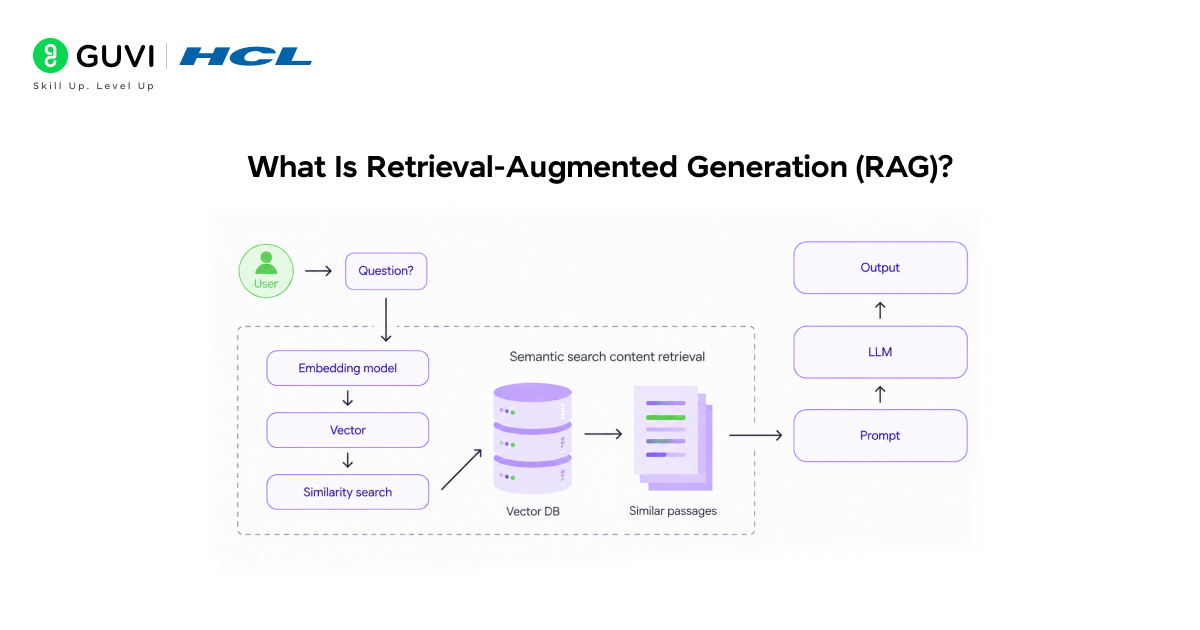
Retrieval-Augmented Generation (RAG) is an AI architecture that enhances language models with external knowledge sources. Instead of relying entirely on pre-trained information, the system retrieves relevant documents and uses them as context before generating responses.
Python is commonly used with LangChain for RAG development because it simplifies document processing, retrieval pipelines, and language model integration. This combination makes it easier to build AI applications that can access up-to-date information and generate more accurate responses.
Want to learn how these components come together in a real-world project? Check out our guide on How to Build a Language Model Application with LangChain to explore LangChain workflows, prompt orchestration, and LLM-powered application development.
Key Components of RAG
- Document Retriever – Finds relevant information based on user queries.
- Vector Database – Stores document embeddings for similarity search.
- Large Language Model (LLM) – Generates responses using retrieved context.
Many enterprise AI assistants use RAG (Retrieval-Augmented Generation) architectures because they can access updated company documents without retraining the underlying language model. This allows organizations to keep responses accurate, context-aware, and continuously up to date while reducing the cost and complexity of model retraining.
Why Learn RAG with Python?

Python and LangChain provide one of the easiest entry points into Generative AI development.
You can build useful AI applications without training your own large language models while still learning industry-relevant skills that are increasingly in demand.
| Benefit | Why It Matters |
| Easy Syntax | Python simplifies AI development |
| LangChain Integration | Accelerates RAG application building |
| Reduced Hallucinations | Improves response accuracy |
| Enterprise Demand | Widely adopted across industries |
Data Point: According to LangChain documentation, retrieval systems help improve response quality by providing external context to language models during generation.
Source
If you’re new to Python, HCL GUVI’s Python eBook can help you strengthen the fundamentals needed to build RAG and Generative AI projects with confidence.
Building a RAG Application in 30 Minutes
Let’s build a simple RAG application.
A basic RAG system loads documents, converts them into vector embeddings, stores them in a vector database, retrieves relevant information, and generates responses using the retrieved context. This workflow demonstrates the core stages of many modern AI assistants and intelligent search systems.
Step 1: Install Required Libraries
pip install langchain

pip install langchain-community

pip install langchain-huggingface

pip install faiss-cpu

pip install sentence-transformers

Verify installation:

import langchain

print("LangChain Installed Successfully")
Step 2: Build the RAG Application
from langchain_community.document_loaders import TextLoader

from langchain_huggingface import HuggingFaceEmbeddings

from langchain_community.vectorstores import FAISS

loader = TextLoader("knowledge_base.txt")

documents = loader.load()

embeddings = HuggingFaceEmbeddings()

vector_store = FAISS.from_documents(

    documents,

    embeddings

)

retriever = vector_store.as_retriever()

query = "What is Retrieval-Augmented Generation?"

results = retriever.get_relevant_documents(query)

for doc in results:

    print(doc.page_content)
⚠️ Warning
Use clean, well-structured documents when learning RAG development. Poor-quality data can reduce retrieval accuracy and affect response quality.

Once you’ve built a basic RAG application, the next step is exploring larger datasets and advanced retrieval strategies. Learning document chunking, hybrid search, and vector databases can help you understand how real-world AI assistants are built and optimized.
How Does RAG Work?
RAG retrieves relevant information before generating responses.
Instead of answering immediately, the system first searches a knowledge base, identifies useful documents, and then provides that information to the language model as context.
Key Stages
- Document Ingestion – Collect and prepare source documents.
- Embedding Generation – Convert text into vector representations.
- Similarity Search – Retrieve relevant content for a query.
- Context Injection – Supply retrieved information to the LLM.
- Response Generation – Generate a grounded and context-aware answer.
Data Point: Meta’s RAG research demonstrated that retrieval-enhanced language models can improve performance on knowledge-intensive natural language processing tasks.
Source
Real-World Applications of RAG
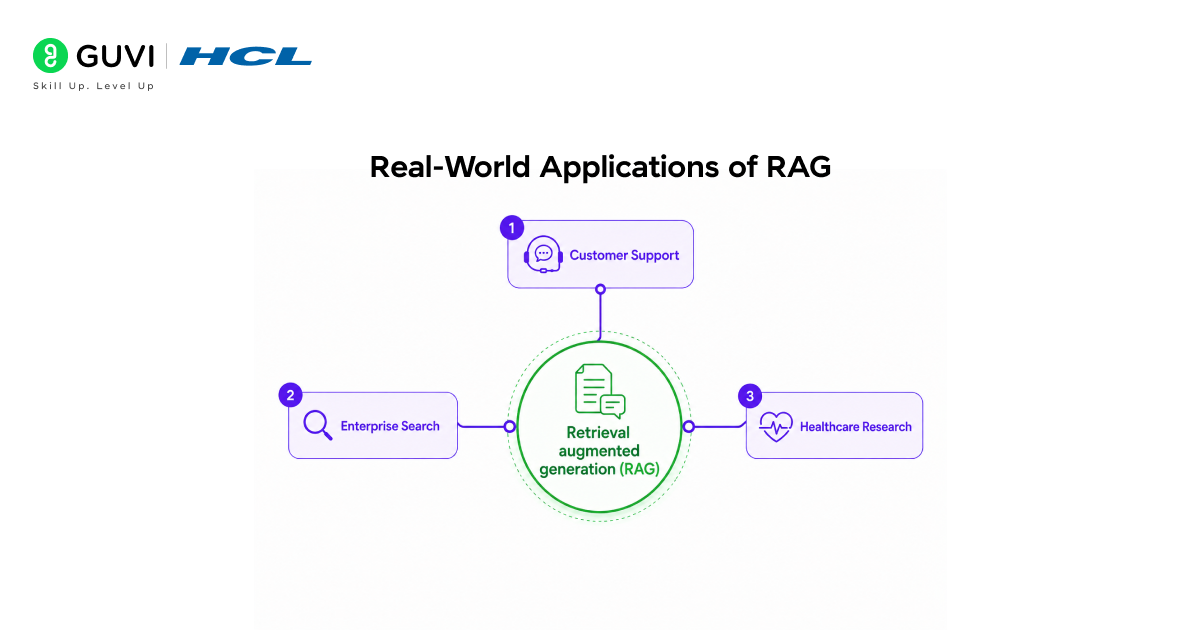
RAG extends far beyond beginner projects.
Customer Support
Organizations use RAG-powered chatbots to answer customer questions using support documentation, FAQs, and knowledge bases.
Enterprise Search
Businesses use RAG systems to help employees quickly locate information from internal documents, policies, and databases.
Healthcare Research
Healthcare professionals and researchers use retrieval-based AI systems to access relevant studies, reports, and medical information more efficiently.
Best Practice
Keep your knowledge base organized from the beginning. Well-structured documents make RAG systems easier to maintain and improve as projects grow.
Mastering RAG is often the first step toward building advanced Generative AI and LLM-powered solutions. If you’d like to progress from beginner projects to industry-level AI applications, HCL GUVI’s AI & Machine Learning Course offers structured learning, practical projects, and real-world use cases designed to help you develop job-ready AI skills.
Key Takeaways
- RAG combines retrieval systems with large language models.
- Python makes RAG development accessible to beginners.
- Vector databases power efficient information retrieval.
- RAG helps improve response accuracy and reliability.
- Retrieval-based AI skills are increasingly valuable across industries.
What To Do Next
After completing this tutorial, explore:
- Conversational RAG chatbots
- Hybrid search systems
- PDF question-answering applications
- Enterprise knowledge assistants
- Multi-document AI search systems
Building practical projects will help strengthen your Generative AI skills and create portfolio-ready work.
Conclusion
This RAG Application Python tutorial demonstrated how to build a simple Retrieval-Augmented Generation application using Python and LangChain. You learned how to load documents, create embeddings, retrieve relevant information, and understand the fundamentals of retrieval-based AI systems.
As Generative AI adoption continues to grow across industries, RAG remains one of the most valuable techniques for building real-world AI applications. Strengthening your RAG skills through hands-on projects can help you explore opportunities in artificial intelligence, enterprise automation, intelligent search, and machine learning while building a strong foundation for advanced AI development.
FAQs
1. What is RAG used for?
RAG is used for AI assistants, enterprise search systems, customer support chatbots, document question answering, and knowledge management applications. It helps language models access external information before generating responses.
2. Is RAG beginner-friendly?
Yes. Python and LangChain provide beginner-friendly tools for building RAG applications. Many developers start learning Generative AI by building simple retrieval-based projects.
3. Do I need machine learning knowledge to build RAG applications?
No. You can build basic RAG applications using Python and LangChain without deep machine learning expertise. However, machine learning knowledge becomes useful when working with advanced retrieval and optimization techniques.
4. Can RAG work with PDF documents?
Yes. RAG systems can process PDFs, Word documents, websites, databases, and other knowledge sources. This flexibility makes them useful across multiple industries.
5. What vector databases are used in RAG?
Popular vector databases include FAISS, Pinecone, Weaviate, Chroma, and Milvus. These databases store embeddings and support similarity-based retrieval.
6. Is LangChain required for RAG development?
No. However, LangChain simplifies many aspects of retrieval pipeline development, making it one of the most popular frameworks for building RAG applications.
7. Is RAG still relevant in 2026?
Yes. RAG remains one of the most widely adopted approaches for enterprise AI because it improves factual accuracy, supports the integration of external knowledge, and reduces the need to retrain large language models.
Success Stories

About the Author
Vishalini Devarajan
An Aerospace Engineer turned content writer, I focus on making complex concepts easy to understand through well-structured, reader-friendly blogs. Whether it’s a technical topic or a non-technical one, I love creating content that is clear, engaging, and impactful.
View all posts by Vishalini Devarajan
Connect with me @










Did you enjoy this article?