


Database Articles
How to Design ER Diagram for a Hospital Management System : Complete Beginner's Guide
Candidate Key in DBMS: A Complete Guide
Databricks for Data Analysis: A Complete Beginner’s Guide
ER Model in DBMS: Simplify Complex Data into a Clear Visual Design


Get In Touch For Details! Request More Information
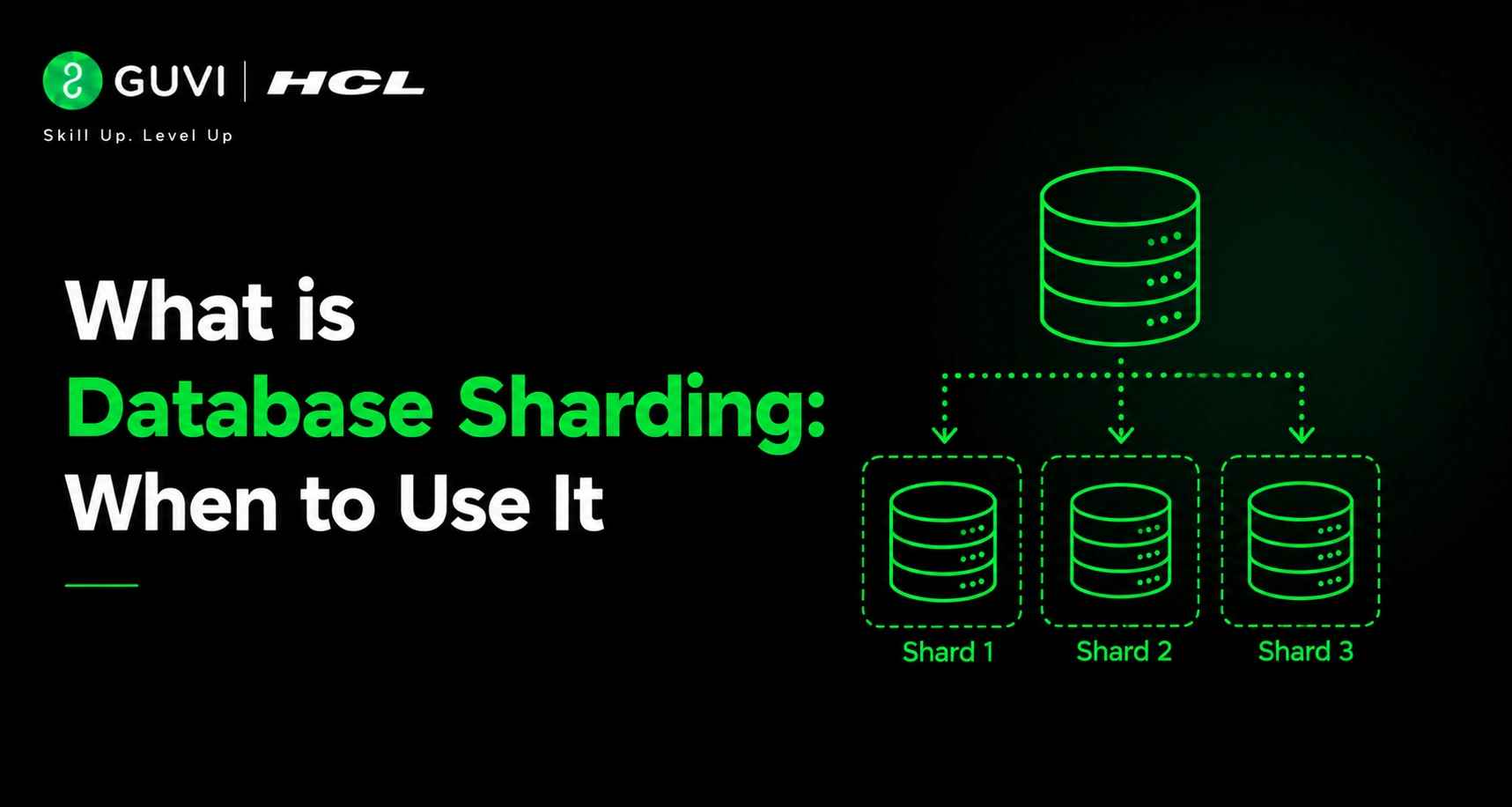
At some point, a single database starts cracking under pressure. Queries slow down, write throughput hits a ceiling, and no amount of indexing moves the needle. That’s usually when sharding enters the conversation. It sounds complex, and it is, but the core idea is surprisingly simple.
Table of contents
- TL;DR Summary
- What Is Database Sharding?
- The Problem Sharding Solves
- How Sharding Actually Works
- The Four Sharding Strategies
- Picking the Right Shard Key
- Sharding vs Partitioning: Not the Same Thing
- When to Shard and When Not To
- The Real Cost of Sharding
- Database-Specific Sharding Support
- Conclusion
- FAQs
- What’s the difference between sharding and partitioning?
- How do I choose a good shard key?
- Which sharding strategy should I pick?
- When should I actually shard?
- What are cross-shard queries, and why avoid them?
- How do I handle schema changes in a sharded system?
- Which databases support sharding best?
TL;DR Summary
- Database Sharding is horizontal scaling: split one large DB into multiple independent shards using a shard key and a routing layer.
- Pick a shard key with high cardinality, even distribution, and presence in most queries to avoid expensive scatter-gather.
- Common strategies: hash-based (even distribution), range-based (efficient ranges), directory-based (lookup table), geographic (latency/residency).
- Try partitioning, vertical scaling, read replicas, and indexing first; shard only when write throughput or storage truly exceeds a single node.
- Real costs: cross-shard queries, rebalancing, distributed schema changes, and multiplied monitoring tooling and ops discipline matter.
Ready to master databases and data engineering at scale? Enroll in HCL GUVI’s Data Science Course and learn SQL, database design, sharding, data pipelines, and real-world analytics projects.
What Is Database Sharding?
Database sharding is a horizontal scaling technique that splits one large database into multiple smaller databases called shards, each living on a separate server. Every shard holds a distinct subset of the data, and a shard key determines where each row lives. Together, the shards behave like one logical database, but no single server holds all the data.
The Problem Sharding Solves
- Imagine one PostgreSQL instance handling 600 million user rows. Every write, read, and index scan hits that one machine. At some threshold determined by CPU, RAM, disk I/O, and connection limits, it can’t keep up, no matter how powerful it is.
- Sharding solves this by spreading the load horizontally. Instead of one server handling 600 million rows, six servers handle 100 million each. Write throughput multiplies. Storage grows linearly. No single server is a bottleneck.
- The tradeoff is complexity, and it’s real.
How Sharding Actually Works
Every sharded database has three core components working together.
- The shard key is a column, often something like user_id or tenant_id, used to decide which shard a given row belongs to. It’s the routing decision that the entire system depends on.
- The routing layer is application code or a proxy that evaluates the shard key and directs each query to the right shard.
- The shards are independent database instances, each with its own CPU, memory, disk, and connection pool.
Writes and reads both go to the same shard as long as the query includes the shard key. When it doesn’t, the routing layer must query every shard and merge results, called a scatter-gather query. These are expensive and slow.
The Four Sharding Strategies
Choosing how to distribute data across shards is one of the most important architectural decisions you’ll make. Each strategy has different tradeoffs.
| Strategy | How It Works | Best For | Watch Out For |
| Hash-Based | Hash the shard key and use modulo to pick the shard | Even distribution, avoiding hotspots | Range queries become scatter-gather |
| Range-Based | Assign contiguous key ranges to each shard | Range queries, time-series data | Hotspots when new data clusters at one end |
| Directory-Based | A lookup table maps each key to a shard | Full control over data placement | A lookup table is a single point of failure |
| Geographic | Route by region (EU users → EU shard) | Latency reduction, data residency rules | Data imbalance across regions |
- Hash-based sharding applies a hash function to the shard key: shard = hash(user_id) % total_shards. This distributes data evenly and prevents hotspots. The downside: range queries hit every shard because adjacent values land on different shards.
- Range-based sharding assigns contiguous key ranges to shards. Range scans are efficient because related data sits together. The risk: if most writes target recent data, the latest-range shard absorbs all write traffic.
- Directory-based sharding uses a lookup table to map keys to shards. Precise control, but if the lookup table goes down, routing breaks entirely.
- Geographic sharding routes users by region EU users to EU servers, US users to US servers. Reduces latency and helps with data residency rules like GDPR.

Picking the Right Shard Key
- The shard key is the most consequential decision in any sharding setup. A bad shard key creates problems you cannot fix without resharding, which means migrating all your data, usually while the system is live.
- A good shard key needs three qualities: high cardinality (enough distinct values to spread data evenly, a boolean is a terrible choice), even value distribution across shards, and presence in most of your queries so routing can target a specific shard rather than fanning out.
- Here’s how shard key choice maps to common use cases:
| Use Case | Recommended Shard Key | Reason |
| Multi-tenant SaaS | tenant_id | All queries scope to one tenant |
| Social platform | user_id | Reads and writes are per-user |
| E-commerce | customer_id or order_id | Depends on query patterns |
| Time-series / IoT | time_bucket + source_id | Prevents write hotspots on latest data |
| Messaging platform | conversation_id | Messages in a thread stay together |
Sharding vs Partitioning: Not the Same Thing
These two terms get used interchangeably, but they’re different at a fundamental level.
- Partitioning splits a table within the same database instance. The engine handles routing transparently; your application doesn’t change. PostgreSQL and MySQL both support it natively.
- Sharding splits data across separate server instances. Your application handles routing, cross-shard queries require coordination, and schema changes must run on every shard.
Try partitioning first. Only move to sharding when a single instance genuinely can’t handle write throughput or storage after thorough tuning.
When to Shard and When Not To
Sharding is a last resort, not a starting architecture. Before you commit to it, exhaust every alternative.
- Try vertical scaling first; a bigger server often solves the problem far cheaper than sharding. Add read replicas if reads are the bottleneck.
- Fix bad indexes, rewrite expensive queries, eliminate N+1 patterns, and use a connection pooler like PgBouncer if you’re hitting connection limits. Table partitioning handles many of the same problems with far less overhead.
- Shard when a single instance cannot absorb write throughput, even after all of the above, when storage requirements genuinely exceed what any single node can hold, or when you have hard data residency requirements that mandate geographic separation of data.
The Real Cost of Sharding
Most explanations of sharding stop at the architecture diagram. The actual cost shows up in day-to-day operations.
- Cross-shard queries are the most painful ongoing cost. Any query without the shard key hits every shard and merges results. Aggregations, joins, and analytics all become scatter-gather operations: slower, more expensive, and harder to debug.
- Rebalancing is painful when you add a shard. Data must migrate to the new set of shards while the system stays live, even though consistent hashing doesn’t eliminate this.
- Schema changes multiply. A 30-second ALTER TABLE becomes 30 seconds × 16 shards, and every one must succeed. Rolling migrations require tooling that doesn’t exist out of the box.
- Monitoring multiplies too. A latency spike on one shard only affects users on that shard, making it easy to miss. You need per-shard tracking of query latency, QPS, connection pool usage, replication lag, and disk growth.
Ready to master databases and data engineering at scale? Enroll in HCL GUVI’s Data Science Course and learn SQL, database design, sharding, data pipelines, and real-world analytics projects.
Database-Specific Sharding Support
Different databases handle sharding differently, and the tooling matters.
- PostgreSQL has no native sharding. Citus, now part of the Azure ecosystem, adds distributed table support. Vitess provides a proxy layer originally built for YouTube’s MySQL but increasingly used for PostgreSQL too.
- MySQL’s standard answer is Vitess. ProxySQL can route queries but doesn’t manage shard placement on its own.
- MongoDB has built-in sharding with automatic chunk balancing. You pick a shard key, and MongoDB handles routing and rebalancing. It’s the simplest path if you’re already in the MongoDB ecosystem.
- CockroachDB, TiDB, and YugabyteDB are distributed SQL databases that handle sharding internally. Your application connects to a single endpoint, and the database manages distribution under the hood. The tradeoff is that you’re now operating a distributed database system, which brings its own complexity.
Conclusion
Sharding is a powerful tool for scaling beyond what a single database instance can handle, but it’s not a starting point, and it’s not free. The architecture is straightforward: split data across servers using a shard key, route queries to the right shard, and scale each shard independently.
The operational reality is more demanding: cross-shard queries, rebalancing, distributed schema changes, and per-shard monitoring all add up. Exhaust vertical scaling, read replicas, indexing, and partitioning first.
When those options are genuinely exhausted and write throughput or data volume is the real constraint, sharding is the right answer; just go in with a clear-eyed view of what you’re taking on.
FAQs
What’s the difference between sharding and partitioning?
Partitioning splits a table within one DB instance (engine routes); sharding splits across multiple server instances (app/proxy routes).
How do I choose a good shard key?
Use a key with high cardinality, even value distribution, and found in most queries (e.g., user_id, tenant_id, conversation_id).
Which sharding strategy should I pick?
Hash-based for even distribution and hotspots avoidance; range-based for efficient range scans; geographic for latency/residency; directory for precise control.
When should I actually shard?
Shard when a single instance can’t handle write throughput or storage after tuning, or when data residency mandates geographic separation.
What are cross-shard queries, and why avoid them?
Queries missing the shard key hit all shards and merge the results (scatter-gather), making joins/aggregations slow and expensive.
How do I handle schema changes in a sharded system?
ALTER TABLE on every shard (operations multiply); use rolling migrations and tooling to coordinate changes safely across shards.
Which databases support sharding best?
MongoDB has built-in sharding; Citus (PostgreSQL) and Vitess (MySQL) add distributed support; CockroachDB/TiDB/YugabyteDB handle sharding internally.
Success Stories

About the Author
Vishalini Devarajan
An Aerospace Engineer turned content writer, I focus on making complex concepts easy to understand through well-structured, reader-friendly blogs. Whether it’s a technical topic or a non-technical one, I love creating content that is clear, engaging, and impactful.
View all posts by Vishalini Devarajan
Connect with me @








Did you enjoy this article?