


Software Development Articles
How to Read and Understand System Design Diagrams?
System Engineer Roles and Responsibilities: 12 Proven Duties for Growth
SAP Consultant Roles and Responsibilities: 12 Proven Duties for Growth and Success
Network Engineer Roles and Responsibilities: 12 Essential Duties for Success


Get In Touch For Details! Request More Information
Passive Income Ideas for Software Engineers in 2026
Jul 21, 2026 5 Min Read 1534 Views
(Last Updated)
Many software engineers earn a strong salary but rely entirely on active income, meaning if they stop working, the income stops too. Passive income for software engineers changes that equation by letting your skills, code, and knowledge work for you even when you are not at your desk. In 2026, with more platforms, tools, and global audiences available than ever before, building passive income streams alongside a full-time engineering role has become a realistic goal for developers at every level.
Table of contents
- Quick TL;DR
- What Is Passive Income for Software Engineers?
- Top Passive Income Ideas for Software Engineers in 2026
- Selling Online Courses
- Building a SaaS Product
- Affiliate Marketing for Tech Products
- Monetising a Technical Blog or YouTube Channel
- Licensing Code, Templates, or Plugins
- Writing Technical eBooks
- Open-Source Sponsorships
- Earning Potential Comparison
- Roadmap to Building Passive Income as a Software Engineer
- Common Mistakes Software Engineers Make with Passive Income
- Conclusion
- FAQ
- What is the best passive income idea for software engineers in 2026?
- How much passive income can a software engineer realistically earn?
- Can a software engineer build passive income without an audience?
- How long does it take to earn passive income as a software engineer?
- Is building a SaaS product a good passive income idea for solo developers?
- Do software engineers need to pay tax on passive income in India?
- What technical skills generate the most passive income opportunities?
- Can a junior software engineer build passive income or is it only for seniors?
Quick TL;DR
- Passive income for software engineers means earning money from work done once that continues to generate revenue over time.
- In 2026, software engineers have more passive income opportunities than ever, including selling online courses, building SaaS products, affiliate marketing, licensing code, and monetising technical content.
- Unlike active income from a salary, passive income streams compound over time and give engineers financial flexibility beyond their primary job.
Want to deepen your technical skills so you have something worth teaching, building, and creating content around? Explore HCL GUVI’s Full Stack Development Course, built for engineers who want to stay ahead and grow their careers in 2026.
What Is Passive Income for Software Engineers?
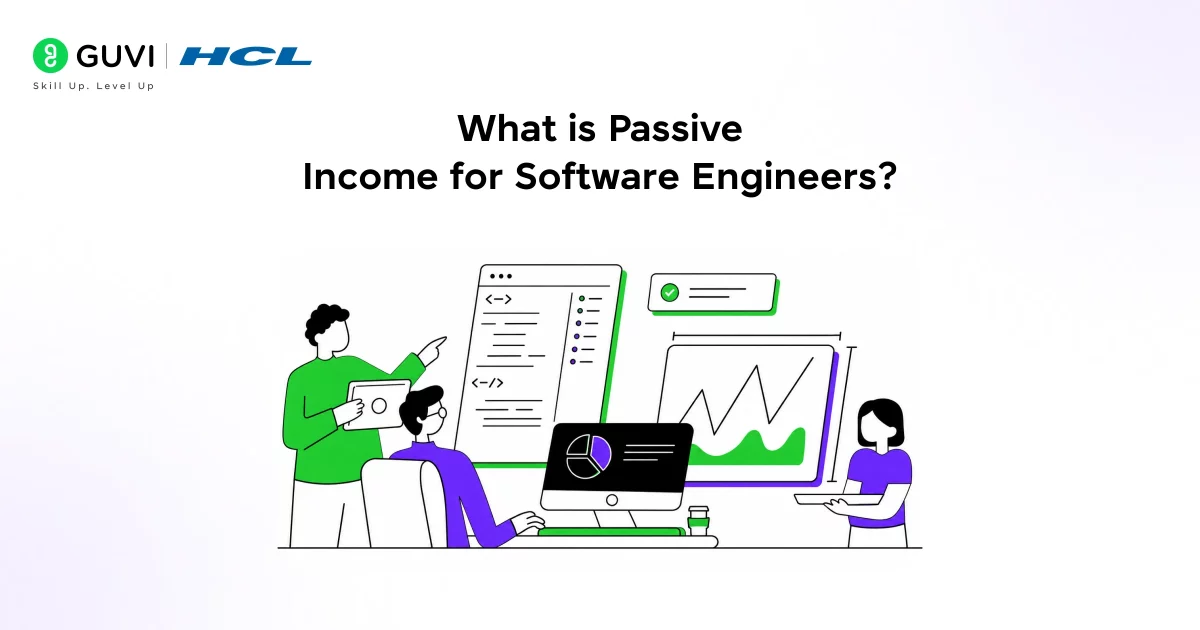
Passive income is money earned from an asset or system you build once that continues to generate revenue with minimal ongoing effort. For software engineers, that asset is usually knowledge, code, or content.
It is different from freelancing, where you trade time for money directly. Passive income scales without requiring proportional time investment.
Read More: Proven 2026 Software Development Roadmap
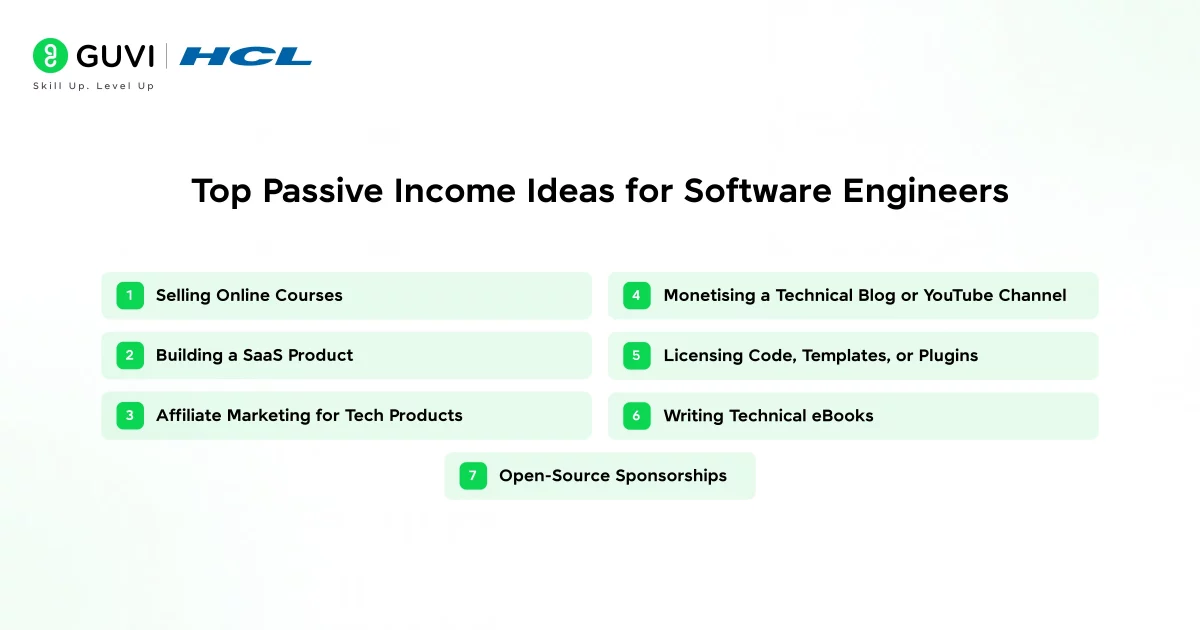
Top Passive Income Ideas for Software Engineers in 2026
1. Selling Online Courses
Creating a course on platforms like Udemy, Gumroad, or your own website is one of the highest-return passive income strategies for engineers. You record the course once and earn from every sale indefinitely.
High-demand course topics in 2026 include Python, system design, AWS, React, data structures and algorithms, and machine learning fundamentals. A well-produced course on Udemy priced between Rs. 500 and Rs. 2,000 can generate thousands of sales over its lifetime.
Udemy serves tens of millions of learners worldwide, making it one of the largest online learning marketplaces in the world. Technology-related subjects—particularly programming, software development, data science, cloud computing, and AI—consistently rank among the platform’s most popular course categories. One of the biggest advantages for instructors is global reach: courses published in English can be accessed by learners across more than 180 countries, allowing educators and developers to build an international audience. This means a single high-quality course can attract students from regions such as North America, Europe, Southeast Asia, and beyond, creating opportunities to share expertise at a truly global scale.
2. Building a SaaS Product
A small SaaS (Software as a Service) product that solves a specific problem and charges a monthly or annual subscription is one of the most scalable passive income models for engineers.
Micro-SaaS products, meaning small single-feature tools built by one or two developers, are particularly attractive because they require low maintenance and can reach profitability quickly. Examples include invoice generators, resume builders, code snippet managers, and API monitoring tools.
3. Affiliate Marketing for Tech Products
Recommending developer tools, hosting platforms, and SaaS products through affiliate links earns a commission on every successful referral. This works especially well if you have a blog, YouTube channel, or newsletter where you review tools you already use.
High-paying affiliate programmes for software engineers include AWS, DigitalOcean, Hostinger, GitHub, Notion, and various SaaS platforms. Commission rates range from 20% to 50% of the referred product’s value in many cases.
4. Monetising a Technical Blog or YouTube Channel
A technical blog optimised for SEO or a YouTube channel focused on programming tutorials can generate consistent ad revenue, sponsorships, and affiliate income over time.
The initial effort is high, but once content ranks on Google or builds a subscriber base, it continues to attract traffic and revenue with minimal updates. Engineers who publish consistently for six to twelve months typically begin seeing meaningful passive income from these channels.
5. Licensing Code, Templates, or Plugins
Selling reusable code templates, UI component libraries, WordPress plugins, Figma templates, or developer tools on marketplaces like CodeCanyon, Gumroad, or GitHub Sponsors is a straightforward passive income stream.
You build the asset once and list it for sale. Every purchase earns you revenue without additional work on your part.
6. Writing Technical eBooks
A focused technical eBook covering a specific topic, such as system design interview preparation, Python for data science, or AWS for beginners, can be sold repeatedly on Gumroad, Amazon Kindle, or your own website.
eBooks require significantly less time to produce than a video course and can be updated quickly when content becomes outdated.
7. Open-Source Sponsorships
If you maintain a useful open-source project, platforms like GitHub Sponsors and Open Collective allow the developer community and companies to financially support your work.
Developers with popular libraries or tools on GitHub have built consistent monthly income through sponsorships from both individuals and organisations that rely on their projects.
Earning Potential Comparison
| Income Stream | Startup Effort | Time to First Income | Monthly Potential (INR) |
| Online course | High | 1 to 3 months | Rs. 10,000 to Rs. 2,00,000 |
| Micro-SaaS product | Very high | 3 to 6 months | Rs. 20,000 to Rs. 5,00,000 |
| Affiliate marketing | Low to medium | 2 to 6 months | Rs. 5,000 to Rs. 1,00,000 |
| Technical blog or YouTube | Medium | 6 to 12 months | Rs. 10,000 to Rs. 3,00,000 |
| Code templates or plugins | Low | 1 to 2 months | Rs. 3,000 to Rs. 50,000 |
| Technical eBook | Low to medium | 1 to 2 months | Rs. 2,000 to Rs. 30,000 |
| Open-source sponsorships | High | 6 to 18 months | Rs. 5,000 to Rs. 80,000 |
Want to deepen your technical skills so you have something worth teaching, building, and creating content around? Explore HCL GUVI’s Full Stack Development Course, built for engineers who want to stay ahead and grow their careers in 2026.
Roadmap to Building Passive Income as a Software Engineer
Step 1: Identify Your Strongest Skill (Week 1–2): List technical topics you can teach. Pick the one with high market demand and low competition.

Step 2: Choose One Income Stream (Week 2–3): Start with online course or technical blog; fastest revenue path for engineers. Pick one, not multiple.
Step 3: Build and Launch (Month 1–3): Ship functional, not perfect. Real user feedback beats solo polish.
Step 4: Monetize (Month 2–3): Set up: affiliate programs, Gumroad/Stripe payments, ads, sponsorships.
Step 5: Promote Free (Month 3+): LinkedIn, Reddit, Twitter, Discord. Consistent promotion in first 3 months drives traction.
Step 6: Diversify (Month 6+): Once one stream generates revenue, reinvest into a second. Example: blog traffic → course upsell; YouTube subscribers → template pack.
According to the 2025 Stack Overflow Developer Survey, over 28% of software developers worldwide reported earning income outside their primary job. These additional income streams often include freelancing, consulting, content creation, open-source contributions, and digital product sales. In India, this trend has been steadily increasing as more developers leverage their technical skills to build side income opportunities alongside full-time roles. This reflects a broader shift in the tech industry, where software engineering skills are increasingly being used not just for employment, but also for independent income generation and entrepreneurial ventures.
Common Mistakes Software Engineers Make with Passive Income
1. Too Many Streams at Once: Pick one, scale to stable income, then add the next. Parallel execution = poor results everywhere.
2. Underpricing: Engineers price courses at Rs. 499 out of fear. Rs. 1,999 needs only 1/4 the sales for the same revenue. Price for value, not just acquisition.
3. Building Without Validation: Don’t spend months building. Validate demand with a landing page or pre-sale first.
4. Expecting Instant Passive Income: Passive income requires heavy upfront active work. The passive part comes only after launch, distribution, and ranking. Quit-too-soon deaths happen here.
5. Ignoring Taxes: Income from products, affiliates, and content is taxable in India. Set aside a portion from day one. Non-compliance now = penalties later.
Conclusion
As the global creator economy and SaaS ecosystem continue to expand, passive income for software engineers has moved from a niche idea to a mainstream career strategy. Your technical skills are the foundation for every income stream covered in this guide, from courses and SaaS tools to affiliate marketing and open-source sponsorships.
Start with one stream, build it consistently for six months, and let the compounding effect do the rest. The engineers who begin today will be the ones with diversified, resilient income by the end of 2026.
FAQ
1. What is the best passive income idea for software engineers in 2026?
Selling online courses is the most accessible high-return passive income stream for most software engineers. It requires no upfront capital, leverages existing technical knowledge, and can generate recurring revenue indefinitely once published on platforms like Udemy or Gumroad.
2. How much passive income can a software engineer realistically earn?
Earnings depend on the income stream and consistency of effort. Engineers who combine two or three streams, such as a course, a blog, and affiliate marketing, commonly reach Rs. 50,000 to Rs. 2,00,000 per month within twelve to eighteen months of starting.
3. Can a software engineer build passive income without an audience?
Yes. Platforms like Udemy, CodeCanyon, and Amazon Kindle have built-in audiences. Affiliate marketing works through SEO-driven blog content. You do not need a large existing following to start earning from digital products or code templates.
4. How long does it take to earn passive income as a software engineer?
The timeline depends on the stream. Code templates and eBooks can generate income within one to two months. Blogs and YouTube channels typically take six to twelve months to build meaningful revenue. SaaS products vary widely based on product complexity and market fit.
5. Is building a SaaS product a good passive income idea for solo developers?
Yes, particularly micro-SaaS products that solve a narrow problem. Solo developers have built profitable SaaS products generating lakhs per month. The key is choosing a problem with a clear audience willing to pay a monthly subscription for a reliable solution.
6. Do software engineers need to pay tax on passive income in India?
Yes. Income from online courses, affiliate marketing, SaaS subscriptions, and content monetisation is taxable in India under the Income Tax Act. It is advisable to consult a chartered accountant once passive income begins to scale.
7. What technical skills generate the most passive income opportunities?
High-demand technical skills for passive income in 2026 include Python, machine learning, AWS, system design, React, data structures and algorithms, and DevOps. These topics have large learner audiences and strong sponsorship demand from companies in those spaces.
8. Can a junior software engineer build passive income or is it only for seniors?
Junior engineers can absolutely build passive income. Beginner-friendly courses and tutorials are among the most in-demand content categories. Teaching concepts you recently learned is often more effective than teaching as a senior, because you remember the exact confusion points your audience faces.
Success Stories

About the Author
Vishalini Devarajan
An Aerospace Engineer turned content writer, I focus on making complex concepts easy to understand through well-structured, reader-friendly blogs. Whether it’s a technical topic or a non-technical one, I love creating content that is clear, engaging, and impactful.
View all posts by Vishalini Devarajan
Connect with me @













Did you enjoy this article?