


Python Articles
Ray Serve Tutorial: How to Deploy Scalable ML Models with RayServe
SQLModel: Combining SQLAlchemy + Pydantic for Cleaner Code


Get In Touch For Details! Request More Information

Topological Sorting: A Complete Beginner’s Guide
Jul 20, 2026 7 Min Read 371 Views
(Last Updated)
Think about any situation where some steps must come before others: you can’t cook without ingredients, register for an advanced class without prerequisites, or compile code before resolving dependencies. Topological sorting answers this scheduling problem by determining a valid order for interdependent tasks so every prerequisite appears before the tasks that rely on it.
Topological sort operates on a directed acyclic graph (DAG), where nodes represent tasks and directed edges represent dependencies. Visiting each node and edge once (via DFS or Kahn’s algorithm), it produces a linear ordering of tasks in linear time, making it a fundamental and widely used tool for dependency resolution in compilers, build systems, and project planning.
In this article, we will walk through everything you need to understand about topological sorting: what a DAG is and why it matters, what topological order means and when it exists, the two main algorithms for computing it, how to detect cycles in the process, Python implementations of both approaches, and where topological sorting is actually used in the software you work with every day.
Table of contents
- TL;DR
- What Topological Order Means
- Algorithm 1: DFS-Based Topological Sort
- Algorithm 2: Kahn's Algorithm (BFS-Based)
- DFS vs. Kahn's: Choosing the Right Approach For Topological Sorting
- Common Mistakes to Avoid
- Wrapping Up
- FAQ
- Q: When should I use Kahn’s algorithm vs DFS-based topological sort?
- Q: How do I detect a cycle while topologically sorting?
- Q: Can topological sort handle disconnected graphs?
- Q: What’s the time and space complexity?
- Q: What practical problems commonly fail because of cycles?
TL;DR
- Topological sorting produces a linear order of tasks in a directed acyclic graph (DAG) so every prerequisite comes before dependent tasks.
- It only works for DAGs; if a cycle exists no valid topological order exists.
- Two standard algorithms: DFS-based (record nodes on finish, reverse order) and Kahn’s algorithm (queue zero in‑degree nodes and remove them). Both run in O(V + E).
- Kahn’s algorithm naturally detects cycles (if processed count < V) and is intuitive for real‑time scheduling; DFS is natural when you already use recursion and can also detect cycles via the recursion stack.
- Common uses include build systems, package managers, job/workflow schedulers (Airflow), spreadsheet recalculation, and dependency resolution in compilers.
What Is Topological Sorting?
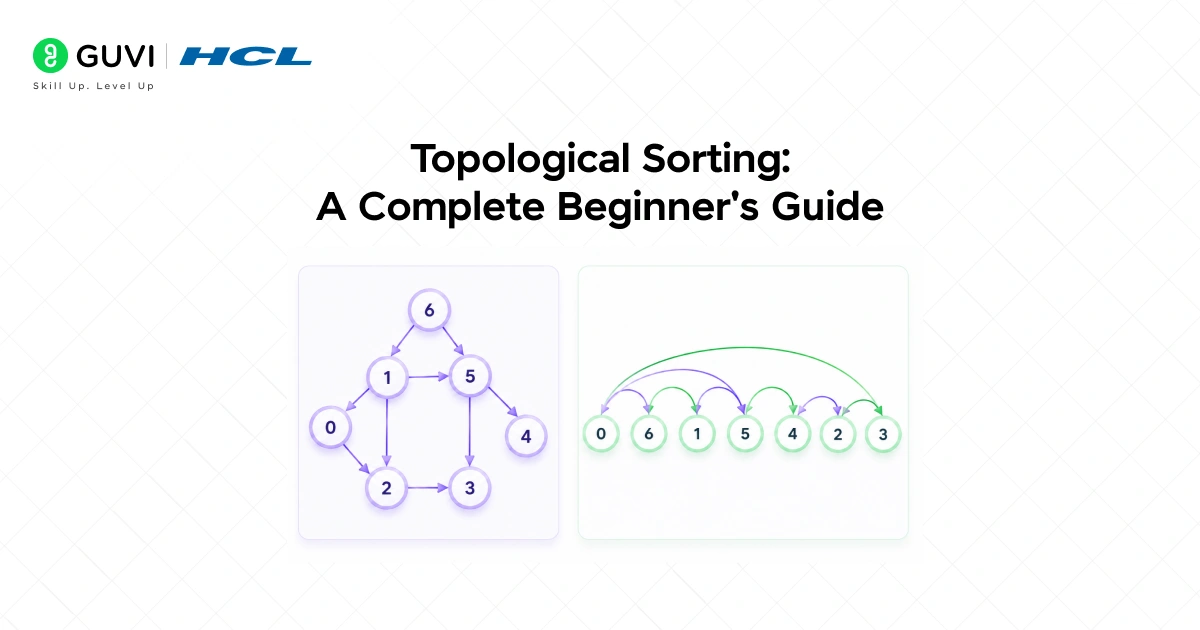
Topological sorting is a linear ordering of vertices in a Directed Acyclic Graph (DAG) such that for every directed edge from vertex U to vertex V, vertex U appears before vertex V in the ordering. It is commonly used to solve dependency-based problems where certain tasks must be completed before others can begin, such as course scheduling, build systems, and task planning. Topological sorting is only possible when the graph contains no cycles, and efficient algorithms such as Kahn’s Algorithm and Depth-First Search (DFS) can compute the ordering in O(V + E) time, where V is the number of vertices and E is the number of edges.
What Topological Order Means
Topological sorting for a directed acyclic graph is a linear ordering of its vertices such that for every directed edge U to V, vertex U comes before V in the ordering. There may be several topological orderings for a graph.
- The existence of multiple valid orderings is an important point that surprises many beginners. If you have four courses where Course A must come before C, and Course B must come before D, but A and B have no relationship to each other, then both A-B-C-D and B-A-C-D are valid topological orderings. The algorithm finds one valid ordering, not the only ordering.
- Topological sorting is only possible in a DAG and is not possible for cyclic or undirected graphs. It represents dependency ordering between vertices, which is different from normal DFS or BFS traversals.
- The key practical insight is this: a topological sort answers the question of in what order tasks should be completed, rather than how to visit all nodes. That purpose-driven distinction is what makes it a separate algorithm from standard graph traversal.

Algorithm 1: DFS-Based Topological Sort
- The first approach uses depth-first search. The core idea is elegant: when DFS finishes exploring all descendants of a node, that node has fulfilled all its obligations to the nodes that depend on it. At that point, it is safe to add it to the result. By collecting nodes in the reverse of their finishing order, we get a valid topological ordering.
- The DFS-based algorithm uses depth-first traversal, adding nodes to a stack during backtracking to generate the topological order. Execute DFS traversal for each unvisited node. Mark nodes as visited and add them to the topological order after all descendants are already visited.
- The use of a stack is critical. As DFS recurses deeper into the graph, nodes are added to the stack only after all their dependents have been fully explored. When the recursion unwinds, the stack naturally holds nodes in reverse topological order. Popping the entire stack gives the correct sequence.
Here is a clean Python implementation of the DFS approach:
from collections import defaultdict
class Graph:
def __init__(self, vertices):
self.V = vertices
self.graph = defaultdict(list)
def add_edge(self, u, v):
self.graph[u].append(v)
def _dfs_helper(self, node, visited, stack):
visited.add(node)
for neighbor in self.graph[node]:
if neighbor not in visited:
self._dfs_helper(neighbor, visited, stack)
# Add to stack AFTER all descendants are processed
stack.append(node)
def topological_sort_dfs(self):
visited = set()
stack = []
for node in range(self.V):
if node not in visited:
self._dfs_helper(node, visited, stack)
# Reverse the stack for correct topological order
return stack[::-1]
# Example: Course prerequisites
# 0 -> 1 means Course 0 must be completed before Course 1
g = Graph(6)
g.add_edge(5, 2)
g.add_edge(5, 0)
g.add_edge(4, 0)
g.add_edge(4, 1)
g.add_edge(2, 3)
g.add_edge(3, 1)
result = g.topological_sort_dfs()
print(“Topological Order (DFS):”, result)
# Output: Topological Order (DFS): [5, 4, 2, 3, 1, 0]
The time complexity of this approach is O(V + E) because every vertex and every edge is visited exactly once. The space complexity is O(V) for the visited set and the recursion stack.
Topological sorting powers many tools developers use every day. Build systems such as Make and Gradle, package managers like pip and npm, and workflow orchestrators such as Apache Airflow all model tasks as a Directed Acyclic Graph (DAG). By performing a topological sort, these systems determine a safe execution order in which every dependency is processed before the tasks that rely on it. An additional benefit of Kahn’s Algorithm is that it can detect cycles: if some nodes never reach an in-degree of zero during execution, the graph contains a circular dependency that must be resolved before processing can continue.
Algorithm 2: Kahn’s Algorithm (BFS-Based)
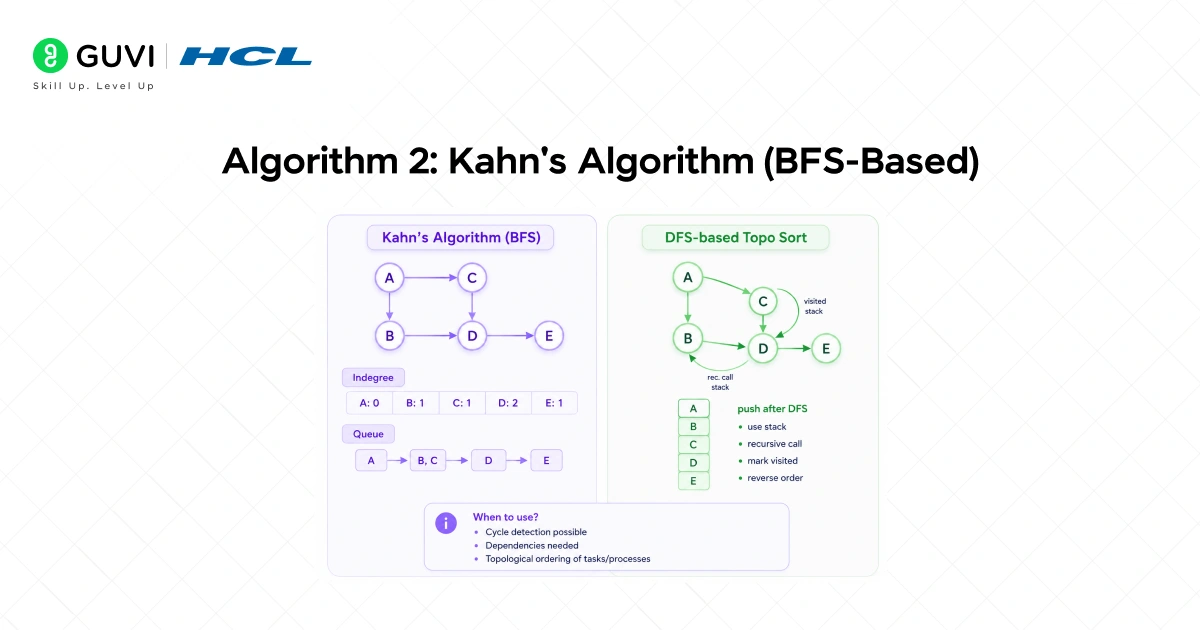
- The second approach, known as Kahn’s algorithm, takes a completely different perspective. Instead of diving deep into the graph and backtracking, it works from the outside in: repeatedly removing nodes that have no remaining dependencies.
- Kahn’s algorithm uses in-degrees and a queue to process nodes. Compute the in-degree of each vertex. Put all the nodes with an in-degree of zero in the queue. Dequeue nodes, add them to the topological order and reduce the in-degree of their neighbours. If a neighbour’s in-degree drops to zero, add it to the queue.
- The intuition is straightforward. A node with an in-degree of zero has no prerequisites. It can safely go first. Once it is placed in the ordering and its outgoing edges are removed, some of its neighbours may now have their in-degrees reduced to zero. Those nodes can go next. The process repeats until every node has been placed in the ordering.
Here is the complete Python implementation:
from collections import defaultdict, deque
def kahns_topological_sort(vertices, edges):
# Build adjacency list and in-degree count
graph = defaultdict(list)
in_degree = {i: 0 for i in range(vertices)}
for u, v in edges:
graph[u].append(v)
in_degree[v] += 1
# Initialize queue with all zero in-degree nodes
queue = deque([node for node in in_degree if in_degree[node] == 0])
topological_order = []
while queue:
node = queue.popleft()
topological_order.append(node)
for neighbor in graph[node]:
in_degree[neighbor] -= 1
if in_degree[neighbor] == 0:
queue.append(neighbor)
# If not all nodes processed, a cycle exists
if len(topological_order) != vertices:
return None # Cycle detected
return topological_order
# Same graph as before
edges = [(5,2), (5,0), (4,0), (4,1), (2,3), (3,1)]
result = kahns_topological_sort(6, edges)
print(“Topological Order (Kahn’s):”, result)
# Output: Topological Order (Kahn’s): [4, 5, 0, 2, 3, 1]
Notice that Kahn’s algorithm naturally produces a different but equally valid topological ordering compared to the DFS approach. Both are correct. The time complexity is O(V + E), identical to the DFS approach.
DFS vs. Kahn’s: Choosing the Right Approach For Topological Sorting
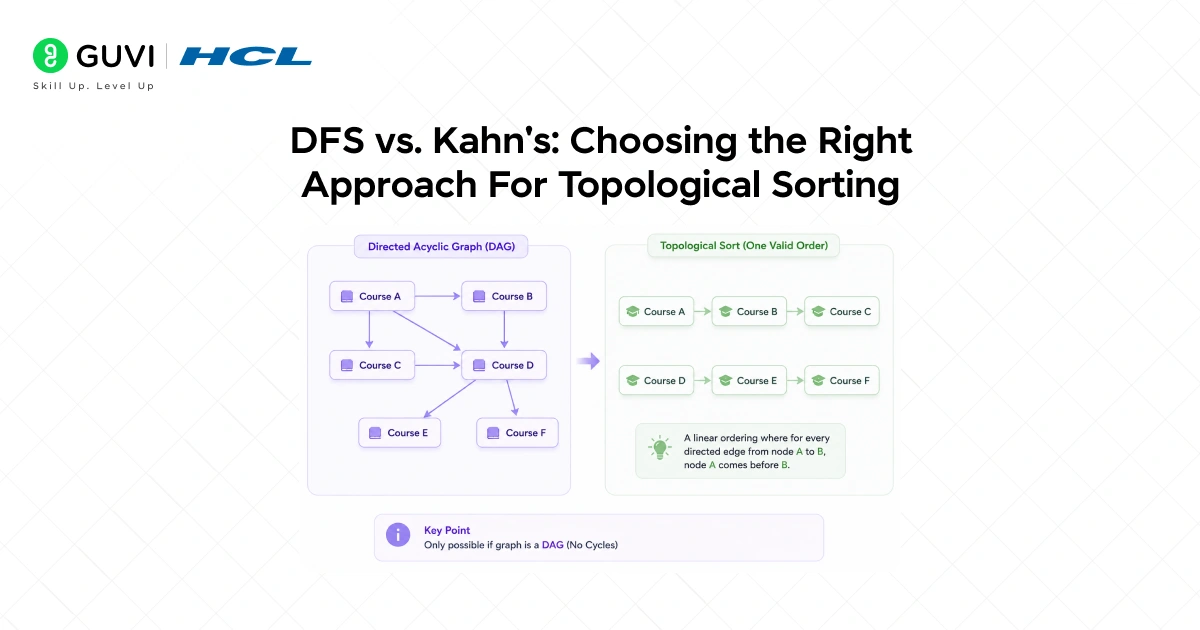
Both algorithms produce valid topological orderings with identical time and space complexity. The choice between them often comes down to the problem’s requirements and which implementation feels more natural for the context.
- Topological sort’s memory needs depend on the implementation. Kahn’s algorithm requires space for in-degree calculations, while the DFS-based approach relies on the recursion stack. DFS generally consumes less memory since it only tracks the current path, while BFS can require significant space to store all nodes at a given level.
- Kahn’s algorithm is generally easier to understand and explain because the logic maps directly to the dependency concept: start with what has no prerequisites, then progressively unlock what becomes available.
- It also handles cycle detection as a natural side effect without any additional code. For iterative implementations and problems where you want to process nodes as they become available in real time, Kahn’s algorithm is often the cleaner choice.
- The DFS approach is more natural when you are already working with DFS traversals elsewhere in your solution, or when you need to identify the specific nodes forming a cycle. In competitive programming, both are used with roughly equal frequency depending on personal style and problem constraints.
Real-World Applications
Topological sort is used in task scheduling and project management, for example, course scheduling in universities, and it detects cycles in a directed graph.
- Build systems are one of the most direct applications. When you run a build tool like Make, Gradle, or Webpack, the tool constructs a dependency graph of all source files, libraries, and build targets. Topological sorting determines the order in which each component must be compiled or built so that no component is built before its dependencies are ready. If you introduce a circular dependency between two modules, the build tool detects the cycle using exactly the mechanism described above and reports an error.
- Package managers like npm, pip, and apt use topological sorting to determine the order in which dependencies should be installed. When you install a library, the package manager resolves its dependency tree, performs topological sorting on that tree, and installs packages in an order that guarantees every dependency is available before the package that needs it.
- Optimization problems involve solving optimization problems that require ordering or sequencing constraints. Resource allocation involves managing resources in scenarios with interdependent tasks or processes.
- Spreadsheet applications use topological sorting to determine the order in which cells should be recalculated when values change. If cell C3 contains a formula that depends on B2, and B2 depends on A1, the spreadsheet must recalculate A1 first, then B2, then C3. This is a topological sort of the dependency graph formed by cell references.
- Data pipeline orchestration tools like Apache Airflow define workflows as DAGs and use topological sorting to schedule tasks. Tasks with no dependencies run first. As each task completes, the tasks that depended on it become eligible to run. The entire workflow progresses in a dependency-respecting order that ensures correctness.
Common Mistakes to Avoid
- The most common mistake is attempting to apply topological sorting to a graph that contains a cycle. Always verify that the input graph is a DAG before running a topological sort.
- Using Kahn’s algorithm with the cycle check built in is the cleanest way to handle this: if the returned ordering does not contain all vertices, you know a cycle exists and can handle it appropriately.
- Another frequent mistake is not handling disconnected graphs. A graph may have multiple connected components, some of which have no relationship to each other.
- Both algorithms handle this correctly as written: the DFS approach iterates over all nodes to ensure unvisited ones are reached, and Kahn’s algorithm initializes the queue with all nodes with a zero in-degree regardless of connectivity.
- Confusing directed and undirected graphs also causes problems. Topological sorting is only defined for directed graphs. If you apply it to an undirected graph, every edge creates a two-way connection that makes the concept of ordering undefined.
If you’re serious about mastering topological sorting, understanding dependency ordering in directed acyclic graphs (DAGs), Kahn’s algorithm, DFS‑based topological sort, and how to use it in task scheduling and build systems, don’t miss the chance to enroll in HCL GUVI’s programming courses co‑designed by Intel.
Wrapping Up
Topological sorting is one of those algorithms that appears deceptively academic until you realize how many tools you use every day depend on it. Build systems, package managers, spreadsheets, data pipelines, and task schedulers all rely on the same fundamental insight: given a set of tasks with dependencies, find a valid ordering that respects all of them.
Both the DFS approach and Kahn’s algorithm achieve this in O(V + E) time, making topological sorting efficient even for large dependency graphs. Understanding both approaches gives you flexibility: Kahn’s algorithm is intuitive and comes with built-in cycle detection, while the DFS approach integrates naturally into recursive graph solutions and can pinpoint exactly which nodes form a cycle.
For any developer working with dependency graphs, task scheduling, or ordering constraints, topological sorting is an essential tool that belongs in every toolkit.
FAQ
Q: When should I use Kahn’s algorithm vs DFS-based topological sort?
A: Use Kahn’s for clarity, iterative implementations, or when you want built‑in cycle detection and to process nodes as they become available. Use DFS when a recursive solution fits your codebase or when you need to identify the specific cycle nodes via the recursion stack.
Q: How do I detect a cycle while topologically sorting?
A: With Kahn’s algorithm, check if the number of processed nodes is less than V—then a cycle exists. With DFS, detect a back edge by tracking nodes currently in the recursion stack; encountering one signals a cycle.
Q: Can topological sort handle disconnected graphs?
A: Yes. Both algorithms handle disconnected components: DFS iterates over all nodes and Kahn’s initializes the queue with every zero in‑degree node across components.
Q: What’s the time and space complexity?
A: Both algorithms run in O(V + E) time. Space is O(V + E) for adjacency structures; DFS also uses recursion stack (O(V) worst case), while Kahn’s uses an explicit queue and in‑degree array (O(V)).
Q: What practical problems commonly fail because of cycles?
A: Circular module imports in codebases, mutual package dependencies, circular task dependencies in CI/CD or workflow definitions, and circular references in spreadsheets — all of these prevent a topological order and must be refactored or broken with manual intervention.
Success Stories

About the Author
Vishalini Devarajan
An Aerospace Engineer turned content writer, I focus on making complex concepts easy to understand through well-structured, reader-friendly blogs. Whether it’s a technical topic or a non-technical one, I love creating content that is clear, engaging, and impactful.
View all posts by Vishalini Devarajan
Connect with me @














Did you enjoy this article?