


Artificial Intelligence and Machine Learning Articles
Finance Manager to Data Analytics: Career Growth, Salary and Seniority
How to Evaluate LLM Outputs in Production Deployments
AI/ML Skills Gap 2026: Why Companies Can't Find Job-Ready Talent
20 AI/ML Interview Questions Recruiters Can Use Without a Tech Background - Best Guide


Get In Touch For Details! Request More Information
T5: The Text-to-Text Transfer Transformer Explained
Jul 18, 2026 7 Min Read 968 Views
(Last Updated)
The text-to-text framing lets researchers reuse the same model, loss, and hyperparameters across dozens of tasks, so improvements became comparable and transferable instead of isolated. It also simplified pipelines: instead of designing task-specific heads and bespoke data formats, practitioners only needed to craft the right input prefix and target text.
That uniformity accelerated experimentation, made large-scale multitasking and instruction tuning practical (as in Flan-T5), and helped the community move from bespoke solutions toward more general-purpose language models.
In this article, we will walk through everything you need to understand about T5: what problem it was built to solve, how its text-to-text framework works, the architecture and training details behind it, the different model sizes it comes in, how it compares to BERT and GPT-style models, and where it is applied in the real world.
Table of contents
- TL;DR
- The Problem T5 Was Built to Solve
- The Text-to-Text Framework: The Core Idea of T5
- The Architecture: Encoder-Decoder Transformer
- The Span Corruption Pre-Training Objective of T5
- Did you know?
- T5 Model Sizes and Variants
- T5 vs. BERT vs. GPT: Key Differences
- Real-World Applications of T5
- Wrapping Up
- FAQs
- What makes T5 different from BERT and GPT?
- Why use task prefixes?
- How does span corruption work?
- Which T5 size should I choose?
- Is T5 suitable for multilingual applications?
TL;DR
- T5 reframes every NLP problem as a text-to-text task: the model always takes text in and produces text out, using task prefixes to specify behavior.
- It uses a standard encoder–decoder transformer so it can both deeply understand inputs (encoder) and autoregressively generate outputs (decoder).
- Pretraining used the large, cleaned C4 corpus and a span-corruption objective that masks contiguous spans and trains the model to reconstruct them.
- T5 is a family of models (Small, Base, Large, 3B, 11B) that trade compute and memory for performance; Base/Large are best for most projects.
- The text-to-text unification simplified fine-tuning, made cross-task comparisons fairer, and enabled large-scale multitask and instruction tuning (e.g., Flan-T5).
- Limits include high computational cost for large variants, English-centric pretraining (addressed by mT5), and reliance on careful prompt/format engineering for structured outputs.
| What Is the T5 Model?T5, which stands for Text-to-Text Transfer Transformer, is a large language model developed by Google Research and introduced in 2019. It converts every NLP task into a text-to-text format, where the model takes a text string as input and produces a text string as output, regardless of the task. This unified approach allows a single model architecture to handle translation, summarization, classification, question answering, and more. |
The Problem T5 Was Built to Solve
- Before T5, the NLP landscape was in a productive but chaotic state. BERT had shown the world the power of pre-training on large amounts of unlabeled text and then fine-tuning on specific tasks. This two-stage approach, called transfer learning, became the standard template for NLP.
- Due to the rapid development in this field, comparison between alternatives was difficult. The Text-to-Text Transformer T5 proposed a unified framework for studying transfer learning approaches in NLP, allowing analysis of different settings and deriving a set of best practices.
- Before T5, many NLP models were built for specific tasks. Earlier approaches often required separate model heads or distinct training pipelines for classification, translation, summarization, and question answering. T5 reframes all of these as a single transformation: input text sequence to output text sequence.
- This unification was not just an engineering convenience. It was a research tool. By expressing every task in the same format and using the same training objective, Google’s team could systematically compare pre-training strategies, architectures, and datasets in a way that had never been done before.
- With the T5 text-to-text framework and the new pre-training dataset C4, the researchers surveyed the vast landscape of ideas and methods introduced for NLP transfer learning over the previous few years.
The Text-to-Text Framework: The Core Idea of T5
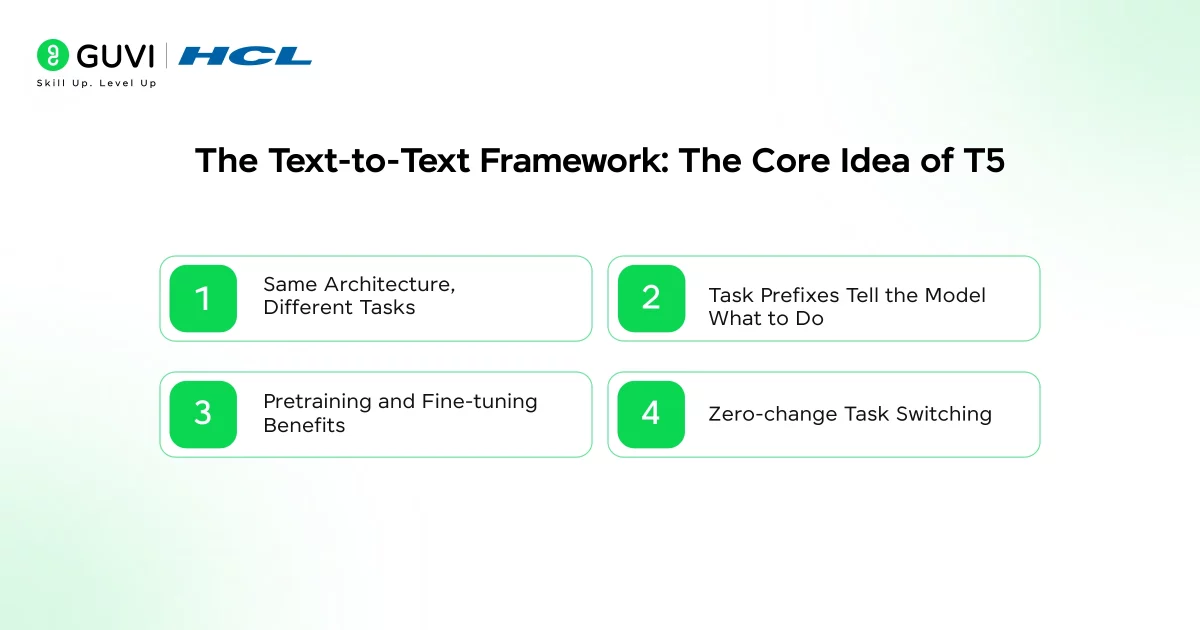
In-article image 1: The infographic should depict the above title and below 4 points.
Text-to-Text as the Core Idea
T5’s defining innovation is treating every NLP problem as a text-to-text task: the model always takes a text string as input and produces a text string as output, unifying diverse tasks under a single interface.
- Same Architecture, Different Tasks
Architecturally T5 is a standard encoder–decoder transformer; its power comes from framing, not a new network. The same weights and structure handle translation, summarization, classification, and more. - Task Prefixes Tell the Model What to Do
T5 uses simple, human-readable prefixes to specify tasks, e.g., “translate English to German,” “summarize,” or “sentiment,” letting the model switch behaviors by changing the input string alone. - Pretraining and Fine-tuning Benefits
By phrasing pretraining as general text-to-text mapping, T5 can reuse datasets across stages, apply uniform hyperparameters and losses, and improve transferability between tasks. - Zero-change Task Switching
Because the model’s parameters and architecture remain fixed, you train once and then perform new tasks by only altering the prefix and fine-tuning data. The same model weights serve many applications.
The Architecture: Encoder-Decoder Transformer
1. Why encoder–decoder suits text-to-text tasks
- Processes variable-length inputs and outputs, so the same model handles short prompts and long documents.
- Encoder builds bidirectional contextual representations (reads the whole input), giving a deep understanding of meaning and dependencies.
- Decoder performs autoregressive generation (produces output one token at a time), enabling fluent, coherent text production conditioned on encoder signals.
2. How T5’s encoder and decoder interact
- Encoder encodes the entire input into a sequence of hidden representations that summarize meaning at each position.
- Decoder attends to those encoder representations plus previously generated tokens at every step, combining input understanding with generation context.
- This attention-based communication lets the model produce outputs that are tightly grounded in the input (useful for translation, summarization, and guided generation).
3. Why does this architecture outperform decoder-only models for many tasks
- Bidirectional encoding gives richer input understanding than decoder-only models that rely on left-to-right context during conditioning.
- Clear separation of understanding (encoder) and generation (decoder) improves performance on tasks that require complex conditioning, such as question answering and structured summarization.
- Training with teacher forcing (providing target sequences during training) stabilizes learning of conditional generation, helping the model map diverse input prefixes to appropriate textual outputs.
The Span Corruption Pre-Training Objective of T5
With the architecture and dataset in place, the next design decision was the pre-training objective: what task does the model learn to perform on the unlabeled C4 data before being fine-tuned on specific tasks?
- T5 uses a technique called span corruption, which is a variation of the masked language modeling approach used by BERT but adapted for an encoder-decoder architecture.
- The words marked for corruption are randomly chosen. Each consecutive span of corrupted tokens is replaced by a sentinel token, shown as unique placeholder markers, that is unique over the example. The aim is to mask consecutive spans of tokens and only predict the dropped-out tokens during pre-training.
- The researchers developed a new pre-training objective called span corruption, where contiguous spans of text were masked, and the model learned to reconstruct them, providing a more flexible alternative to BERT’s masked language modeling that worked better for generation tasks.
- The key difference from BERT’s approach is what the model outputs. BERT fills in masked tokens in place. T5 outputs only the masked spans, labeled with sentinel tokens, which is more efficient and naturally aligns with the text-to-text framework, where inputs and outputs are always text strings.
- The researchers confirmed that fill-in-the-blank-style denoising objectives, where the model is trained to recover missing words in the input, worked best, and that the most important factor was the computational cost of the objective.
Did you know?
T5’s simple idea makes every task look the same to the model. Did more than simplify engineering: it turned an experimental mess of bespoke heads and formats into a consistent research platform. That uniformity let researchers reuse datasets, hyperparameters, and losses across tasks, accelerating innovation (and enabling instruction-tuned variants like Flan-T5 that boost zero- and few-shot performance).
T5 Model Sizes and Variants
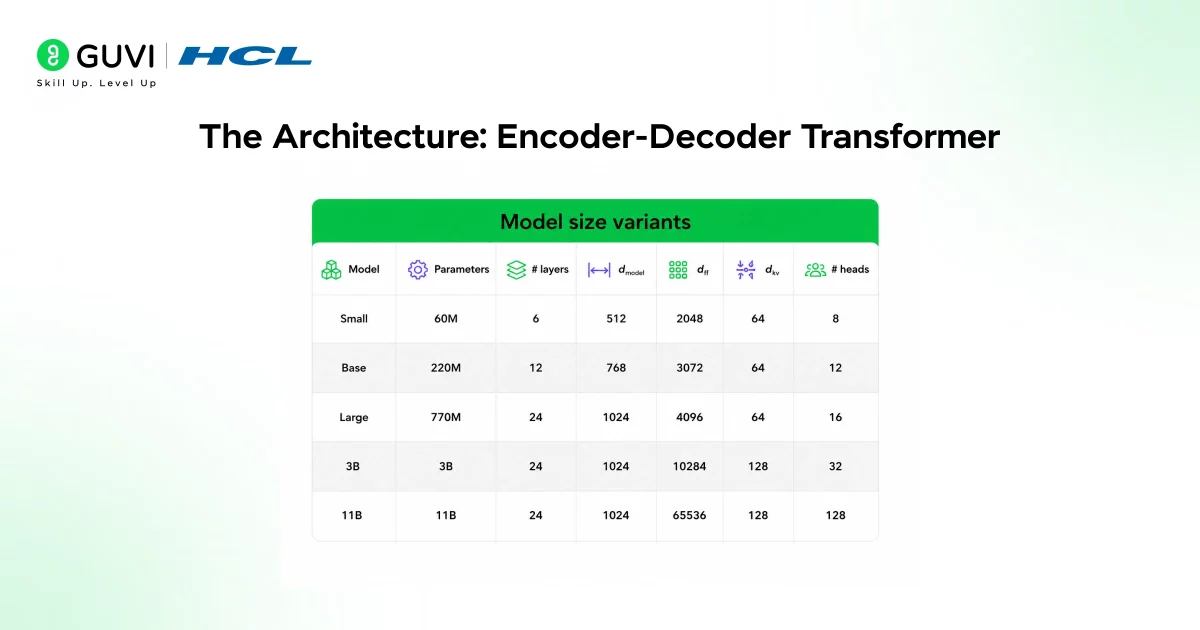
- T5 Is a Model Family—T5 isn’t a single network but a family of encoder-decoder models designed at multiple scales to match different compute and performance needs, from lightweight prototypes to research-grade giants.
- Five Core Sizes (Original Paper) – The original T5 paper reported five sizes: T5-Small (~77M parameters, 6 encoder + 6 decoder layers), T5-Base (~248M, 12+12), T5-Large (~771M, 24+24), T5-3B (~2.88B), and T5-11B (~11.3B).
- Trade-offs by Size—Each size reflects a trade-off between latency, memory footprint, and accuracy: smaller models run faster and fit constrained hardware, while larger models typically yield better performance but demand more resources.
- Practical Recommendations—For most projects, T5-Base or T5-Large strikes the best balance between effectiveness and cost; T5-Small is useful for limited-memory environments or fast iteration.
- When to Use the Biggest Models—T5-3B and T5-11B are appropriate when maximum performance matters and you have ample compute and memory (research labs, large-scale production systems, or benchmark-driven work).
How to Use T5 in Python
Getting started with T5 using the Hugging Face Transformers library is straightforward. Here is a practical example showing how to use T5 for summarization and translation:

from transformers import T5ForConditionalGeneration, T5Tokenizer
# Load model and tokenizer
model = T5ForConditionalGeneration.from_pretrained(“t5-base”)
tokenizer = T5Tokenizer.from_pretrained(“t5-base”)
# Summarization
text = “””summarize: The Amazon rainforest, often referred to as the lungs
of the Earth, produces about 20% of the world’s oxygen and is home to
millions of species of plants, animals, and insects. Deforestation is
threatening this vital ecosystem at an alarming rate.”””
inputs = tokenizer(text, return_tensors=”pt”,
max_length=512, truncation=True)
outputs = model.generate(inputs.input_ids,
max_length=60, min_length=20,
length_penalty=2.0, num_beams=4)
print(“Summary:”, tokenizer.decode(outputs[0],
skip_special_tokens=True))
# Translation
text = “translate English to German: The weather is beautiful today.”
inputs = tokenizer(text, return_tensors=”pt”)
outputs = model.generate(inputs.input_ids)
print(“Translation:”, tokenizer.decode(outputs[0],
skip_special_tokens=True))
The prefix before the colon in each input string is what tells the model which task to perform. Change the prefix and you change the task, without changing any model weights. This is the text-to-text framework in practice.
T5 vs. BERT vs. GPT: Key Differences
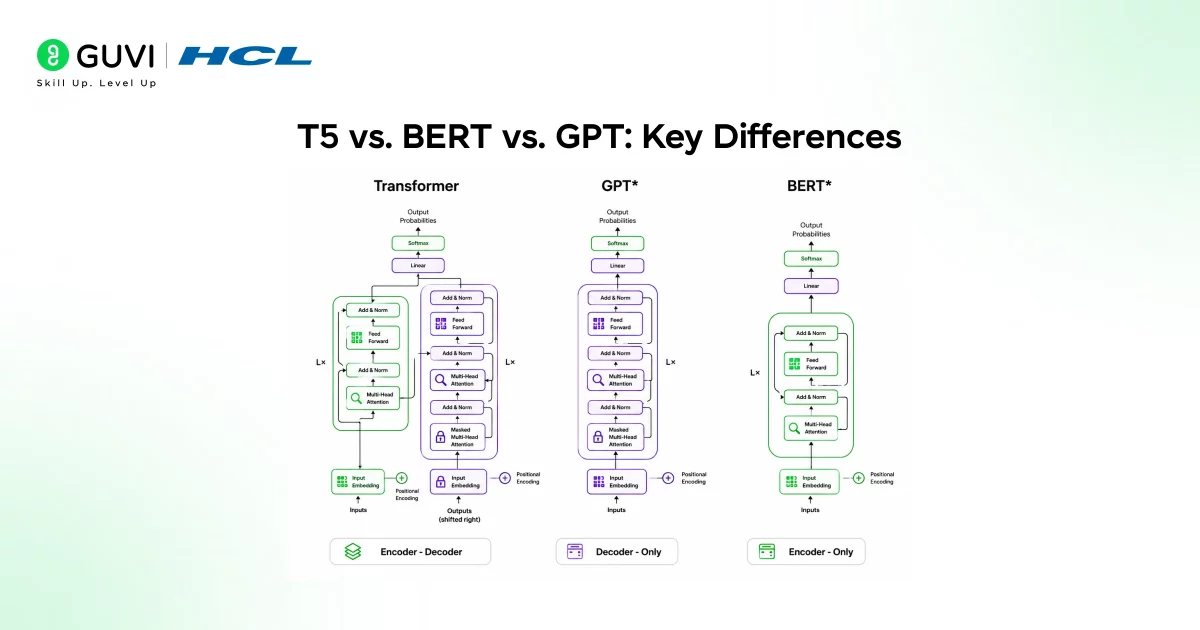
Understanding where T5 fits relative to BERT and GPT-style models helps clarify when to use each one.
- BERT, developed by Google, uses a bidirectional approach to understand context by analyzing text from both left-to-right and right-to-left directions. This makes it strong for tasks like sentiment analysis or named entity recognition. T5, also from Google, treats every task as a text-to-text problem, offering flexibility across tasks like translation or question answering.
- BERT is an encoder-only model, which makes it excellent for understanding tasks but not naturally suited for generation.
- GPT-style models are decoder-only, making them excellent at generating text but originally less suited for understanding tasks that require looking at the full input context. T5’s encoder-decoder design gives it the strengths of both: it understands the full input through the encoder and generates output through the decoder.
- The transfer learning paradigm is comprised of two main stages: pre-training a deep neural network over large data, then fine-tuning the model over a more specific downstream dataset. T5’s unified framework made this two-stage process systematic and comparable across tasks for the first time.
Real-World Applications of T5
T5 and its derivatives are used in a wide range of production NLP systems today.
- Automatic Summarization
T5-based models convert long articles into coherent, concise summaries quickly and reliably, helping newsrooms and content platforms scale editorial workflows and give readers fast overviews without losing key points. - Machine Translation
T5’s text-to-text design lets it handle translation tasks effectively when given the right prompts and fine-tuning data, enabling multilingual applications even though translation was not its exclusive pretraining objective. - Question Answering
T5 excels at producing direct textual answers from a provided passage, making it useful for customer support, search systems, and educational tools that require precise, context-aware responses. - Unified Text-to-Text Fine-tuning
By reformulating diverse NLP tasks into a single text-in/text-out format, T5 simplifies fine-tuning across benchmarks (GLUE, CNN/Daily Mail, SQuAD, etc.), allowing one architecture to be applied broadly with task-specific datasets. - Product Integration and Instruction Tuning (Flan-T5)
Variants like Flan-T5 fine-tuned on thousands of instruction-style tasks boost zero- and few-shot capabilities, which have led to T5-derived models being integrated into Google products (Search, Assistant) and widely used in applied NLP.
Limitations of T5
Despite its power, T5 has practical limitations worth understanding before choosing it for a project.
- Computational cost is the most immediate constraint. The larger T5 variants require significant GPU memory to run and fine-tune.
- Large models are difficult to handle. It is impossible to fine-tune large pretrained models on a GPU with 12 to 16 GB of RAM. This poses a large barrier of entry for communities without the resources to purchase several large graphics processing units. Smaller models lead to improved speed of learning.
- T5 was primarily designed and trained on English text, which limits its effectiveness for multilingual applications. Google subsequently released mT5, a multilingual version trained on 101 languages, to address this gap.
- The text-to-text format, while elegant and flexible, also means that some tasks requiring structured output, like generating properly formatted JSON or performing complex multi-step reasoning, require careful prompt engineering to work reliably.
If you’re serious about mastering T5: The Text-to-Text Transfer Transformer, understanding its encoder-decoder architecture, span-corruption pretraining, and unified text-to-text framework for tasks like translation and summarization, don’t miss the chance to enroll in HCL GUVI’s Artificial Intelligence & Machine Learning Course, co-designed by Intel.
Wrapping Up
T5 represents one of the most important architectural ideas in modern NLP: that a single unified framework, where every task looks like a text-to-text transformation, is more powerful and more flexible than a collection of task-specific models.
By combining a well-understood encoder-decoder architecture with a massive clean pre-training dataset, span corruption as the learning objective, and task prefixes for multi-task fine-tuning, Google Research created a model that established new state-of-the-art performance across nearly every NLP benchmark of its time.
The influence of T5 extends well beyond its original results. The text-to-text paradigm it introduced has shaped the design of instruction-tuned models, multi-task learning systems, and the general shift toward treating language understanding and generation as two sides of the same coin.
For anyone learning deep learning and NLP, understanding T5 is not just useful for working with the model directly. It is essential for understanding how modern language models think about the relationship between tasks, data, and transfer learning.
FAQs
What makes T5 different from BERT and GPT?
T5 is encoder–decoder and text-to-text: it combines bidirectional input understanding (like BERT) with autoregressive generation (like GPT), whereas BERT is encoder-only (understanding) and GPT is decoder-only (generation).
Why use task prefixes?
Prefixes (e.g., “summarize:”, “translate English to German:”) tell a single model which transformation to perform, removing the need for task-specific heads and letting one architecture handle many tasks.
How does span corruption work?
Contiguous spans of tokens are replaced with sentinel tokens; the model is trained to output the missing spans. This denoising objective aligns naturally with text-to-text generation and aids conditional generation tasks.
Which T5 size should I choose?
T5-Base or T5-Large are good default choices balancing performance and resource needs. Use T5-Small for prototyping or tight memory limits; pick 3B or 11B only if you have substantial compute and strong performance needs.
Is T5 suitable for multilingual applications?
Original T5 was English-focused; for multilingual work use mT5 (a multilingual variant) or fine-tune T5 on multilingual corpora. Also consider instruction-tuned variants (Flan-T5) for better zero/few-shot generalization.
Success Stories

About the Author
Vishalini Devarajan
An Aerospace Engineer turned content writer, I focus on making complex concepts easy to understand through well-structured, reader-friendly blogs. Whether it’s a technical topic or a non-technical one, I love creating content that is clear, engaging, and impactful.
View all posts by Vishalini Devarajan
Connect with me @














Did you enjoy this article?