


Artificial Intelligence and Machine Learning Articles
AI/ML Skills Gap 2026: Why Companies Can't Find Job-Ready Talent
20 AI/ML Interview Questions Recruiters Can Use Without a Tech Background - Best Guide
How Industry-Backed AI/ML Bootcamps Are Changing the AI/ML Hiring Pipeline - Best Guide 2026
From IT Support to AI Engineer: A Realistic Career Switch Guide 2026


Get In Touch For Details! Request More Information
Rational Agent in AI: Concepts, Design & Examples
Aug 19, 2026 6 Min Read 909 Views
(Last Updated)
Every intelligent system, whether a chess engine, a self-driving car, or a customer service chatbot, shares one fundamental objective: to act in a way that produces the best possible outcome given its situation.
This idea is captured precisely by the concept of a rational agent in AI.
A rational agent is not simply an agent that “thinks.” It is an agent that acts correctly, selecting actions that maximise its expected performance based on its perceptions and built-in knowledge. Rationality provides the theoretical standard against which every AI system is designed and evaluated.
This guide explains what rational agents are, how they are structured using the PEAS framework, what types of environments they operate in, and why rationality, not omniscience, is the right standard for intelligent behaviour.
Table of contents
- TL;DR
- What Is a Rational Agent in AI?
- The PEAS Framework for Agent Design
- P — Performance Measure
- E — Environment
- A — Actuators
- S — Sensors
- Types of AI Agents
- Simple Reflex Agents
- Model-Based Reflex Agents
- Goal-Based Agents
- Utility-Based Agents
- Learning Agents
- Performance Measure and Optimal Behaviour
- Real-World Examples of Rational AI Agents
- Designing a Rational Agent: Key Principles
- Conclusion
- FAQs
- What is a rational agent in AI?
- What does the PEAS framework stand for?
- What is the difference between a rational and omniscient agent?
- What are the five types of AI agents?
- Why is the performance measure important in agent design?
TL;DR
- A rational agent perceives its environment and acts to maximise a defined performance measure.
- Rationality is about making the best decision given available information — not omniscience.
- The PEAS framework defines every agent in terms of Performance measure, Environment, Actuators, and Sensors.
- Agents range from simple reflex agents to fully autonomous learning agents.
- Understanding agent types and environment properties is essential for effective AI agent design.
What Is a Rational Agent in AI?
A rational agent in artificial intelligence is an entity that perceives its environment through sensors, processes that information, and takes actions through actuators to achieve the best possible outcome based on a defined performance measure. Rationality does not require perfect knowledge or guaranteed success; instead, it means selecting the action that is expected to maximize performance given the available information and prior knowledge. This concept is a foundational idea in AI, especially in intelligent agent design.
What Is a Rational Agent in AI?
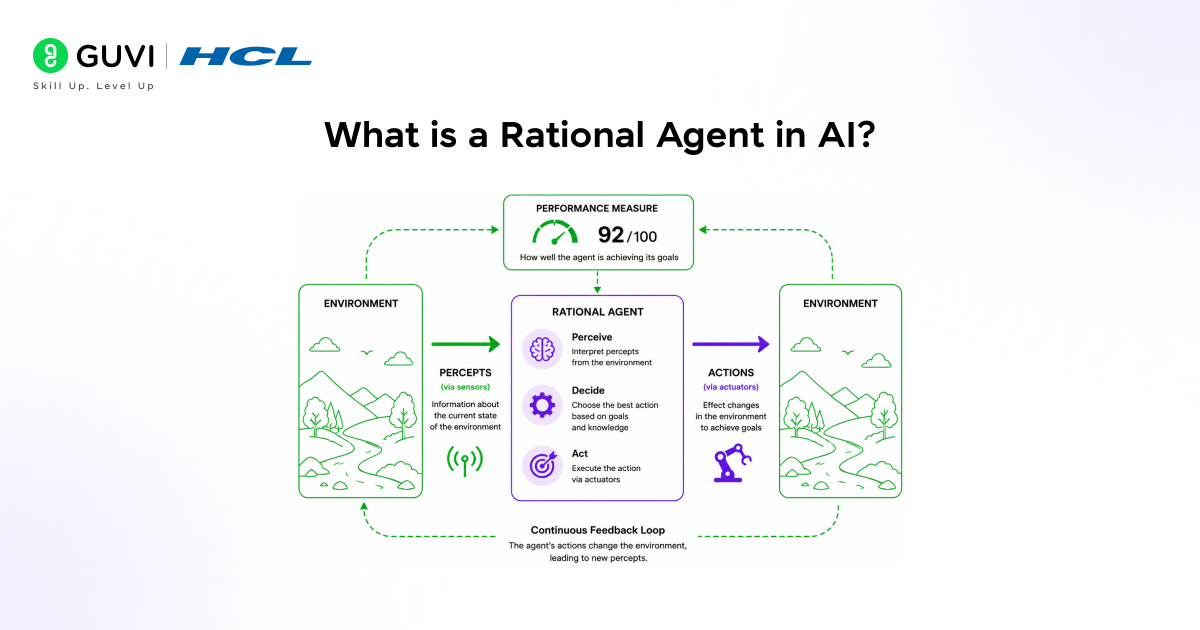
In artificial intelligence, an agent is any entity that perceives its environment and takes actions that affect that environment. A rational agent is a specific class of agent: one that always selects the action that is expected to maximise its performance measure, given its percept sequence and any built-in knowledge.
The term “rational” in this context is precise. It does not mean the agent is always correct, nor that it is all-knowing. It means the agent makes the best possible decision given what it knows.
This distinction is critical. AI researchers distinguish between:
- Rationality: Maximising expected performance based on available information and knowledge.
- Omniscience: Knowing the actual outcome of every action impossible in the real world.
- Perfection: Always achieving the optimal outcome is also impossible under uncertainty.
A rational agent is not expected to be omniscient or perfect. It is expected to act optimally given its perceptions and knowledge. This makes rationality a practical and achievable standard for real AI systems.
The PEAS Framework for Agent Design
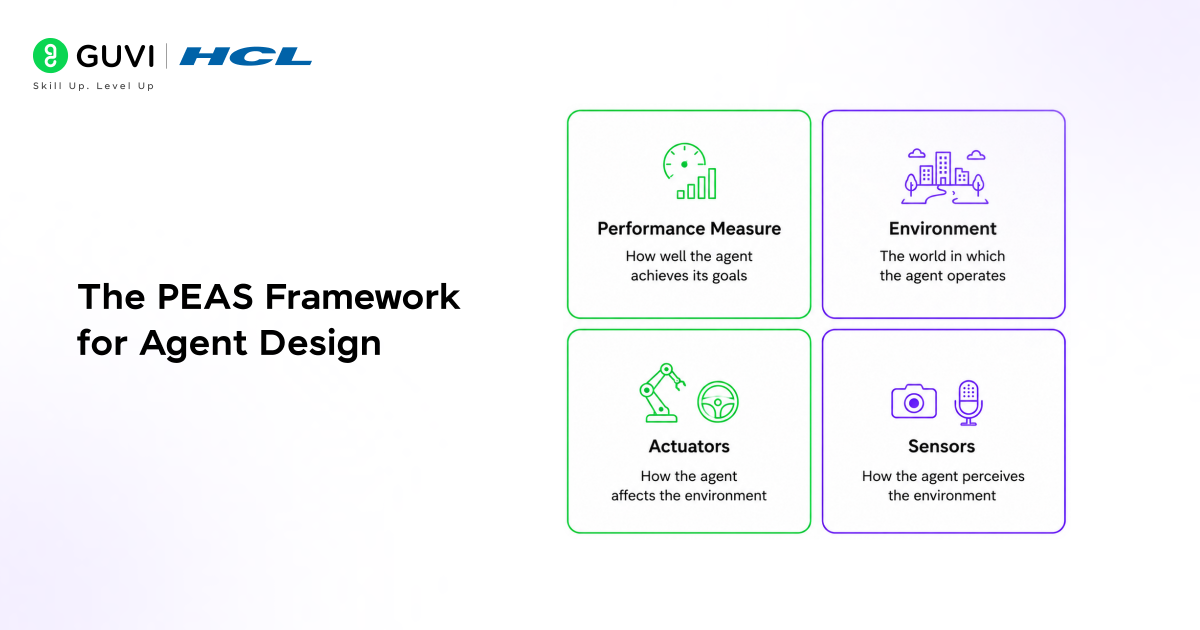
To design or analyse any rational agent, AI practitioners use the PEAS framework as a structured way to specify the four essential components that define an agent and its task.
P — Performance Measure
The performance measure defines what it means for the agent to succeed. It quantifies how well the agent is doing relative to its goal. Crucially, the performance measure is defined externally by the designer or the task not by the agent itself.
Examples:
• A chess-playing agent: wins, draws, and losses over a set of games.
• A self-driving car: safety record, journey time, passenger comfort, and fuel efficiency.
• A medical diagnosis agent: accuracy, false positive rate, and patient outcomes.
Choosing the right performance measure is one of the most important — and most difficult — decisions in agent design. A poorly specified measure can cause the agent to optimise for the wrong objective.
E — Environment
The environment is everything the agent interacts with the external world that the agent perceives and acts upon. Environments vary enormously in complexity, and their properties determine which agent architectures and algorithms are appropriate.
Key environment properties include:
- Observable vs. partially observable: Can the agent sense the complete state of the environment at all times, or only a partial view?
- Deterministic vs. stochastic: Is the next state fully determined by the current state and the agent’s action, or is there randomness?
- Episodic vs. sequential: Does each decision episode stand alone, or do current decisions affect future ones?
- Static vs. dynamic: Does the environment change while the agent is deliberating?
- Discrete vs. continuous: Are the state space and action space finite and countable, or continuous?
- Single-agent vs. multi-agent: Is the agent the only decision-maker, or are other agents present?
A — Actuators
Actuators are the mechanisms through which a rational agent acts upon its environment. They are the output channels through which decisions become real-world effects.
Examples:
• A robotic agent: motors, grippers, and wheels that move the robot through physical space.
• A software agent: API calls, database writes, and user interface updates.
• An autonomous vehicle: steering, throttle, brake, and indicator controls.
• A conversational AI: text or speech output delivered to the user.
S — Sensors
Sensors are the mechanisms through which the agent perceives its environment. They define what information is available to the agent at each point in time — the agent’s percept sequence.
Examples:
• An autonomous vehicle: cameras, LiDAR, radar, GPS, and ultrasonic sensors.
• A medical diagnosis agent: patient records, lab results, and imaging data.
• A game-playing agent: the current board state, available moves, and score.
• A chatbot: user text input, session history, and intent signals.
The rational agent framework was formalised by Stuart Russell and Peter Norvig in their influential textbook Artificial Intelligence: A Modern Approach, first published in 1995. The framework defines an intelligent agent as one that selects actions to maximize expected performance based on its perceptions and knowledge of the environment. Widely adopted in AI education, the book has become a standard reference in universities around the world and continues to shape how artificial intelligence is taught, particularly through its structured approach to agents, search, reasoning, and learning.
Types of AI Agents
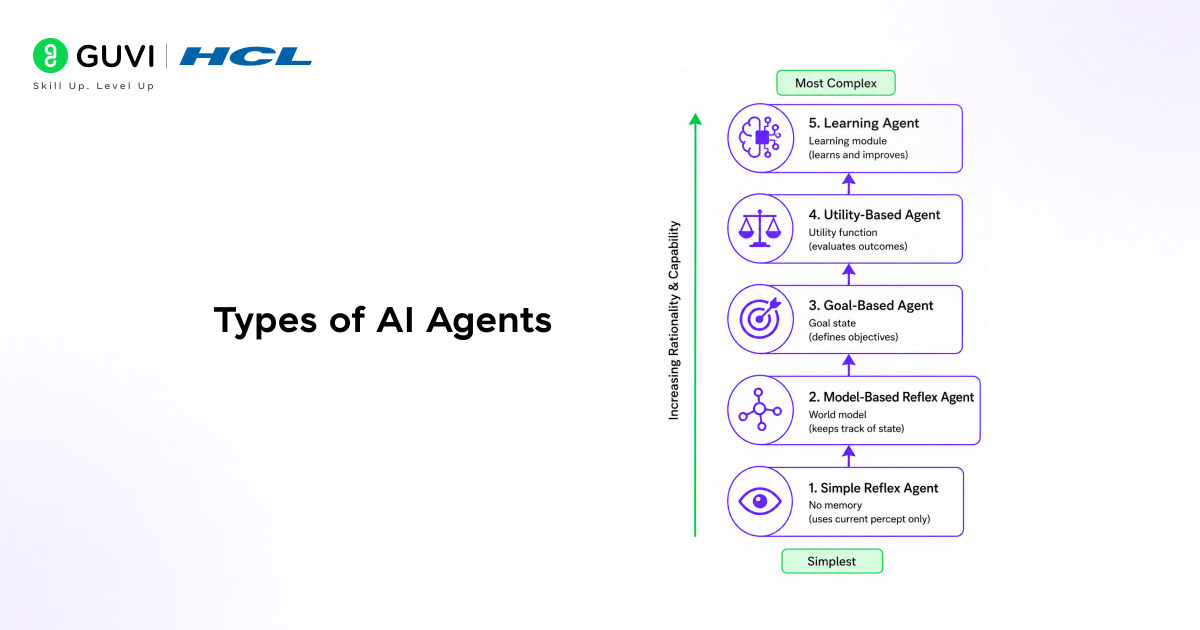
Not all rational agents are built the same way. The field of AI defines five canonical agent architectures, each with increasing capability and internal complexity.
1. Simple Reflex Agents
Simple reflex agents act solely on the current percept, using condition-action rules: if this condition is true, perform this action. They have no memory of past percepts and no model of the world.
• Example: A thermostat that turns heating on when the temperature drops below a threshold.
• Limitation: Only rational in fully observable, deterministic environments. Fail under partial observability.
2. Model-Based Reflex Agents
Model-based agents maintain an internal state, a model of the world that tracks aspects of the environment they cannot currently observe. They update this model with each new percept and use it to inform their decisions.
• Example: A robot vacuum that maps previously cleaned areas and avoids revisiting them.
• Advantage: Can handle partially observable environments by reasoning about the unobserved state.
3. Goal-Based Agents
Goal-based agents act to achieve explicitly defined goal states. They consider not just the current state but future states, searching or planning sequences of actions that lead to the goal.
• Example: A GPS navigation system that finds a route from the current location to a destination.

• Advantage: Flexible, changing the goal changes behaviour without redesigning the agent.
4. Utility-Based Agents
Utility-based agents go beyond binary goal achievement. They use a utility function — a measure of how desirable each state is — to choose the action that maximises expected utility when multiple goals or trade-offs are involved.
• Example: An autonomous vehicle that balances journey speed, passenger comfort, and fuel efficiency.
• Advantage: Handles trade-offs and uncertainty — the hallmark of optimal behaviour in complex environments.
5. Learning Agents
Learning agents improve their performance over time through experience. They consist of four components: a learning element (which improves the agent), a performance element (which selects actions), a critic (which evaluates performance against a standard), and a problem generator (which suggests exploratory actions).
- Example: A recommendation system that learns user preferences from interaction history.
- Advantage: Can operate effectively in environments that are initially unknown, adapting as more data is gathered.
Performance Measure and Optimal Behaviour
The performance measure is the formal criterion by which a rational agent’s behaviour is judged. It defines what “doing well” means for a specific task and environment.
Designing an effective performance measure requires care. Common pitfalls include:
- Measuring means instead of ends: Rewarding the agent for intermediate steps (e.g., number of actions taken) rather than actual goal achievement.
- Incomplete specification: Failing to capture all relevant dimensions of success, leading the agent to optimise for an incomplete objective.
- Reward hacking: The agent finds a way to achieve a high score on the performance measure without achieving the intended goal — a well-documented failure mode in reinforcement learning.
Optimal behaviour the gold standard for a rational agent means selecting, at every step, the action that maximises the expected value of the performance measure over time. In practice, this ideal is approximated through a variety of algorithms: search, planning, reinforcement learning, and probabilistic inference.
Real-World Examples of Rational AI Agents
The rational agent framework is not abstract theory it describes real AI systems deployed across industries today.
- Autonomous vehicles: Sensors (cameras, LiDAR, radar) feed percepts to the agent; actuators (steering, throttle, brakes) execute decisions; the performance measure balances safety, speed, and comfort across fully continuous, partially observable, stochastic environments.
- Chess and game-playing engines: Agents like Stockfish and AlphaZero perceive the full board state, select moves via search and evaluation functions, and are measured by game outcomes — a fully observable, deterministic, sequential, adversarial environment.
- Medical diagnosis systems: AI agents process patient data through sensors (imaging, labs, records), suggest diagnoses or treatments through output interfaces, and are measured on accuracy, sensitivity, and specificity.
- Recommendation systems: Agents perceive user behaviour (clicks, watch time, ratings), act by selecting content to display, and are measured by engagement, retention, and user satisfaction.
- Fraud detection agents: Financial AI agents perceive transaction patterns in real time, flag or block suspicious activity, and are measured by true positive rate, false positive rate, and financial loss prevented.
Designing a Rational Agent: Key Principles
Building an effective rational agent requires systematic design. The following principles guide the process:
- Define the performance measure first: Clarity about what success means prevents misaligned optimisation. The measure should reflect real-world goals, not proxies.
- Characterise the environment thoroughly: Understanding whether the environment is observable, deterministic, static, and discrete determines which algorithms and architectures are appropriate.
- Match the agent architecture to the task: A simple reflex agent may suffice for a thermostat; a utility-based or learning agent is needed for autonomous navigation.
- Design for partial observability: Most real environments are partially observable. Agents must be designed with internal state models and uncertainty-handling mechanisms from the outset.
- Plan for learning and adaptation: In dynamic environments, a learning agent that improves from experience will outperform a fixed agent over time. Building in a learning element is often essential for long-term rationality.
If you want practical experience working with activation functions, neural networks, and deep learning models, HCL GUVI’s AI and ML program can help you understand how concepts like sigmoid, backpropagation, and gradient descent are implemented using frameworks such as TensorFlow and PyTorch through hands-on projects
Conclusion
The rational agent is the foundational concept of modern artificial intelligence. By defining intelligence not as omniscience or perfection, but as the ability to make the best decision possible given available information, the rational agent framework provides a practical and theoretically grounded standard for building AI systems.
From the PEAS framework which gives designers a structured way to specify any agent’s task to the five agent architectures ranging from simple reflex to autonomous learning agents, the tools of rational agent design apply across every domain of AI: robotics, natural language processing, computer vision, game playing, and decision support.
The performance measure defines the goal. The environment defines the challenge. Sensors and actuators define the interface. And the agent architecture defines how intelligence is brought to bear on the problem.
Understanding rational agents is understanding what it means for a machine to act intelligently and that understanding is the starting point for every serious AI practitioner.
FAQs
1. What is a rational agent in AI?
A rational agent is an AI entity that perceives its environment through sensors and selects actions via actuators to maximise its performance measure. It acts optimally given available information without requiring perfect knowledge or guaranteed perfect outcomes.
2. What does the PEAS framework stand for?
PEAS stands for Performance measure, Environment, Actuators, and Sensors. It is the standard framework used in AI to fully specify the task and context of any rational agent before designing its architecture or selecting algorithms.p;
3. What is the difference between a rational and omniscient agent?
A rational agent maximises expected performance based on available percepts and knowledge. An omniscient agent would know the actual outcome of every action something impossible in uncertain, real-world environments. Rationality is achievable; omniscience is not.
4. What are the five types of AI agents?
The five canonical agent types are: simple reflex agents, model-based reflex agents, goal-based agents, utility-based agents, and learning agents each offering increasing internal complexity and capability for handling more challenging environments.
5. Why is the performance measure important in agent design?
The performance measure defines what success means for the agent. A poorly chosen measure leads the agent to optimise for the wrong objective a critical failure mode. It must reflect real-world goals accurately and completely to produce genuinely rational behaviour.
Success Stories

About the Author
Vishalini Devarajan
An Aerospace Engineer turned content writer, I focus on making complex concepts easy to understand through well-structured, reader-friendly blogs. Whether it’s a technical topic or a non-technical one, I love creating content that is clear, engaging, and impactful.
View all posts by Vishalini Devarajan
Connect with me @











Did you enjoy this article?