


Artificial Intelligence and Machine Learning Articles
Multi-Turn Conversation Management with Claude API
How to Stream Claude Responses with the API


Get In Touch For Details! Request More Information

What Is a Bagging Classifier in ML? A Complete Beginner’s Guide
Jul 18, 2026 7 Min Read 263 Views
(Last Updated)
Imagine deciding whether to watch a movie by asking ten friends and going with the majority, combining many imperfect judgments to get a more reliable decision. Bagging (Bootstrap Aggregating) applies this idea to machine learning by training multiple models on different random samples of the training data and aggregating their predictions, often by majority vote for classification or averaging for regression.
Individual models like decision trees tend to have high variance: small changes in training data can produce very different trees that overfit. Bagging reduces this variance by averaging many diverse learners, yielding more stable, robust predictions and improving generalization without changing the underlying model type.
In this article, we will walk through everything you need to understand about the Bagging Classifier: what bootstrap aggregation means, how bootstrap sampling works, what out-of-bag evaluation is and why it matters, how to implement it in Python using scikit-learn, how it relates to Random Forest, and where it is actually used in the real world.
Table of contents
- TL;DR
- The Core Problem Bagging Solves: High Variance
- Bootstrap Sampling: The Foundation of Bagging
- How the Bagging Classifier Works: Step by Step
- Implementing BaggingClassifier in Scikit-Learn
- Bagging vs. Pasting: What Is the Difference?
- Bagging vs. Random Forest: Understanding the Relationship
- Bagging vs. Boosting: Key Differences
- Advantages of the Bagging Classifier
- Real-World Applications
- Wrapping Up
- FAQ
- Q: When should I use BaggingClassifier versus Random Forest?
- Q: How many estimators (n_estimators) should I use?
- Q: What does bootstrap=False do?
- Q: Should I bag every kind of base estimator?
- Q: How do I use OOB score and when is it reliable?
TL;DR
- Bagging (Bootstrap Aggregating) trains many base classifiers on different bootstrap samples and aggregates their predictions (majority vote for classification, average for regression) to reduce variance.
- It’s most effective with high‑variance, unstable learners (e.g., deep decision trees); averaging many diverse models stabilizes predictions and reduces overfitting.
- Bootstrap sampling (with replacement) produces ~63.2% unique examples per bag; the ~36.8% left out are out‑of‑bag (OOB) and provide cheap internal validation.
- Scikit‑learn’s Bagging Classifier wraps any estimator (not just trees), supports OOB scoring, and is parallelizable (n_jobs), making it flexible and practical.
- Random Forest is a specialized bagging variant for decision trees that adds random feature selection at each split to further decorrelate trees; bagging differs from boosting (parallel variance reduction vs sequential bias reduction).
What Is the Bagging Classifier?
The Bagging Classifier (Bootstrap Aggregating Classifier) is an ensemble learning technique that improves prediction accuracy by training multiple versions of a base model on different randomly sampled subsets of the training data. Each model makes its own prediction, and the final output is determined through majority voting. By combining diverse models trained on varied data samples, bagging reduces variance, helps prevent overfitting, and improves the overall stability and generalization performance of machine learning classifiers.
The Core Problem Bagging Solves: High Variance
- Before understanding how bagging works, you need to understand what it is solving. Machine learning models suffer from two fundamental sources of error: bias and variance.
- Bias is how far off the model’s predictions are on average from the true values. A model with high bias underfits, meaning it is too simple to capture the actual patterns in the data.
- Variance is how much the model’s predictions change when it is trained on different samples of the same data. A model with high variance overfits, meaning it memorizes the noise in the training data and fails on new examples.
- Bagging aims to reduce variance in high-variance models such as deep decision trees. In bagging methods like Random Forest, the algorithm creates many independent decision trees, each trained on a different random sample of the data.
- These trees learn in parallel, and their predictions are averaged or voted on equally to produce a stable and reliable outcome.
- The basic idea behind bagging is that averaging reduces variance. Variance of the means of multiple samples is far lower than the variance of any individual sample.
- This is why bagging works: you train on samples and combine them later by averaging, reducing the overall variability of predictions without significantly increasing bias.
Bootstrap Sampling: The Foundation of Bagging
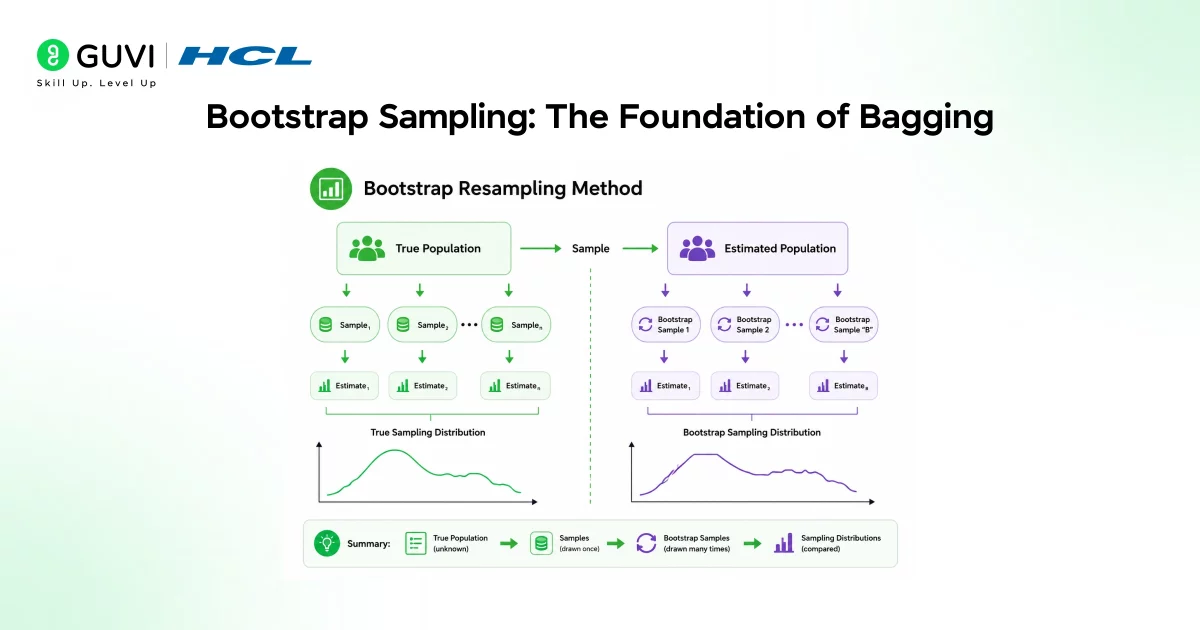
- What “Bagging” Means
Bagging stands for Bootstrap Aggregation: an ensemble technique that trains multiple models independently on different random subsets of the data and combines their outputs (voting or averaging) to produce a final prediction. - Sampling “With Replacement” Explained
Bootstrap sampling draws N examples from the original N-point dataset by picking points one at a time and returning them to the pool before the next draw. That “with replacement” step allows some points to appear multiple times in a sample and others to be omitted entirely. - The 63.2% Rule and Out‑of‑Bag Examples
When N is large, each bootstrap sample contains about 63.2% of the unique original observations on average; roughly 36.8% are left out. The excluded examples are called out‑of‑bag (OOB) and are useful for internal validation without a separate holdout set. - Why This Matters Practically
Bootstrap sampling creates diversity among base learners (different data views), which is key to bagging’s success; the OOB fraction provides a handy, low-cost way to estimate model performance and error without retraining on separate validation data.

How the Bagging Classifier Works: Step by Step
Step 1 — Create bootstrap samples
From the original training dataset of N samples, draw B bootstrap samples (each of size N) by sampling with replacement. Some original examples may appear multiple times in a bootstrap sample while others may be left out.
Step 2 — Train base models independently
Train one base classifier on each bootstrap sample, producing B independently trained models. Training is done in parallel when possible because each model uses a different sampled dataset.
Step 3 — Make predictions with each model
For a new, unseen input, feed it to every one of the B trained models. Each model produces its own prediction independently.
Step 4 — Aggregate predictions by majority vote
Collect the B predictions and choose the class label predicted by the majority of models. That majority vote becomes the ensemble’s final classification.
Step 5 — Why aggregation helps (bias and variance)
Although each predictor trained on a bootstrap sample may have higher bias, aggregating many such models reduces variance. Independent errors tend to cancel out, producing a more stable and generalizable ensemble with similar bias but lower variance than a single model trained on the full dataset.
Step 6 — Intuition for unstable learners (e.g., decision trees)
Unstable base learners like single decision trees have high variance: small data changes produce very different trees. Bagging’s parallel ensemble smooths those differences when many trees err on different examples, their mistakes average out, yielding a stronger, more robust predictor.
Implementing BaggingClassifier in Scikit-Learn
Scikit-learn provides a clean, flexible BaggingClassifier that can wrap any base estimator. Here is a complete implementation:
import numpy as np
from sklearn.ensemble import BaggingClassifier
from sklearn.tree import DecisionTreeClassifier
from sklearn.datasets import make_classification
from sklearn.model_selection import train_test_split
from sklearn.metrics import accuracy_score, classification_report
# Generate a sample classification dataset
X, y = make_classification(
n_samples=1000, n_features=20,
n_informative=15, n_redundant=5,
random_state=42
)
X_train, X_test, y_train, y_test = train_test_split(
X, y, test_size=0.2, random_state=42
)
# Single Decision Tree (baseline)
single_tree = DecisionTreeClassifier(random_state=42)
single_tree.fit(X_train, y_train)
tree_pred = single_tree.predict(X_test)
print(f”Single Decision Tree Accuracy: {accuracy_score(y_test, tree_pred):.4f}”)
# BaggingClassifier with Decision Trees
bag_clf = BaggingClassifier(
estimator=DecisionTreeClassifier(),
n_estimators=100, # number of base classifiers
max_samples=1.0, # proportion of samples per bag
max_features=1.0, # proportion of features per bag
bootstrap=True, # sample with replacement (bagging)
oob_score=True, # enable out-of-bag evaluation
n_jobs=-1, # use all CPU cores
random_state=42
)
bag_clf.fit(X_train, y_train)
bag_pred = bag_clf.predict(X_test)
print(f”Bagging Classifier Accuracy: {accuracy_score(y_test, bag_pred):.4f}”)
print(f”Out-of-Bag Score: {bag_clf.oob_score_:.4f}”)
print(“\nDetailed Report:”)
print(classification_report(y_test, bag_pred))
The BaggingClassifier is an ensemble meta-estimator that fits base classifiers each on random subsets of the original dataset and then aggregates their individual predictions either by voting or by averaging to form a final prediction.
It can typically be used to reduce the variance of a black-box estimator such as a decision tree by introducing randomization into its construction procedure and then making an ensemble out of it.
In bagging (bootstrap aggregating), each model is trained on a bootstrap sample of the data, which on average leaves out about 36.8% of the original observations. These excluded points form the basis of out-of-bag (OOB) evaluation, allowing performance to be estimated without needing a separate validation set, often with surprisingly low bias. Bagging is also model-agnostic, meaning it can be applied to algorithms like SVMs, k-NN, or logistic regression. However, its biggest gains are seen with high-variance, unstable models, while for already stable, low-variance models, bagging typically provides little additional improvement.
1. Bagging vs. Pasting: What Is the Difference?
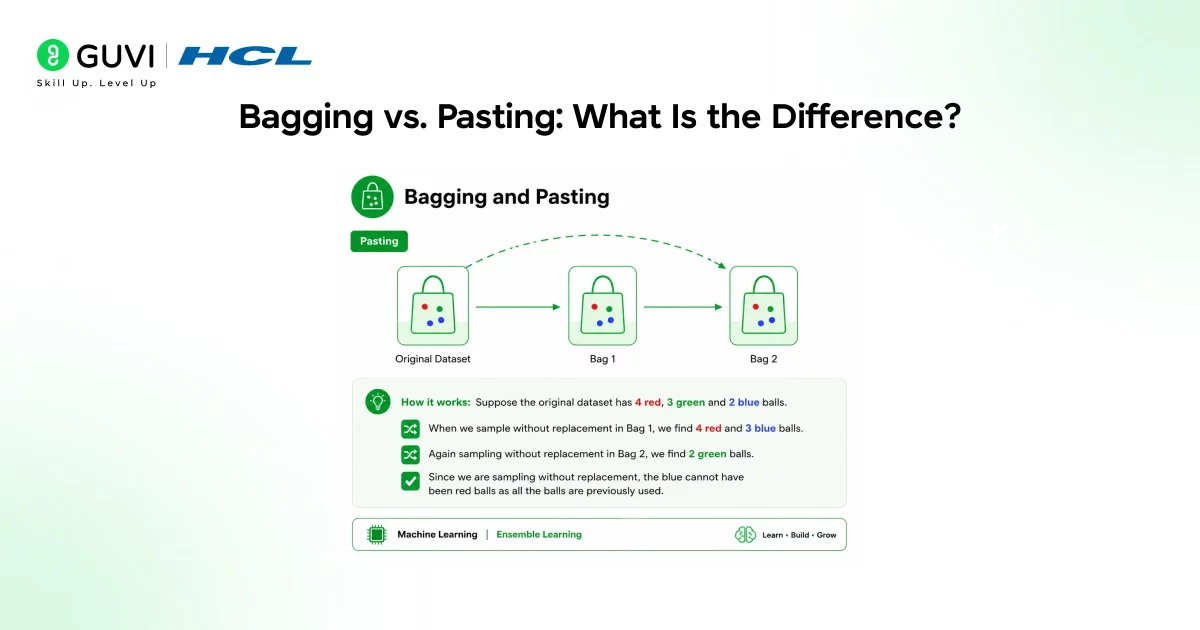
- When you set bootstrap=True in BaggingClassifier, you get bagging because samples are drawn with replacement.
- When you set bootstrap=False, you get a related technique called pasting, where samples are drawn without replacement.
- The practical difference is that replacement creates more diverse subsets because the same point can appear multiple times in one bag and be absent from another.
- Without replacement creates subsets that are more similar to each other since each data point can only be used once across all samples. Bagging generally produces more diverse models and therefore larger variance reduction, which is why it is the more commonly used setting.
2. Bagging vs. Random Forest: Understanding the Relationship
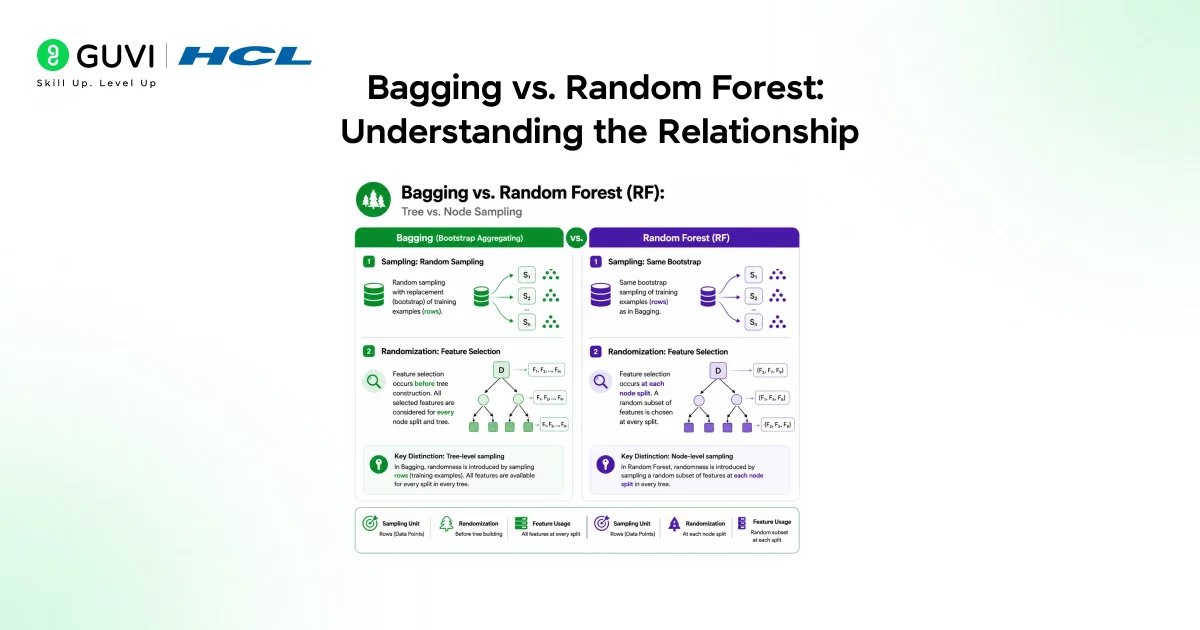
- A very common question for beginners is how bagging relates to Random Forest. The relationship is direct: Random Forest is a specialized version of bagging applied exclusively to decision trees.
- The main difference between bagging and random forest is the choice of predictor subset size. When the number of features considered at each split equals the total number of features, it is bagging.
- When it equals the square root of the total number of features, it is a Random Forest. Random forest helps in overcoming overfitting and makes the model robust through its characteristics.
- Random forests are very similar to bagging except that they make use of a technique called feature bagging, which has the advantage of significantly decreasing the correlation between each decision tree and thus increasing predictive accuracy, on average.
- The key insight is that when decision trees in a standard bagging ensemble all have access to the same full set of features, they tend to split on the same dominant features at the top levels and end up correlated with each other.
- Correlated predictions do not cancel out as effectively as uncorrelated ones, limiting the variance reduction. By randomly restricting which features each tree can consider at each split, Random Forest decorrelates the trees and extracts more benefit from the ensemble.
3. Bagging vs. Boosting: Key Differences
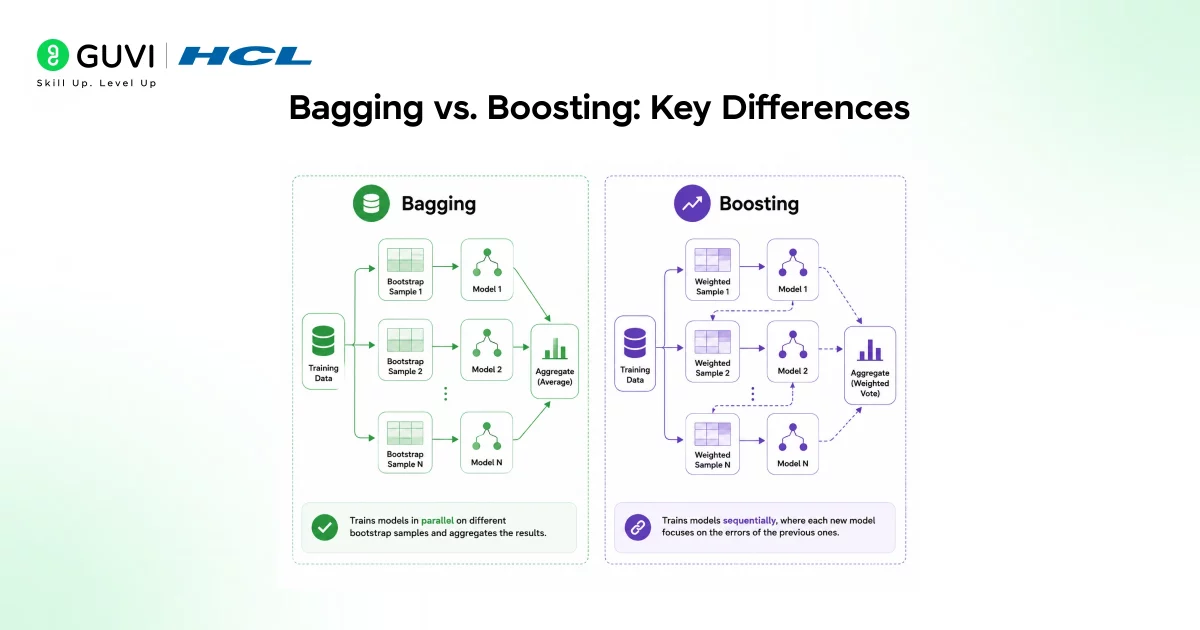
- Bagging builds multiple models in parallel using random subsets of the data, where each model is independent. It reduces variance, making it great for high-variance models like decision trees, and helps prevent overfitting. Bagging is less sensitive to outliers because errors are averaged across models.
- Boosting builds models sequentially, where each new model focuses on correcting the mistakes of the previous ones. It reduces bias, making weak models stronger, but it can sometimes overfit if not carefully tuned. Boosting is more sensitive to outliers because it tries harder to correct errors, including noisy data.
- In practice, use bagging when your model already overfits, and you want to stabilize it. Use boosting when your base model underfits, and you want to gradually build it into something more powerful.
Advantages of the Bagging Classifier
- Bagging combines multiple models to reduce overfitting and improve accuracy. It reduces the impact of noise and outliers, making results more stable. It lowers variance by training on different samples, improving generalization.
- Because the individual models are trained completely independently of each other, bagging is naturally parallelizable. You can use the n_jobs=-1 parameter in scikit-learn to train all models simultaneously across all available CPU cores, which makes it practical even with large numbers of estimators.
- The out-of-bag score also means you get built-in cross-validation for free, saving the time and complexity of setting up a separate validation pipeline.
Limitations of Bagging
- The most significant limitation of bagging is the loss of interpretability. A single decision tree can be visualized and explained to non-technical stakeholders. An ensemble of 100 decision trees cannot be easily explained in the same way.
- One disadvantage of bagging is that it introduces a loss of interpretability of the model. The resultant model can experience lots of bias when the proper procedure is ignored.
- Bagging also increases computational and memory requirements proportionally to the number of estimators. Training 100 models takes roughly 100 times the compute of training a single one. For large datasets and complex base models, this cost can become significant.
- Bagging is also most effective when the base estimator has high variance. If your base model already has low variance, such as a logistic regression, bagging produces minimal improvement.
Real-World Applications
- Bagging is used in image classification to increase classification accuracy and reduce overfitting by averaging results from multiple classifiers. In natural language processing, it combines predictions from multiple language models to improve text classification and sentiment analysis tasks.
- In fraud detection, bagging classifiers trained on different bootstrap samples learn to identify different patterns of fraudulent behavior. Their combined vote is more robust than any single model and less likely to be fooled by novel fraud patterns that fall outside what any individual model learned.
- Medical diagnosis is another major application where stability and reliability are critical. Rather than relying on a single model that might behave erratically on edge cases, a bagging ensemble produces consistently reliable predictions across a wide range of patient profiles.
If you’re serious about mastering What Is a Bagging Classifier? Understanding bootstrap aggregation, variance reduction, ensemble learning, and how to implement BaggingClassifier in Python with Scikit‑Learn, don’t miss the chance to enroll in HCL GUVI’s Artificial Intelligence & Machine Learning Course, co-designed by Intel.
Wrapping Up
The Bagging Classifier solves one of the most fundamental problems in machine learning: a powerful individual model that memorizes training data instead of generalizing. By training many versions of the same model on different random subsets and combining their predictions through majority voting, bagging reduces variance dramatically without requiring any changes to the base model’s architecture or training procedure.
Understanding bagging also unlocks your understanding of Random Forest, one of the most widely used and practically effective algorithms in the field. Random Forest is simply bagging with decision trees plus one additional tweak, random feature selection, that makes the ensemble even more powerful by reducing correlation between trees.
For any beginner building their machine learning toolkit, the Bagging Classifier is both a valuable tool in its own right and a gateway to understanding the entire family of ensemble methods that form the backbone of modern machine learning practice.
FAQ
Q: When should I use BaggingClassifier versus Random Forest?
A: Use BaggingClassifier when you want to wrap a non‑tree base estimator or when you want simple bagging without feature subsampling. Use Random Forest when you specifically want tree ensembles with built‑in feature randomness to further reduce tree correlation.
Q: How many estimators (n_estimators) should I use?
A: Start with 50–200. More estimators reduce variance but give diminishing returns and increase compute/memory roughly linearly. Use OOB score or validation curves to find a practical tradeoff.
Q: What does bootstrap=False do?
A: It switches to pasting (sampling without replacement). Subsets are more similar to each other, reducing diversity and typically providing less variance reduction than bagging (bootstrap=True).
Q: Should I bag every kind of base estimator?
A: No—bagging benefits high‑variance, unstable learners most (decision trees). For low‑variance models (e.g., well‑regularized linear models), bagging usually provides little to no improvement.
Q: How do I use OOB score and when is it reliable?
A: Set oob_score=True in BaggingClassifier and read bag_clf.oob_score_ after fitting. OOB is a convenient, nearly unbiased estimate when bootstrap=True and the number of estimators is reasonably large; still validate on a held-out test set for final evaluation.
Success Stories

About the Author
Vishalini Devarajan
An Aerospace Engineer turned content writer, I focus on making complex concepts easy to understand through well-structured, reader-friendly blogs. Whether it’s a technical topic or a non-technical one, I love creating content that is clear, engaging, and impactful.
View all posts by Vishalini Devarajan
Connect with me @












Did you enjoy this article?