


Software Development Articles
How to Read and Understand System Design Diagrams?
System Engineer Roles and Responsibilities: 12 Proven Duties for Growth
SAP Consultant Roles and Responsibilities: 12 Proven Duties for Growth and Success
Network Engineer Roles and Responsibilities: 12 Essential Duties for Success

Get In Touch For Details! Request More Information
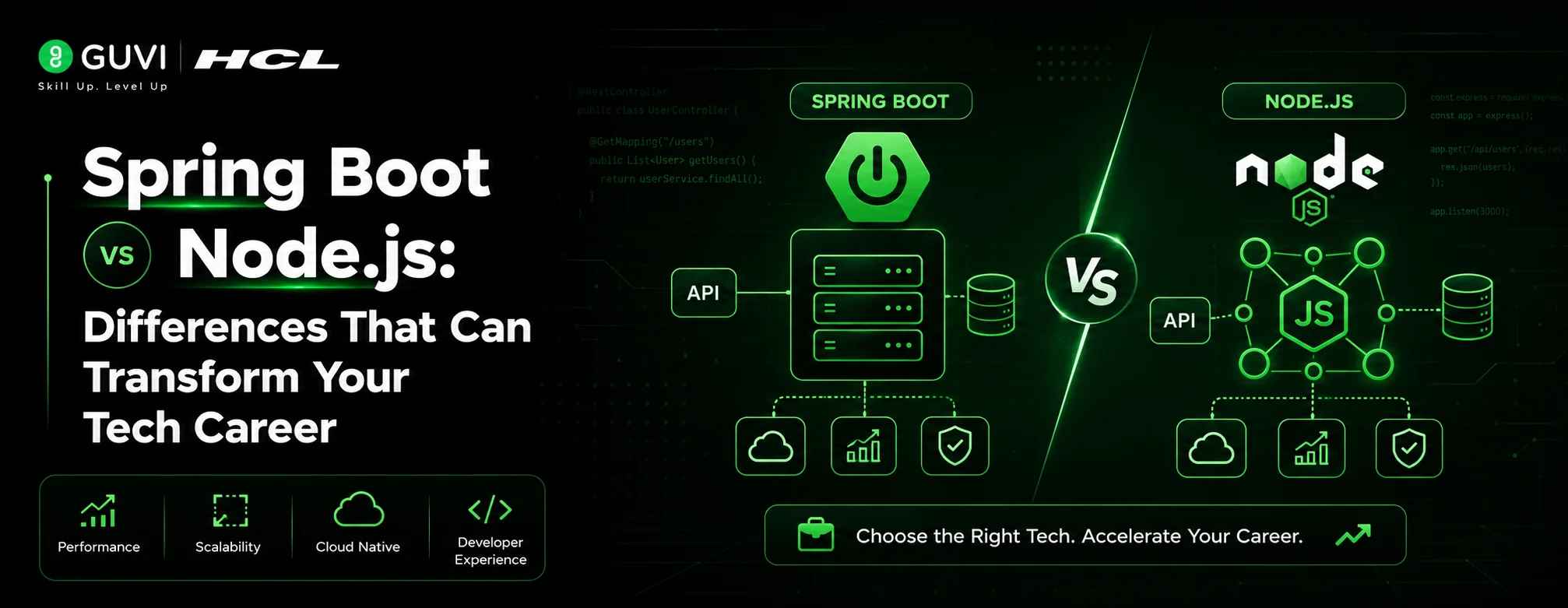
Spring Boot vs Node.js Differences That Can Transform Your Tech Career in 2026
Jun 16, 2026 3 Min Read 1633 Views
(Last Updated)
In today’s software industry, two technologies dominate backend development discussions — Spring Boot and Node.js. Both are widely used for building scalable web applications, REST APIs, enterprise systems, and microservices.
But the biggest question for beginners and developers is:
“Which one should I learn — Spring Boot or Node.js?”
The answer depends on your career goals, learning background, project requirements, and the type of companies you want to work with.
This blog compares Spring Boot vs Node.js in terms of performance, scalability, salary, learning curve, job opportunities, and future demand to help you make the right decision.
Table of contents
- What is Spring Boot?
- Popular Uses of Spring Boot
- Companies Using Spring Boot
- What is Node.js?
- Popular Uses of Node.js
- Companies Using Node.js
- Spring Boot vs Node.js: Detailed Comparison
- Performance Comparison
- Spring Boot Performance
- Node.js Performance
- Which is Easier to Learn?
- Learn Spring Boot If:
- Learn Node.js If:
- Job Opportunities in 2026
- Spring Boot Demand
- Node.js Demand
- Salary Comparison
- Spring Boot vs Node.js for Microservices
- Spring Boot Advantages
- Node.js Advantages
- Which One is Better for Freshers?
- Choose Spring Boot if:
- Choose Node.js if:
- Can You Learn Both?
- Final Verdict: Spring Boot vs Node.js
- Recommended Resources
- Conclusion
- Frequently Asked Questions
- Is Spring Boot better than Node.js?
- Which has better salary — Spring Boot or Node.js?
- Is Node.js easier than Spring Boot?
- Which technology is best for backend development in 2026?
What is Spring Boot?
Spring Boot is a Java-based framework used to build enterprise-grade backend applications quickly.
It is built on top of the Spring Framework and simplifies Java development by reducing configuration and boilerplate code.
Popular Uses of Spring Boot
- Banking applications
- Enterprise software
- Microservices architecture
- E-commerce platforms
- Cloud-based backend systems
Companies Using Spring Boot
- Netflix
- Amazon
- Accenture
- Infosys
What is Node.js?
Node.js is a JavaScript runtime environment that allows developers to run JavaScript on the server side.
It is known for its speed, lightweight architecture, and event-driven non-blocking I/O model.
Popular Uses of Node.js
- Real-time applications
- Chat applications
- Streaming platforms
- REST APIs
- Single-page applications
Companies Using Node.js
- PayPal
- Uber
- Netflix
Spring Boot vs Node.js: Detailed Comparison
| Feature | Spring Boot | Node.js |
|---|---|---|
| Language | Java | JavaScript |
| Learning Curve | Moderate to High | Beginner Friendly |
| Performance | Excellent for large enterprise apps | Excellent for real-time apps |
| Scalability | Highly scalable | Highly scalable |
| Speed of Development | Moderate | Very Fast |
| Best For | Enterprise applications | Lightweight APIs & realtime apps |
| Multithreading | Yes | Single-threaded event loop |
| Community Support | Very Strong | Very Strong |
| Microservices Support | Excellent | Excellent |
| Database Integration | Strong with JPA/Hibernate | Flexible with many libraries |
Performance Comparison
Spring Boot Performance
Spring Boot performs exceptionally well in:
- Complex business logic
- High-security applications
- Large enterprise systems
- Multi-threaded processing
Java’s JVM optimization makes Spring Boot highly stable for long-term enterprise projects.
Node.js Performance
Node.js shines in:
- Real-time communication
- WebSockets
- Streaming applications
- Fast API response systems
Its non-blocking architecture handles thousands of concurrent requests efficiently.
Which is Easier to Learn?
Learn Spring Boot If:
- You already know Java
- You want enterprise jobs
- You aim for product-based companies
- You are interested in backend architecture
Learn Node.js If:
- You know JavaScript
- You want faster development
- You prefer full-stack development
- You want to build startups or freelance projects quickly
Job Opportunities in 2026
Both technologies are in high demand, but the market differs slightly.
Spring Boot Demand
Spring Boot is heavily used in:
- MNCs
- Banking sector
- Enterprise IT companies
- Large-scale backend systems
Popular Roles
- Java Backend Developer
- Spring Boot Developer
- Microservices Engineer
- Enterprise Application Developer
Node.js Demand
Node.js is highly preferred in:
- Startups
- SaaS companies
- Real-time application development
- Full-stack JavaScript ecosystems
Popular Roles
- Node.js Developer
- MERN Stack Developer
- Backend JavaScript Engineer
- API Developer
Salary Comparison
| Role | Average Salary in India |
|---|---|
| Spring Boot Developer | ₹6–18 LPA |
| Node.js Developer | ₹5–16 LPA |
Experienced professionals in both domains can earn significantly higher packages.
Spring Boot vs Node.js for Microservices
Both technologies support microservices architecture effectively.

Spring Boot Advantages
- Strong ecosystem
- Better security integration
- Enterprise-level architecture
- Advanced dependency injection
Node.js Advantages
- Faster deployment
- Lightweight services
- Easy JSON handling
- Faster MVP development
Which One is Better for Freshers?
Choose Spring Boot if:
- You want stable corporate jobs
- You are preparing for enterprise development roles
- You want deep backend engineering knowledge
Choose Node.js if:
- You want quick project building
- You are learning MERN stack
- You want startup or freelance opportunities
Can You Learn Both?
Yes — and that can be a major advantage.
Many developers start with Node.js because it is easier and faster to learn, then move to Spring Boot for enterprise-level backend development.
A combination of:
- Java + Spring Boot
- JavaScript + Node.js
- REST APIs
- Microservices
- Cloud & DevOps
can make your profile highly valuable in 2026.
Final Verdict: Spring Boot vs Node.js
There is no universal winner.
- Choose Spring Boot for enterprise applications, stability, and large-scale systems.
- Choose Node.js for speed, real-time applications, and full-stack JavaScript development.
If your goal is long-term backend engineering growth, both technologies are worth learning eventually.
Recommended Resources
To learn more about Spring Boot and Node.js, explore these official resources and guides:
- Spring Boot Official Documentation
- https://www.guvi.in/blog/spring-boot-project-step-by-step-guide/
- Node.js Official Website
- Oracle Java Documentation
- MDN JavaScript Guide
- Spring Framework Guides
- Node.js Learning Resources
- REST API Best Practices by Microsoft
- AWS Microservices Architecture Guide
Conclusion
Choosing between Spring Boot and Node.js is not about which technology is superior overall — it is about which one aligns better with your learning goals and career aspirations.
For enterprise software and scalable business systems, Spring Boot remains a strong choice. For modern web apps, real-time systems, and fast development cycles, Node.js continues to dominate.
Whichever path you choose, focus on:
- Building projects
- Understanding APIs
- Learning databases
- Practicing system design
- Working on deployment and cloud basics
That combination will help you stand out as a backend developer in 2026.
Frequently Asked Questions
Is Spring Boot better than Node.js?
It depends on the project requirement. Spring Boot is better for enterprise systems, while Node.js is better for real-time and lightweight applications.
Which has better salary — Spring Boot or Node.js?
Both offer competitive salaries. Spring Boot often has slightly higher enterprise-level packages.
Is Node.js easier than Spring Boot?
Yes, Node.js is generally easier for beginners, especially if they already know JavaScript.
Which technology is best for backend development in 2026?
Both are highly relevant in 2026. Your choice should depend on your career path and project goals.
Success Stories

About the Author
Lavish Jain
A Professional Developer Mentor and Corporate Trainer with over 10 years of experience, I have contributed to technological advancements through comprehensive training and mentorship. My journey includes pivotal roles at Cluebix, Focus-4D,ThoughtWorks, and currently with Guvi -HCL Group, where I shape the careers of aspiring developers. I specialize in simplifying complex concepts, making them accessible to learners at all levels, and have successfully trained lakhs of budding developer through corporate and boot camp courses focused on full-stack development.
View all posts by Lavish Jain
Connect with me @









Did you enjoy this article?