


Interview Articles
InfyTQ Interview Experience 2026: Process, Questions, Preparation & Tips
Deloitte NLA Interview Experience 2026: Rounds, Questions and Preparation - Best Guide
Capgemini Exceller Interview Questions 2026: Coding, Technical, HR, and AI Prep - Best Guide
Wipro Elite NTH Interview Experience 2026: What Candidates Say


Get In Touch For Details! Request More Information

Coding and Decoding Aptitude Questions (2026): Types, Tricks, and Solved Examples
Sep 02, 2026 8 Min Read 3466 Views
(Last Updated)
Coding and decoding aptitude questions appear in almost every competitive exam in India. Whether you are preparing for SSC, banking exams, campus placements, CAT, UPSC, or RRB, this topic is guaranteed to show up. The good news is that once you understand the types and the tricks behind each pattern, these questions become some of the fastest to solve in the reasoning section.
This guide covers every type of coding and decoding aptitude question with solved examples, step by step explanations, and shortcuts that help you crack them under exam pressure.
Table of contents
- AI Overview
- What Are Coding and Decoding Aptitude Questions
- How to Solve Coding and Decoding Questions
- Alphabet Position Chart You Must Know
- Types of Coding and Decoding Aptitude Questions
- Letter Shifting Coding
- Reverse Letter Coding (Mirror Coding)
- Reverse Word Coding
- Number Coding
- Substitution Coding
- Conditional or Symbolic Coding
- Matrix Coding
- Mixed or Variable Shift Coding
- Common Coding-Decoding Shortcuts
- How to Approach Any Coding and Decoding Aptitude Question
- Solve It Yourself: Practice Questions by Type
- Type 1: Letter Shifting Coding
- Type 2: Reverse Letter (Opposite) Coding
- Type 3: Reverse Word Coding
- Type 4: Number Coding
- Type 5: Substitution Coding
- Type 6: Conditional or Symbolic Coding
- Type 7: Matrix Coding
- Type 8: Mixed or Variable Shift Coding
- Answers
- Common Mistakes to Avoid in Coding and Decoding Aptitude Questions
- Tips to Score Full Marks in Coding and Decoding Aptitude Questions
- 💡 Did You Know?
- Conclusion
- FAQs
- What are coding and decoding aptitude questions?
- How many types of coding and decoding aptitude questions are there?
- What is the fastest way to solve coding and decoding aptitude questions?
- How do I remember alphabet positions for coding and decoding aptitude questions?
- Which exams have coding and decoding aptitude questions?
AI Overview
Coding and decoding aptitude questions test your ability to identify a hidden pattern used to transform letters, numbers, words, or symbols. To solve them, compare the given code with the original, identify the rule, and apply it consistently. Common types include letter shifting, reverse coding, number coding, substitution coding, and mixed coding.
What Are Coding and Decoding Aptitude Questions
Coding and decoding aptitude questions test your logical reasoning and pattern recognition ability. A word or number is given in a coded form and you have to figure out the rule used to create that code, then apply the same rule to find the answer.
Why exams include coding and decoding aptitude questions:
- They test both speed and accuracy at the same time
- They measure how quickly you can spot hidden patterns
- They require no formula memorization, only logical thinking
- They can be solved in 20 to 30 seconds if you know the approach
Exams where coding and decoding aptitude questions appear:
| Exam | Section |
| SSC CGL, CHSL, MTS | Reasoning Ability |
| SBI PO, IBPS PO, Clerk | Reasoning Ability |
| CAT | Verbal and Logical Reasoning |
| RRB NTPC, Group D | General Intelligence |
| Campus Placements | Aptitude and Reasoning |
| UPSC CSAT | General Studies Paper 2 |
Prepare for coding rounds, aptitude tests, HR interviews, resume building, and placement challenges with HCL GUVI’s Interview Preparation course. Learn problem-solving techniques, interview strategies, communication skills, and real-world placement tips through structured lessons and practice sessions designed to help students and freshers crack technical interviews confidently.
How to Solve Coding and Decoding Questions
Use this four-step approach:
- Identify the question type: Check whether it uses letter shifts, reverse coding, numbers, symbols, or word substitution.
- Find the pattern: Compare the original and coded forms letter by letter or word by word.
- Verify the rule: Apply the pattern to the complete given example before using it on the question.
- Apply and check: Encode or decode the target word and verify the answer once.
Quick tip: Don’t assume a +1 or −1 shift immediately. Check at least two or three letters before deciding the rule.
Alphabet Position Chart You Must Know
Before solving any coding and decoding aptitude question involving letters, memorize the position of each letter in the alphabet. This is the single most important tool for this topic.
| A | B | C | D | E | F | G | H | I | J | K | L | M |
| 1 | 2 | 3 | 4 | 5 | 6 | 7 | 8 | 9 | 10 | 11 | 12 | 13 |
| N | O | P | Q | R | S | T | U | V | W | X | Y | Z |
| 14 | 15 | 16 | 17 | 18 | 19 | 20 | 21 | 22 | 23 | 24 | 25 | 26 |
Trick to remember positions quickly: Use the shortcut EJOTY. E=5, J=10, O=15, T=20, Y=25. Count forward or backward from the nearest anchor letter.
Types of Coding and Decoding Aptitude Questions
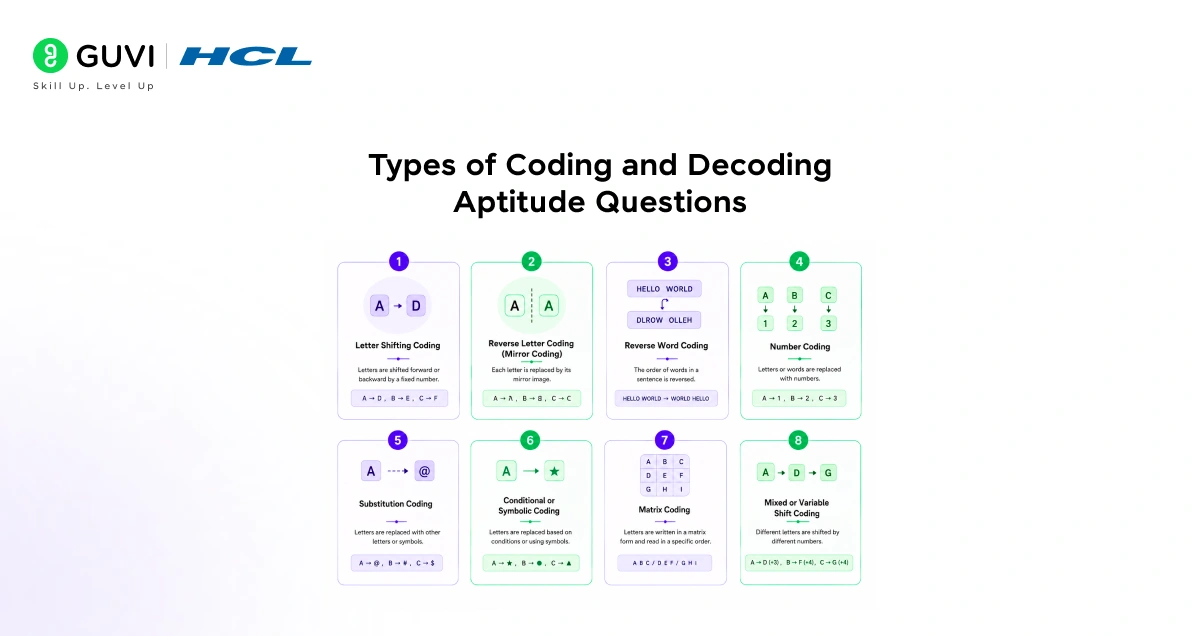
There are 6 main types of coding and decoding aptitude questions. Each type has a fixed pattern and a fixed approach. Learning all six makes you ready for any exam.
1. Letter Shifting Coding
In this type, each letter in the word is shifted forward or backward by a fixed number of positions in the alphabet.
Example: If CAT is coded as DBU, what is the code for DOG?
Step 1: Find the pattern
| Original | Position | Shift | Coded | Position |
| C | 3 | +1 | D | 4 |
| A | 1 | +1 | B | 2 |
| T | 20 | +1 | U | 21 |
Pattern: Each letter shifts +1 forward
Step 2: Apply to DOG
| Original | Position | Shift | Coded |
| D | 4 | +1 | E |
| O | 15 | +1 | P |
| G | 7 | +1 | H |
Answer: EPH
Shortcut tip: Always check the first letter first. If C becomes D, that is +1. Confirm with the second letter. If both match, the pattern is confirmed and you can apply it straight away.
2. Reverse Letter Coding (Mirror Coding)
In this type, each letter is replaced by its opposite letter in the alphabet. A is replaced by Z, B by Y, C by X, and so on.
Opposite letter pairs:
| A-Z | B-Y | C-X | D-W | E-V | F-U | G-T | H-S | I-R | J-Q | K-P | L-O | M-N |
Example: If WATER is coded as DZGVI, what is the code for SPACE?
Step 1: Check the pattern
- W (23) opposite is D (4). W + D = 27. 27 = 26 + 1. Pattern confirmed as opposite coding.
Step 2: Apply to SPACE
| Letter | Opposite |
| S | H |
| P | K |
| A | Z |
| C | X |
| E | V |
Answer: HKZXV
Shortcut tip: For any letter, its opposite is found by the formula: Position of opposite = 27 minus position of the letter. So W is position 23. 27 minus 23 = 4. The 4th letter is D. Confirmed.
3. Reverse Word Coding
In this type, the letters of the word are simply written in reverse order.
Example: If CHAIR is coded as RIAHC, what is the code for TABLE?
Step 1: Check pattern
CHAIR reversed = RIAHC. Pattern confirmed.
Step 2: Apply to TABLE
TABLE reversed = ELBAT
Answer: ELBAT
Shortcut tip: This is the easiest type. Always check if the code is just the word written backwards before looking for complex patterns.
4. Number Coding
In this type, letters are replaced by their alphabet position numbers or by numbers following a specific mathematical rule.
Example: If SUN is coded as 19-21-14, what is the code for MOON?
Step 1: Check pattern
- S = 19, U = 21, N = 14. These are the direct alphabet positions. Pattern confirmed.
Step 2: Apply to MOON
| Letter | Position |
| M | 13 |
| O | 15 |
| O | 15 |
| N | 14 |
Answer: 13-15-15-14
Variation: Some questions use digit sum. For example if H = 8, A = 1, R = 9+18 = 9 (digit sum of 18), Y = 2+5 = 7 (digit sum of 25). Always check if direct positions work first, then try digit sums.
5. Substitution Coding
In this type, words are replaced by other words. There is no letter-level pattern. You have to match which code word represents which meaning.
Example:
- If “sky is blue” is coded as “pit na ja”
- And “blue ocean water” is coded as “na sa ra”
- What is the code for “blue”?
Step 1: Find the common word
- “blue” appears in both sentences
- “na” appears in both codes
- Therefore “na” is the code for “blue”
Answer: na
Shortcut tip: Always look for the word that appears in two or more coded sentences. Its code will be the common code word across those sentences. Cross-match systematically.
6. Conditional or Symbolic Coding
In this type, specific conditions are given for how certain letters are coded. The code changes based on the position of the letter in the word.
Example: Code each word using the rule: vowels are coded as their position number and consonants are coded as their opposite letter.
Apply to CAT:
| Letter | Type | Rule | Code |
| C | Consonant | Opposite of C = X | X |
| A | Vowel | Position of A = 1 | 1 |
| T | Consonant | Opposite of T = G | G |
Answer: X1G
Shortcut tip: Read the conditions carefully before starting. Mark which letters are vowels and which are consonants first. Then apply the correct rule to each one separately.
7. Matrix Coding
In this type, a matrix or grid is given where rows and columns have number or letter headers. Each letter of the word is found inside the matrix and represented by its row and column number.
Example:
| 0 | 1 | 2 | 3 | 4 | |
| 0 | A | B | C | D | E |
| 1 | F | G | H | I | J |
| 2 | K | L | M | N | O |
| 3 | P | Q | R | S | T |
| 4 | U | V | W | X | Y |
Find the code for CAT using row-column format.
- C is at row 0, column 2. Code = 02
- A is at row 0, column 0. Code = 00
- T is at row 3, column 4. Code = 34
Answer: 02, 00, 34
Shortcut tip: Always read row first then column. Scan the matrix row by row to find each letter. Do not guess positions.
8. Mixed or Variable Shift Coding
In this type, each letter in the word is shifted by a different number. The shift itself follows a pattern like +1, +2, +3 or alternating +1, -1.
Example: If TEACHER is coded as UGDGMKY, what is the code for BIG?
Step 1: Find the pattern
| Original | T | E | A | C | H | E | R |
| Coded | U | G | D | G | M | K | Y |
| Shift | +1 | +2 | +3 | +4 | +5 | +6 | +7 |
Pattern: Each letter shifts by an increasing number (+1, +2, +3 …)
Step 2: Apply to BIG
| Letter | Position | Shift | New Position | Code |
| B | 2 | +1 | 3 | C |
| I | 9 | +2 | 11 | K |
| G | 7 | +3 | 10 | J |
Answer: CKJ
Shortcut tip: When the simple +N rule does not work across all letters, always check if the shift itself is increasing or alternating. This type looks hard but has a very clean pattern once you spot it.
Common Coding-Decoding Shortcuts
| Pattern | Rule | Example |
|---|---|---|
| Forward shift | Move letters forward | CAT → DBU (+1) |
| Backward shift | Move letters backward | DBU → CAT (−1) |
| Mirror coding | A↔Z, B↔Y, C↔X | CAT → XZG |
| Reverse coding | Reverse the letter order | CAT → TAC |
| Alphabet position | Replace letters with positions | CAT → 3-1-20 |
| Alternating shift | Apply different shifts by position | +1, −1, +1… |
These patterns cover many of the common coding-decoding questions found in aptitude and reasoning tests.
How to Approach Any Coding and Decoding Aptitude Question
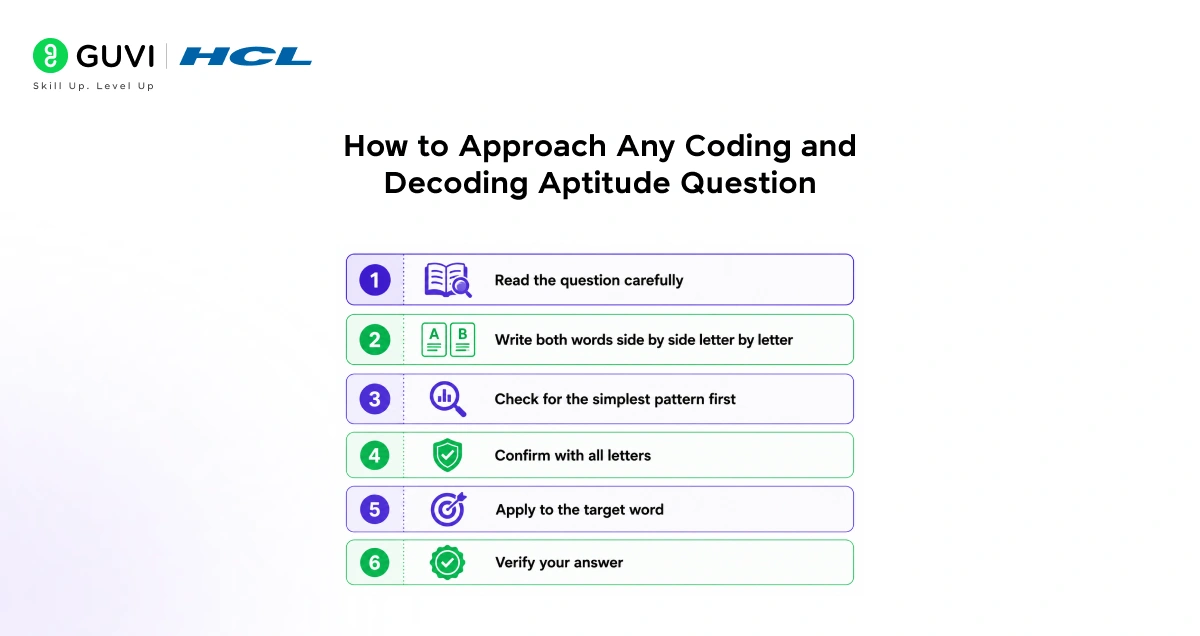
Follow this exact approach for every question and you will never be stuck:
Step 1: Read the question carefully Note the original word and its code. Do not assume the pattern before checking.
Step 2: Write both words side by side letter by letter Align original and coded letters directly below each other. This makes the pattern visible immediately.
Step 3: Check for the simplest pattern first
- Is the word reversed? Check this first.
- Is it opposite letter coding? Check if positions add up to 27.
- Is it a fixed shift? Check if the difference between positions is constant.
Step 4: Confirm with all letters Apply your identified rule to every letter in the example. If even one letter does not match, the pattern is wrong. Keep looking.
Step 5: Apply to the target word Once the pattern is confirmed, apply it systematically to each letter of the new word.
Step 6: Verify your answer Quickly re-check your final answer by reversing the process. If applying the reverse logic gives back the original word, your answer is correct.
Solve It Yourself: Practice Questions by Type
Try solving all questions on your own first. Answers are at the very end of this section.
Type 1: Letter Shifting Coding
- If CAT = DBU, what is the code for BAT?
- If MANGO = NBNHP, what is the code for APPLE?
- If KING = LJOH, what is the code for QUEEN?
- If ROSE = TQUG, what is the code for LILY?
- If COOL = EQQN, what is the code for WARM?
- If BALL = DCNN, what is the code for GAME?
- If SUN = VXQ, what is the code for MOON?
- If FISH = HKUJ, what is the code for BIRD?
- If STAR = UVCT, what is the code for MOON?
- If DESK = FGUM, what is the code for LAMP?
Type 2: Reverse Letter (Opposite) Coding
- If WATER = DZGVI, what is the code for FIRE?
- If CAT = XZG, what is the code for DOG?
- If MANGO = NZMTL, what is the code for APPLE?
- If KING = PRMT, what is the code for QUEEN?
- If ROSE = ILHV, what is the code for LILY?
- If BOLD = YLOW, what is the code for CALM?
- If STAR = HGZI, what is the code for MOON?
- If HARD = SZIW, what is the code for SOFT?
- If JUMP = QFNK, what is the code for FALL?
- If WIND = DRMS, what is the code for RAIN?
Type 3: Reverse Word Coding
- If MANGO = OGNAM, what is the code for APPLE?
- If CRICKET = TEKCRIC, what is the code for FOOTBALL?
- If TIGER = REGIT, what is the code for LION?
- If SCHOOL = LOOHCS, what is the code for COLLEGE?
- If WATER = RETAW, what is the code for JUICE?
- If BRIGHT = THGIRB, what is the code for SMART?
- If PLANET = TENALP, what is the code for EARTH?
- If MOBILE = ELIBOM, what is the code for LAPTOP?
- If DANCE = ECNAD, what is the code for MUSIC?
- If SILVER = REVLIS, what is the code for GOLDEN?

Type 4: Number Coding
- If CAT = 3-1-20, what is the code for DOG?
- If SUN = 19-21-14, what is the code for MOON?
- If BALL = 2-1-12-12, what is the code for GAME?
- If KING = 11-9-14-7, what is the code for QUEEN?
- If ROSE = 18-15-19-5, what is the code for LILY?
- If STAR = 19-20-1-18, what is the code for MOON?
- If TABLE = 20-1-2-12-5, what is the code for CHAIR?
- If MANGO = 13-1-14-7-15, what is the code for GRAPE?
- If FIRE = 6-9-18-5, what is the code for WIND?
- If BLUE = 2-12-21-5, what is the code for PINK?
Type 5: Substitution Coding
- “sky is blue” = “ra la na” and “sea is deep” = “ma la pa”. What is the code for “is”?
- “sun rises east” = “ka ta ra” and “moon rises west” = “sa ta ja”. What is the code for “rises”?
- “dog is friendly” = “pa na ma” and “cat is smart” = “ba na da”. What is the code for “is”?
- “books are useful” = “ra ba la” and “books are expensive” = “ra ba da”. What is the code for “books are”?
- “she plays well” = “da ma ka” and “he plays badly” = “na ma ra”. What is the code for “plays”?
- “red is colour” = “ja ta ra” and “blue is colour” = “ja ta pa”. What is the code for “colour”?
- “fish swim fast” = “la ra na” and “fish eat less” = “la ka ba”. What is the code for “fish”?
- “time is money” = “ra la ka” and “money is precious” = “na la ra”. What is the code for “money”?
- “run fast now” = “ba da na” and “walk slow now” = “ka sa na”. What is the code for “now”?
- “good work done” = “ra ka da” and “good result expected” = “ra la pa”. What is the code for “good”?
Type 6: Conditional or Symbolic Coding
Use this rule for all 10 questions: Vowels are coded as their alphabet position number. Consonants are coded as their opposite letter.
- What is the code for CAT?
- What is the code for SUN?
- What is the code for DOG?
- What is the code for MAN?
- What is the code for BIG?
- What is the code for RUN?
- What is the code for FLY?
- What is the code for MAP?
- What is the code for WIN?
- What is the code for JOY?
Type 7: Matrix Coding
Use this matrix for all 10 questions:
| 0 | 1 | 2 | 3 | 4 | |
| 0 | A | B | C | D | E |
| 1 | F | G | H | I | J |
| 2 | K | L | M | N | O |
| 3 | P | Q | R | S | T |
| 4 | U | V | W | X | Y |
- What is the matrix code for CAB?
- What is the matrix code for BAD?
- What is the matrix code for FIG?
- What is the matrix code for HEN?
- What is the matrix code for MAN?
- What is the matrix code for PEN?
- What is the matrix code for RAN?
- What is the matrix code for LAP?
- What is the matrix code for WIN?
- What is the matrix code for YAK?
Type 8: Mixed or Variable Shift Coding
Each word below uses the pattern +1, +2, +3, +4 and so on for each letter position.
- What is the code for CAT?
- What is the code for SUN?
- What is the code for BALL?
- What is the code for KING?
- What is the code for ROSE?
- What is the code for DESK?
- What is the code for LAMP?
- What is the code for FISH?
- What is the code for MANGO?
- What is the code for WATER?
Answers
Type 1: Letter Shifting Coding (all shift +1)
- CBU 2. BQQMF 3. RVFFO 4. VQNA 5. YCTS 6. HBNF 7. PRPO 8. DJSE 9. PRPO 10. NBNQ
Type 2: Reverse Letter (Opposite) Coding
- URHV 2. WLT 3. NZMTOV 4. JFVVM 5. OROE 6. XZON 7. NLLM 8. HLUG 9. UZOOW 10. IZRM
Type 3: Reverse Word Coding
- ELPPA 2. LLABTOOF 3. NOIL 4. EGELLOC 5. ECIUJ 6. TRAMS 7. HTRAE 8. POTPAL 9. CISUM 10. NEDLOG
Type 4: Number Coding (direct alphabet positions)
- 4-15-7 2. 13-15-15-14 3. 7-1-13-5 4. 17-21-5-5-14 5. 12-9-12-25 6. 13-15-15-14 7. 3-8-1-9-18 8. 7-18-1-16-5 9. 23-9-14-4 10. 16-9-14-11
Type 5: Substitution Coding
- la 2. ta 3. na 4. ra ba 5. ma 6. ja or ta (both appear in both) 7. la 8. ra 9. na 10. ra
Type 6: Conditional Coding (vowels = position, consonants = opposite)
- X-1-G 2. H-21-M 3. W-15-T 4. N-1-M 5. Y-9-T 6. I-21-M 7. U-O-B 8. N-1-K 9. D-9-M 10. Q-15-B
Type 7: Matrix Coding
- 02-00-01 2. 01-00-03 3. 11-12-11 4. 12-04-23 5. 22-00-23 6. 30-04-23 7. 32-00-23 8. 21-00-30 9. 42-12-23 10. 44-00-21
Type 8: Variable Shift (+1, +2, +3…)
- DBW 2. UWQ 3. CEMO 4. LKRK 5. STXH 6. EFWY 7. MCOQ 8. GJWL 9. NBQTS 10. XGYHX
Common Mistakes to Avoid in Coding and Decoding Aptitude Questions
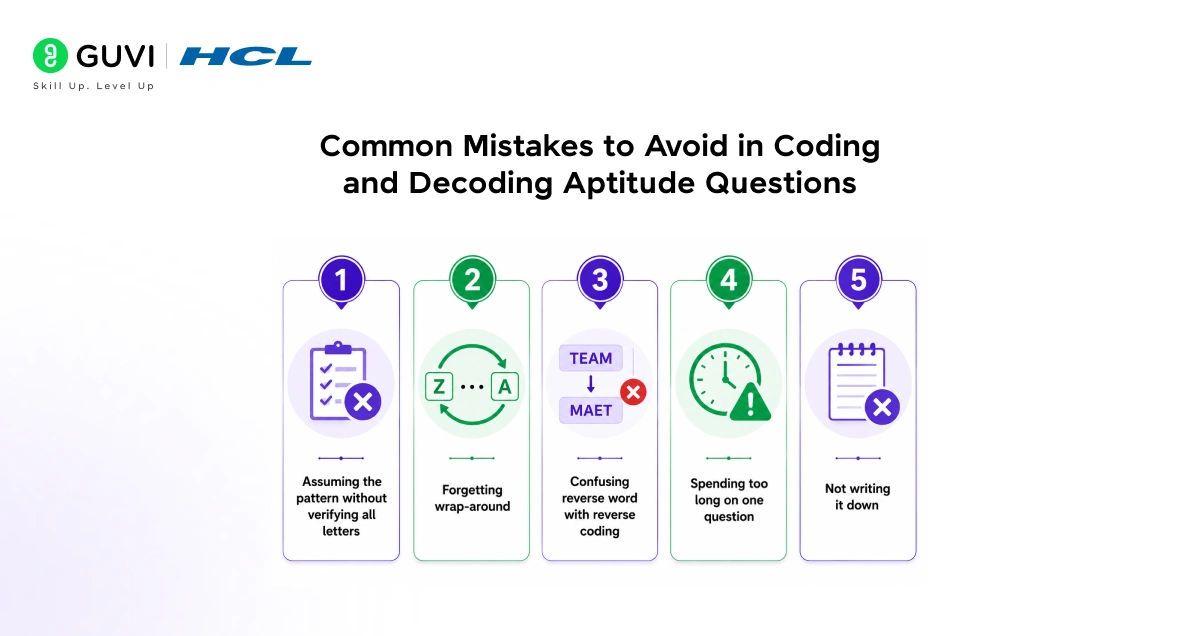
- Assuming the pattern without verifying all letters. Always confirm the rule works for every letter in the example before applying it.
- Forgetting wrap-around. If a letter is Z (position 26) and shifts +1, it wraps around to A (position 1), not a 27th letter.
- Confusing reverse word with reverse coding. Reverse word means the whole word is flipped. Reverse coding means each letter is replaced by its opposite.
- Spending too long on one question. If you cannot spot the pattern in 30 seconds, move on and come back. Time management is critical.
- Not writing it down. Always write the original and coded words in parallel columns on paper. Trying to solve coding and decoding aptitude questions in your head leads to errors.
Tips to Score Full Marks in Coding and Decoding Aptitude Questions
- Learn the alphabet positions by heart. Use EJOTY (E=5, J=10, O=15, T=20, Y=25) as anchor points and count from there.
- Check the reverse first. It takes two seconds and many questions use this pattern.
- Check opposite coding second. Add the positions of original and coded letters. If they always add to 27, it is the opposite coding.
- Look for consistent shifts. Subtract the position of the original letter from the coded letter. If the difference is the same across all letters, you have your answer.
- For substitution questions, cross-match sentences. The word that appears in two examples will have the same code in both. That is how you isolate it.
- Practice 10 questions every day. Speed only comes from pattern recognition built through regular practice.
Also read – Smart Aptitude Test Preparation in 30 Days: Complete Guide to Crack Any Company Exam
💡 Did You Know?
- Coding and decoding aptitude questions are among the highest-weightage topics in the reasoning section of SSC CGL and IBPS PO exams, with 3 to 5 questions appearing in almost every paper.
- The EJOTY trick for remembering alphabet positions has been used by toppers for decades and is still the fastest mental shortcut available for this topic.
- In competitive exams, a candidate who practices coding and decoding aptitude questions regularly can solve each question in under 25 seconds, giving them a significant time advantage over others.
Conclusion
Coding and decoding aptitude questions reward preparation more than almost any other topic in the reasoning section. There are only 8 types. Each type has a fixed logic. Once you know all six and practice spotting them quickly, these questions become guaranteed marks in every exam.
Start by memorizing the alphabet positions using EJOTY. Then work through one type at a time starting with letter shifting and reverse word coding since these are the most common. Practice 10 questions per day for two weeks and you will be able to identify any pattern in seconds. Coding and decoding aptitude questions are not about being smart. They are about being prepared.
FAQs
1. What are coding and decoding aptitude questions?
Coding and decoding aptitude questions give you a word or number written in a coded form and ask you to find the code for another word using the same logic. They test your ability to recognize patterns quickly and apply them accurately under exam time pressure.
2. How many types of coding and decoding aptitude questions are there?
There are 6 main types: letter shifting coding, reverse letter or opposite coding, reverse word coding, number coding, substitution coding, and mixed or variable shift coding. Each type has a distinct pattern and a specific solving approach.
3. What is the fastest way to solve coding and decoding aptitude questions?
Write the original word and its code side by side letter by letter. Check if the word is reversed first, then check for opposite coding, then check for a fixed shift. Confirm the rule works for all letters before applying it to the new word.
4. How do I remember alphabet positions for coding and decoding aptitude questions?
Use the EJOTY shortcut. E=5, J=10, O=15, T=20, Y=25. For any letter, find the nearest anchor and count forward or backward. With regular practice this becomes automatic within a week.
5. Which exams have coding and decoding aptitude questions?
Coding and decoding aptitude questions appear in SSC CGL, SSC CHSL, IBPS PO, SBI PO, RRB NTPC, CAT, campus placement aptitude tests, and most state-level competitive exams. They typically carry 3 to 5 marks in the reasoning section.
Success Stories

About the Author
Jebasta
I translate the language of data into stories that anyone can understand. As a writer with a data science background, I simplify analytics, AI, and decision-making so beginners and enthusiasts can confidently explore the world of data.
View all posts by Jebasta
Connect with me @















Did you enjoy this article?