


Artificial Intelligence and Machine Learning Articles
Finance Manager to Data Analytics: Career Growth, Salary and Seniority
How to Evaluate LLM Outputs in Production Deployments
AI/ML Skills Gap 2026: Why Companies Can't Find Job-Ready Talent
20 AI/ML Interview Questions Recruiters Can Use Without a Tech Background - Best Guide


Get In Touch For Details! Request More Information

State Space Search in Artificial Intelligence: The Complete Guide
Jul 02, 2026 7 Min Read 872 Views
(Last Updated)
You are trying to solve a puzzle. You know where you start. You know what solved looks like. But there are thousands of possible moves between here and there.
How do you find the right path without trying everything?
This is exactly the problem state space search was built to solve. It is one of the most fundamental ideas in all of artificial intelligence, the engine behind chess-playing programs, GPS navigation, robotic planning, and countless other systems that need to find a solution in a sea of possibilities.
In this guide, you will get a complete breakdown of state space search, how it works, why it matters, and how AI uses it to think through problems of every size and complexity. Once you see it, you will recognize it everywhere.
Table of contents
- Quick TL;DR Summary
- Why State Space Search Is the Heart of AI Problem Solving
- The Core Components of State Space Search
- Types of State Space Search Strategies
- How State Space Search Works: Step-by-Step
- Step 1: Define Your State Representation
- Step 2: Identify the Initial State
- Step 3: Define the Goal Condition
- Step 4: Enumerate Your Operators
- Step 5: Choose Your Search Strategy
- Step 6: Execute the Search
- Step 7: Extract and Verify the Solution
- Common Mistakes in State Space Search
- Getting State Space Search Right in Practice
- Real Applications of State Space Search
- Conclusion
- FAQs
- What is the difference between a state space and a search tree?
- When should I use uninformed versus informed search?
- How do I handle problems where the state space is infinite?
- What makes a good state representation?
- Is state space search still relevant with modern deep learning?
Quick TL;DR Summary
- This guide explains what state space search is and how AI uses it to solve problems by navigating from an initial state to a goal state.
- You will learn how states, operators, search trees, and goal conditions work together to represent and solve complex problems.
- The guide covers the main search strategies used in AI and when each one is the right choice for a given problem.
- Clear examples make abstract concepts concrete so the ideas stick rather than blur together.
- You will finish with a solid understanding of one of the most important foundational concepts in all of artificial intelligence.
What Is State Space Search?
State space search is the process an AI system uses to solve problems by exploring possible states. It begins from an initial state, applies operators to move between states, and searches for a path that reaches the goal state. This approach forms the foundation of planning, pathfinding, and game-playing systems in artificial intelligence.
Why State Space Search Is the Heart of AI Problem Solving
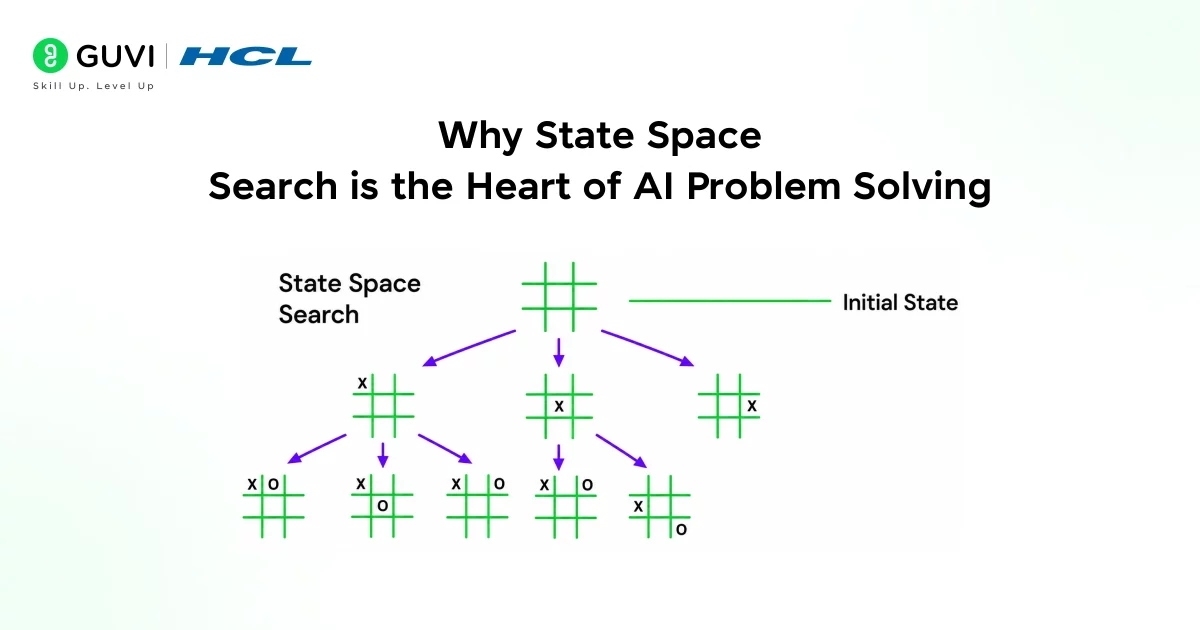
- Most real problems are navigation problems in disguise
Finding a route on a map, solving a puzzle, planning a robot’s movements, scheduling flights. These look like completely different problems. They are all the same problem underneath: find a path from where you are to where you want to be through a space of possibilities. State space search is how you do that.
- It turns vague problems into precise ones
One of the most powerful things about the state space framework is that it forces clarity. You cannot apply state space search until you have defined exactly what a state is, what operators exist, and what the goal looks like. This process of formalization often reveals ambiguities in the problem that would have caused failures later.
- It scales from simple puzzles to enormously complex decisions
The same framework that solves a sliding tile puzzle also powers chess engines that beat world champions and planning systems that coordinate complex logistics operations. The underlying idea scales across an enormous range of problem complexity.
- Every major AI search algorithm is built on top of it
Breadth first search, depth first search, A*, Best First Search, minimax. Every search algorithm you will ever encounter in AI is a specific strategy for navigating a state space. Understanding state space search means understanding all of them at once.
Read More: Top 20 Graph Algorithms You Must Know
The Core Components of State Space Search

- Component 1: The State
A state is a complete description of the problem at a particular moment. In a chess game, the state is the position of every piece on the board. In a navigation problem, the state is your current location. In a scheduling problem, the state is the current assignment of tasks to time slots. Every unique configuration of the problem is a unique state.
- Component 2: The Initial State
The initial state is where the problem begins. The starting position of the puzzle. The robot’s current location before it begins navigating. The unscheduled list of tasks before any assignments are made. The search always begins here and expands outward from this point.
- Component 3: The Goal State
The goal state defines what a solution looks like. Sometimes it is a single specific state, the puzzle solved with every tile in its correct position. Sometimes it is a condition that multiple states can satisfy, any state where the robot has reached the charging station. The search terminates when a goal state is found.
- Component 4: Operators
Operators are the actions that move the system from one state to another. Moving a puzzle tile. Taking a step in a direction. Assigning a task to a time slot. Each operator takes the current state and produces a new state. The collection of all operators defines what moves are possible within the problem.
- Component 5: The Search Tree
As the AI explores the state space, it builds a search tree. The root is the initial state. Each node is a state reached during exploration. Each branch represents the application of an operator. The search tree is the record of where the algorithm has been and what it has discovered.
The game of chess is estimated to have around 10120 possible game states—a number far larger than the estimated number of atoms in the observable universe.
Because exploring every possibility is impossible, AI systems rely on state space search algorithms that intelligently decide which positions are worth analyzing.
Techniques like heuristic search, pruning, and evaluation functions allow chess engines to navigate these enormous search spaces efficiently and make strong decisions in real time.
Types of State Space Search Strategies
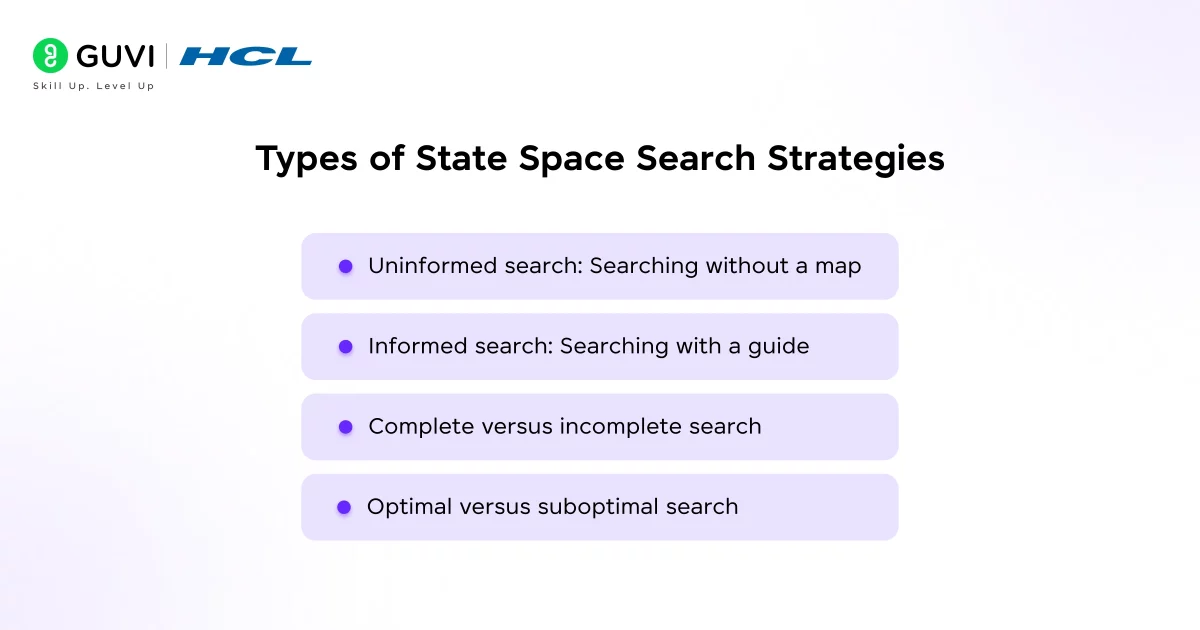
- Uninformed search: Searching without a map
Uninformed search strategies have no information about which states are closer to the goal. They explore systematically but blindly. Breadth first search explores all states at one depth before going deeper, guaranteeing the shortest path but using significant memory. Depth first search goes as deep as possible before backtracking, using less memory but not guaranteeing the shortest solution.
- Informed search: Searching with a guide
Informed search strategies use a heuristic function to estimate which states are closer to the goal and prioritize those. Best First Search always expands the state that looks most promising. A* combines the heuristic estimate with the actual cost so far, finding optimal paths efficiently. Informed search is dramatically faster than uninformed search on most real problems.
- Complete versus incomplete search
A search strategy is complete if it guarantees finding a solution when one exists. Breadth first search is complete. Depth first search on infinite graphs is not because it can follow an infinite path and never backtrack. Understanding completeness matters when you need to know whether a failure to find a solution means no solution exists or just that the algorithm missed it.
- Optimal versus suboptimal search
An optimal search finds the best solution, not just any solution. A* with an admissible heuristic is optimal. Greedy Best First Search finds solutions quickly but not always the shortest one. Choosing between optimal and suboptimal search involves a tradeoff between solution quality and computational cost that depends on your specific problem.
To go deeper on the algorithms and data structures behind state space search and AI problem solving, download HCL GUVI’s free DSA eBook and build the foundations that every serious AI developer needs.
How State Space Search Works: Step-by-Step
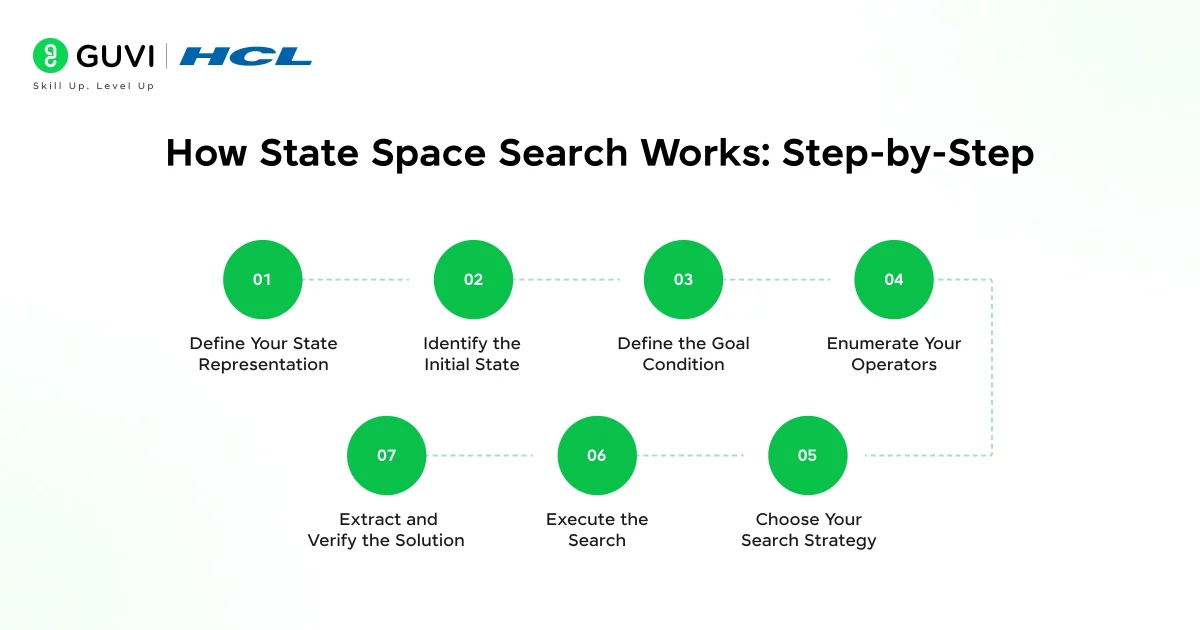
Here is exactly how to apply the state space search framework to any problem from formulation to solution.
Step 1: Define Your State Representation
Everything else depends on getting this right
Decide what information is needed to fully describe the problem at any point in time and represent it precisely. Too much information in your state makes the space unnecessarily large. Too little means different situations look identical to the algorithm. The right state representation captures exactly what matters and nothing else.
Step 2: Identify the Initial State
This is your starting point in the search space
Define the exact state the problem begins in. For a puzzle, this is the scrambled configuration. For a navigation problem, this is the current location. For a planning problem, this is the current situation before any actions are taken. Be precise. Ambiguity in the initial state causes ambiguity everywhere downstream.
Step 3: Define the Goal Condition
Know what you are looking for before you start searching
Define what a solution looks like. This can be a specific state, reach location X, or a condition that multiple states satisfy, any state where the battery is above 20 percent. Write this as a function that takes a state and returns true if it is a goal state. This function is what the search uses to know when it can stop.
Step 4: Enumerate Your Operators
Define every possible move in the problem
List every action that can change the current state to a new state. For each operator, define the preconditions that must be true for it to apply and the effect it has on the state. Complete operator definition is critical. Missing an operator means the search might never find a solution that requires that action.

Step 5: Choose Your Search Strategy
Match the strategy to the problem’s properties
If you need the optimal solution and have a good heuristic, use A*. If you need any solution quickly and optimality does not matter, use greedy Best First Search. If the state space is small and you need guaranteed completeness, breadth first search works fine. If memory is very limited, depth first search or iterative deepening is more appropriate. The right strategy depends on your specific constraints.
Step 6: Execute the Search
Run the algorithm and track what gets explored
Initialize the frontier with the initial state. Repeatedly select a state from the frontier according to your strategy, check if it is a goal state, generate its successors by applying all applicable operators, and add new states to the frontier. Track visited states to avoid exploring the same state twice on graphs with cycles.
Step 7: Extract and Verify the Solution
Trace back the path and confirm it is valid
When a goal state is found, trace back through parent pointers to reconstruct the sequence of operators that leads from initial state to goal. Verify that each operator application is valid and that the final state actually satisfies the goal condition. The path of operators is your solution, the sequence of actions the AI recommends taking.
Common Mistakes in State Space Search
- Defining states with too much information, making the space exponentially larger than necessary
- Forgetting to track visited states and letting the search loop forever on graphs with cycles
- Choosing an uninformed strategy for a large problem where a heuristic is available
- Defining operators incorrectly so they produce invalid states or miss valid transitions
- Confusing the search tree with the state space itself, they are related but different structures
- Using an inadmissible heuristic with A* and losing the optimality guarantee
- Not checking whether a solution actually exists before running an expensive search
Getting State Space Search Right in Practice
- Start with the simplest strategy that might work
Breadth first search on a small problem is always faster to implement correctly than A* on the same problem. Start simple. Verify your state representation and operators are correct. Then upgrade to a smarter strategy when you need better performance.
- Visualize the search tree on small examples
Before running your search on the full problem, draw the search tree for a tiny version by hand. This reveals errors in your state representation and operator definitions faster than any debugging session.
- Test your goal condition independently
Write tests that check your goal condition function on states you know are goals and states you know are not. A subtle bug in the goal condition is one of the most common sources of search failures and one of the hardest to spot during debugging.
- Profile which states are being expanded
When search is slower than expected, log which states are being expanded. If the same states keep appearing, your visited-state tracking is broken. If the search is expanding states obviously far from the goal, your heuristic needs work. What gets expanded tells you everything about what is going wrong.
- Consider the state space size before choosing a strategy
Estimate how many states your problem has before choosing a search strategy. A problem with thousands of states can use breadth first search comfortably. A problem with millions or billions of states needs an informed strategy with a good heuristic or the search will never finish in useful time.
IBM’s Deep Blue, the chess computer that defeated world champion Garry Kasparov in 1997, could evaluate roughly 200 million chess positions per second.
It achieved this using powerful state space search algorithms combined with sophisticated evaluation functions that estimated the quality of board positions.
Modern chess engines go even further by using learned evaluation functions trained through millions of self-play games, allowing them to discover strategies beyond traditional handcrafted rules.
Real Applications of State Space Search
- GPS and navigation systems
Every route calculation your GPS makes is a state space search on a road network graph. The state is your current location. The goal is your destination. The operators are road segments. The search finds the optimal path using A* with heuristics based on geographic distance and traffic data.
- Game playing AI
Chess, Go, and other game-playing AI systems use state space search to look ahead through possible game states. The state is the current board position. Operators are legal moves. The search explores future states to find moves that lead to winning positions.
- Robot motion planning
Autonomous robots plan their movements through physical environments using state space search. The state represents the robot’s configuration in space. Operators represent possible movements. The search finds collision-free paths from the current position to the target.
- Automated planning systems
Logistics, scheduling, and resource allocation systems use state space search to find feasible plans. Supply chain optimization, flight scheduling, and manufacturing planning all involve searching through enormous spaces of possible configurations to find ones that satisfy complex constraints.
To learn more about State Space Search, do not miss the chance to enroll in HCL GUVI’s Intel & IITM Pravartak Certified Artificial Intelligence & Machine Learning course. Endorsed with Intel certification, this course adds a globally recognized credential to your resume, a powerful edge that sets you apart in the competitive AI job market.
Conclusion
State space search is not one algorithm. It is a way of thinking about problems.
The moment you can define a problem in terms of states, operators, and goals, you have access to the entire toolkit of AI search algorithms. Every search strategy ever developed, from the simplest breadth first search to the most sophisticated modern planning system, is a different way of navigating the same fundamental structure.
This is why state space search sits at the foundation of artificial intelligence. It is the framework that turns real-world problems into computational ones and computational ones into solutions.
Master this and you have not just learned an algorithm. You have learned how AI approaches problems at the most fundamental level. Everything else builds on top of it.
FAQs
1. What is the difference between a state space and a search tree?
The state space is the set of all possible states in a problem. The search tree is the structure the algorithm builds as it explores that space, with the initial state at the root and branches representing operator applications. The same state can appear multiple times in a search tree but exists only once in the state space.
2. When should I use uninformed versus informed search?
Use uninformed search when you have no information about which states are closer to the goal or when the problem is small enough that blind exploration is fast enough. Use informed search whenever you can define a heuristic that estimates proximity to the goal, which is most real problems of any significant size.
3. How do I handle problems where the state space is infinite?
Use search strategies with depth limits, iterative deepening depth first search, or heuristic-guided approaches that avoid going too deep in unproductive directions. Infinite state spaces require explicit management of search depth or you risk running forever without finding a solution.
4. What makes a good state representation?
A good state representation captures exactly the information needed to determine what actions are available and what the result of each action will be. It should be no larger than necessary, efficient to compare for equality, and easy to generate successor states from.
5. Is state space search still relevant with modern deep learning?
Absolutely. Deep learning and state space search are complementary. AlphaGo and AlphaZero combine deep neural networks for state evaluation with tree search for planning. The most powerful AI systems in games, robotics, and planning all use state space search as a core component alongside learned models.
Success Stories

About the Author
Vishalini Devarajan
An Aerospace Engineer turned content writer, I focus on making complex concepts easy to understand through well-structured, reader-friendly blogs. Whether it’s a technical topic or a non-technical one, I love creating content that is clear, engaging, and impactful.
View all posts by Vishalini Devarajan
Connect with me @


















Did you enjoy this article?