


Artificial Intelligence and Machine Learning Articles
Text Classification with Scikit-learn: TF-IDF to BERT
MLflow Experiment Tracking: A Complete Beginner's Guide
Optuna for Hyperparameter Optimization
Explainable ML with SHAP Values: Interpreting Black-Box Models


Get In Touch For Details! Request More Information
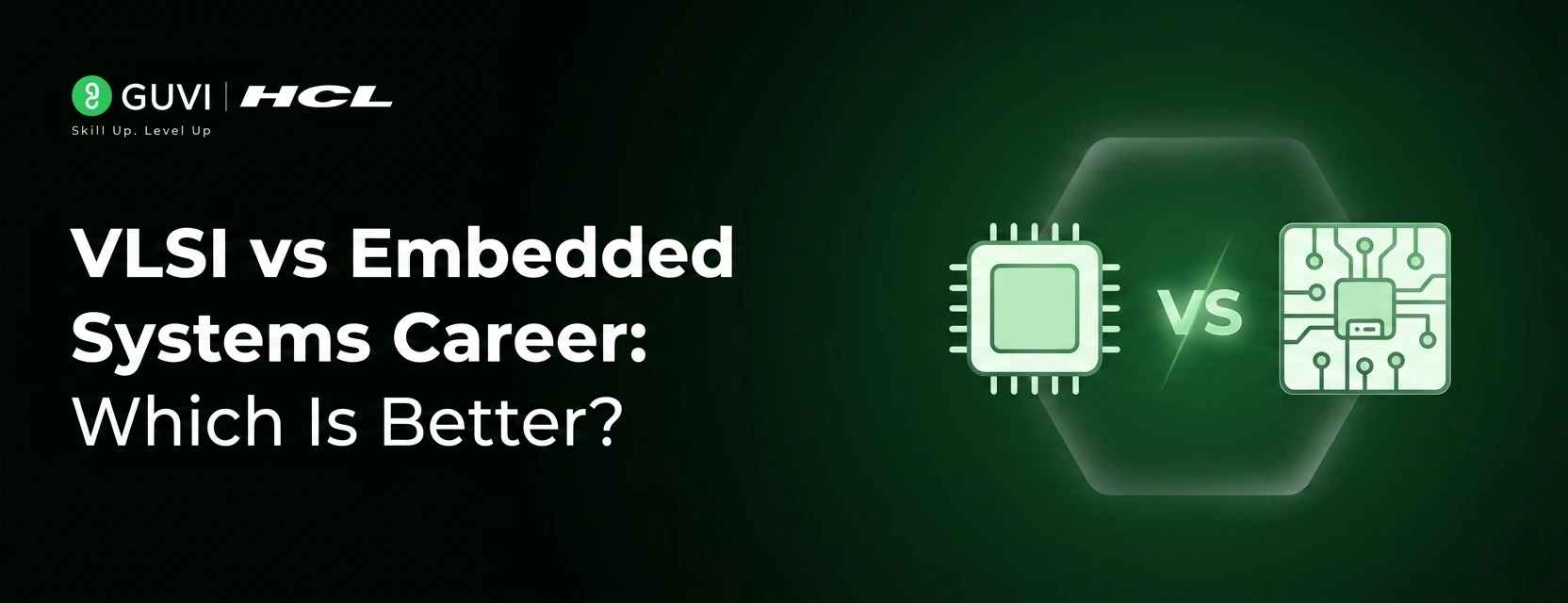
VLSI vs Embedded Systems Career: Which Is Better?
May 07, 2026 5 Min Read 630 Views
(Last Updated)
The question of VLSI versus Embedded Systems isn’t just a subject choice; it’s a career path decision, a path that will define how you will work, think, and develop over time in the technology space. Both fall in the realm of modern electronics, yet operate at different depths of technology.
One focuses on building the core of the system, while the other focuses on making it function in real-world applications. This directly impacts how you work day-to-day and shapes your career path.
This article provides you with an understanding not only of what VLSI vs embedded systems career paths are, but also of the actual career implications you will face when deciding between them in 2026 and the coming years.
Table of contents
- TL;DR
- Core Difference Between VLSI vs Embedded Systems Career Paths
- Job Market Reality in India (2026)
- Salary Comparison: What You Actually Get
- Skills You Need: Practical vs Theoretical
- Embedded Systems Skills
- VLSI Skills
- Practical Example: How Work Differs
- Embedded Systems Example
- VLSI Example
- Future Scope (2026–2030)
- Career Decision Logic
- Choose Embedded Systems if
- Choose VLSI if
- Critical Insight
- How to Make the Right Choice
- Conclusion
- FAQs
- Which is better, a VLSI or an embedded systems career?
- Is VLSI harder than embedded systems?
- Can a fresher get a job in VLSI easily?
- Which field has more job opportunities in India?
- Can I switch from embedded systems to VLSI later?
- Does VLSI have a future with AI growth?
TL;DR
- A VLSI versus embedded systems career distinction can be characterized as a distinction between roles related to chip-level design and those related to product-level development.
- Embedded Systems can lead to a relatively quick career entry and opportunities, as well as very practical developmental roles.
- VLSI will give more career potential in the longer term, but at the cost of greater specialization and delayed entry into a role.
- Embedded Systems and VLSI career paths involve hardware-to-software interaction, as opposed to solely hardware-level chip design.
- Both roles are very future-proof; however, a career decision hinges upon whether you prefer speed and extensibility or depth and specialization.
What is the difference between VLSI and an Embedded Systems Career?
The difference between a VLSI and embedded systems career is based on the level of work in electronics. VLSI focuses on integrated circuits and chip-level design, while embedded systems focus on writing software or firmware that runs on and controls hardware devices.
Core Difference Between VLSI vs Embedded Systems Career Paths
The fundamental difference that the reader is likely to be most interested in is the type of work performed.
Embedded Systems engineers, primarily, are involved in the development of actual products. They are responsible for coding, connecting various sensors, debugging the hardware, and ensuring that the product operates appropriately in real time.
VLSI engineers then work one level deeper. The chips are developed by VLSI engineers and then implemented in devices. They work with transistors, logic gates, and the like at a level of silicon design.
To better understand VLSI design at a deeper level, you can explore a detailed guide.
If you confuse these roles, the entire career comparison becomes meaningless. One is about execution and integration, the other is about foundation and design.
Job Market Reality in India (2026)
Embedded systems are one where you can get a lot of options, be it automotive, IoT, robotics, or consumer electronics. Each has a demand for engineers to build and maintain products.
VLSI is very limited in its market scope, as there are few openings, requiring you to be a niche expert in RTL, verification, and physical design.
- Embedded has more openings across industries.
- A fresher entry can be comparatively easy with good project experience.
- Short time to become job-ready.
- VLSI positions are limited, yet require an extremely strong grip on fundamentals.
- A fresher entry requires you to have adequate academic as well as technical prerequisites.
So here you can see a vast difference between Embedded (volume hiring) and VLSI (selective hiring).
Salary Comparison: What You Actually Get
Salary is definitely one of the strongest factors, but it differs between the two.
Embedded systems pay you a moderate beginning salary with a constant and stable increment throughout your journey across industries, enabling you to enter the market soon and then grow with experience and domain exposure.
VLSI will definitely pay you well, as it reaches high salary levels. Your starting may not be that far apart, but a senior position in VLSI requires and pays an extremely high amount compared to others due to its specialized nature.
- Embedded: Fresher – 2.5–5 LPA
- VLSI: Fresher – 3–7 LPA
- Embedded mid-level grows quite well across industries.
- VLSI mid-level and above – 25–50+ LPA
If you want to get into the market quickly, then Embedded will lead you; if you want to reach extreme heights, then VLSI will lead you.

Skills You Need: Practical vs Theoretical
When building, the skills you use most heavily depend on the nature of the skill sets you are developing.
Embedded systems will primarily involve hands-on development and execution; you will be programming, debugging hardware, working with actual devices, etc.
VLSI is far more theory-driven and tool-dependent; you will be designing circuits, simulating logic, analyzing, and optimizing chip performance, etc.
Embedded Systems Skills
- C and C++ to write firmware.
- Microcontrollers such as ARM, AVR, etc.
- RTOS concepts for real-time system development.
- Debugging hardware using oscilloscopes and logic analyzers.
- Communication protocols like I2C, SPI, CAN, etc.
VLSI Skills
- Verilog and VHDL to describe hardware.
- Basic CMOS and digital electronics.
- EDA tools (Electronic Design Automation) like Cadence and Synopsys.
- Timing analysis and chip verification.
Therefore, Embedded systems are project-driven, while VLSI systems are precision-driven. To explore commonly used VLSI design tools in the industry, you can refer to this.
Practical Example: How Work Differs
Let us understand how these concepts work in practice,
Embedded Systems Example
A simple firmware loop controlling a sensor:
#include <stdio.h>
int sensorValue = 0;
int main() {
while(1) {
sensorValue = readSensor();
if(sensorValue > 50) {
turnOnMotor();
} else {
turnOffMotor();
}
}
}
This is real-time decision-making with hardware interaction.
VLSI Example
A basic logic module in Verilog:
module comparator(
input [3:0] A,
input [3:0] B,
output reg greater
);
always @(*) begin
if (A > B)
greater = 1;
else
greater = 0;
end
endmodule
This is hardware logic design, not software execution.
In simpler terms,
Embedded = you control devices
VLSI = you design what controls devices
After building hands-on understanding like this, strengthening your programming fundamentals becomes important. You can explore HCL GUVI’s Python ebook to improve scripting and automation skills that support both embedded and VLSI workflows.
Future Scope (2026–2030)
Both are growing at an accelerating rate; however, the growth drivers are different.
Embedded systems are growing extremely fast due to IoT, Electric Vehicles, Robotics, and smart gadgets. Essentially, every connected device has firmware and system integration.
VLSI is growing extremely fast due to semiconductor industry growth, AI chips, and government initiatives for chip manufacturing.
- Embedded is driven by widespread adoption across industries.
- VLSI is driven by targeted global demand for semiconductors.
- Embedded offers scope across different domains.
- VLSI offers cutting-edge specialization and global opportunities.
Both careers are future-proof, but the growth that you will achieve depends on your entry and specialization.
Career Decision Logic
One should choose these careers based on personal strengths and preferences rather than trends.
Choose Embedded Systems if
- You want faster placement and security in a job.
- You have an interest in coding as well as interacting with hardware.
- You want to work on a finished product.
- You have an interest in diversified industries.
Choose VLSI if
- You are good at digital electronics.
- You have the capacity for studying theory-based content in depth.
- You have more time for learning and getting a job.
- You want a job in the semiconductor and chip design domains.
If you want a step-by-step path, you can explore this VLSI career roadmap.
Critical Insight
The real positioning of both should be considered as such:
Embedded Systems is an early, safe, fast, and momentum-generating career. You gain experience quickly and have lots of job opportunities at hand, which gives you the flexibility to choose any of your domains.
VLSI is a high-risk, high-reward career, which is for students who are patient and want to invest in the long term with massive pay-offs.
This differentiation helps in making a smart career choice.
India’s semiconductor market is projected to exceed $100 billion by 2030, driven by major investments in chip manufacturing and design.
This growth is expected to make VLSI roles more valuable, while also increasing competition and skill requirements for aspiring engineers.
How to Make the Right Choice
Rather than asking what’s better, two questions must be asked.
Do you need to work fast, or can you wait and learn a very specific thing?
Do you like constructing a whole system, or do you like designing a technology that is going to be part of a system?
Whatever your response is will lead you to where you should go next.
If you’re leaning toward VLSI and want to build strong fundamentals in chip design, RTL, and verification, you can explore HCL GUVI’s VLSI Course to get hands-on exposure to industry-relevant concepts.
Conclusion
There is no single winner between embedded and VLSI career paths.
Embedded systems are best for fast, versatile, and early entry into industry, while VLSI is best for depth, specialization, and high-end jobs.
The intelligent choice isn’t a better career path. The better choice is how you would prefer to work every day.
Since both embedded systems and VLSI are advancing towards an AI-dominated world, like AI chip design and edge intelligence, a study on the interaction between hardware and software has become more important than ever.
FAQs
1. Which is better, a VLSI or an embedded systems career?
Neither is universally better. Embedded is better for faster entry, while VLSI is better for long-term specialization and higher pay.
2. Is VLSI harder than embedded systems?
Yes, VLSI generally has a steeper learning curve due to its focus on digital electronics, chip design, and EDA tools.
3. Can a fresher get a job in VLSI easily?
It is possible, but harder. Most VLSI roles require strong fundamentals or specialization, sometimes including postgraduate study.
4. Which field has more job opportunities in India?
Embedded Systems has more job openings because it is used across multiple industries like IoT, automotive, and robotics.
5. Can I switch from embedded systems to VLSI later?
Switching is difficult but possible with additional learning in digital design, HDL languages, and semiconductor concepts.
6. Does VLSI have a future with AI growth?
Yes, VLSI is critical for AI because it enables the design of chips that power AI systems and hardware acceleration.
Success Stories

About the Author
Vishalini Devarajan
An Aerospace Engineer turned content writer, I focus on making complex concepts easy to understand through well-structured, reader-friendly blogs. Whether it’s a technical topic or a non-technical one, I love creating content that is clear, engaging, and impactful.
View all posts by Vishalini Devarajan
Connect with me @









Did you enjoy this article?