


Artificial Intelligence and Machine Learning Articles
Dropout Regularization in Neural Networks
Federated Learning: Training Models Without Centralizing Data
Attention Mechanism Explained: The Building Block of Transformers


Get In Touch For Details! Request More Information
Campus x Replit: AI App Building Revolution
Jun 24, 2026 5 Min Read 800 Views
(Last Updated)
Ever get excited to build an app, then hit the setup wall? Environments, packages, and syntax friction kill ideas before code starts. This idea-to-app gap took years to close. Vibe coding changes everything.
Replit + Campus launched Vibe Coding 101 for zero-experience builders. Andrew Ng’s free deep learning. The AI course teaches the same AI-agent approach. Describe apps in plain English. AI handles the code. From idea to deployed product, no syntax needed.
In this article, we will walk through what vibe coding actually is, what both the Campus x Replit and Deep Learning AI courses teach, who they are designed for, what you will build during the course, and how to enroll and get started today.
Table of contents
- TL;DR: Vibe Coding 101 in 5 Points
- Vibe Coding 101 Course
- Campus x Replit: Full Program Details
- Deep Learning. AI Free Short Course
- The Five-Skill Framework at the Core of Both Courses
- Thinking: Structure Before Prompting
- Frameworks: Leverage Existing Tools
- Checkpoints: Track Progress Systematically
- Debugging: Describe Problems Clearly
- Context: Provide Project Background
- What You Actually Build in the Courses
- Who Should Take These Courses
- Final Thoughts
- FAQ’s
- How is vibe coding different from regular coding?
- What makes Replit perfect for beginners?
- Do I need prior AI/prompting experience?
- What's the time commitment for each course?
- Can I add these projects to my portfolio?
TL;DR: Vibe Coding 101 in 5 Points
- Zero coding needed: Build/deploy real apps using AI prompts on Replit, with no setup friction.
- Two courses: Free 2 hr Deep Learning. AI intro vs. 8-week Campus x Replit with credits/4 apps.
- Vibe coding = AI agency: Describe ideas → AI builds; focus on architecture, not syntax.
- Build voting apps and analyzers: Hands-on projects deploy live from week 1.
- For beginners: Founders, non-tech pros, and students start free at deeplearning.ai today.
What is Campus x Replit: AI App Building Revolution?
The Campus x Replit partnership democratizes AI app development for students through no-code Replit Agent workflows. Learners can build and deploy production-ready AI and machine learning applications using intuitive prompts, without requiring prior coding experience.
Vibe Coding 101 Course
It is a beginner-friendly program that teaches you to build and ship real apps using AI tools, with no prior coding experience required.
Vibe Coding 101 is an immersive 8-week live online program that teaches students how to design, build, and deploy real apps using AI tools. Led by Campus’s world-class faculty, who also teach at institutions like Stanford and Northwestern, alongside industry experts from companies like Meta, PayPal, and Coinbase, helps learners ship real projects from week one.
By the end of the program, students walk away with four completed apps, academic credits, and practical AI skills they can immediately apply in the real world.
Campus x Replit: Full Program Details
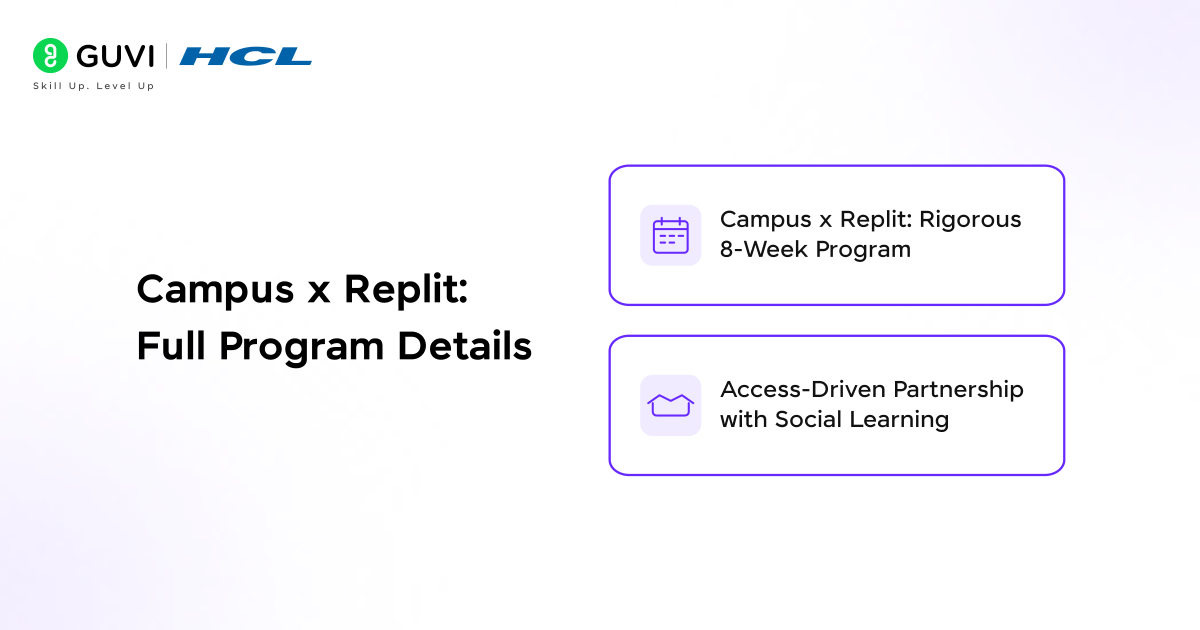
- Campus x Replit: Rigorous 8-Week Program
- The Campus x Replit partnership produces the more structured and academically rigorous of the two course options. It is built for people who want a deeper experience, real accountability, and a credential they can point to at the end.
- The program is led by the campus’s world-class faculty who also teach at institutions like Stanford and Northwestern, alongside industry experts from companies like Meta, PayPal, and Coinbase.
- The course helps learners ship real projects from week one. By the end, students walk away with four completed apps, academic credits, and hands-on AI skills they can immediately apply in the real world.
- Access-Driven Partnership with Social Learning
- The goal behind the partnership is explicitly about access. Replit is proud to partner with Campus, an institution known for its mission to maximize access to a world-class education. Campus embodies the same values that shape Replit: accessibility, creativity, and collaboration.
- This partnership is a match made in heaven, as both Campus and Replit are committed to making AI upskilling accessible to all. The program also builds in the kind of social learning that accelerates growth.
- The program mirrors Replit’s spirit of rapid experimentation. Learners move quickly from concept to prototype, using AI at every step to speed up understanding and creation. Students learn together, build together, and amplify each other’s ideas through group projects, peer feedback, and open remixing.
- This is not a course you complete alone in isolation; it is a cohort experience where the community is part of the learning.
Deep Learning. AI Free Short Course
- The second offering is the free “Vibe Coding 101 with Replit” course published on DeepLearning. AI in partnership with Replit was launched on March 26, 2025. This is a shorter, video-focused experience designed for people who want to learn the core concepts and start building quickly.
- The course lasts 1 hour and 34 minutes and is taught by Michele Catasta, president of Replit, and Matt Palmer, head of developer relations at Replit.
- The combination of the platform’s president and its developer relations head means you are getting both the strategic vision behind how Replit is built and the practical guidance of someone who spends every day helping developers use it effectively.
- Replit eliminates many of the barriers that prevent users from building and deploying applications. It provides a powerful code editor and a universal package manager, so you do not need to struggle with the installation of Python and JavaScript packages.
- Source control is powered by Git but made as seamless as possible. Replit also offers built-in key-value stores, databases, and deployment solutions.
- Now, with Replit Agent, every person with no coding experience can create apps and deploy them publicly. This is the platform the free course is built around, and because it is browser-based, you never need to install anything locally.
The Five-Skill Framework at the Core of Both Courses
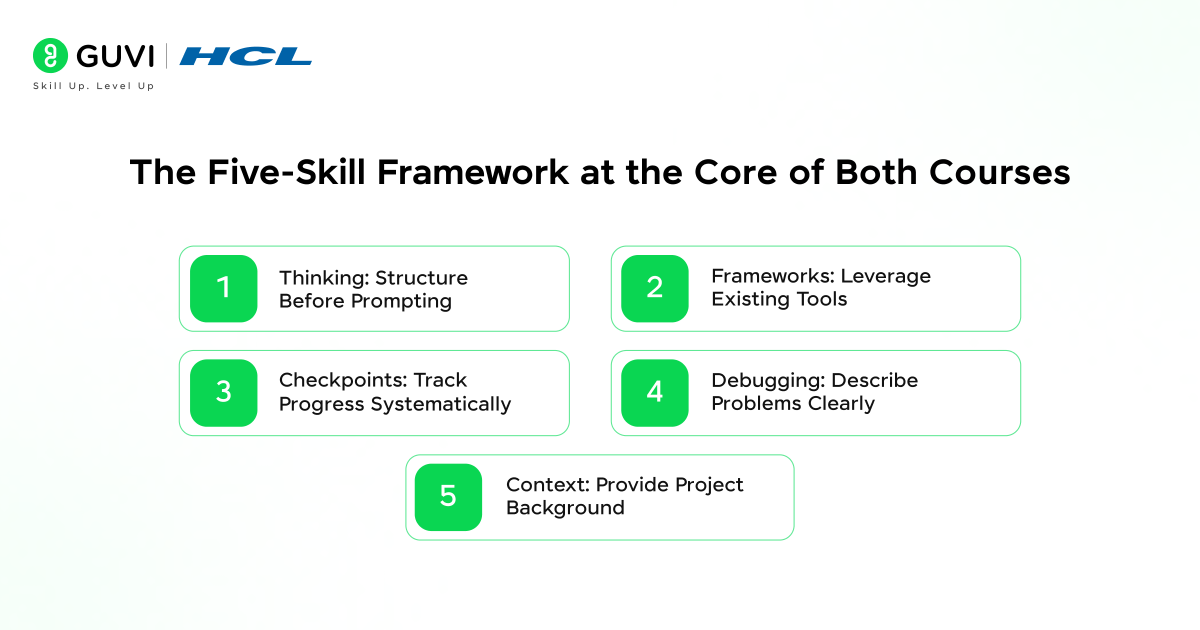
1. Thinking: Structure Before Prompting
Both courses teach thinking as the first skill, structuring ideas before prompting AI agents. Be precise, give one task at a time, make prompts specific, keep projects tidy, and start fresh sessions for new features. These habits separate consistent results from frustration.
2. Frameworks: Leverage Existing Tools
Using frameworks means knowing existing libraries, so AI doesn’t reinvent solutions. Instead of asking agents to build from scratch, reference proven tools. This skill accelerates development while ensuring robust, industry-standard implementations.
3. Checkpoints: Track Progress Systematically
Checkpoints involve saving working project states before major changes. Always maintain a stable version to return to when experiments fail. This systematic tracking prevents lost progress and builds confidence in iterative development.
4. Debugging: Describe Problems Clearly
Debugging with AI requires describing exactly what went wrong, not just “fix it.” Learn to articulate errors precisely so agents solve root causes effectively. This discipline turns debugging into a reliable collaboration skill.
5. Context: Provide Project Background
Providing context gives agents your project’s goals, constraints, and background. Without it, AI builds technically correct but misaligned solutions. Rich context ensures the agent delivers exactly what your vision requires.
Vibe coding, popularized by Andrej Karpathy, allows non-developers to ship applications in hours using tools like Replit Agent—without worrying about package installs or local setup.
Andrew Ng emphasizes modular prompting over one-shot instructions, improving how developers guide AI systems to build reliably.
Programs like Campus x Replit combine top-tier faculty with industry experts from companies like Meta and Coinbase, offering structured 8-week cohorts.
Participants build multiple deployable apps with academic-style rigor, while benefiting from Replit’s seamless in-browser workflow where Git, databases, and deployments are handled automatically—ideal for founders rapidly prototyping MVPs without hiring developers.

What You Actually Build in the Courses
- Both courses are project-based, which means your learning happens through building real things rather than completing exercises disconnected from practical application.
- In the DeepLearning.AI short course, you build two applications. The first is a Website Performance Analyzer Prototype: you craft a product requirement document and wireframe, then guide the AI agent to build and refine a visually appealing prototype for deployment.
- The second is a National Park Ranking App: a head-to-head ranking application with voting capabilities and persistent data storage, using a sample dataset, which you refine by asking the agent to explain and improve the build.
- The course teaches how to create a product requirement document and wireframe for the agent to build a prototype, use the agent to make the prototype more visually appealing, and switch to assistant mode to customize applications with screenshots and prompts.
- Deploy the application so others can access it online, build a voting app with persistent data storage, and refine the app by asking the assistant to recap and explain what it built to find room for improvement and reinforce learning.
- The Campus x Replit 8-week program goes deeper. By the end of the program, students walk away with four completed apps.
- These are real, deployed applications, not toy examples that students can show to employers, use for their own projects, or continue developing after the course ends. The academic credit component adds dimension for students who want their learning formally recognized.
Who Should Take These Courses
Both courses are explicitly designed for people without a technical background, but they serve slightly different audiences based on their format and time commitment.
- Deep Learning. The AI short course is ideal if you want a fast, free introduction to vibe coding concepts with hands-on projects you can complete in an afternoon. While open to all, deep learning.
- AI notes that some coding experience and familiarity with prompting large language models will help learners maximize the course.
- That said, the course is designed to be accessible even for people just starting on the Replit platform itself, which handles most of the setup complexity, and the structured approach means you are guided at every step.
- The Campus x Replit 8-week program is the right choice if you want accountability, peer community, formal credentials, and the experience of building across a full cohort cycle with expert instructors.
- The goal is to make it possible for anyone, not just engineers, to build useful tools fast. Founders building their first product, professionals wanting to prototype ideas without hiring a developer, and students looking to add practical AI skills to their resume are all strong candidates for this program.
Ready to dominate AI and ML? Enroll now and launch your future in artificial intelligence: Start Your AI ML Journey
Final Thoughts
Vibe coding is not a gimmick or a shortcut for people who do not want to learn. It is a legitimate shift in how software gets built, one that moves the skill requirement from memorizing syntax to thinking clearly, communicating precisely, and iterating quickly. Vibe Coding 101 with Replit reflects a broader trend of AI transforming how we code.
As Ng explains, it is not about blindly accepting AI output but about refining your approach to work smarter and faster. Replit and Campus are here to help you create, experiment, and ship fast. Whether you start with the free DeepLearning. AI short course this afternoon, or register for the full 8-week Campus x Replit program; the most important step is the first one.
Pick a project idea you actually care about, open Replit, and start describing what you want to build. The process will teach you more than any guide can.
FAQ’s
1. How is vibe coding different from regular coding?
You describe app features in plain English. AI agents handle all implementation. Focus shifts from syntax to architecture and iteration.
2. What makes Replit perfect for beginners?
Browser-based, no installs, built-in Git/databases/deployment. Replit Agent turns prompts into full apps instantly.
3. Do I need prior AI/prompting experience?
No, the courses teach structured prompting from scratch. Both assume zero technical background.
4. What’s the time commitment for each course?
Free Deep Learning. AI: 1hr 34min on-demand. Campus x Replit: 8 weeks of live sessions + projects.
5. Can I add these projects to my portfolio?
Yes, both courses produce deployed apps (2 in the free course, 4 in the full program), perfect for GitHub/resumes.
Success Stories

About the Author
Vishalini Devarajan
An Aerospace Engineer turned content writer, I focus on making complex concepts easy to understand through well-structured, reader-friendly blogs. Whether it’s a technical topic or a non-technical one, I love creating content that is clear, engaging, and impactful.
View all posts by Vishalini Devarajan
Connect with me @






Did you enjoy this article?