


Artificial Intelligence and Machine Learning Articles
AI/ML Skills Gap 2026: Why Companies Can't Find Job-Ready Talent
20 AI/ML Interview Questions Recruiters Can Use Without a Tech Background - Best Guide
How Industry-Backed AI/ML Bootcamps Are Changing the AI/ML Hiring Pipeline - Best Guide 2026
From IT Support to AI Engineer: A Realistic Career Switch Guide 2026


Get In Touch For Details! Request More Information
How to Use the Open Targets Connector in Claude?
Jun 16, 2026 4 Min Read 741 Views
(Last Updated)
Modern biomedical research is no longer limited by a lack of data. The difficulty now lies in interpreting massive amounts of scattered data that span genetics, diseases, and drug discovery processes.
In current research workflows, scientists will waste valuable time navigating individual datasets, studying GWAS data, exploring variant associations, comparing drug targets, and looking up literature. This means a slow decision-making process and the risk of losing important insights.
However, the Open Targets Connector built into Claude is set to revolutionize these processes. Using it will give researchers the ability to instantly access interpreted, evidence-backed information without having to manually skim through multiple applications.
In this article, you will discover how to install and utilize the Open Targets Connector within Claude, what happens when it works under the hood, and use cases demonstrating the tool’s value in disease research and drug discovery.
TL;DR
- Open Targets Connector integrates with Claude to provide access to up-to-date data on targets from the Open Targets Platform.
- It will help you identify and prioritize drug targets by linking them to the appropriate diseases using relevant evidence.
- You will be able to interact with genetic associations, GWAS data, drug safety, and other information using natural language.
- It brings various datasets into a single system and cuts down the researchers’ time to analyze them considerably.
- It can be highly beneficial for bioinformaticians, researchers, and healthcare applications powered by AI.
Table of contents
- What is the Open Targets Connector in Claude
- What is the Open Targets Platform
- Why is this connector important for modern research
- Key Features and Capabilities
- Target Discovery
- Evidence Breakdown
- How the Connector Works Inside Claude
- Step-by-Step Setup Guide
- For Individual Users
- For Teams
- For Claude Code Users
- How to Use It with Example Prompts
- Discovery of Disease Targets
- Genetic Studies Analysis
- Evaluating a Drug
- Comparing Two Targets
- Real-World Use Cases
- Drug Discovery Teams
- Academia
- Bioinformatics Tools
- Strategic Decision-Making
- Best Practices
- Common Mistakes to Avoid
- Conclusion
- FAQs
- What is the Open Targets Connector used for?
- Do I need a technical background to use it?
- Can it be used for real research?
- Does it provide real-time data?
- Is the data free to use?
- What makes it different from other tools?
What is the Open Targets Connector in Claude
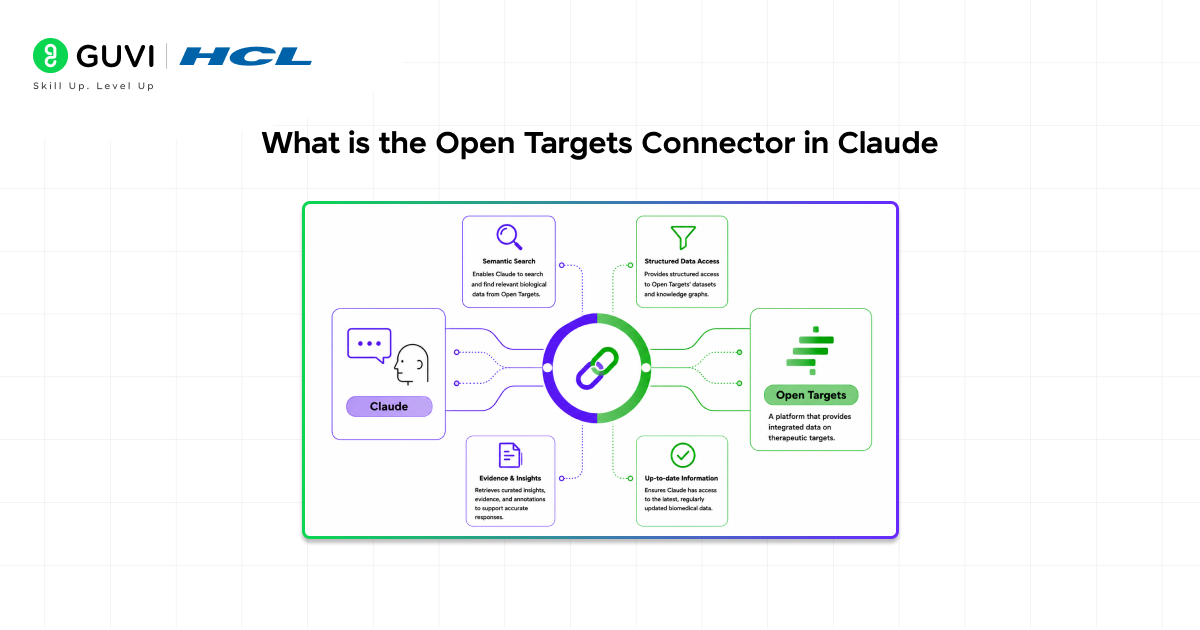
The Open Targets Connector integrates Claude with the Open Targets Platform, which is a massive-scale biomedical resource for understanding which genes and proteins are linked to particular diseases, and thus are targets for drug development.
Instead of simply knowing what we’ve trained it on, we can access the data in Open Targets, which has data related to genes, proteins, diseases, drugs, and the relationships between them, and use that to understand and reason about biomedical data, rather than simply accessing static knowledge.
This elevates Claude from a ‘general purpose’ AI assistant into a powerful research assistant, which can do “real” scientific reasoning. You can understand biology through actual biomedical data rather than through pre-trained static knowledge.
What is the Open Targets Platform
The Open Targets Platform is used by researchers around the world in order to identify potential drug targets through analysis of a large number of disparate sources of biological data.
This integrates into a unified system all relevant genetic association information, GWAS study data, information about drugs and clinical trials, variant and phenotype data, and molecular pathway data. It removes the need to navigate many separate databases and assigns a score to how associated a particular gene or protein is to a disease.
This is a core function used in target identification and prioritization.
Why is this connector important for modern research

Historically, research workflows would entail finding data points in the literature, then cross-referencing data in separate databases and interpreting the raw data, which isn’t just time-consuming, but fragmented and does not encourage the finding of new links or ideas.
The Claude connectors allow all the data in the platform to be accessed through one interface, where it is translated into clear and actionable insights and analysis in a short amount of time.
This drastically speeds up the research process, moving the process from one of collecting data, then analysing, and then drawing a conclusion, into one that allows a simple question to produce an insight.
Key Features and Capabilities
The Open Targets connector isn’t simply access to data. It also provides value in the form of its capabilities:
Target Discovery
Target discovery allows the researcher to find which genes or proteins are associated with a particular disease by posing structured questions. The tool allows one to receive ranked results for specific targets based on evidence association scoring.
Evidence Breakdown
Claude breaks down the different data sources for the user, including genetic data, clinical trials data, and pathways data, as well as the ability to combine data with other datasets to increase the validity of discovered information and provide actionable insights for further research, as opposed to data as individual points.
How the Connector Works Inside Claude
The workflow of the Open Targets Connector is as follows:
- You give Claude your prompt.
- Claude gives the connector a request.
- The connector runs a query against the Open Targets platform via its API.
- The connector returns and interprets the data.
- Claude analyzes the data and provides it in context to the user, so even a non-expert can understand and make educated decisions from it.
Step-by-Step Setup Guide
For Individual Users
- Open the settings for Claude.
- Look for connectors.
- Search for “Open Targets”.
- Connect.
For Teams
- Navigate to Admin settings.
- Look for Connectors.
- Add Open Targets for your team.
For Claude Code Users
- Download the plugin marketplace.
- Enable “Open Targets” Connector.
- Confirm the connector.
After setting up the connector, Claude will instantly have access to biomedical data for your use!
To take this further and better understand how these workflows are handled within AI systems, you can explore this GenAI ebook.

How to Use It with Example Prompts
Discovery of Disease Targets
Prompt:
“What are the most important targets in Alzheimer’s?”
Output: Ranked list of targets, their association scores, and breakdown of the evidence.
Genetic Studies Analysis
Prompt:
“Is there any GWAS evidence in PSEN1?”
Output: A list of studies, with variant-level and population information.
Evaluating a Drug
Prompt:
“Are there safety issues in using PTGS2 as a target?”
Output: Information about adverse effects and results from clinical trials, providing a clear risk evaluation.
Comparing Two Targets
Prompt:
“Compare the top two inflammatory targets regarding safety and evidence.”
Output: Comparative insights on safety and evidence to support decision-making for drug development pipelines.
The Open Targets Platform releases its data under a CC0 (Creative Commons Zero) license, placing it in the public domain. This allows unrestricted use, making it one of the most accessible large-scale biomedical datasets available today.
Real-World Use Cases
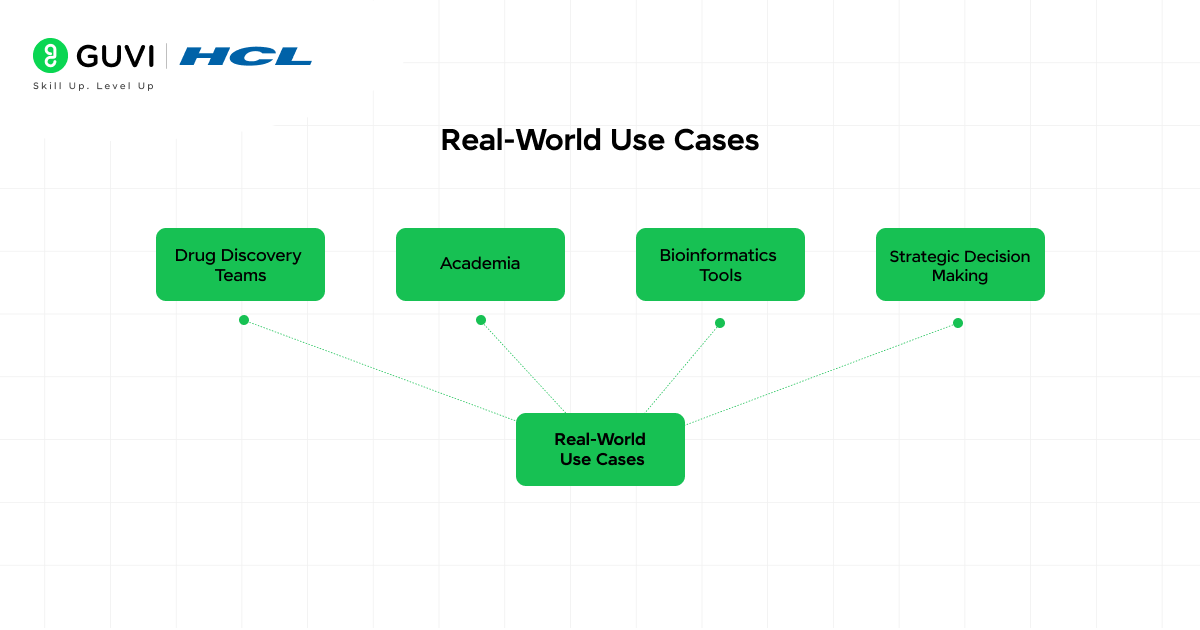
Let’s look at how the connector is applied in real-world scenarios. These use cases show how it supports everyday research workflows.
Drug Discovery Teams
Used by drug companies to identify and rank targets for clinical trials.
Academia
Researchers can cross-validate their research with datasets and test hypotheses.
Bioinformatics Tools
Developers can integrate Open Targets data into their own internal applications or AI models.
Strategic Decision-Making
Research leads can use evidence scoring to decide on the targets for investment.
For a broader understanding of how Claude supports research workflows across domains, you can explore this Claude for life sciences guide.
Best Practices
The key to getting the most out of the connector is to be specific and structured in queries asked, rather than open-ended or ambiguous. Clearer questions elicit more relevant results.
Improving how you structure queries using concepts from natural language processing can significantly enhance the quality of insights you get.
Asking follow-up questions can take your analysis to new depths, and comparison of multiple targets can be useful in the decision-making process. Focusing on the evidence breakdown and not just the conclusions drawn from it can be key in obtaining a thorough analysis and robust conclusions.
Common Mistakes to Avoid
One is to expect the connector to behave as a simple search engine, rather than to perform a structured analysis.
Another common mistake is to ask generic and unspecified questions. Clearly stating what you are investigating, for example, the disease or the target, and the nature of the analysis.
A further and crucial mistake is to ignore the association scores presented by the connector. They are fundamental to the prioritization of targets and must always be taken into account when making decisions.
To effectively use tools like the Open Targets Connector in Claude, understanding biomedical data, precise query formulation, and how AI interacts with structured scientific datasets is essential. Programs like HCL GUVI’s Artificial Intelligence and Machine Learning Course can help you build these skills through hands-on experience with real-world data and AI-driven systems.
Conclusion
The Open Targets Connector within Claude is more than a simple addition. It is indicative of an evolving landscape in the field of biomedical research.
It moves away from tedious manual exploration of numerous datasets to natural language interaction with structured data, enabling instantaneous evidence-based analysis. This accelerates both the speed and the accuracy of research processes.
The synergy of Claude’s reasoning ability and the comprehensive Open Targets platform provides researchers with capabilities for target identification and validation, as well as for smart decision-making processes in the development of novel drugs.
FAQs
1. What is the Open Targets Connector used for?
It is used to identify and prioritize drug targets based on disease associations using structured biomedical data.
2. Do I need a technical background to use it?
No, a basic understanding is enough. The interface is prompt-based and beginner-friendly.
3. Can it be used for real research?
Yes, it is widely used in academic and pharmaceutical research workflows.
4. Does it provide real-time data?
It accesses updated datasets from the Open Targets Platform, ensuring relevant and current insights.
5. Is the data free to use?
Yes, the platform data is available under a public domain license and can be used without restrictions.
6. What makes it different from other tools?
It combines multiple datasets and provides interpreted insights instead of raw data, making it more useful for decision-making.
Success Stories

About the Author
Vishalini Devarajan
An Aerospace Engineer turned content writer, I focus on making complex concepts easy to understand through well-structured, reader-friendly blogs. Whether it’s a technical topic or a non-technical one, I love creating content that is clear, engaging, and impactful.
View all posts by Vishalini Devarajan
Connect with me @












Did you enjoy this article?