


Artificial Intelligence and Machine Learning Articles
AI/ML Skills Gap 2026: Why Companies Can't Find Job-Ready Talent
20 AI/ML Interview Questions Recruiters Can Use Without a Tech Background - Best Guide
How Industry-Backed AI/ML Bootcamps Are Changing the AI/ML Hiring Pipeline - Best Guide 2026
From IT Support to AI Engineer: A Realistic Career Switch Guide 2026


Get In Touch For Details! Request More Information
Claude Nonprofits Partnership Guide with Structured Outputs
Jun 20, 2026 6 Min Read 658 Views
(Last Updated)
Nonprofits operate under constant pressure. Limited resources, increasing demands, and the need to deliver measurable impact make efficiency non-negotiable. Concurrently, information lies dormant in disparate systems, work relies on manual processes, and decisions are made based on partial information.
This is where AI can offer immense value to nonprofits. While an instinct is to see Claude simply as a chatbot or writing assistant, the true power for nonprofits lies in how Claude connects systems, formats output, and supports concrete workflows.
The Claude nonprofits partnership isn’t merely about access to AI. Instead, it’s about a structured system that includes guided adoption, external data connectors, and formatted outputs, aimed at helping nonprofit teams be more efficient.
In this article, we will explore the mechanics of Claude for nonprofits, explain the role that partnerships such as Benevity play in this ecosystem, and investigate how structured output on the Claude Developer platform changes AI from text generators to robust system components.
TL;DR
- Claude Nonprofits Partnership is an ecosystem of AI access, connectors, and training to improve nonprofit workflows.
- The Claude nonprofits system consists of three interconnected layers: adoption workflows, external data connectors, and structured output.
- Partnerships such as Benevity, Blackbaud, and Candid provide connectors for Claude to use real-world nonprofit data and eschew generative assumptions.
- The Model Context Protocol enables Claude to access data from external systems in real time.
- The structured output feature ensures that Claude’s responses are in machine-readable formats that are suitable for use in applications and automated processes.
Table of contents
- What is Claude Nonprofits Partnership
- The Three Layer Architecture of Claude for Nonprofits
- Layer 1: Adoption and Workflow Integration
- Layer 2: Connector Ecosystem
- Layer 3: Structured Output & Developer Integration
- Why Connectors Matter More Than Prompts
- Understanding the Benevity Connector
- The Model Context Protocol
- Structured Outputs on Claude Developer Platform
- From Prompt Engineering to an AI System
- How the Whole System Works Together
- Real World Use Case: Nonprofit Discovery System
- Shifting the Role from AI Assistant to AI System
- Benefits of Claude for Nonprofits
- Best Practices for Using Claude in Nonprofits
- Mistakes Organizations Commonly Make
- Future of AI in Nonprofit Ecosystem
- Conclusion
- FAQs
- What is Claude's nonprofit partnership?
- Can Claude be used for nonprofit research?
- What are structured outputs in Claude?
- Does Claude support donations through connectors?
- Why are connectors important in Claude?
What is Claude Nonprofits Partnership
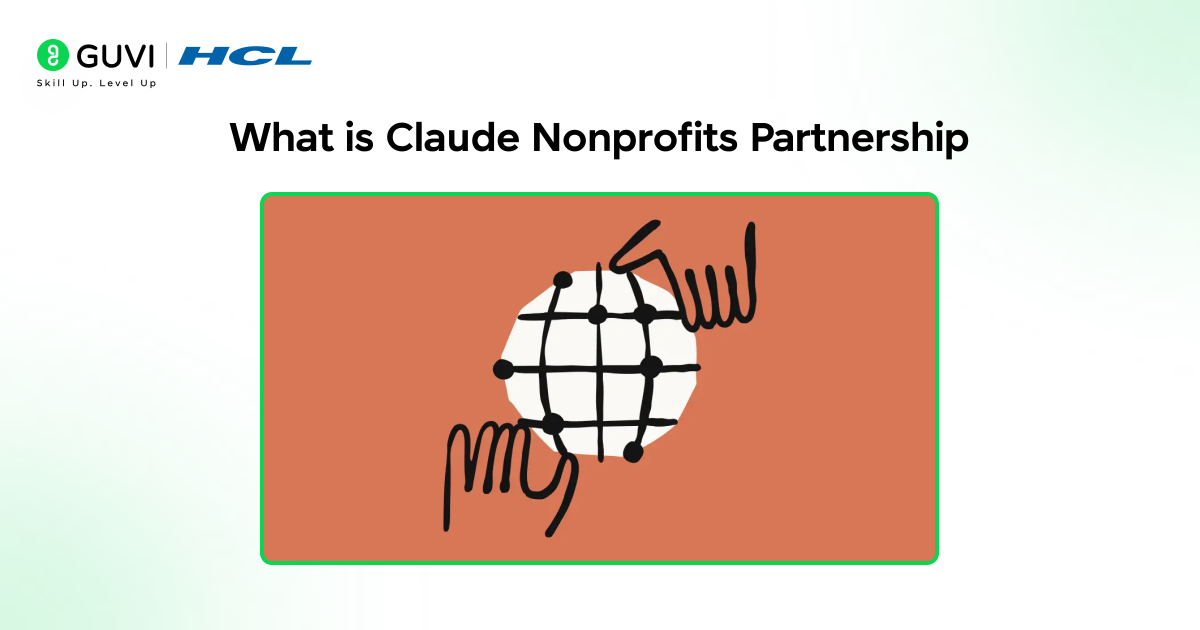
Claude for nonprofits is a structured initiative built for the primary purpose of helping nonprofits use AI in their operations in a real and sustainable way. It’s not about just getting organizations to have access to an AI model; it’s about adoption, integration, and scale.
The partnership’s three key features are discounted access to Claude, AI fluency training, and connectors for the tools that nonprofits use. With these elements in place, organizations can transition beyond simple testing into truly integrated AI adoption.
The desired outcome is simple: lessen the burden of tedious, repetitive work to allow nonprofit teams to focus on their mission.
Nonprofits are well-suited for Claude to assist in proposal writing, communication with donors, program assessment, reporting, and collaboration with team members, but this is just the beginning. Organizations can elevate their use and begin to connect Claude to their own existing systems and workflow structures.
The Three Layer Architecture of Claude for Nonprofits
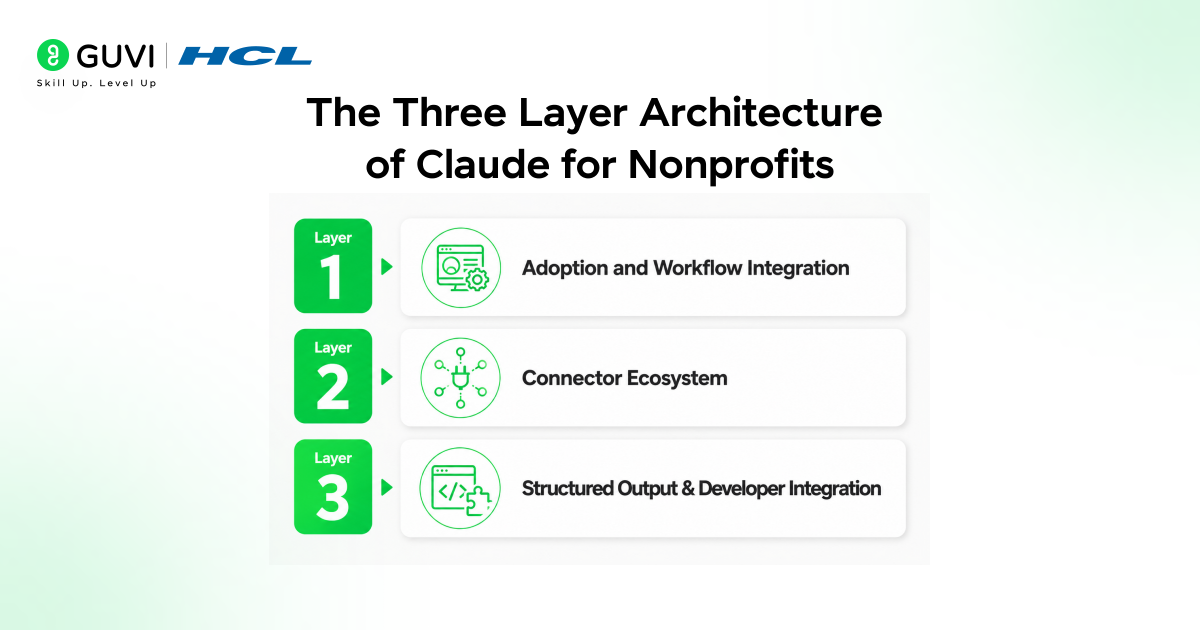
To truly understand this system, one has to think of it as three layers rather than a single solution.
Layer 1: Adoption and Workflow Integration
The first layer is centered around user interaction with Claude.
Nonprofit teams will move through different stages of learning: becoming comfortable with the tool, mapping out relevant use cases, and integrating it into existing workflow patterns. This is done through simple yet effective processes, such as using prompt variations and saving common prompts for future use, and task decomposition into smaller parts.
This layer is human-centric and focuses on team adoption of the tool, rather than just treating it as an add-on to a particular task or service.
Layer 2: Connector Ecosystem
The second layer is where the tool becomes significantly more powerful.
Claude isn’t limited to just the data it has already been trained on, and begins to connect to other platforms, such as Benevity, Blackbaud, and Candid. Connecting Claude to other systems will give it access to accurate data about organizations, donors, and fundraising initiatives.
This feature turns Claude into more than a generalist AI assistant; it transforms it into a solution built for real-time data.
Layer 3: Structured Output & Developer Integration
The third layer is the most technical and often underestimated.
Structured outputs are where Claude will generate responses in formats like JSON rather than plain text. This allows it to be usable within applications, dashboards, or automation. Without structured outputs, it’s difficult to use the responses generated from the AI in your system. With it, Claude becomes a backend tool.
Why Connectors Matter More Than Prompts
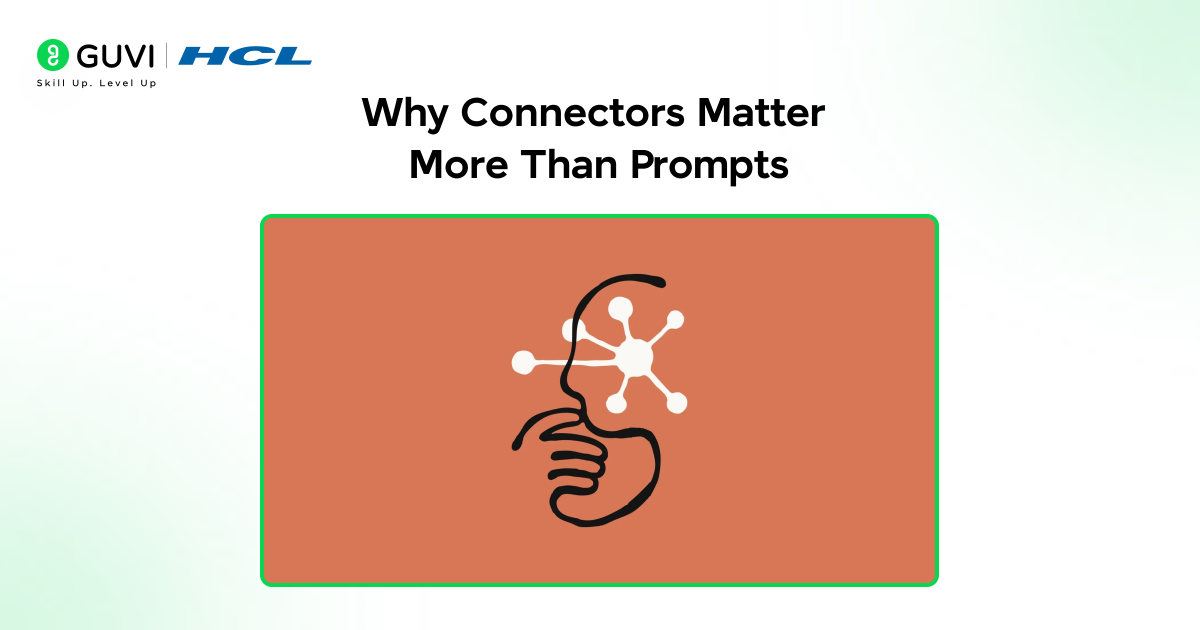
The common thing people tend to prioritize is writing better AI prompts when working with AI, and while that’s important, it is not the main driver of the value that exists within the system that we’re describing.
Connectors are the actual differentiator in this system.
When Claude runs without connectors, it generates text based on patterns that it has seen or training data. This is useful but not recommended for things requiring actual data or real-time information. With connectors in place, Claude will be accessing systems and databases. In this scenario, the connector for Benevity means that Claude will be accessing a database of millions of real, verified nonprofits instead of guessing or interpolating the answer. This transforms Claude from an article writer to a data-based assistant.
Understanding the Benevity Connector
The Benevity connector is essential in this partnership between Claude and nonprofits. Benevity allows access to a robust and comprehensive database of verified nonprofit organizations. It empowers users with direct access to discovery, research, and the analysis of nonprofit organizations within the AI interface.
For example, users can prompt Claude for organizations with a focus on climate change in a specific region, and Claude can return real information directly from the Benevity database, rather than providing a theoretical or hypothetical response.
It should be clarified that this connector specifically provides the functionality for discovery and research and does not execute transactions such as donations within the interface. This design allows Claude to remain a research- and workflow-based tool.
The Model Context Protocol
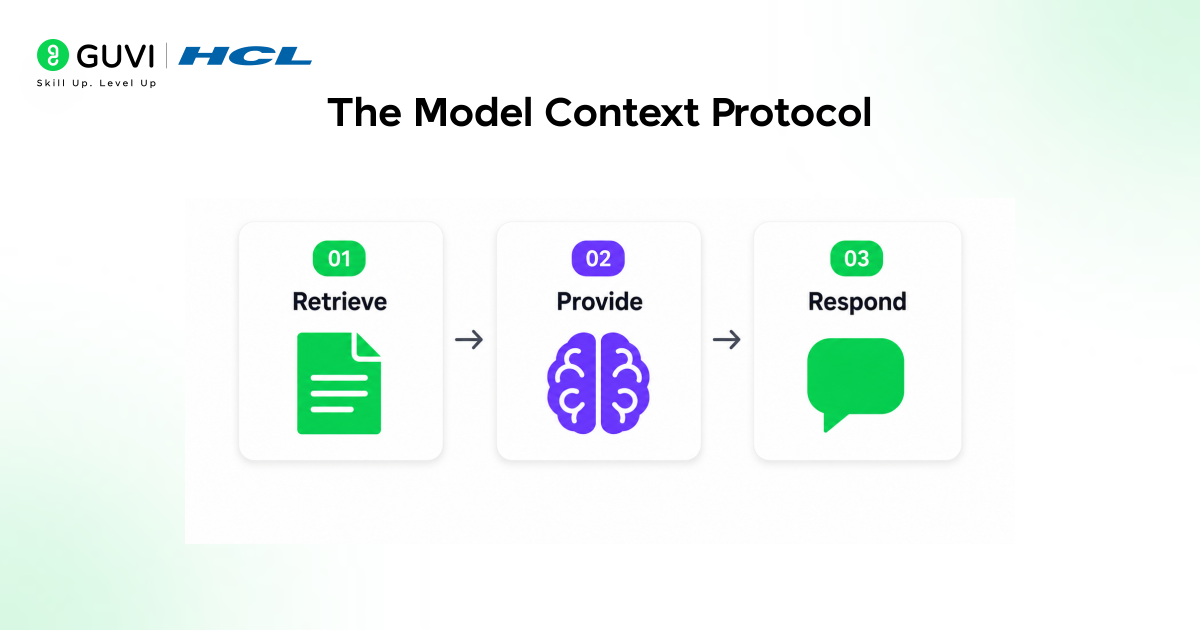
The role of the Model Context Protocol is to communicate between Claude and external tools. It will allow Claude to make requests of connected tools to pull information and provide that information back within its response.
Connectors will not work without the Model Context Protocol. This will serve as the layer where an AI model is capable of communicating with real-world platforms.
When a user asks for a prompt, the Model Context Protocol will allow Claude to know which connector it should utilize, pull the necessary information, and pass it back into the AI model’s response. This ultimately provides context and a more useful response to the user.
Structured Outputs on Claude Developer Platform
Structured outputs are what make Claude capable of use in real-world applications. Unlike most other LLMs, which return an unstructured text response, Claude can provide output based on pre-designed schemas.
To understand how these capabilities are implemented in practice, exploring the Claude Developer Platform provides deeper insight into how structured outputs and integrations work together.
Structured outputs are important to ensuring consistency and predictable behavior. Instead of providing Claude with unstructured text about a nonprofit, Claude is capable of responding with structured information like the name of the nonprofit, the location, mission, and funding information in machine-readable format.
There are a few important reasons why this is extremely valuable.
- It allows Claude to be seamlessly integrated into existing applications without the need for a parser to understand its response.
- Reduces any possibility for error associated with understanding what Claude has responded with.
- Allows for high-scale automation of tasks utilizing Claude.
Structured outputs are the key to building reliable systems with an AI.
With connectors like Benevity, Blackbaud, and Candid, Claude can access millions of verified nonprofit records in real time. This enables far more accurate research and decision-making compared to traditional AI systems that rely only on static training data.
From Prompt Engineering to an AI System
The majority of teams, however, began by using Claude for prompt engineering, that is, understanding how to pose a better question to receive a better answer. This is powerful, but only the initial step.

As a team’s workflows become more complicated, a prompt is no longer sufficient. There is a need for reproducible outputs, external data that can come from a system of record, and an output that can be put to use in a system of action.
At this point, the paradigm shift occurs. A chatbot has evolved into an AI system. Some connectors can access the data from systems of record, a Model Context Protocol that allows Claude to interact with external systems, and structured outputs that can be put to use in applications.
The true value of Claude is not an ever-better prompt, but rather an output that is consistently reproducible and immediately usable.
Curious how tools like Claude go beyond basic prompts and actually power real-world nonprofit workflows? This guide explores how connectors, structured outputs, and system-based AI approaches help organizations move from simple usage to building scalable, data-driven systems.
How the Whole System Works Together
In order to demonstrate the full power of a Claude and a nonprofit’s partnership, it’s important to show how everything interacts.
Here is a sample workflow:
- A user requests Claude.
- Claude understands the request and determines that it needs data from a system outside of Claude.
- Model Context Protocol connects Claude with that external system (e.g., Benevity).
- Claude pulls the required data.
- Claude then processes the data and returns a structured output.
- This structured output can then be put to use in other applications and workflows.
This shows that Claude is not a stand-alone application at all, but an AI system.
If you’re looking to translate this workflow into real applications, learning how to build AI apps with Claude can help you understand how these components come together in practical implementations.
Real World Use Case: Nonprofit Discovery System
A practical scenario involves creating a nonprofit partner discovery tool for a nonprofit organization. Traditionally, this would involve considerable data compilation, organization, and research efforts.
However, this task becomes simpler with the use of Claude and the expanded ecosystem of tools that it supports.
A user can ask Claude to retrieve organizations operating in a particular area of interest and region, then use the Benevity connector to obtain relevant data.
Structured outputs ensure the retrieved data is consistently structured and can then be displayed or used in a dashboard or application for interactive filtering and action.
Shifting the Role from AI Assistant to AI System
A significant element of the Claude ecosystem is the shift of AI from an assistant-based role to a system-based role.
Whereas an assistant produces text and answers requests, a system produces results.
In this case, Claude delivers through its connectors and structured outputs.
In this model, it becomes an integrated component within an end-to-end workflow that includes data fetching, processing, and presentation of results.
This enables an AI system that functions reliably in an enterprise context.
Benefits of Claude for Nonprofits
The value Claude adds for nonprofits, when applied correctly, includes efficiency.
- This includes automation of time-consuming tasks such as report generation and analysis.
- Improves accessibility by enabling user interaction through natural language.
- It ensures consistency, as structured outputs standardize data flows.
- Supports scalability by integrating with existing tools and systems.
- Most importantly, it enables nonprofits to concentrate on their mission-driven work.
Best Practices for Using Claude in Nonprofits
Organizations that want to fully benefit from Claude should observe some best practices.
- Begin with specific use cases. There are repetitive, time-consuming tasks in every organization. Use Claude to streamline this.
- Utilize connectors. To ensure Claude has access to current data, it should be connected to the desired applications.
- Employ structured output to enable system integration. This is critical for creating robust workstreams.
- Iterate and refine. Initial outputs are only a draft. Organizations must iterate on this draft to enhance the outputs.
- Validate every output. While Claude is advanced, the human eye is necessary for validation and to ensure consistency with organizational objectives.
Mistakes Organizations Commonly Make
Many nonprofits fail to fully capitalize on Claude due to mistakes that could have been avoided.
Organizations that only rely on prompts instead of using connectors will hinder Claude’s potential. Ignoring structured output makes integrating it difficult.
Utilizing Claude for individual tasks instead of integrating it into workflow systems hinders its value. Failing to approach it as an evolving system instead of a single-use tool will have a diminishing long-term impact.
Future of AI in Nonprofit Ecosystem
The partnership between Claude and nonprofit institutions signals a new trend in the utilization of artificial intelligence.
Artificial intelligence is no longer seen as a separate tool but an integral part of the entire system. Data, workflow systems, and outputs are integrated into one ecosystem.
This will grow with more connector releases and increased adoption of structured outputs as standard practice.
Organizations that embrace this concept now will possess an unparalleled advantage in operational efficiency, organizational scalability, and impact.
To effectively implement AI-driven systems in nonprofit workflows, having a strong understanding of data handling, system integration, and how AI models interact with real-world data is essential. If you’re looking to build these skills in a structured and practical way, programs like the HCL GUVI Artificial Intelligence and Machine Learning Course can help you gain hands-on experience in working with real data, connectors, and building scalable AI-powered systems.
Conclusion
Claude for nonprofits is not an AI. It’s a framework for building real workflows with adoption layers, data connectors, and structured outputs.
By understanding these layers, organizations can begin to move beyond just using the tool and instead start to use it to build real systems and achieve real outcomes.
The real benefit of Claude is not about its ability to output text; it is the ability to connect to real data and to have structured, reliable outputs that can then be integrated into applications and decision-making processes.
FAQs
1. What is Claude’s nonprofit partnership?
It is a program that provides nonprofits with access to Claude, along with connectors, training, and tools to integrate AI into their workflows.
2. Can Claude be used for nonprofit research?
Yes, especially with connectors like Benevity and Candid, Claude can retrieve and analyze real nonprofit data.
3. What are structured outputs in Claude?
Structured outputs are responses formatted in a predefined schema, making them suitable for applications and automation.
4. Does Claude support donations through connectors?
No, connectors like Benevity support discovery and research, but not direct transactions within Claude.
5. Why are connectors important in Claude?
Connectors allow Claude to access real-world data, making its responses more accurate and useful for practical applications.
Success Stories

About the Author
Vishalini Devarajan
An Aerospace Engineer turned content writer, I focus on making complex concepts easy to understand through well-structured, reader-friendly blogs. Whether it’s a technical topic or a non-technical one, I love creating content that is clear, engaging, and impactful.
View all posts by Vishalini Devarajan
Connect with me @





Did you enjoy this article?