


Python Articles
Excel SQL Python for BPO Professionals Best Guide to Move Into Data Science
Go vs Python for Forward Deployed Engineering Workloads
Python for Forward Deployed Engineers: What You Actually Need to Know
Freelancing as a Python Developer: Getting Your First Client


Get In Touch For Details! Request More Information
Pattern Programs in Python: A Beginner-Friendly Guide to Mastering Logic Step by Step
Sep 23, 2026 6 Min Read 2247 Views
(Last Updated)
When you begin your journey in programming, writing your first few lines of code feels exciting. It gives you confidence when you are printing simple statements or carrying out some simple calculations. But soon you find out that you actually were only writing instructions, the real programming is about developing logical thinking.
This is where Python pattern programs come in play.
Many beginners underestimate the significance of pattern programs in python since they are simple. These in fact are exercises that condition your brain to think structurally and repetitively. They teach you how loops work, the interaction of inner and outer loops and the control of the formatting of output to the dot.
This step-by-step guide will cover all that you should know about python pattern programs including basics to the advanced logic in an easy-to-understand.
Table of contents
- Quick Answer
- Pattern Programs in Python at a Glance
- What Are Pattern Programs in Python?
- Why are Python Pattern Programs Important?
- Types of Pattern Programs in Python
- Star Pattern Programs in Python
- Square Star Pattern
- Right-Angled Triangle Pattern
- Inverted Triangle Pattern
- Output:
- Pyramid Pattern Programs in Python
- Full Pyramid Pattern
- Output:
- Number Pattern Programs in Python
- Increasing Number Triangle
- Floyd’s Triangle
- Alphabet Pattern Programs in Python
- Alphabet Triangle Pattern
- The Most Important Pattern-Printing Formulas
- How to Solve Any Pattern Program in Python
- Step 1: Count the rows
- Step 2: Count the elements in each row
- Step 3: Check whether spaces are required
- Step 4: Find the mathematical relationship
- Step 5: Write the outer loop first
- Common Mistakes Beginners Make in Python Pattern Programs
- Step-by-Step Strategy to Solve Any Pattern
- Best Python Concepts to Learn After Pattern Programs
- Conclusion
- FAQs
- What are python pattern programs?
- Why are python pattern programs important for beginners?
- Are python pattern programs asked in interviews?
- What is the easiest pattern program in Python?
- Why are nested loops used in Python pattern programs?
- How can I improve my pattern-programming logic?
Quick Answer
Pattern programs in Python are beginner-friendly coding exercises that use loops, nested loops, conditions, and spacing to print structured shapes using stars, numbers, or characters. They help you understand iteration, row-column relationships, formatting, and problem-solving logic before moving to more complex programming and DSA problems.
Pattern Programs in Python at a Glance
- Best for: Python beginners, students, and coding-interview preparation
- Core concepts:
forloops, nested loops,range(), conditions, counters, strings, andprint() - Common pattern types: Star, number, alphabet, pyramid, diamond, hollow, and mixed patterns
- Main skill developed: Logical thinking and loop control
- Typical difficulty: Beginner to intermediate
- Most useful prerequisite: Understanding Python
forloops and nested loops
What Are Pattern Programs in Python?
Pattern programs are coding programs in which you print structured designs using:
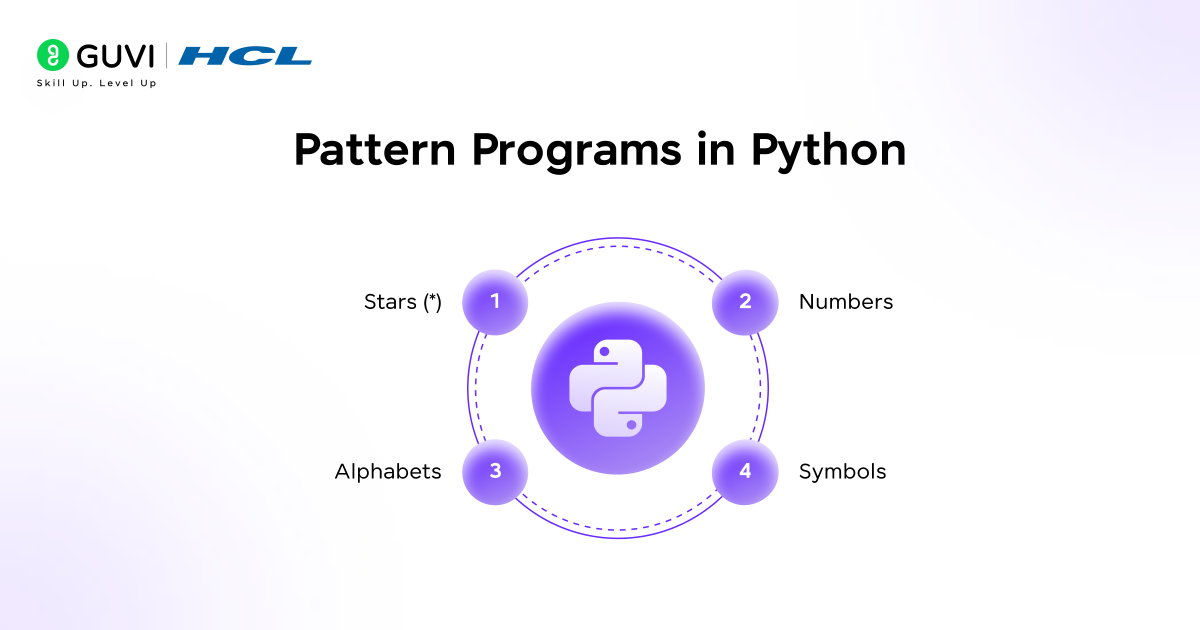
- Stars (*)
- Numbers
- Alphabets
- Symbols
These patterns usually form shapes such as:
- Squares
- Triangles
- Pyramids
- Diamonds
- Hollow shapes
Python pattern programs need not look decorative, but are mostly exercises in logic-building. They make you know about nested loops and manipulation of rows and columns.
Why are Python Pattern Programs Important?
The most common question among learners is why pattern questions are still being asked during interviews?
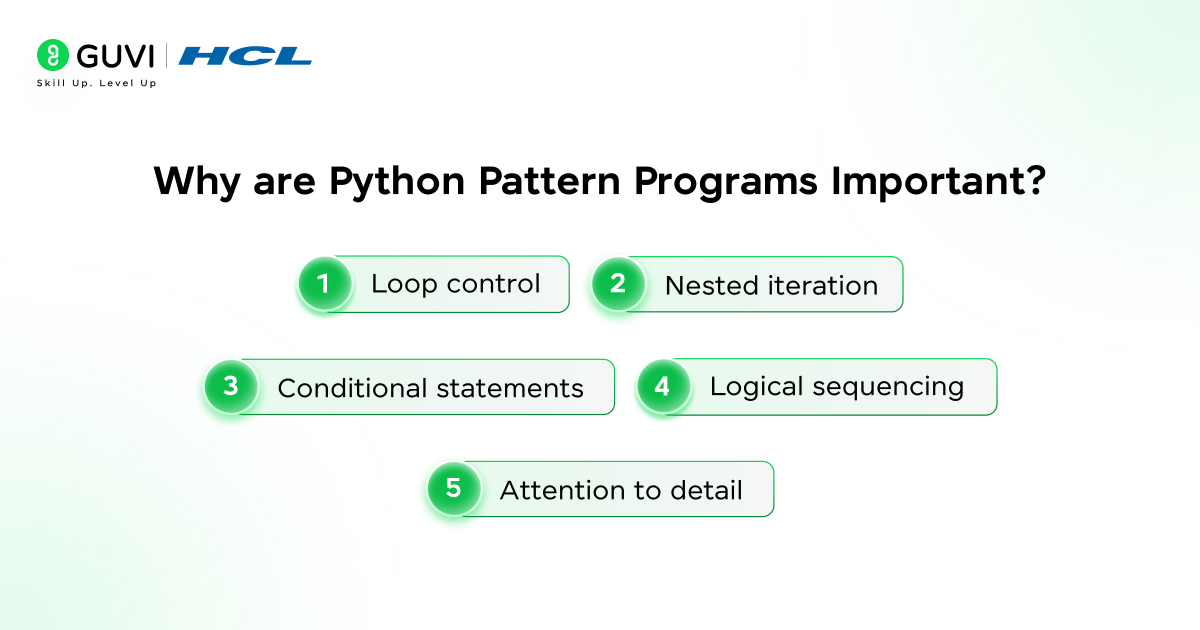
The reason is simple. Pattern programs test your understanding of:
- Loop control
- Nested iteration
- Conditional statements
- Logical sequencing
- Attention to detail
You cannot help thinking step by step when you write Python pattern programs. You have to carefully consider the number of rows you need, the number of elements per row, and how spacing influences alignment.
These activities are a foundation of good programming. It will become harder to go forward to more advanced topics, such as data structures and algorithms, without a command of loop logic, using pattern programs in python.
Understanding the Structure of Pattern Programs
All python pattern programs tend to be organized as follows:
- The outer loop controls rows
- The inner loop controls columns or elements inside each row.
- Sometimes, additional loops manage spacing.
- Mathematical formulas determine element count.
With this structure in mind, you can solve nearly any pattern.
Also read: Learn Python in 2026: 10 Interesting Reasons to Do So!
Types of Pattern Programs in Python
| Pattern type | What it prints | Main concept | Difficulty |
|---|---|---|---|
| Square star | Equal stars in every row | Nested loops | Easy |
| Right triangle | Increasing stars | Row-dependent loop | Easy |
| Inverted triangle | Decreasing stars | Reverse iteration | Easy |
| Pyramid | Centered stars | Spaces + formulas | Easy–Medium |
| Inverted pyramid | Decreasing centered stars | Reverse formulas | Medium |
| Diamond | Pyramid + inverted pyramid | Multiple sections | Medium |
| Hollow square | Border only | Conditions | Medium |
| Hollow triangle | Triangle border | Conditions + loops | Medium |
| Number triangle | Increasing numbers | Counters | Easy |
| Floyd’s triangle | Continuous numbers | Running counter | Medium |
| Repeated number triangle | Same number per row | Row-based value | Easy |
| Alphabet triangle | Increasing letters | chr() / characters | Medium |
| Reverse alphabet triangle | Decreasing letters | Reverse iteration | Medium |
| Character pyramid | Centered characters | Spacing | Medium |
| Butterfly pattern | Two mirrored triangles | Multiple loops | Medium |
| Hourglass pattern | Shrinking and expanding | Reverse logic | Medium |
| X pattern | Diagonal characters | Conditions | Medium |
| Plus pattern | Horizontal + vertical lines | Conditions | Medium |
| Hollow pyramid | Pyramid border | Conditions | Medium |
| Number pyramid | Centered numbers | Spacing + counters | Medium |
Star Pattern Programs in Python
The most common pattern programs in python are star patterns. They are suitable for beginners as they only deal with loop logic.
1. Square Star Pattern
Output:
| ***** ***** ***** ***** ***** |
Code:
| n = 5 for i in range(n): for j in range(n): print(“*”, end=””) print() |
Explanation:
The outer loop runs five times, representing five rows. The inner loop prints five stars in each row. After printing five stars, print() moves to the next line.
This is the simplest example of python pattern programs and helps you understand row-column logic.
Also read: 20 Best YouTube Channels to Learn Python in 2026
2. Right-Angled Triangle Pattern
Output:
| * ** *** **** ***** |
Code:
| n = 5 for i in range(1, n+1): for j in range(i): print(“*”, end=””) print() |
Explanation:
Here, the number of stars depends on the row number. In the first row, one star is printed. In the second row, two stars are printed, and so on.
This introduces dependency between outer and inner loops a critical concept in python pattern programs.
3. Inverted Triangle Pattern
Output:
| ***** **** *** ** * |
Code:
| n = 5 for i in range(n, 0, -1): for j in range(i): print(“*”, end=””) print() |
Explanation:
This pattern simply reverses the logic of the previous triangle. Instead of increasing, the star count decreases.
Learning how to reverse loops is an important milestone in mastering python pattern programs.
Pyramid Pattern Programs in Python
Pyramid patterns are slightly more complex because they involve spacing logic along with star printing.
Full Pyramid Pattern
Output:
| * *** ***** ******* ********* |
Code:
| n = 5 for i in range(n): for j in range(n – i – 1): print(” “, end=””) for k in range(2*i + 1): print(“*”, end=””) print() |
Explanation:
Each row contains:
- Spaces → decreasing as rows increase
- Stars → increasing in odd numbers
The formula 2*i + 1 ensures the star count remains odd. Understanding this mathematical logic is what makes python pattern programs powerful learning tools.
Also read: Becoming A Top Python Backend Developer: Must-Know Technologies
Number Pattern Programs in Python
Number patterns introduce incrementing logic and counters.
1. Increasing Number Triangle
Output:
| 1 12 123 1234 12345 |
Code:
| n = 5 for i in range(1, n+1): for j in range(1, i+1): print(j, end=””) print() |
Here, instead of printing stars, we print numbers. The inner loop prints numbers from 1 up to the row number.
This small change transforms a star pattern into a number pattern, demonstrating how flexible python pattern programs can be.
Also read: How to Set Up Python in Visual Studio Code: A Beginner’s Guide
2. Floyd’s Triangle
Output:
| 1 2 3 4 5 6 7 8 9 10 |
Code:
| n = 4 num = 1 for i in range(1, n+1): for j in range(i): print(num, end=” “) num += 1 print() |
This pattern introduces a continuous counter variable. Such logic is frequently tested in interviews.
Alphabet Pattern Programs in Python
Alphabet patterns work similarly to number patterns but use ASCII values.
Alphabet Triangle Pattern
Output:
| A AB ABC ABCD ABCDE |
Code:
| n = 5 for i in range(1, n+1): for j in range(i): print(chr(65 + j), end=””) print() |
The function chr() converts ASCII values into characters. Learning this allows you to expand your python pattern programs beyond stars and numbers.
Also read: What Is a Data Type in Python?
The Most Important Pattern-Printing Formulas
You don’t need to memorize every pattern program. Instead, learn the relationships between the row number and the output.
| Pattern | Spaces | Characters/elements |
|---|---|---|
| Right triangle | 0 | i |
| Inverted triangle | 0 | n - i + 1 |
| Pyramid | n - i | 2i - 1 |
| Inverted pyramid | i | 2(n-i)+1 |
| Diamond upper half | n - i | 2i - 1 |
| Hollow square | Depends on position | Border only |
| Floyd’s triangle | Usually none | Running counter |
| Alphabet triangle | 0 | i |
| Number pyramid | n - i | 2i - 1 |
These formulas are more useful than memorizing complete solutions because they let you derive new patterns.

How to Solve Any Pattern Program in Python
When you see a new pattern, don’t immediately start writing code.
Use this five-step process.
Step 1: Count the rows
Ask:
How many rows are there?That usually determines your outer loop.
Step 2: Count the elements in each row
Write the count separately.
For example:
1
2
3
4
5
means the number of elements is increasing.
But:
5
4
3
2
1
means the number is decreasing.
Step 3: Check whether spaces are required
Centered patterns usually require spaces.
For a pyramid:
spaces = n - iStep 4: Find the mathematical relationship
Ask whether the number of characters follows a sequence.
Common sequences include:
1, 2, 3, 4, 55, 4, 3, 2, 11, 3, 5, 7, 9Recognizing the sequence often reveals the loop range immediately.
Step 5: Write the outer loop first
Start with:
for i in range(...):Then add the logic for spaces and characters.
This prevents you from trying to solve the entire pattern simultaneously.
Common Mistakes Beginners Make in Python Pattern Programs
- Miscounting spaces – Beginners tend to count the number of spaces wrongly which alters the shape of a pyramid pattern python programs.
- Leaving out end=”” – Without end=””, to allow Python to continue to a new line after each print statement, which violates the desired pattern layout.
- Row loops and column loops mixed up – Most learners pair such outer loops (rows) and inner loop (elements per row), resulting in wrong results.
- Off-by-one errors in range() – Because range only includes the last value, minor errors can easily cause it to print too many or too few elements.
Step-by-Step Strategy to Solve Any Pattern
This organized procedure will also help you get rid of confusion every time you see a new python pattern program:
- Count total row – The first step is to count the number of rows the pattern has, since the outer loop will always be based on that number.
- Observe how elements change row by row – Attentively note whether the number of stars, numbers or characters in the row increases, decreases or follows some formula.
- Separate spaces and characters – In pyramid pattern programs in python, the number of spaces and the number of elements in a row will be known before the code is written.
- Write the outer loop first – Start by creating the loop that controls the rows, since it forms the overall structure of the pattern.
- Add inner loops with caution – Then write inner loops for printing spaces and elements, making sure their ranges depend correctly on the row number.
- Test small values, such as 3, 4, etc. It is clear that before scaling up, you should always test your logic with small inputs first to easily identify errors.
This method of working simplifies even complicated pattern programs written in Python.
Best Python Concepts to Learn After Pattern Programs
Once you can solve pattern questions without copying code, move to:
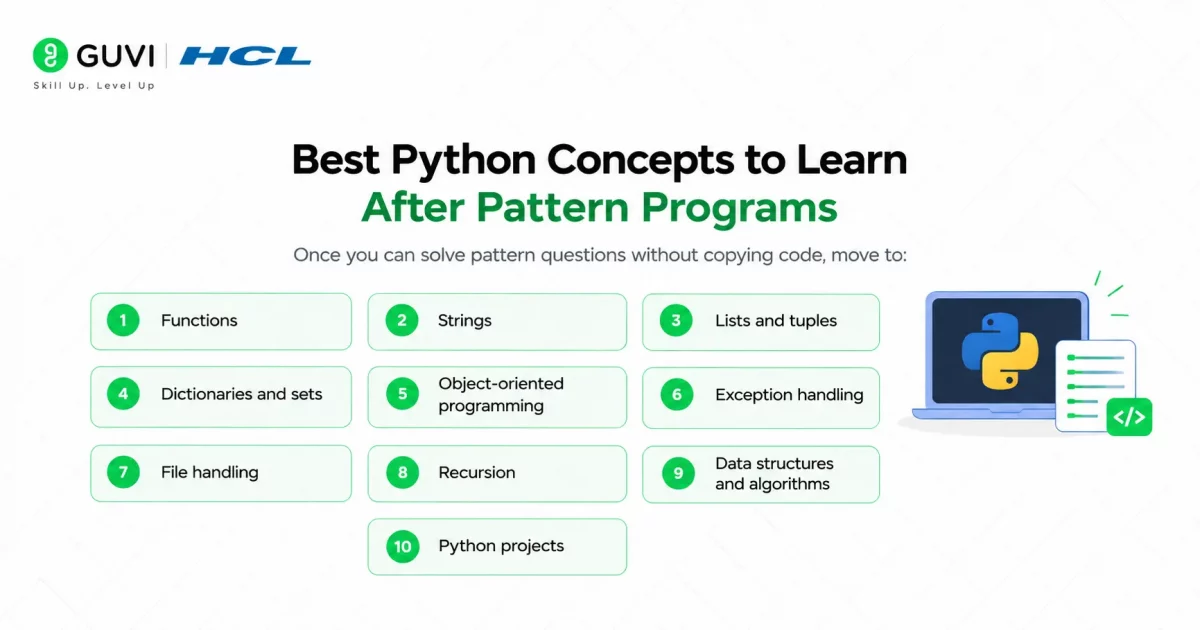
- Functions
- Strings
- Lists and tuples
- Dictionaries and sets
- Object-oriented programming
- Exception handling
- File handling
- Recursion
- Data structures and algorithms
- Python projects
If your goal is Python development rather than only interview practice, the broader skill set also includes OOP, frameworks, APIs, databases, testing, Git, and specialization-specific technologies.
Ready to move from understanding Python data types to writing confident, real-world code? Join HCL GUVI’s Python course to learn through 100 percent online and self-paced modules, get full lifetime access to all content, clear doubts via dedicated forum support, and practise hands-on using four gamified practice platforms that strengthen your core Python foundations.
Conclusion
Even though they appear to be simple exercises, creating pattern programs is an essential part of developing programming logic. Practicing and mastering python pattern programs will also improve your ability to use loops effectively, enhance your analytical capabilities and prepare you for coding interviews.
Try not to go too fast with this task; instead, focus on practicing multiple types, changing existing patterns, and challenging yourself with more complex shapes. Over time you will find that your logical reasoning becomes enhanced substantially.
FAQs
1. What are python pattern programs?
Python pattern programs are exercises that allow you to create a shapes like triangles, squares, pyramids, and diamonds using a character set (stars, numbers or letters) to improve your skills in logical thinking.
2. Why are python pattern programs important for beginners?
Python pattern programs will help you gain a better understanding of nested loops, spacing logic and control over iterating through a collection. These skill sets are very fundamental to learning how to apply advanced programming concepts.
3. Are python pattern programs asked in interviews?
Yes, many companies ask python pattern programs in technical interviews to test logical clarity, loop control, and structured problem-solving ability.
4. What is the easiest pattern program in Python?
The square star pattern is one of the easiest because every row contains the same number of characters.n = 5 for i in range(n): for j in range(n): print("*", end="") print()
After mastering a square, move to a right triangle, inverted triangle, pyramid, and then hollow patterns.
5. Why are nested loops used in Python pattern programs?
Nested loops are useful because one loop can control the rows while another controls the elements printed within each row.
For example:for i in range(1, 6): for j in range(i): print("*", end="") print()
Here, the outer loop determines the current row and the inner loop determines how many stars appear in that row.
6. How can I improve my pattern-programming logic?
Don’t memorize complete programs. Instead, learn to identify the relationship between the row number and the number of spaces, characters, or values printed.
Practice by:
1. Drawing the pattern on paper
2. Counting each row
3. Identifying increasing or decreasing sequences
4. Writing the outer loop first
5. Testing with small values
6. Converting star patterns into number patterns
7. Converting solid patterns into hollow patterns
8. Solving the same pattern using a different approach
Once you can derive a pattern from its output, your loop logic becomes much stronger.
Success Stories

About the Author
Vishalini Devarajan
An Aerospace Engineer turned content writer, I focus on making complex concepts easy to understand through well-structured, reader-friendly blogs. Whether it’s a technical topic or a non-technical one, I love creating content that is clear, engaging, and impactful.
View all posts by Vishalini Devarajan
Connect with me @












Did you enjoy this article?