


Digital Marketing Articles
8 Best Career Change Options for Content Writers
CPM in Digital Marketing: Calculation, Costs & Strategies in 2025

Get In Touch For Details! Request More Information
Types & Stages of Marketing Funnels: A 2025 Funnel Marketing Guide
Sep 15, 2025 14 Min Read 2418 Views
(Last Updated)
Anyone new to marketing must have come across the term ‘marketing funnels’ and then scratched their heads trying to understand what exactly this entails. Worry not, if you’re a budding marketer or looking to gain some technical knowledge, this blog will be just the thing for you.
Marketing funnels are a crucial part of developing a foolproof marketing strategy for your products and services. Various types of marketing funnels help you secure your marketing goals by evaluating your customers’ journey for various purposes.
We’ll be discussing a few major ones here today, while also giving you detailed insights into stages in marketing funnels and how they apply to modern marketing norms. So, let’s dive in now.
Table of contents
- What is a Marketing Funnel?
- Types of Marketing Funnels
- Email Funnel
- Webinar Funnel
- Landing Page Funnel
- Content Funnel
- Ad Funnel
- Lead Generation Funnel
- Sales Funnel
- E-commerce Funnel
- Social Media Marketing Funnel
- Video Marketing Funnel
- SEO Funnel
- Product Launch Funnel
- Affiliate Marketing Funnel
- Free Trial Funnel
- Tripwire Funnel
- Membership Funnel
- Survey Funnel
- Event Funnel
- Consultation Funnel
- Upsell Funnel
- Levels in Marketing Funnels
- Awareness
- Interest
- Decision
- Action
- Loyalty
- Advocacy
- What are TOFU, MOFU, and BOFU?
- TOFU (Top of Funnel)
- MOFU (Middle of Funnel)
- BOFU (Bottom of Funnel)
- TOFU vs MOFU vs BOFU: Complete Breakdown
- Concluding Thoughts
- FAQs
- What is a marketing funnel?
- What are the stages of a marketing funnel?
- What are the different types of marketing funnels?
- How do you create a marketing funnel?
- Why is a marketing funnel important?
- How do you optimize a marketing funnel?
What is a Marketing Funnel?
A marketing funnel is a strategic model that depicts the journey potential customers undergo from first learning about a service to finally making a purchase. Picture it as a funnel: wide at the top to capture a large audience, which then narrows down as prospects move closer to conversion.
Why is understanding marketing funnels essential? They enable businesses to effectively address different needs at each stage of the customer’s journey. For example, a visitor at the top might just be looking for educational content, while someone deeper into the funnel could be evaluating course features or pricing.
Consider an ed-tech company that offers coding courses. At the top of the funnel, they might attract interest with free introductory webinars on popular programming languages. As potential learners progress down the funnel, the company can engage them with trial modules or student testimonials. By the time these prospects reach the bottom of the funnel, targeted offers like course discounts or bonus learning materials could be the final nudge they need to enroll.
By thoroughly understanding and managing this funnel, a company can significantly enhance its conversion rates, ensuring that every prospective learner is effectively guided toward enrollment with tailored information and incentives. Now, there are many types of digital marketing funnels which you can use.
Types of Marketing Funnels
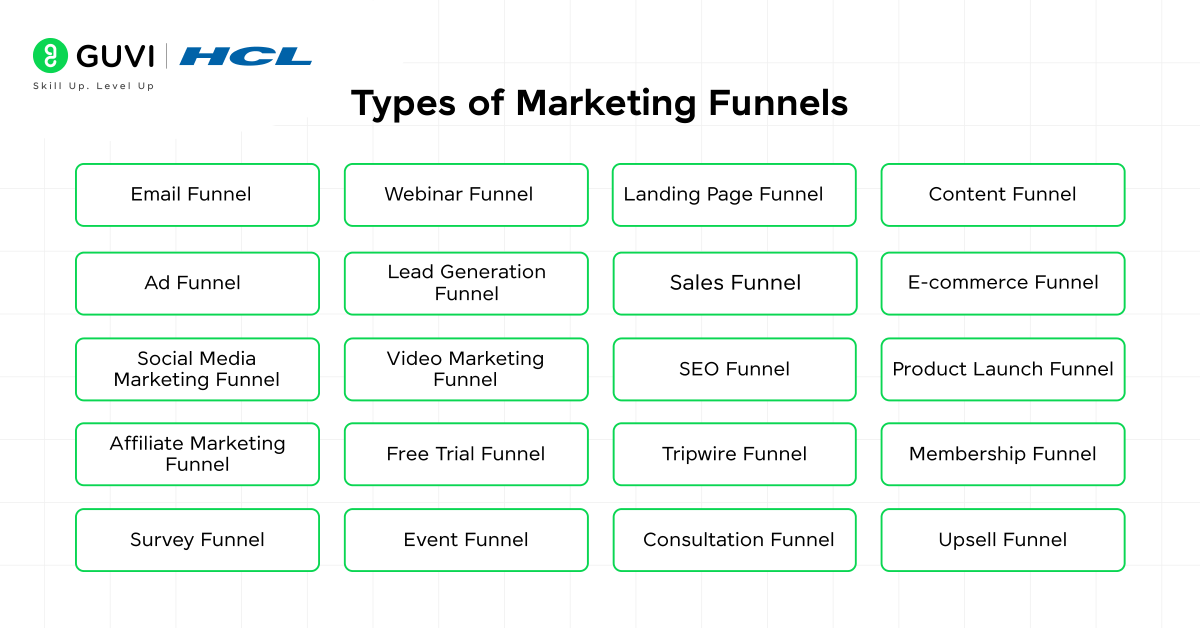
While the concept of a marketing funnel is universal, its application can vary widely depending on the business model and customer engagement strategy. There isn’t a one-size-fits-all funnel; rather, companies tailor them to best suit their audience’s journey. Whether you’re in B2B sales, a startup, or an established e-commerce giant, the structure of your funnel can significantly influence your marketing success.
Let’s explore the common types of marketing funnels. Each type is designed with a unique focus and stages that align with specific business objectives and customer behaviors. Understanding these varieties will help you identify which funnel best matches your company’s needs, enhancing your strategic approach to customer acquisition and retention.
1. Email Funnel
An Email Funnel is designed to nurture leads through automated sequences of emails based on their interactions with your content. It starts with attracting subscribers, moves on to engaging them with relevant information, and aims to convert them into paying customers.
Key aspects include segmenting audiences to tailor content appropriately and timing emails to optimize engagement. When implementing an email funnel, it’s crucial to monitor metrics like open rates and conversions to refine your approach continually.
This funnel type is especially useful for services or products that require consideration, such as subscription services or high-value items.
Also Read: Why Digital Marketing is the Skill of the Future (+ Free 5-Day Email Course to Get You Started)
Goal
The primary goal of an email funnel is to lead a prospect through the buying process by providing them with valuable content at each step. This strategy helps build trust and authority, making it easier to convert leads into loyal customers.
Best Practices for Email Funnel
- Segment Your Audience: Tailor your emails to address the specific needs and interests of different customer segments.
- Personalize Your Emails: Use the recipient’s name and include content relevant to their past interactions with your brand.
- Optimize for Mobile: Ensure your email design looks good and functions well on all devices, especially smartphones.
- Test and Optimize: Continuously test different elements of your emails (like subject lines and call-to-actions) and optimize based on performance.
- Provide Value at Each Step: Each email should offer something valuable to move the recipient closer to a decision.
- Clear Call-to-Action: Make it easy for readers to know what you want them to do next, whether it’s reading a blog post, signing up for a webinar, or making a purchase.

2. Webinar Funnel
A Webinar Funnel focuses on using webinars as the central tool to attract, engage, and convert leads. This type of funnel begins by promoting a free or paid webinar to a target audience, which could be new leads or existing customers.
The key steps involve setting up the webinar, driving registrations, delivering valuable content during the session, and following up with attendees. Implementation requires careful attention to webinar topics that align with audience interests, as well as ensuring a smooth technical experience.
Webinars are highly effective due to their interactive nature, allowing for real-time engagement and immediate feedback.
Goal
The main goal of a Webinar Funnel is to establish expertise and credibility in a specific area, which helps in building a deeper relationship with the audience. This setup is particularly effective in educating the audience and leading them directly to a sale or commitment during or after the webinar.
Best Practices for Webinar Funnel
- Choose Engaging Topics: Select topics that are not only relevant but also likely to draw interest and engagement from your target audience.
- Promote Early and Often: Use multiple channels to promote your webinar, including email, social media, and your website, to maximize attendance.
- Rehearse to Ensure Smooth Delivery: Conduct rehearsals to resolve any potential issues with content or technology beforehand.
- Engage with Your Audience: Encourage interaction through Q&A sessions, polls, and discussions to keep the audience engaged and attentive.
- Follow Up Promptly: Send a follow-up email including a replay of the webinar, additional resources, and a call to action, such as signing up for a service or scheduling a consultation.
- Measure and Optimize: Analyze the performance of your webinars in terms of attendance, engagement, and conversion rates and refine your strategy accordingly.
3. Landing Page Funnel
A Landing Page Funnel is designed around a single page whose sole purpose is conversion. This funnel type starts with driving traffic to a landing page, which could be through ads, social media, email campaigns, or organic searches.
The page itself must be highly focused, showcasing a specific offer with clear messaging and a compelling call-to-action (CTA).
Key steps include creating an attractive design, optimizing content for SEO, and using persuasive elements like testimonials and benefits to encourage conversions. Critical considerations involve user experience, page load speed, and A/B testing to refine effectiveness.
Goal
The primary goal of a Landing Page Funnel is to convert visitors into leads or customers with as little distraction as possible. This focused approach aims to guide visitors towards making a decision, be it signing up, making a purchase, or any other desired action, by reducing the steps and decisions they need to make.
Best Practices for Landing Page Funnel
- Clear and Concise Messaging: Keep your content straightforward and to the point to quickly communicate the value of your offer.
- Strong Visual Elements: Use high-quality images or videos that are relevant to your offer to grab attention and convey your message effectively.
- Optimize for Speed: Ensure your landing page loads quickly to reduce bounce rates and improve user experience.
- Use Social Proof: Include customer testimonials, endorsements, or case studies to build trust and credibility.
- Test Continuously: Regularly run A/B tests on different elements of your page, like headlines, CTA buttons, and images, to see what works best.
- Follow Up: Implement a robust follow-up strategy for those who convert, using email or retargeting ads to keep them engaged.
4. Content Funnel
A Content Funnel leverages various types of content to attract, engage, and convert audiences over time. This funnel type begins with broad, informative content designed to attract a wide audience, like blog posts, infographics, or social media updates.
As prospects move deeper into the funnel, the content becomes more specific and persuasive, such as targeted eBooks, webinars, or case studies that address particular needs or pain points.
The final stages often include personalized content that aims to convert leads, such as free trials, detailed product demos, or exclusive offers.
Goal
The primary goal of a Content Funnel is to educate and nurture potential customers by providing them with valuable content at each stage of their buyer’s journey. This approach helps build trust and authority, making it more likely for the audience to choose your product or service when they’re ready to buy.
Best Practices for Content Funnel
- Map Content to Buyer Stages: Create content that addresses the needs and questions of your audience at each stage of their journey.
- Use Diverse Media: Employ a mix of content types (videos, articles, podcasts) to cater to different preferences and increase engagement.
- Optimize for Search Engines: Ensure your content is SEO-friendly to gain visibility and attract more inbound traffic.
- Promote Across Channels: Distribute your content across various channels to reach a broader audience and drive traffic back to your funnel.
- Measure Engagement: Track how your content performs in terms of engagement metrics like views, shares, and time spent on page to refine your strategy.
- Follow-Up with Leads: Use email marketing or retargeting campaigns to stay in touch with prospects who engage with your content, guiding them to the next step.
5. Ad Funnel
An Ad Funnel is structured around using targeted advertising campaigns to attract, engage, and convert prospects. This funnel begins by capturing attention through broad-reaching ads on platforms like Facebook, Google, or Instagram.
As users show interest, the funnel narrows with more targeted ads based on their interactions, such as visiting a website or engaging with a previous ad. These can include retargeting ads that remind users of products they viewed but didn’t purchase, or offer special promotions.
The final stages often involve highly personalized ads aimed at prompting a purchase decision.
Goal
The primary goal of an Ad Funnel is to convert prospects into customers efficiently by guiding them through a well-structured advertising sequence. This strategy helps maximize the ROI of advertising spend by targeting users more likely to convert at each stage.
Best Practices for Ad Funnel
- Segment Your Audience: Create different ad sets for different segments of your audience to tailor your messages and offers to their specific needs and behaviors.
- Use Compelling Visuals and Copy: Design ads that catch the eye and convey your message quickly and effectively. Ensure your ad copy is clear, compelling, and calls to action are strong.
- Optimize Landing Pages: Make sure the landing pages your ads link to are optimized for conversion. They should match the promise of the ad and make the next steps clear and easy.
- Retarget Effectively: Implement retargeting strategies to bring back users who didn’t convert on their first visit. Use data to tailor the retargeting ads to their interests and previous interactions.
- Test and Refine: Continuously test different elements of your ads (like images, headlines, and CTAs) and landing pages to find what works best with your audience.
- Track and Analyze Results: Use analytics to monitor the performance of your ad funnel stages, measure conversion rates, and adjust your strategies based on data-driven insights.
6. Lead Generation Funnel
A Lead Generation Funnel is specifically designed to capture and convert leads into potential sales opportunities. It starts by attracting potential customers through various means like content marketing, social media, or search engine marketing.
The next step involves capturing these leads through tactics such as signup forms, subscriptions, or free trials, where users provide their contact information in exchange for something of value.
As these leads are nurtured with targeted communications, the funnel helps qualify them as sales-ready before handing them off to the sales team.
Goal
The primary goal of a Lead Generation Funnel is to systematically convert anonymous visitors into leads and then nurture these leads to the point where they are ready to make a purchase. This process helps businesses build a database of potential customers who have shown interest in their products or services.
Best Practices for Lead Generation Funnel
- Offer Value at Every Stage: Provide something valuable at each step of the funnel, whether it’s informative content, a free ebook, or a product discount, to keep prospects engaged.
- Use High-Converting Landing Pages: Design landing pages that are clear, compelling, and focused on action to maximize lead capture rates.
- Segment Your Leads: Categorize leads based on their behavior and interaction with your content to tailor future communications effectively.
- Employ Email Automation: Utilize automated email sequences to nurture leads, provide valuable information, and guide them through the funnel.
- Leverage Social Proof: Incorporate testimonials, case studies, and user reviews to build trust and credibility.
- Continuously Test and Optimize: Regularly test different aspects of your funnel, such as email content, landing page design, and call-to-action buttons, to improve performance and conversion rates.
7. Sales Funnel
A Sales Funnel is a systematic process designed to convert prospects into paying customers. It begins with the awareness stage, where potential customers first learn about your product or service.
As they move down the funnel, they reach the interest phase where they show curiosity and seek more information. This leads to the decision stage, where prospects evaluate your offerings against competitors.
Finally, the action stage is where they make the purchase. The funnel doesn’t end at the sale; follow-up actions are crucial for retention and repeat business.
Goal
The primary goal of a Sales Funnel is to facilitate a smooth journey for the customer from initial awareness to the final purchase and beyond. This funnel aims to maximize the efficiency of the sales process by systematically addressing customer needs and objections at each stage.
Best Practices for Sales Funnel
- Clearly Define Each Stage: Understand and define what the customer needs to move from one stage to the next. Ensure each stage of the funnel is tailored to guide them to the next step.
- Use Targeted Marketing Strategies: Employ specific marketing tactics suited to each stage of the funnel. For instance, use educational content in the awareness stage and more direct sales pitches in the decision stage.
- Optimize Conversion Points: Focus on optimizing key conversion points, like landing pages and checkout processes, to reduce friction and increase conversion rates.
- Leverage Automation Tools: Use CRM and marketing automation tools to streamline parts of the sales process, ensuring timely and personalized communication.
- Monitor and Analyze Performance: Regularly track the effectiveness of each stage of your sales funnel to identify bottlenecks or drop-off points and adjust your strategies accordingly.
- Foster Customer Relationships: Post-purchase engagement is crucial. Implement strategies to keep customers engaged, encouraging loyalty and repeat business through upselling or cross-selling.
8. E-commerce Funnel
An E-commerce Funnel is tailored specifically for online shopping experiences. It starts by drawing in potential customers through various channels like SEO, PPC advertising, or social media.
As customers enter the funnel, they browse products, adding items to their cart. The funnel narrows down through the checkout process, focusing on converting these cart additions into completed purchases.
Post-purchase, the funnel continues with efforts to retain customers through follow-up communications, loyalty programs, and personalized offers.
Goal
The primary goal of an E-commerce Marketing Funnel is to streamline the online shopping process to maximize conversions and enhance customer loyalty. By guiding customers smoothly from initial interest to post-purchase follow-up, this funnel aims to increase both the number and frequency of sales.
Best Practices for E-commerce Funnel
- Optimize User Experience: Ensure your website is easy to navigate, mobile-friendly, and quick to load to reduce bounce rates and abandonments.
- Use High-Quality Product Images and Descriptions: Provide clear, attractive product presentations to help customers make informed decisions.
- Simplify the Checkout Process: Reduce the number of steps required to complete a purchase. Consider options like guest checkout to facilitate quicker transactions.
- Implement Upselling and Cross-Selling: Suggest related products or upgrades to increase the average order value.
- Leverage Retargeting Strategies: Use retargeting campaigns to bring back visitors who didn’t complete their purchases.
- Collect and Act on Customer Feedback: Use customer feedback to continuously improve the shopping experience and address any issues that may cause friction.
9. Social Media Marketing Funnel
The Social Media Marketing Funnel leverages the unique environments of social platforms to guide users from brand awareness to conversion. It begins by generating widespread awareness through engaging content, ads, and influencer collaborations.
As users engage with the content, they move deeper into the funnel, where more focused interactions occur, such as through direct messaging or tailored content feeds. The final stages aim to convert these engaged followers into customers using targeted offers, product launches, or direct sales promotions.
After conversion, the funnel focuses on turning customers into brand advocates who share their positive experiences.
Goal
The primary goal of the Social Media Marketing Funnel is to capitalize on the vast reach and highly engaged nature of social media users to build brand loyalty and drive sales. This funnel aims to create a seamless integration of social interactions and purchasing processes, making it easy for users to move from liking a post to making a purchase.
Best Practices for Social Media Marketing Funnel
- Create Compelling Content: Produce content that resonates with your audience, aligns with your brand identity, and encourages interaction.
- Engage Regularly with Followers: Respond to comments, messages, and posts promptly and in a personalized manner to foster community and loyalty.
- Utilize Targeted Advertising: Employ social media advertising tools to reach specific segments of your audience with tailored messages at different stages of the funnel.
- Monitor Trends and Adapt: Stay on top of current trends on each platform and adapt your strategy to leverage popular content and features.
- Encourage Social Sharing: Make it easy for users to share your content and products on their social media, effectively turning them into brand ambassadors.
- Track and Analyze Data: Use social media analytics tools to track engagement, conversion rates, and overall campaign performance to refine your approach continually.
10. Video Marketing Funnel
Video funnels leverage visual storytelling to increase engagement and conversions. Videos can explain products, share testimonials, or showcase tutorials for trust-building.
Goal:
Engage audiences visually, strengthen brand authority, and drive purchase intent.
Best Practices:
• Create Stage-Specific Videos: Produce videos tailored for awareness, consideration, and decision stages to guide users effectively.
• Optimize for SEO: Add targeted keywords in video titles, descriptions, and tags to boost organic visibility.
• Keep It Short and Valuable: Maintain an ideal length (under 2 minutes for TOFU, 5–10 for BOFU) while providing actionable information.
• Include Strong CTAs: Add clickable links, buttons, or captions prompting viewers to take the next step.
• Enable Captions and Transcripts: Improve accessibility, engagement, and ranking on platforms like YouTube.
• Track Engagement Metrics: Monitor watch time, CTR, and conversions to refine your video strategy.
11. SEO Funnel
SEO funnels attract organic traffic through optimized content and guide visitors toward conversion without heavy ad spend.
Goal:
Increase search visibility, build long-term traffic sources, and improve conversions from organic visitors.
Best Practices:
• Perform Keyword Research: Target TOFU, MOFU, and BOFU keywords to cover the entire buyer journey.
• Optimize On-Page Elements: Use H1–H3 tags, meta descriptions, and internal linking to enhance SEO structure.
• Create Topic Clusters: Build authority by linking blogs, guides, and landing pages around core topics.
• Improve Page Speed and Mobile UX: Fast-loading, mobile-responsive sites rank higher and convert better.
• Use Schema Markup: Enable rich snippets in search results for higher CTR.
• Measure Organic Performance: Track keyword rankings, bounce rate, and goal completions to identify gaps.
12. Product Launch Funnel
Designed to create buzz, a product launch funnel engages audiences through teaser campaigns and pre-launch sign-ups to generate early sales.
Goal:
Build anticipation, increase sign-ups, and maximize revenue during launch campaigns.
Best Practices:
• Build an Email List Early: Capture leads with pre-launch landing pages offering exclusive perks.
• Use Countdown Timers: Add urgency with countdowns on pages and emails to boost conversions.
• Offer Pre-Launch Bonuses: Provide early-bird discounts, freebies, or limited offers to attract buyers.
• Promote Across Channels: Use social media, influencer outreach, and ads for maximum reach.
• Host Live Launch Events: Stream launches or webinars to create real-time engagement.
• Follow-Up Post-Launch: Send thank-you emails, upsell offers, and feedback surveys to sustain momentum.
13. Affiliate Marketing Funnel
Affiliate funnels use influencers and partners to drive targeted traffic through revenue-sharing arrangements.
Goal:
Expand brand reach, generate cost-effective sales, and leverage influencer authority.
Best Practices:
• Choose the Right Affiliates: Collaborate with influencers or websites that align with your niche and audience.
• Provide Marketing Assets: Share ready-to-use creatives, copy, and guidelines to make promotion easy.
• Offer Competitive Commissions: Incentivize affiliates with attractive payout structures.
• Track Performance Accurately: Use affiliate software to monitor clicks, sales, and commissions.
• Maintain Communication: Share new offers, seasonal promotions, and performance tips with affiliates.
• Ensure Compliance: Educate affiliates about FTC disclosure requirements to avoid penalties.
14. Free Trial Funnel
Free trials allow prospects to test your product before committing, making it an effective tool for SaaS and subscription businesses.
Goal:
Convert trial users into paying customers through value-driven onboarding.
Best Practices:
• Simplify Sign-Up: Reduce friction by eliminating unnecessary steps during registration.
• Guide with Onboarding: Use in-app tutorials, tooltips, or welcome emails to demonstrate value quickly.
• Send Usage Reminders: Encourage trial engagement through timely notifications and feature highlights.
• Add Upgrade Prompts: Display CTAs inside the product that promote premium features.
• Provide Live Support: Offer chat or email assistance to address concerns during the trial.
• Follow-Up Post-Trial: Use targeted emails offering discounts or extended trials to close conversions
15. Tripwire Funnel
Tripwire funnels convert leads into customers by offering an irresistible low-cost product that leads to higher-value purchases later.
Goal:
Build trust, establish buying behavior, and increase upsell opportunities.
Best Practices:
• Select a Valuable Low-Cost Offer: Offer something impactful at an affordable price to reduce hesitation.
• Craft Persuasive Copy: Highlight immediate benefits and include urgency triggers like “limited-time offer.”
• Upsell After Purchase: Display one-click upsell offers post-checkout to increase average order value.
• Use Dedicated Landing Pages: Keep the design focused on one action for better conversions.
• Test Offer Variations: Experiment with price points, headlines, and CTAs to maximize ROI.
• Track Funnel ROI: Measure customer acquisition cost and revenue from upsells to validate strategy.
16. Membership Funnel
Membership funnels encourage customers to join subscription plans for access to premium content, tools, or services.
Goal:
Boost recurring revenue and enhance customer loyalty through exclusive value.
Best Practices:
• Offer Introductory Discounts: Use free trials or discounted first months to attract sign-ups.
• Highlight Exclusive Perks: Showcase what members get—premium content, discounts, or priority support.
• Showcase Testimonials: Share social proof to build credibility and reduce resistance.
• Streamline Sign-Up: Ensure quick registration and simple payment options for convenience.
• Deliver Ongoing Value: Continuously update content or benefits to retain members.
• Engage Dormant Users: Use win-back campaigns for members showing low activity.
17. Survey Funnel
Survey funnels capture user insights for better segmentation and personalized offers.
Goal:
Improve personalization, increase engagement, and boost conversion rates through data-driven insights.
Best Practices:
• Keep Surveys Short: Limit to 5–7 questions for higher completion rates.
• Incentivize Completion: Offer discounts, freebies, or early access for participation.
• Segment Responses: Group users based on preferences for targeted messaging.
• Use Conditional Logic: Personalize survey flow based on previous answers.
• Follow-Up Strategically: Send tailored offers or resources matching responses.
• Analyze Trends Regularly: Use response data to refine funnel strategies and content.
18. Event Funnel
Event funnels promote webinars, workshops, or live events to generate leads and drive conversions.
Goal:
Increase registrations, engage attendees, and convert event participation into revenue.
Best Practices:
• Create a Dedicated Landing Page: Highlight event details, benefits, and strong CTAs.
• Promote Early and Often: Use email campaigns, social media ads, and influencers to build interest.
• Offer Early Bird Discounts: Reward early registrations with exclusive pricing.
• Send Timely Reminders: Reduce no-shows with email and SMS reminders.
• Engage During the Event: Use polls, Q&A sessions, and live chat for higher interaction.
• Follow-Up Post-Event: Share recordings, resources, and next-step offers to maintain momentum.
19. Consultation Funnel
Consultation funnels are essential for service-based businesses to build trust and secure long-term clients.
Goal:
Book high-value consultations that lead to contracts or sales.
Best Practices:
• Simplify Booking: Use a clean scheduling interface integrated with calendars.
• Highlight Value Clearly: Communicate what clients gain from the consultation (solutions, strategies, expertise).
• Automate Confirmations: Send instant confirmations and reminders to avoid no-shows.
• Prepare a Personalized Plan: Impress prospects by addressing their specific needs during the call.
• Follow-Up Immediately: Send proposals and packages right after the consultation.
• Leverage Testimonials: Share client success stories to increase trust and credibility.
20. Upsell Funnel
Upsell funnels increase average order value by promoting add-ons or premium upgrades post-purchase.
Goal:
Maximize revenue from existing customers through targeted upsell offers.
Best Practices:
• Offer Relevant Add-Ons: Recommend products or services related to the original purchase.
• Position Benefits Clearly: Show how the upgrade adds value, saves money, or improves outcomes.
• Add Urgency and Scarcity: Use phrases like “limited-time offer” or countdown timers for quick decisions.
• Place Offers Strategically: Display upsell options on thank-you pages or in follow-up emails.
• Test Different Upsell Paths: Experiment with pricing, bundling, and offer placement.
• Track Conversion Metrics: Analyze upsell acceptance rate and impact on total revenue.
These above funnels are not the only funnels. Many others serve specific purposes towards the marketing funnel levels.
Kickstart your digital marketing career with HCL GUVI’s industry-recognized Digital Marketing course! Learn SEO, SEM, social media marketing, content strategy, and analytics from expert mentors while working on real-world projects. Gain a certification powered by HCL GUVI and IIT-M Research Park, along with 100% placement support and career guidance. Flexible learning options, live sessions, and hands-on practice ensure you’re job-ready from day one. Seats are limited, enroll now and transform your future!
Levels in Marketing Funnels
Understanding the various levels in a marketing funnel is key to crafting strategies that effectively guide potential customers through their buying journey. Each level of the funnel represents a different stage of customer engagement, from initial awareness to the final purchase and beyond.
The form and levels keep evolving with new marketing models coming and going with time. But more or less, these six levels seem to stay consistent in line as far as the 2024 marketing funnels are considered. Let’s delve deeper into these levels, exploring what they entail and how they function to maximize both the reach and effectiveness of your marketing efforts.
Awareness
The awareness stage is where potential customers first learn about your brand or product. It’s all about visibility and making a strong first impression. Effective strategies include content marketing, SEO, and social media campaigns that aim to reach a broad audience. For instance, a viral ad can quickly elevate brand recognition.
Interest
Once you’ve captured attention, the interest phase involves nurturing that curiosity into a deeper engagement. At this stage, potential customers start exploring what you offer in more detail. Educational content, newsletters, and targeted ads work well here, like showcasing product demos or customer testimonials to spark further interest.
Decision
The decision stage is crucial as prospects evaluate your product against others. They’re close to purchasing but need that final push. Detailed comparisons, special offers, and strong CTAs are effective. For example, a free trial or a limited-time discount can tip the balance in your favor.
Action
At the action level, the goal is conversion — turning interest into a sale. Ensure the purchasing process is as seamless as possible, whether it’s through an easy-to-navigate online checkout or a persuasive in-store experience. Follow-ups on abandoned carts or additional incentives can also help seal the deal.
Loyalty
After a purchase, the focus shifts to retaining customers through loyalty. This is achieved by providing exceptional post-purchase service, customer support, and benefits like loyalty programs. An example is sending personalized offers or exclusive updates to make customers feel valued and encourage repeat business.
Advocacy
The final level is turning loyal customers into active advocates for your brand. Satisfied customers can be encouraged to share their positive experiences through reviews, testimonials, and social media sharing. Implementing a referral program that rewards customers for bringing in new clients is a great strategy to promote advocacy.
By recognizing and addressing the unique needs and behaviors at each level, marketers can create more targeted, impactful interactions that drive conversions and foster long-term customer loyalty. All these levels can be summarized into three marketing stages: TOFU, MOFU, and BOFU.
What are TOFU, MOFU, and BOFU?
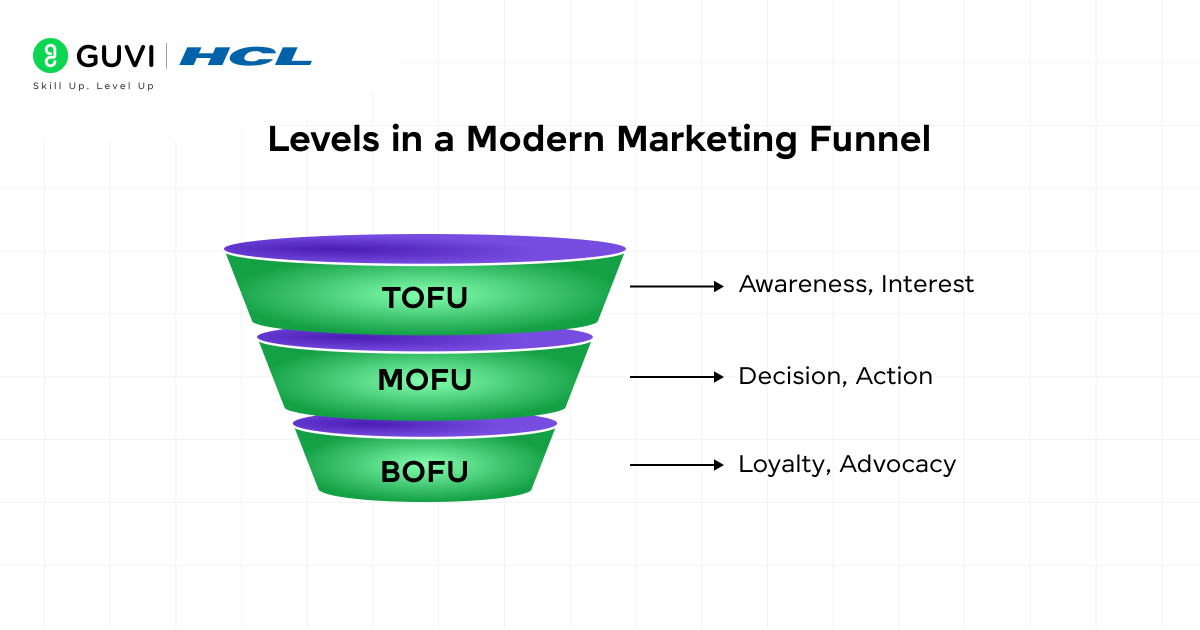
TOFU (Top of Funnel), MOFU (Middle of Funnel), and BOFU (Bottom of Funnel) represent the three key stages of a marketing funnel. Marketing heavily relies on these stages to formulate the strategies based on the user journey.
Each stage is critical as it ensures a systematic approach to nurturing leads and maximizing conversion opportunities. Let’s understand these stages in detail:
TOFU (Top of Funnel)
TOFU is all about awareness and reach. The goal is to attract as many potential customers as possible by making them aware of your brand and its offerings. It’s significant because it starts the customer journey, setting the stage for deeper engagement.
KPI Metrics
- Website Traffic: Number of new and returning visitors.
- Social Media Engagement: Likes, shares, and comments.
- Content Downloads: Number of resources downloaded.
- Page Views: Total views on key informational pages.
- Impressions: Total number of times your content is displayed.
MOFU (Middle of Funnel)
MOFU targets prospects who are already aware of your brand and have shown initial interest. The goal here is to deepen their engagement and move them closer to making a purchase decision. This stage is crucial for building trust and positioning your offerings as the best solution.
KPI Metrics
- Lead Conversion Rates: Percentage of visitors converting into leads.
- Email Engagement: Open and click-through rates.
- Time on Site: Average duration of visits.
- Content Interaction: Depth of engagement with content.
- Form Submissions: Number of completed forms.
BOFU (Bottom of Funnel)
BOFU focuses on conversion, turning interested prospects into paying customers. The goal is to persuade these ready-to-buy prospects with compelling offers and assurances that lead to sales. This stage is key for maximizing ROI and achieving sales targets.
KPI Metrics
- Conversion Rate: Percentage of leads that turn into customers.
- Sales Growth: Increases in sales volume.
- Customer Acquisition Cost: Cost associated with acquiring a new customer.
- ROI: Return on investment from BOFU strategies.
- Customer Lifetime Value: Estimated revenue a customer will bring during their relationship with your brand.
TOFU vs MOFU vs BOFU: Complete Breakdown
| Stage | Definition | Primary Goal | Content Types | Key Metrics | Best Practices |
| TOFU (Top of Funnel) | Website traffic, impressions, social shares,and content downloads | Attract a wide audience and build brand visibility. | Blog posts, social media content, infographics, videos, podcasts, SEO content | The consideration stage where prospects engage and evaluate solutions. | 1. Create educational content focused on pain points. 2. Use SEO to improve organic visibility. 3. Promote widely through social and paid ads. |
| MOFU (Middle of Funnel) | Lead generation rate, email sign-ups, engagement time, and webinar attendance | Nurture leads by providing value and building trust. | E-books, whitepapers, webinars, case studies, comparison guides | Lead generation rate, email sign-ups, engagement time, webinar attendance | 1. Offer gated content to capture leads. 2. Segment audiences for personalized nurturing. 3. Use email marketing for engagement. |
| BOFU (Bottom of Funnel) | Decision stage where prospects are ready to make a purchase. | Convert leads into customers with compelling offers. | Free trials, demos, product comparisons, testimonials, pricing pages | Conversion rate, sales growth, CAC (Customer Acquisition Cost), ROI | 1. Highlight strong CTAs with clear next steps. 2. Showcase social proof and reviews. 3. Offer discounts or limited-time deals to close sales. |
Concluding Thoughts
We believe by now, you must have got a good idea of funel marketing. Funnel marketing is all about the user journey and grasping the consumer’s behavior so that you can use it to your advantage.
When you formulate strategies based on the funnels, you increase your chances of capturing more hot leads, increasing your visibility, and establishing a strong sales funnel that offers long-term results.
Use the strategies, make your own, and drive results. Let us know if we missed anything and keep coming back for more digital marketing guidance and tips.
FAQs
What is a marketing funnel?
A marketing funnel is a model that describes the journey a customer takes from first discovering your product to making a purchase and becoming a loyal customer. It’s like a roadmap for turning potential customers into actual buyers and beyond.
What are the stages of a marketing funnel?
The stages of a marketing funnel include Awareness (when customers first hear about your brand), Interest (when they start showing interest), Consideration (when they compare options), Conversion (when they make a purchase), Loyalty (when they return for more), and Advocacy (when they recommend your brand to others).
What are the different types of marketing funnels?
There are several types of marketing funnels, including sales funnels, email marketing funnels, content marketing funnels, webinar funnels, and social media funnels. Each type is designed to suit different marketing strategies and objectives.
How do you create a marketing funnel?
To create a marketing funnel, start by identifying your target audience and mapping out their journey. Set clear goals and key performance indicators (KPIs), develop a content strategy, implement lead capture and nurturing tactics, and continuously monitor and optimize your funnel based on performance metrics.
Why is a marketing funnel important?
A marketing funnel is essential because it provides a structured approach to converting leads into customers. It helps businesses improve customer retention and overall marketing efficiency by managing and optimizing each stage of the customer journey.
How do you optimize a marketing funnel?
To optimize your marketing funnel, analyze data to identify where customers drop off, conduct A/B testing on different elements, personalize content, use marketing automation tools, and regularly review and adjust your strategies based on performance metrics.
Success Stories

About the Author
Vaishali Ardhana
I'm a seasoned writer with four years of experience across technical, non-technical, and just about every genre or niche you can imagine. Adaptable and curious, I enjoy exploring new topics and making information engaging and easy to understand. Fueled by a steady stream of tea, I approach each project with creativity, reliability, and genuine enthusiasm for storytelling.
View all posts by Vaishali Ardhana
Connect with me @











Did you enjoy this article?