


Career Articles
How I Switched from Web Developer to ML Engineer (A Web Developer's Real Story)
PHP Developer Resume: Writing Guide & Key to Landing Your Dream Job
My Frontend Developer Interview at Google: What Really Happens Behind Closed Doors
Future of Electric Vehicle Course: Fast-Track Your EV Career


Get In Touch For Details! Request More Information
Recruitment has changed into a much more active experience than simply posting a vacancy and waiting for resumes. The employer and candidate experience have evolved. Organizations have begun to think about how they hire, select, and engage with talent from a different lens. Technology, flexible work models, new skill demands, and a growing focus on people-centric policies are shaping how modern recruitment works.
As we move forward, understanding the Top Recruitment Trends becomes essential for HR teams, business owners, and even job seekers. Top Recruitment Trends give insight into how organizations are adapting to remain competitive, create stronger teams, and ultimately support a better workplace culture. From AI in hiring to considering based on skill set, these top recruitment trends are not new. They are applicable, efficient, and redefine how we recruit from the ground up.
Let us take a look at the Top Recruitment Trends that are defining the future of hiring and transforming the way companies discover great talent.
Quick Answer:
Businesses are leaning towards AI, automation, and data analytics to identify the right candidates and make more informed hiring decisions. They are driven by skill-based hiring, employer branding, and the candidate experience. Hybrid work, internal mobility, DEI, and continuous upskilling are also critical in future-proofing companies.
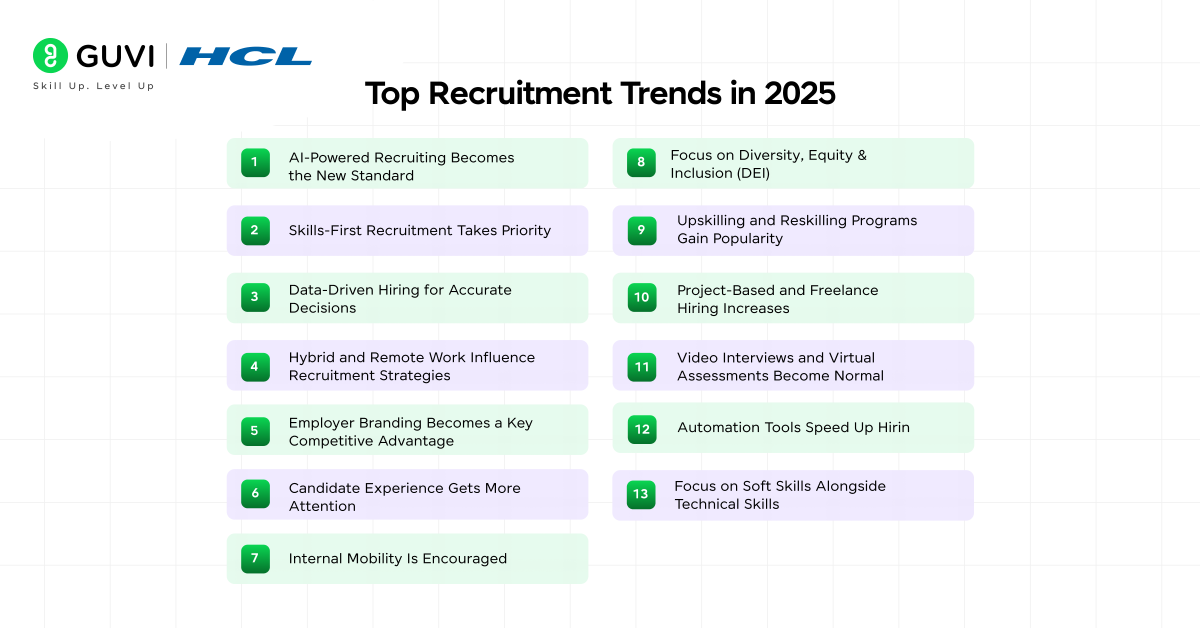
Table of contents
- AI-Powered Recruiting Becomes the New Standard
- Skills-First Recruitment Takes Priority
- Data-Driven Hiring for Accurate Decisions
- Hybrid and Remote Work Influence Recruitment Strategies
- Employer Branding Becomes a Key Competitive Advantage
- Candidate Experience Gets More Attention
- Internal Mobility Is Encouraged
- Focus on Diversity, Equity & Inclusion (DEI)
- Upskilling and Reskilling Programs Gain Popularity
- Project-Based and Freelance Hiring Increases
- Video Interviews and Virtual Assessments Become Normal
- Automation Tools Speed Up Hiring
- Focus on Soft Skills Alongside Technical Skills
- Wrapping it up:
- FAQs
- What are the top recruitment trends in 2026?
- Why is skills-first hiring becoming popular?
- How does AI help in recruitment?
- Is remote work still a major trend?
1. AI-Powered Recruiting Becomes the New Standard
Artificial Intelligence is no longer optional in hiring. It has now become an important component of recruitment policies, as it streamlines working procedures and saves human effort.
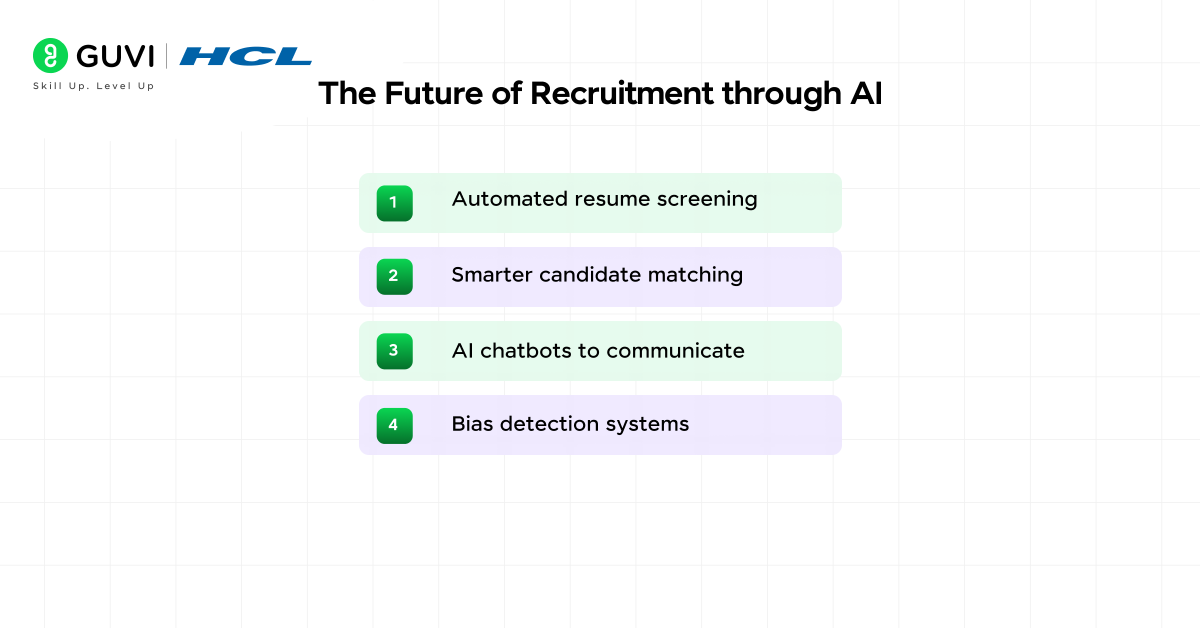
The Future of Recruitment through AI
- Automated resume screening: AI devices check thousands of resumes within seconds and narrow down the candidates according to their skills, experience, and keywords. This will ensure that recruiters do not lose qualified candidates due to manual congestion.
- Smarter candidate matching: AI examines job descriptions and profiles of applicants to see those who best align with the requirements of the company to enhance the quality of the shortlisting process.
- AI chatbots to communicate: Chatbots take candidates through applications, respond to frequently asked questions, and update them in time. This will help in sustaining interest as well as minimizing misunderstanding.
- Bias detection systems: AI verifies job ads and screening trends to avoid bias and assists recruiters in ensuring equity in the hiring channel.
2. Skills-First Recruitment Takes Priority
Organisations no longer rely on degree hiring. Up-to-date skills are more important than educational backgrounds.
Why Skills-First Hiring Is Becoming Popular
- Increasing requests for practical knowledge.
- Students of boot camp and certification are showing that they can deliver results.
- Quickly evolving technology jobs in which degrees are out of fashion.
Recruiters now evaluate:
- Employers like hiring applicants with immediate performance skills instead of those with theoretical skills earned through degrees.
- Individuals who finish the short-term technological boot camps bring in practical skills that suit the needs of the industry.
- Since universities tend to update their syllabus that is slow, companies prefer using skill-based hiring to adapt to the current job demands.
- To assess real ability, recruiters are now analyzing portfolios, GitHub portfolios or coding challenges.

3. Data-Driven Hiring for Accurate Decisions
Data-driven recruitment decisions are more successful. Analytics enables the recruiter to know what is working, what is not working, and why.
How Data Analytics Supports Recruitment
- Predicting candidate performance
- Determining bottlenecks in hiring.
- Reducing hiring time
- Enhancing employment advertising techniques.
- Knowing employee turnover patterns.
Also read: From Campus to Career: Top Tech Skills for Students to Get Hired
Hiring dashboards are also used by many HR teams, and data-driven hiring is an option that has become one of the most reliable Top Recruitment Trends among companies that will make smarter decisions.
4. Hybrid and Remote Work Influence Recruitment Strategies
Remote work is no longer a temporary trend; it’s a permanent shift. Flexible work options are now being offered in even companies that are being operated traditionally.
What This Means for Recruitment
- The companies recruit experts regardless of their location in the world, and this enhances diversity and expertise.
- The majority of candidates are actively searching the companies that permit the possibilities of a hybrid or remote arrangement.
- The virtual interview tools are more convenient in scheduling and also minimize the physical presence.
- The companies save a lot of money in terms of office space, maintenance, and utilities.
5. Employer Branding Becomes a Key Competitive Advantage
An excellent employer brand is also capable of drawing good talent before we even place an advertisement.
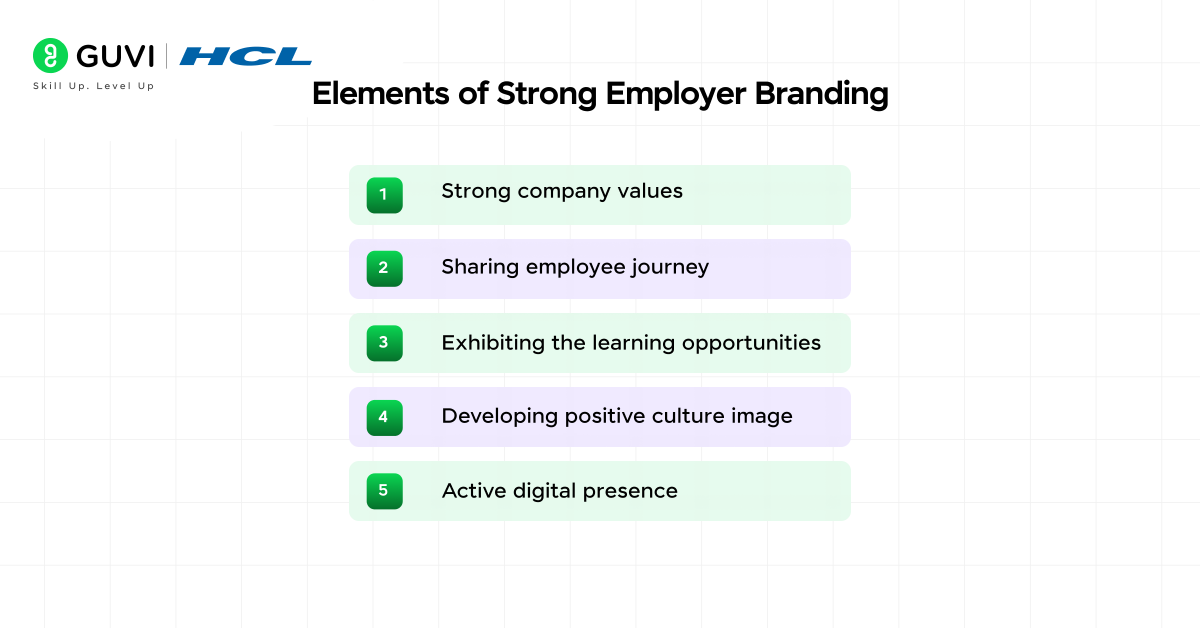
Elements of Strong Employer Branding
- Strong company values: Well-defined mission, vision, and ethics will bring in applicants who share the journey of the company.
- Sharing employee journeys: The testimonials and the success stories provide the candidates with a realistic picture of the company culture.
- Exhibiting the learning opportunities: Mentorship programs, in-house training, and certifications should be highlighted to draw long-term candidates.
- Developing positive culture image: Trust is established through photos, videos, and posts on work-life balance, diversity, and team bonding.
- Active digital presence: Regular posting on LinkedIn, Instagram, and the careers page of the company will enhance visibility.
Also read: Top 8 Strategies for Effective Tech Talent Sourcing
6. Candidate Experience Gets More Attention
Natural consequences of bad candidate experience are a ruined reputation for a company. Recruiters are putting a lot of emphasis on establishing harmonious, dignified, and open hiring processes.
Improvements in Candidate Experience
- Quick communication will minimize drop-offs and demonstrate a sense of respect for the time of the candidate.
- A description of each round will make the candidates ready and will stop any misunderstandings.
- Even unsuccessful applicants are thankful for useful feedback.
- Individualized emails and messages will ensure that candidates feel treasured rather than encountering non-specific messages.
- The application pages are easy to fill out, which makes more candidates to apply using their phones.
- Over 70% of companies now prefer skill-based hiring instead of traditional degree-based recruitment — focusing more on what candidates can do rather than what they’ve studied.
- Artificial Intelligence (AI) can reduce hiring time by up to 40%, especially during tasks like resume screening, shortlisting, and candidate matching.
- Job postings that include clear salary ranges receive 30% more applicants — proving the growing importance of pay transparency in attracting talent.
- Candidate experience plays a major role in employer branding — nearly 60% of applicants avoid companies after a single negative hiring experience.
- Remote and hybrid roles attract nearly 2× more applications compared to fully in-office positions, showing a lasting shift in modern work preferences.
7. Internal Mobility Is Encouraged
Companies are not recruiting outside anymore but are encouraging internal promotion.
The importance of Internal Mobility
- Employees will have longer stays when they perceive growth prospects within the company.
- Internal recruitments take shorter times to adapt, and they are already familiar with the company processes.
- Internal promotions enhance pride and loyalty amongst the employees.
- The current staff possesses valuable information that aids in ensuring that there is consistency in the workflow.
8. Focus on Diversity, Equity & Inclusion (DEI)
Different teams are more effective. That is why nowadays DEI has become the key recruitment priority.
How Companies Are Supporting DEI
- Anonymity, elimination of names, gender, and other personal data, helps in ensuring an objective assessment on the basis of competency.
- Both decision-making and decision-making panels, which consist of individuals with diverse backgrounds, will enable balanced decision-making.
- Job descriptions are crafted in such a way that they do not have words that put off some groups.
- Business organizations work towards ensuring that they give equitable promotions, mentorship, and leadership opportunities to all.
Also read: The Role of Continuous Learning in Tech Hiring
9. Upskilling and Reskilling Programs Gain Popularity
Competences are becoming outdated at a rapid rate. Companies are no longer firing employees who have a skill that is old, but they are training them to do new duties.
Benefits of Upskilling
- To remain relevant, employees are forced to acquire new tools and software on a regular basis.
- Recognizing current employees minimizes the expenses of recruiting new applicants whenever there is a skill deficiency.
- Employees feel encouraged when the organizations assist them in developing
10. Project-Based and Freelance Hiring Increases
More companies hire freelancers for short-term or specialized projects.
Why Companies Prefer Project-Based Hiring
- Lower operational cost
- Access to global talent
- Flexibility in hiring
- Great for skill-specific work
Freelancers, contractors, and gig workers are becoming an important part of the workforce across industries like tech, design, marketing, and writing.
Also read: High-Paying IT/Tech Jobs Without CS Degrees in 2026: Non-CS Graduates Are In Demand
11. Video Interviews and Virtual Assessments Become Normal
The process of recruitment has become fully digital.
Modern Assessment Includes
- Problem solvers live-code in front of recruiters, and the recruiters watch how they solve the problem and the reasoning behind that solution.
- Online exams check dishonesty and give justice.
- Applicants can write down their responses whenever they have time, and the recruiters can look through it during their free time.
- Virtual group exercises can be used to test communication skills and the ability to work in a team.
12. Automation Tools Speed Up Hiring
Automation handles repetitive tasks and helps recruiters focus on important decisions.
Tasks Now Automated
- Sending email reminders
- Interview scheduling
- Follow-up messages
- Application status updates
Also read: 7 Unique Ways Companies Are Attracting Tech Talent in 2026
13. Focus on Soft Skills Alongside Technical Skills
Companies want employees who can communicate well, solve problems, and work in teams.
Soft skills are now evaluated through:
- Candidates act out situations like conflict resolution or customer handling to show communication abilities.
- Group discussions or problem-solving tasks help recruiters judge teamwork.
- Situational questions help uncover traits like responsibility, patience, and leadership.
If you want to strengthen your HR skills and stay updated with modern recruitment practices, check out HCL GUVI’s Human Resources courses. These programs help you master hiring strategies, talent management, and HR tools that are essential in today’s evolving workplace.
Wrapping it up:
The hiring world is changing fast, and staying informed about the Top Recruitment Trends helps both companies and job seekers make smarter decisions. These trends show how modern recruitment is becoming more skill-focused, tech-driven, and people-friendly.
Hope this blog helped you understand the key changes shaping the future of hiring and gave you clear insights into what to expect going forward.
FAQs
1. What are the top recruitment trends in 2026?
The key trends are AI-supported hiring, skills-first hiring practices, flexible remote work, data-led hiring decisions, and more employer branding.
2. Why is skills-first hiring becoming popular?
Companies are prioritizing candidates who are ready to contribute right away, making valuable, tangible skills worth more than traditional credentials and degrees.
3. How does AI help in recruitment?
AI-powered tools do things like pre-screen resumes, match candidates to roles, automate communications, and, ultimately, help speed up the entire hiring process.
4. Is remote work still a major trend?
Many companies continue to use hybrid and remote jobs to adjust their hiring strategy and expand their talent pool globally.
Success Stories

About the Author
Vishalini Devarajan
An Aerospace Engineer turned content writer, I focus on making complex concepts easy to understand through well-structured, reader-friendly blogs. Whether it’s a technical topic or a non-technical one, I love creating content that is clear, engaging, and impactful.
View all posts by Vishalini Devarajan
Connect with me @













Did you enjoy this article?