


Artificial Intelligence and Machine Learning Articles
Getting Started with LangChain Prompt Templates in 2026
Cursor 2.0: Trending AI Model Explained In-Depth
Creating Custom Swag Merchandise Using Generative AI
Create a Recipe with ChatGPT: A Guide to AI-Assisted Cooking


Get In Touch For Details! Request More Information
Top AI Use Cases Transforming Industries in 2026
Feb 11, 2026 10 Min Read 6848 Views
(Last Updated)
According to McKinsey, artificial intelligence could deliver up to 4.4 trillion dollars in annual value across industries by 2030. And, 2026 is already showing how that potential is taking shape. AI is no longer limited to experimental projects or tech-heavy sectors. It is actively reshaping how businesses operate and interact with customers.
Right from predictive analytics to autonomous systems, the most impactful AI use cases are delivering measurable results in accuracy and innovation across multiple industries. This shift is setting new standards for performance and competitiveness in the global market.
Over 90% of companies are either utilizing or exploring the phenomenal use cases of AI.
Waymo’s autonomous vehicles have driven over 100 million miles without a safety driver—highlighting the scale and reliability of AI in transportation.
More than 85% of Fortune 500 companies are using Microsoft AI tools to power their operations. 66% of CEOs report measurable efficiency or customer satisfaction gains from generative AI initiatives.
Table of contents
- Why are AI use cases important in various industries?
- Top 20 AI Use Cases You Must Know
- More Unique Use Cases of AI
- Conclusion
- FAQs
Why are AI use cases important in various industries?
AI use cases are important in various industries because they demonstrate how artificial intelligence can directly solve sector-specific problems and create a measurable impact. Instead of applying AI as a generic tool, well-defined use cases adapt the technology to the unique demands of each industry, whether it is improving diagnostic accuracy in healthcare, predicting equipment failures in manufacturing, or preventing fraud in finance. These targeted applications allow businesses to gain faster returns on investment and reduce operational risks.
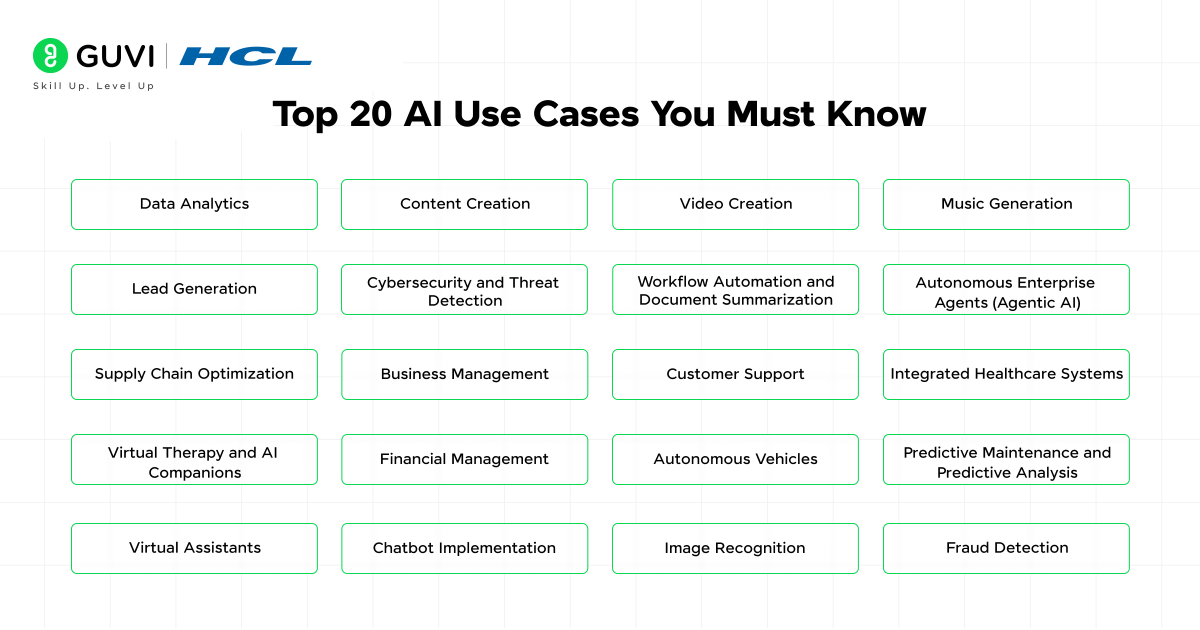
Top 20 AI Use Cases You Must Know
- Data Analytics in AI
Data analytics in artificial intelligence is one of the prominent AI use cases. It refers to the use of AI-powered algorithms to process and draw conclusions from structured and unstructured datasets. AI brings speed and accuracy to analytics processes that would otherwise require extensive human effort. Businesses rely on AI-driven data analytics to improve efficiency and gain deeper insights into customer behavior and market trends.
Top Features of AI in Data Analytics
- Predictive Analysis: Uses historical and current data to forecast future outcomes.
- Automated Data Cleaning: Detects and removes duplicates and missing values. It also standardizes inconsistent formats.
- Natural Language Processing: Interprets text data from multiple sources to extract meaning and sentiment.
- Real-Time Insights: Processes live data feeds to provide immediate and actionable outputs.
Real-World AI Case Studies in Data Analytics
- Retail: Global retail chains can use AI analytics to predict shopping patterns and manage inventory. They can also resort to AI for reducing stock shortages and overstocking.
- Healthcare: AI-powered analytics platforms help hospitals analyze patient histories and lab results to detect early signs of chronic conditions.
- Finance: Banks employ AI-based data analytics to identify fraudulent activities by spotting unusual transaction patterns.
Top AI Tools for Data Analytics
- Tableau with Einstein Discovery: Integrates AI-driven insights into interactive dashboards.
- Microsoft Power BI: Offers AI visualizations and automated data preparation features.
- Google Cloud BigQuery ML: Runs machine learning models directly on large datasets without moving data.
- IBM Watson Analytics: Provides advanced AI-driven statistical analysis and data visualization.
- Content Creation in AI
Content creation is also one of the most notable AI use cases. The production of content with AI involves using algorithms to produce written or interactive materials that align with brand tone and audience preferences. AI tools can generate:
- Blog articles
- Product descriptions
- AD copies
- Creative stories, and a lot more.
These systems learn from vast datasets and adapt to specific guidelines. It allows for high-quality output at scale. Businesses benefit from generative AI-generated content because it saves time and maintains consistency across multiple platforms.
Top Features of AI in Content Creation
- SEO Optimization: Suggests keywords and structures content for better search visibility.
- Tone and Style Adaptation: Matches the brand’s communication style across all outputs.
- Content Personalization: Adjusts messages based on audience demographics and behavior.
Real-World AI Case Studies in Content Creation
- E-commerce: Online marketplaces use AI to automatically write product descriptions for thousands of items.
- Publishing: News agencies employ AI to produce financial market updates in real time.
- Marketing: Social media managers leverage AI to generate captions tailored to trending topics.
Top AI Tools for Content Creation
- Jasper: AI writing assistant for blogs, ads, and website copy.
- Copy.ai: Generates short and long-form content for marketing purposes.
- Writesonic: Produces SEO-optimized blog articles and product descriptions.
- Frase: Combines AI content generation with topic research.
- Video Creation in AI
AI use cases in video creation automates tasks such as editing and scripting. It can also skillfully execute animation and special effects. These tools shorten production timelines and allow creators to produce high-quality videos without advanced technical skills. AI-driven video platforms are widely used for marketing campaigns and training materials.
Top Features of AI in Video Creation
- Automated Editing: Cuts and arranges clips without manual input.
- Text-to-Video Conversion: Turns scripts into animated or live-action videos.
- Voiceover Generation: Produces natural-sounding narrations in multiple languages.
- Scene Enhancement: Improves lighting and resolution for better visual appeal.
Real-World AI Case Studies in Video Creation
- Corporate Training: Companies use AI to turn text-based manuals into engaging training videos.
- Social Media: Brands create quick product demo videos with AI tools for platforms like Instagram and TikTok.
- Education: E-learning platforms generate course videos from lesson scripts to speed up content production.
Top AI Tools for Video Creation
- Synthesia: Converts text into videos with AI avatars and voices.
- Pictory: Creates short videos from long-form content such as webinars.
- Lumen5: Turns blog posts into shareable social media videos.
- Runway: AI-assisted video editing and effects generation.
- Music Generation in AI
AI music generation is one of the leading AI business use cases. It uses algorithms to compose melodies and beats based on specific styles or moods. AI use cases in the musical realm can replicate genres and create background scores. It can also produce unique tracks from scratch.
Top Features of AI in Music Generation
- Style Replication: Produces music in the style of classical, jazz, pop, or other genres.
- Custom Track Creation: Generates unique compositions for specific projects.
- Real-Time Composition: Produces music instantly during live performances or gameplay.
- Instrument Simulation: Recreates sounds of real instruments without physical recording.
Real-World AI Case Studies in Music Generation
- Gaming: AI creates adaptive soundtracks that change with gameplay events.
- Advertising: Brands use AI-generated jingles for quick campaign launches.
- Film Production: Independent filmmakers use AI for affordable background scores.
Top AI Tools for Music Generation
- AIVA: Composes music for film, ads, and games.
- Amper Music: Produces royalty-free tracks for content creators.
- Soundraw: Customizes AI-generated music for videos and podcasts.
- Boomy: Lets users create and publish songs in minutes.
- Lead Generation in AI
AI use cases in lead generation use data enrichment and personalization to identify and qualify potential customers. The technology analyzes large datasets to find prospects most likely to convert. AI-driven systems improve marketing efficiency by reducing time spent on manual prospecting. Businesses across industries use these tools to expand their customer base and increase revenue.
Top Features of AI in Lead Generation
- Predictive Scoring: Ranks leads based on likelihood of conversion.
- Automated Prospecting: Finds potential customers from online and offline databases.
- Personalized Outreach: Sends tailored messages to increase engagement.
- Lead Nurturing Automation: Maintains regular contact with prospects until they are ready to buy.
Real-World AI Case Studies in Lead Generation
- B2B Marketing: AI platforms help sales teams prioritize leads from trade show attendee lists.
- E-commerce: Online stores use AI to target shoppers who abandoned carts.
- SaaS Companies: Predictive algorithms identify users likely to upgrade from free to paid plans.
Top AI Tools for Lead Generation
- HubSpot AI: Offers predictive lead scoring and automated workflows.
- Apollo.io: AI-powered prospecting with contact enrichment.
- ZoomInfo: Uses AI to find and qualify business leads.
- Clearbit: Provides real-time data enrichment for sales and marketing teams.
- Cybersecurity and Threat Detection in AI
AI use cases in cybersecurity and threat detection use advanced algorithms to identify vulnerabilities. The technology helps detect malicious activities and respond to incidents in real time. AI security platforms can predict potential threats and prevent them before damage occurs. This technology is essential for organizations dealing with sensitive information and large-scale digital infrastructure.
Top Features of AI in Cybersecurity and Threat Detection
- Anomaly Detection: Identifies unusual patterns in network traffic or user behavior.
- Automated Incident Response: Acts on threats instantly without manual intervention.
- Phishing Detection: Flags suspicious emails and websites.
- Threat Intelligence Integration: Uses global data sources to recognize new threats.
Real-World AI Case Studies in Cybersecurity and Threat Detection
- Financial Services: Banks use AI to detect fraudulent transactions within seconds.
- Healthcare: Hospitals deploy AI to monitor for ransomware attacks targeting patient records.
- Cloud Platforms: AI systems block suspicious login attempts from unfamiliar locations.
Top AI Tools for Cybersecurity and Threat Detection
- Darktrace: AI-powered threat detection and autonomous response.
- CrowdStrike Falcon: Endpoint protection with AI-driven analytics.
- Vectra AI: Detects hidden cyberattacks across networks and cloud.
- Cylance: Predictive cybersecurity based on AI models.
- Workflow Automation and Document Summarization in AI
AI in workflow automation and document summarization helps organizations improve productivity by streamlining repetitive processes and condensing large documents into concise summaries. These tools save time for employees and improve decision-making by providing relevant information quickly. Businesses use them to handle email sorting and meeting note generation.
Top Features of AI in Workflow Automation and Document Summarization
- Process Automation: Deals with routine tasks such as approvals and data entry.
- Text Summarization: Extracts key points from lengthy reports.
- Integration with Productivity Tools: Works with platforms like Slack and Google Workspace.
- Contextual Understanding: Maintains accuracy when condensing information.
Real-World AI Case Studies in Workflow Automation and Document Summarization
- Legal Firms: AI reviews contracts and produces summaries for attorneys.
- Corporate Offices: Teams use AI to summarize meeting transcripts for quick follow-up.
- Government Agencies: AI systems condense policy documents for decision-makers.
Top AI Tools for Workflow Automation and Document Summarization
- UiPath: Automates workflows across different applications.
- Zapier: Connects tools to automate multi-step processes.
- SMMRY: Generates concise summaries of text content.
- SummarizeBot: AI-powered summarization for documents and web pages.
- Supply Chain in AI
AI use cases in supply chain management improve forecasting. It also plays a key part in leveling up inventory optimization and logistics planning. These tools help businesses predict demand and monitor shipments. AI also supports risk management by identifying disruptions early and suggesting alternative solutions.
Top Features of AI in Supply Chain
- Demand Forecasting: Predicts product demand using historical and seasonal data.
- Inventory Optimization: Maintains stock at optimal levels to reduce costs.
- Route Optimization: Finds the most efficient delivery paths.
- Supplier Risk Assessment: Evaluates supplier reliability and potential delays.
Real-World AI Case Studies in Supply Chain
- Retail: Large retailers use AI to plan restocking schedules and reduce overstocking.
- Manufacturing: Plants use AI to monitor supply shortages and suggest quick replacements.
- Logistics Companies: AI systems track shipments and predict delivery delays.
Top AI Tools for Supply Chain
- Llamasoft: AI supply chain design and analytics platform.
- Blue Yonder: Predictive supply chain and demand planning software.
- Infor Nexus: Real-time supply chain visibility and optimization.
- ClearMetal: AI-driven inventory and demand forecasting.
- Business Management in AI
AI in business management supports decision-making. It also supports resource allocation and performance monitoring. It processes company data to identify opportunities and challenges.
Top Features of AI in Business Management
- Performance Tracking: Monitors sales and project progress.
- Decision Support Systems: Suggests actions based on predictive analytics.
- Automated Scheduling: Organizes tasks and meetings without manual input.
- Cost Optimization: Identifies ways to reduce unnecessary expenses.
Real-World AI Case Studies in Business Management
- Consulting Firms: AI platforms recommend strategies based on client data.
- Small Businesses: Use AI to manage employee schedules and payroll.
- Enterprises: Implement AI dashboards to track performance in real time.
Top AI Tools for Business Management
- Monday.com: AI-assisted project and task management.
- Asana Intelligence: Suggests workflow improvements based on data.
- Trello with Butler AI: Automates repetitive project board tasks.
- Zoho One: All-in-one AI-supported business suite.
- Customer Support in AI
AI use cases in customer support enrich service quality by automating responses. It also modifies routing inquiries and offers self-service options. These systems learn from past interactions to provide more accurate and personalized assistance over time. Businesses use AI to maintain availability outside traditional working hours.
Top Features of AI in Customer Support
- Chatbots: Provide instant responses to customer queries.
- Sentiment Analysis: Detects customer emotions in messages.
- Automated Ticket Routing: Directs issues to the right department.
- Knowledge Base Integration: Pulls answers from help articles and FAQs.
Real-World AI Case Studies in Customer Support
- E-commerce Stores: AI chatbots handle common shipping and refund questions.
- Telecom Companies: AI routes network outage complaints to technical teams.
- SaaS Platforms: Use AI to suggest relevant help articles before escalating issues.
Top AI Tools for Customer Support
- Zendesk AI: Automates ticket categorization and response suggestions.
- Freshdesk AI: Offers smart responses and sentiment tracking.
- Intercom AI: Combines live chat with AI automation.
- Tidio: AI chatbot for websites and messaging apps.
- Integrated Healthcare System in AI
AI and ML in integrated healthcare systems improves patient record management. It furthermore plays a key part in connecting different healthcare departments for better coordination. It also pulls data from pharmacies to support accurate treatment decisions.
Top Features of AI in Integrated Healthcare Systems
- Unified Patient Records: Stores medical history in a central database.
- Predictive Analytics: Anticipates health risks using past data.
- Automated Scheduling: Coordinates appointments between departments.
- Real-Time Monitoring: Tracks patient vitals from connected devices.
Real-World AI Case Studies in Integrated Healthcare Systems
- Hospitals: AI platforms link departments to reduce delays in diagnosis.
- Public Health Systems: Use AI to manage vaccination programs and screening drives.
- Private Clinics: Deploy AI for sharing patient data securely between branches.
Top AI Tools for Integrated Healthcare Systems
- Cerner: AI-powered healthcare data integration.
- Epic Systems: Unified patient management software with AI analytics.
- Health Catalyst: Predictive and prescriptive healthcare analytics.
- Meditech Expanse: Cloud-based AI healthcare platform.
- Autonomous Enterprise Agents (Agentic AI)
Agentic AI use cases in enterprises automates complex decision-making. It also supports workflow execution without constant human oversight. These AI agents manage tasks such as negotiation and reporting. They also perform process optimization based on given objectives.
Top Features of Autonomous Enterprise Agents
- Goal-Driven Automation: Executes multi-step processes toward a defined target.
- Contextual Understanding: Adapts to changing business conditions.
- Cross-System Integration: Works across multiple software platforms.
- Decision Justification: Explains reasoning behind actions.
Real-World AI Case Studies in Autonomous Enterprise Agents
- E-commerce Firms: AI agents handle supplier negotiations and stock updates.
- Financial Services: Agents prepare compliance reports automatically.
- Tech Companies: AI agents manage cloud resource allocations.
Top AI Tools for Autonomous Enterprise Agents
- Auto-GPT: Open-source agent for automated task execution.
- LangChain Agents: AI-driven decision-making framework.
- IBM Watson Orchestrate: Automates enterprise workflows.
- Adept ACT-1: AI agent for business task management.
- Virtual Therapy and AI Companions
AI business use cases in virtual therapy support mental health consultations. It also acts as a companion for people who need emotional interaction and guidance. These tools bridge the gap in access to therapists. They also provide ongoing emotional support between sessions.
Top Features of Virtual Therapy and AI Companions
- 24/7 Availability: Provides support anytime.
- Sentiment Tracking: Monitors user mood over time.
- Personalized Guidance: Adapts responses based on user needs.
- Secure Conversations: Protects privacy with encryption.
Real-World AI Case Studies in Virtual Therapy and AI Companions
- Mental Health Startups: Use AI chatbots for early emotional support.
- Senior Care: AI companions provide conversation to reduce loneliness.
- Corporate Wellness Programs: Offer virtual therapy access to employees.
Top AI Tools for Virtual Therapy and AI Companions
- Wysa: AI chatbot for mental health support.
- Replika: AI companion for daily conversation.
- Woebot Health: AI-based CBT (Cognitive Behavioral Therapy) tool.
- Tess AI: Mental wellness AI for organizations.
- Financial Management in AI
AI use cases in financial management improves expense tracking. It also levels up investment decision-making with predictive insights. Businesses use AI to manage budgets effectively. Individuals use it to reduce financial risks.
Top Features of AI in Financial Management
- Expense Categorization: Organizes transactions automatically.
- Investment Recommendations: Suggests options based on market trends.
- Fraud Detection: Flags suspicious activity.
- Cash Flow Forecasting: Predicts future financial health.
Real-World AI Case Studies in Financial Management
- Banks: AI systems monitor transactions for unusual activity.
- Wealth Management Firms: Use AI to tailor investment portfolios.
- Small Businesses: Implement AI to manage cash flow and payments.
Top AI Tools for Financial Management
- Intuit QuickBooks: AI-based expense tracking.
- Fyle: AI-powered expense management tool.
- Kavout: AI investment analytics.
- Zeni: AI-driven finance department for startups.
- Autonomous Vehicles in AI
AI use cases in autonomous vehicles improves object detection. It also plays a key part in route planning based on real-time conditions. These vehicles use AI to make safe driving decisions. They also adjust routes automatically when conditions change.
Top Features of AI in Autonomous Vehicles
- Computer Vision: Detects pedestrians and vehicles.
- Adaptive Cruise Control: Maintains safe distances automatically.
- Predictive Navigation: Adjusts routes for traffic or weather changes.
- Sensor Fusion: Combines data from cameras and radar.
Real-World AI Case Studies in Autonomous Vehicles
- Ride-Hailing Companies: Use AI for self-driving car trials.
- Logistics Firms: Deploy autonomous trucks for long-haul deliveries.
- Agriculture: Self-driving tractors assist in precision farming.
Top AI Tools for Autonomous Vehicles
- Waymo Driver: AI driving platform from Alphabet.
- Tesla Autopilot: AI-assisted driving system.
- Aptiv: Autonomous driving technology provider.
- Aurora Driver: AI for freight and passenger transport.
- Predictive Maintenance and Predictive Analysis in AI
AI business use cases in predictive maintenance helps reduce equipment downtime. It also plays a key part in lowering repair costs by predicting issues before they happen. Predictive analysis applies AI to forecast trends and performance outcomes. It uses historical and real-time data to provide actionable insights.
Top Features of Predictive Maintenance and Predictive Analysis
- Anomaly Detection: Spots unusual patterns in performance.
- Failure Prediction: Anticipates mechanical issues before breakdown.
- Trend Forecasting: Predicts outcomes based on past data.
- Automated Alerts: Notifies teams about potential risks.
Real-World AI Case Studies in Predictive Maintenance and Predictive Analysis
- Manufacturing: AI predicts machine wear to schedule repairs on time.
- Energy Sector: Predicts faults in wind turbines or power grids.
- Transportation: Uses AI to anticipate maintenance needs in fleets.
Top AI Tools for Predictive Maintenance and Predictive Analysis
- Uptake: AI platform for industrial equipment monitoring.
- C3 AI: Predictive analytics for enterprises.
- Predikto: Predictive maintenance for transport and logistics.
- IBM Maximo: AI-driven asset management software.
- Virtual Assistants in AI
Virtual assistants powered by AI improve task automation. They also enhance communication between businesses and customers, making them a valuable part of artificial intelligence in businesses. These assistants respond to voice or text inputs and perform tasks such as scheduling and information retrieval.
Top Features of AI Virtual Assistants
- Natural Language Processing: Understands and responds to human speech.
- Multi-Platform Integration: Works across web, mobile, and desktop.
- Personalized Responses: Adapts replies based on user history.
- Task Automation: Handles repetitive requests efficiently.
Real-World AI Case Studies in Virtual Assistants
- Corporate Offices: AI assistants schedule meetings and manage emails.
- Customer Service: Assistants provide instant support for queries.
- Healthcare: Virtual assistants help patients book appointments.
Top AI Tools for Virtual Assistants
- Google Assistant: Voice-based virtual helper.
- Amazon Alexa: AI assistant for home and business use.
- Cortana: Microsoft’s AI assistant for productivity tasks.
- Haptik: AI virtual assistant platform for enterprises.
- Chatbot Implementation in AI
AI use cases in chatbot implementation improve real-time customer interaction. Artificial intelligence in businesses also plays a key role in reducing human workload for repetitive tasks. These bots handle text-based communication through websites or apps and provide instant answers to common queries.
Top Features of AI Chatbots
- 24/7 Availability: Responds anytime without downtime.
- Automated FAQ Responses: Answers common questions instantly.
- Context Awareness: Maintains conversation flow.
- Integration Support: Works with CRM and helpdesk tools.
Real-World AI Case Studies in Chatbot Implementation
- Retail: AI chatbots assist shoppers with order tracking.
- Banking: Chatbots provide account updates and loan information.
- Education: AI bots answer student questions on online learning platforms.
Top AI Tools for Chatbot Implementation
- Dialogflow: Google’s AI chatbot platform.
- Tidio: Chatbot and live chat combination tool.
- ManyChat: AI chatbots for social media and websites.
- Intercom: Business messaging and chatbot platform.
- Image Recognition in AI
AI in image and pattern recognition identifies objects in photos or videos. It further enriches accuracy in categorizing visual content. This technology processes visual data to detect patterns. It also supports decision-making based on visual inputs.
Top Features of AI Image Recognition
- Object Detection: Identifies specific items in images.
- Facial Recognition: Matches faces with stored profiles.
- Image Classification: Groups images based on content.
- Real-Time Processing: Analyzes visuals instantly.
Real-World AI Case Studies in Image Recognition
- Retail: AI checks shelves for product availability.
- Security: Facial recognition improves access control.
- Healthcare: AI assists in analyzing medical images.
Top AI Tools for Image Recognition
- Amazon Rekognition: AI image and video analysis tool.
- Clarifai: Visual recognition API.
- Microsoft Azure Computer Vision: Image recognition and analysis service.
- Face++: AI facial recognition technology.
- Fraud Detection in AI
AI use cases in fraud detection identify suspicious activities in transactions. Artificial intelligence in businesses also augments prevention strategies by learning from past fraud patterns. These systems track financial behavior and flag anomalies for further investigation.
Top Features of AI Fraud Detection
- Pattern Recognition: Detects irregularities in user activity.
- Real-Time Alerts: Flags potential fraud instantly.
- Risk Scoring: Assigns probability levels to transactions.
- Behavior Analysis: Monitors changes in normal patterns.
Real-World AI Case Studies in Fraud Detection
- Banking: AI detects unusual credit card spending.
- E-commerce: Identifies fake transactions or return fraud.
- Insurance: Flags suspicious claims for review.
Top AI Tools for Fraud Detection
- Kount: AI fraud prevention platform.
- SAS Fraud Management: Risk and fraud detection software.
- Feedzai: AI-powered risk management system.
- FICO Falcon: Fraud detection for financial institutions.
Ready to do more than just read about AI’s impact? Turn insights on 2026’s top AI use cases into career-ready skills with our Intel®-certified AI–ML course. With an industry-aligned curriculum, hands-on training, native language support and a global community of 80,000+ learners, you will gain the expertise top companies demand in 2026 and beyond.

More Unique Use Cases of AI
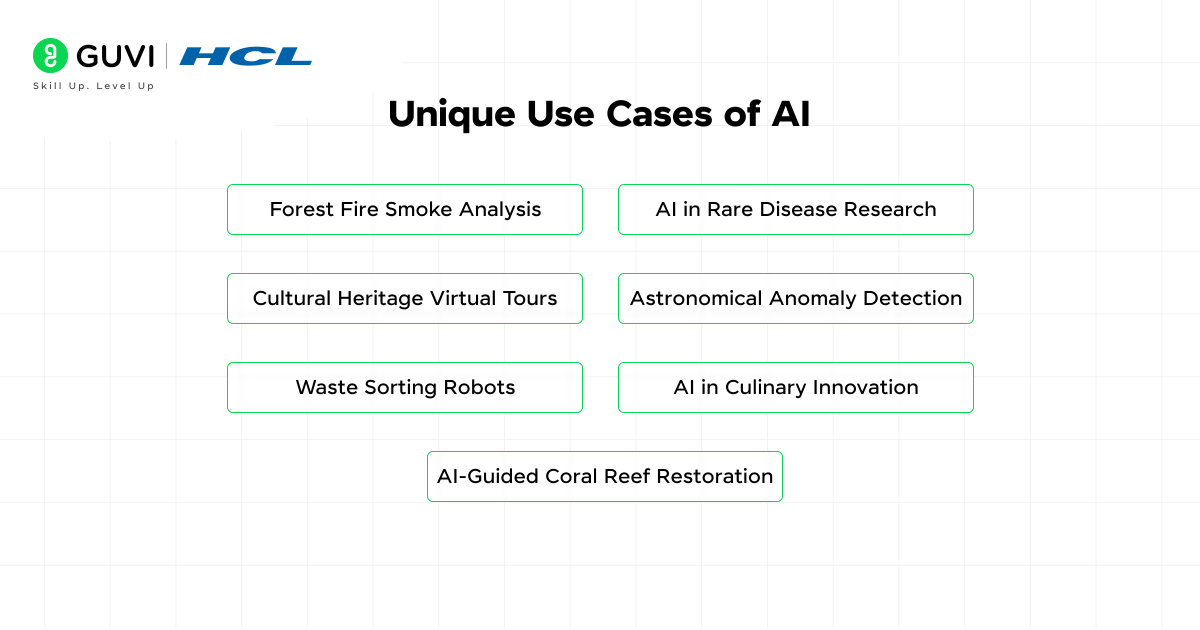
- Forest Fire Smoke Analysis: Interprets satellite images to detect early smoke signatures. It estimates the spread direction for timely evacuation.
- AI in Rare Disease Research: Matches patient genetic data with global research databases. It suggests potential clinical trials.
- Astronomical Anomaly Detection: Spots unusual space signals that could indicate new celestial phenomena. It helps filter out cosmic noise for cleaner data.
- Cultural Heritage Virtual Tours: Builds 3D reconstructions of heritage sites from scattered photos. It also offers AI-guided narration for immersive exploration.
- Waste Sorting Robots: Classify recyclables from landfill waste using AI vision. It also adapts sorting speed to match conveyor belt flow.
- AI in Culinary Innovation: Suggests new recipes by combining unlikely ingredient pairings. It also adapts them to specific dietary restrictions.
- AI-guided Coral Reef Restoration: Maps damaged coral zones with drones. It also recommends optimal species for replanting based on ocean conditions.
Conclusion
Artificial intelligence is a transformative force actively reshaping every sector. The technology is breaking silos by automating decision-making. It is enriching human capabilities at scale. As integration deepens, the coming years will be defined not by the question of whether to adopt AI, but by how creatively and responsibly it can be applied to solve real-world challenges.
FAQs
Q1: How is AI different from traditional automation?
AI learns and improves over time, whereas traditional automation follows fixed, pre-programmed rules without the ability to evolve.
Q2: What’s the biggest benefit of integrating AI across multiple departments?
It eliminates data silos and enables faster plus coordinated decision-making and consistent experiences for customers or patients.
Q3: Can small businesses realistically adopt AI?
Yes. With cloud-based tools and subscription models, AI solutions are increasingly affordable and scalable for smaller operations.
Q4: How does AI improve decision-making accuracy?
AI does so by detecting hidden patterns and removing human bias from certain analytical steps.
Q5: Which industries are expected to see the fastest AI growth next?
Healthcare and financial services are projected to experience rapid adoption due to high data volume and operational complexity.
Success Stories

About the Author
Vaishali
I'm a seasoned writer with four years of experience across technical, non-technical, and just about every genre or niche you can imagine. Adaptable and curious, I enjoy exploring new topics and making information engaging and easy to understand. Fueled by a steady stream of tea, I approach each project with creativity, reliability, and genuine enthusiasm for storytelling.
View all posts by Vaishali
Connect with me @














Did you enjoy this article?