


Career Articles
How I Switched from Web Developer to ML Engineer (A Web Developer's Real Story)
PHP Developer Resume: Writing Guide & Key to Landing Your Dream Job
My Frontend Developer Interview at Google: What Really Happens Behind Closed Doors
Future of Electric Vehicle Course: Fast-Track Your EV Career


Get In Touch For Details! Request More Information

Choosing the right career path can feel confusing when there are so many options, new job trends, and different skills to consider. Many beginners worry about making the wrong choice or feel unsure about what truly suits their strengths and interests. Understanding yourself, your abilities, likes, dislikes, and natural talents makes this journey much easier. With the right guidance, choosing a career becomes less stressful and more meaningful.
In this blog, we will explore simple and practical steps to help you identify the right career path, understand your strengths, match them with real job roles, and make confident decisions. You will learn how to assess yourself, explore industries, try hands-on experiences, and plan your long-term career growth. This guide is especially useful for students, freshers, career changers, and anyone who feels confused about which direction to take.
Quick Answer
The right career path is the one that fits your strengths, interests, and personality while also offering good opportunities. You can find it by exploring different roles, learning basic skills, and trying small projects. For example, if you enjoy drawing and spend time creating digital art, you could try designing a simple poster or logo. If you enjoy the process and feel motivated to learn more, graphic design might be a good career path for you.
Table of contents
- Steps To Decide The Right Career Path
- Know Yourself
- Explore Different Career Options
- Identify Your Strengths
- Understand Market Demand
- Seek Guidance From Mentors
- Try Projects And Internships
- Build Relevant Skills
- Set Short-Term And Long-Term Goals
- How To Analyse Yourself And Match Your Interests To The Right Career Path
- Identify What You Enjoy Doing
- Recognize What You Are Naturally Good At
- Understand Your Work Personality
- Evaluate Your Energy Levels
- Align Interests With Market Demand
- Create a Simple Career-Matching Matrix
- Validate Your Choices Through Small Experiments
- Beginner-Friendly Career Matching Guide: Map Your Interests to the Right Career Path
- Conclusion
- FAQs
- How do I choose a career if I have multiple interests?
- What if I choose the wrong career path?
- How early should students start career planning?
- Is passion more important than salary when choosing a career?
- How long does it take to figure out the right career path?
Steps To Decide The Right Career Path
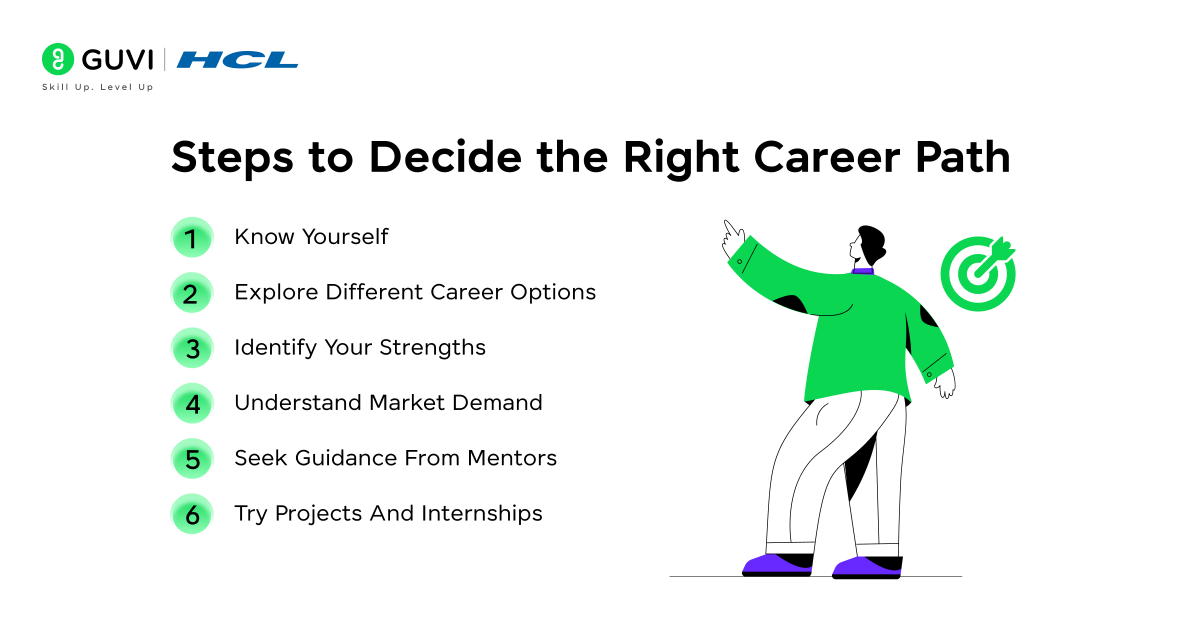
Finding the right career path becomes much easier when you follow a clear set of steps instead of guessing your way forward. These steps help you understand who you are, what you enjoy, and which opportunities match both your strengths and future goals. By exploring your interests and testing real experiences, you can make confident decisions about your professional journey.
Here are the key steps we will explore in this section:
- Know yourself
- Explore different career options
- Identify your strengths
- Understand market demand
- Seek guidance from mentors
- Try projects and internships
- Build relevant skills
- Set short-term and long-term goals
1. Know Yourself
Choosing the right career path starts with understanding what naturally motivates you. When you notice the activities that energize you and the environments where you perform your best, it becomes much easier to choose roles that feel meaningful and comfortable instead of confusing or forced.
What to focus on:
- Activities you genuinely enjoy
- Work environments you prefer
- Whether you lean toward creativity, analysis, leadership, or technical tasks
- Your strengths and limitations
- How you handle pressure or deadlines
How to do it:
- Take personality or aptitude tests
- Write down tasks that make you feel enthusiastic
- List the things you dislike doing
- Observe when your energy levels rise or drop
Example:
If solving problems excites you, careers like data analysis or cybersecurity may be a natural fit.
2. Explore Different Career Options
Understanding your choices is the only way to choose the right career path confidently. Exploring various industries helps you compare roles realistically based on responsibilities, learning requirements, and your long-term goals.
What to research:
- Job roles across industries
- Daily responsibilities
- Required skills or qualifications
- Growth opportunities
- Salary trends
Students often review fields like technology, business, design, marketing, cloud computing, full-stack development, and artificial intelligence to understand what suits them best.
Example:
A student exploring UI/UX design, digital marketing, and data science realizes UX design fits their creativity and research-oriented mindset.

3. Identify Your Strengths
Your natural strengths point you toward the right career path faster than anything else. When you know what you’re naturally good at, learning becomes easier and career growth becomes smoother.
Key areas to consider:
- Communication
- Creative thinking
- Analytical ability
- Leadership
- Technical aptitude
Tips:
- Ask mentors or teachers for feedback
- Notice tasks you complete quickly
- Observe where others depend on you
Example:
If you communicate well and enjoy helping others understand topics, teaching or content-related careers may suit you.
4. Understand Market Demand
Choosing the right career path also means choosing a field that has long-term growth. Understanding market demand helps you pick careers that remain relevant and offer stable opportunities.
What to check:
- Growing industries
- Top skills companies are hiring for
- Future job predictions
- Emerging technologies
- Industry growth reports
Example:
A student interested in tech learns that cloud computing and data analytics are fast-growing fields with strong global demand.
5. Seek Guidance From Mentors
Talking to the right people can shape your direction much faster. Mentors share real experiences, practical advice, and industry insights that help you choose the right career path without confusion or guesswork.
Who can guide you:
- Seniors or alumni
- Teachers
- Industry professionals
- Career counselors
- Online mentors
What they help with:
- Understanding real job expectations
- Reviewing your strengths
- Suggesting learning paths
- Avoiding common mistakes
Example:
A senior in software development explains required skills and timelines to a beginner, helping them set a realistic learning plan.
6. Try Projects And Internships
Hands-on experience often reveals whether you’re on the right career path. Projects and internships show the practical side of a role and help you decide whether the work truly excites you.
Why it helps:
- Shows real job responsibilities
- Builds practical skills
- Boosts confidence
- Increases job readiness
- Helps you verify your interest
Where to start:
- Mini projects
- Freelance tasks
- Online internships
- Case studies
- Open-source contributions
Example:
A student builds a basic Python project and discovers a strong interest in software development.
7. Build Relevant Skills
Skill-building turns decisions into action. Choosing the right career path is not enough — you must also learn the skills that make you capable and employable in that field.
What to focus on:
- Technical skills
- Soft skills
- Teamwork
- Communication
- Industry tools
Example:
Someone interested in cybersecurity begins learning networking, Linux, and ethical hacking to build a strong base.
8. Set Short-Term And Long-Term Goals
Clear goals keep your journey toward the right career path steady and focused. When you break your aspirations into smaller steps, you stay motivated and track your progress easily.
Types of goals:
- Short-term goals (3–6 months)
- Medium-term goals (1–2 years)
- Long-term goals (3–5 years)
What goals should cover:
- Skills you plan to learn
- Certifications to complete
- Projects to build
- Jobs or internships to apply for
Example:
A learner sets a 6-month plan to master Python basics, complete 50 problems, build two beginner-level projects, and apply for internships.
How To Analyse Yourself And Match Your Interests To The Right Career Path

Choosing the right career path becomes much easier when there is a clear understanding of personal interests, strengths, work style, and future goals. This simple self-analysis method helps connect what you naturally enjoy with career roles that genuinely fit your personality and long-term aspirations.
1. Identify What You Enjoy Doing
Start by noticing tasks that feel effortless and enjoyable. These activities reflect natural curiosity and long-term interest, which are important when selecting a career.
What to check:
- Activities you do without external pressure
- Subjects you enjoy learning
- Tasks that make time pass quickly
Career match examples:
- Enjoy solving puzzles → Data Science, Cybersecurity, Analytics
- Enjoy designing visuals → UI/UX Design, Graphics
- Enjoy communication → HR, Content Writing, Marketing
2. Recognize What You Are Naturally Good At
Strengths often point toward careers where growth feels smooth and consistent. These are abilities that show up in everyday tasks and academic performance.
What to check:
- Skills where performance is better than others
- Tasks completed quickly and confidently
- Positive feedback from teachers or seniors
Career match examples:
- Strong communication → Digital Marketing, Training, Writing
- Strong logic/maths → Cloud Computing, Full Stack Development, AI
- Strong creativity → UI/UX, Video Editing, Branding
3. Understand Your Work Personality
A career becomes more sustainable when it matches personal work style—whether structured, flexible, independent, or collaborative.
What to check:
- Preference for routines vs. creative freedom
- Comfort with teamwork vs. independent tasks
- Leadership interest vs. backend execution
Career match examples:
- Prefer structured environments → Backend Development, Testing
- Prefer flexible creative work → UI/UX, Social Media Marketing
- Prefer organizing and planning → Project Management
4. Evaluate Your Energy Levels
Energy levels reveal what genuinely motivates you. Tasks that energize you naturally indicate a suitable direction.
What to check:
- Activities that make you feel confident
- Tasks that drain or excite you
- Skills you keep returning to
Career match examples:
- Energized by tech → Software Development, DevOps, Data Science
- Energized by social interaction → Sales, HR, Community roles
- Energized by creativity → Design, Content, Branding
5. Align Interests With Market Demand
The ideal career is a mix of personal interest and strong market opportunities. This creates long-term stability and growth.
High-demand career areas:
- AI & Data Science
- Cloud & DevOps
- Cybersecurity
- UI/UX Design
- Digital Marketing
- Full Stack Development
6. Create a Simple Career-Matching Matrix
A clear comparison helps visualize how interests and strengths align with potential careers.
| What I Enjoy | What I’m Good At | Possible Careers |
| Creativity | Visual thinking | UI/UX, Graphic Design |
| Problem-solving | Logical reasoning | Data Science, Full Stack Dev |
| Communication | Speaking, writing | HR, Content, Marketing |
7. Validate Your Choices Through Small Experiments
Testing options in real life helps confirm career direction before fully committing.
How to test:
- Build mini-projects
- Take short courses
- Try internships
- Join workshops
- Speak to mentors
These small steps provide clarity, confidence, and practical understanding of daily work in each field.
Beginner-Friendly Career Matching Guide: Map Your Interests to the Right Career Path
Choosing the right career path becomes much simpler when there is a clear picture of what you enjoy, what you’re naturally good at, and which roles align with those strengths. This beginner-friendly guide gives a quick idea of how different interests and skills connect to real-world careers, helping you discover options that fit your personality, abilities, and future goals.
| What I Enjoy | What I’m Good At | Possible Careers |
| Creativity | Visual thinking, design sense | UI/UX Design, Graphic Design, Animation, Video Editing |
| Problem-solving | Logical reasoning, analysis | Data Science, Artificial Intelligence, Cybersecurity, Full Stack Development |
| Communication | Speaking, writing, presenting | HR, Content Writing, Digital Marketing, Corporate Training |
| Working with technology | Coding, debugging, experimenting | Software Development, DevOps, Cloud Engineering, Mobile App Development |
| Research & analysis | Pattern recognition, statistics | Business Analytics, Market Research, Financial Analysis |
| Helping people | Empathy, listening, guiding | Counseling, HR, Community Management, Customer Success |
| Organizing tasks | Planning, structuring work | Project Management, Product Management, Operations Management |
| Creativity + strategy | Branding, conceptual thinking | Digital Marketing, Social Media Strategy, Brand Management |
| Attention to detail | Accuracy, precision | Quality Assurance (QA), Testing, Technical Writing |
| Visual storytelling | Creativity + communication | Video Production, Motion Graphics, Social Media Content |
| Innovation & building ideas | Experimentation, prototyping | Entrepreneurship, Product Design, Start-up Roles |
| Teaching or explaining | Simplifying concepts | EdTech Instructor, Mentor, Content Educator |
| Working with numbers | Maths, statistics | Data Analytics, Finance, Accounting |
| Exploring new tech | Curiosity, adaptability | AI Engineer, Blockchain Developer, AR/VR Developer |
| Strategic thinking | Decision-making, logic | Business Development, Consulting, Product Strategy |
| Writing | Grammar, storytelling | Content Writing, Copywriting, Script Writing |
| Social interaction | Networking, people skills | Sales, Public Relations, Community Leadership |
| System thinking | Understanding workflows | Supply Chain Management, Operations, Process Engineering |
| Creativity + empathy | Understanding user needs | UI/UX Research, User Testing, Service Design |
Conclusion
By now, you’ve understood the essential steps that make choosing the right career path clearer, easier, and more structured. This blog has helped you identify how self-awareness, skill-building, exploration, and mentorship together shape strong career decisions. When you apply these steps, you stop feeling confused and start moving with purpose.
To take this forward, begin by analyzing your interests, exploring career options that excite you, and testing them through small projects or internships. Continue building relevant skills and set realistic short-term and long-term goals. With consistent learning and proper guidance, you can create a career roadmap that supports your growth and leads to fulfilling opportunities.
To continue exploring your career options with more clarity, you can make use of HCL GUVI’s Free Resources, which offer beginner-friendly webinars, practice platforms like CodeKata and SQLKata, downloadable eBooks, and guided 5-day email lessons. These tools help you experiment with different fields such as data science, full-stack development, UI/UX, and AI without any cost, allowing you to understand what interests you, build foundational skills, and gain confidence before choosing a long-term career direction.
FAQs
1. How do I choose a career if I have multiple interests?
Start by comparing your interests based on passion, skill potential, and future demand. Shortlist a few options and test each one through small projects, online courses, or internships. This helps you understand what feels right in real situations.
2. What if I choose the wrong career path?
It’s completely okay to change direction. Many people switch careers as they learn more about themselves. With steady upskilling and practical experience, you can smoothly transition into a new field whenever you’re ready.
3. How early should students start career planning?
It’s ideal to begin in high school or the early years of college because it gives you more time to explore and grow. However, there is no fixed timeline—anyone can start career planning at any stage.
4. Is passion more important than salary when choosing a career?
Both are important. The best career gives you enjoyment, long-term stability, growth opportunities, and financial security. A balanced choice ensures you don’t lose interest or struggle later.
5. How long does it take to figure out the right career path?
There is no universal timeline. But with proper research, guidance from mentors, and hands-on exploration, most learners gain clarity within a few months. Consistent effort speeds up the decision-making process.
Success Stories

About the Author
Jebasta
I translate the language of data into stories that anyone can understand. As a writer with a data science background, I simplify analytics, AI, and decision-making so beginners and enthusiasts can confidently explore the world of data.
View all posts by Jebasta
Connect with me @

















Did you enjoy this article?