


Interview Articles
Technical Interview Questions Commonly Asked in Startups
Technical Interview vs HR Interview: 7 Key Differences
Advanced DNS Interview Questions for Senior Engineers: What to Expect in 2026
How to Handle a Technical Interview When the HR Interviewer Isn’t Technical


Get In Touch For Details! Request More Information

How to Prepare for Non-LeetCode Technical Interviews: A Complete Guide
Feb 02, 2026 4 Min Read 366 Views
(Last Updated)
Technical interviews are not always based on LeetCode problems. Most programmers who are just beginning their careers in software engineering or are aspiring to crack product-based companies have the common misconception that, to pass the technical rounds, extensive practice on LeetCode problems is a must. However, this is not the case.
Your performance in technical interview rounds depends on how deeply you understand real-world issues and how well you can convert them into software solutions. Yes, DSA is indeed crucial for efficient problem-solving and writing optimized code, but purely sticking to DSA also limits your capabilities to build features, fix bugs, and work with databases and APIs.
Due to this reason, even the most elite software companies are now focusing more on testing your hands-on experience instead of your ability to solve algorithm puzzles. In this blog, we will explore how to prepare for non-Leetcode technical interviews effectively.
Quick Answer:
Prepare for non-LeetCode technical interviews by strengthening your fundamentals—OOPS, databases, APIs, and debugging—by practicing building small, real-world features rather than focusing only on algorithm puzzles. Improve your communication by explaining your thought process clearly during problem-solving.
Table of contents
- Essential Skills You Need Beyond DSA
- Object-Oriented Programming (OOPS)
- Databases (SQL/NoSQL)
- API integration and handling
- Version control (Git)
- Writing clean, readable, and maintainable code
- Debugging and troubleshooting
- Basic understanding of system design
- Testing and handling edge cases
- Problem-solving with practical logic
- Code optimization and performance thinking
- Step-by-Step Guide to Prepare for Non-LeetCode Technical Interviews
- Step 1: Strengthen your fundamentals
- Step 2: Practice building small projects
- Step 3: Solve practical coding problems
- Step 4: Improve your debugging skills
- Step 5: Write clean, readable code
- Step 6: Think about performance
- Step 7: Keep learning with mini-projects
- Conclusion
- FAQs
- What skills matter most in non-LeetCode interviews?
- Do I still need DSA for non-LeetCode interviews?
- How can I practice for real-world technical questions?
Essential Skills You Need Beyond DSA
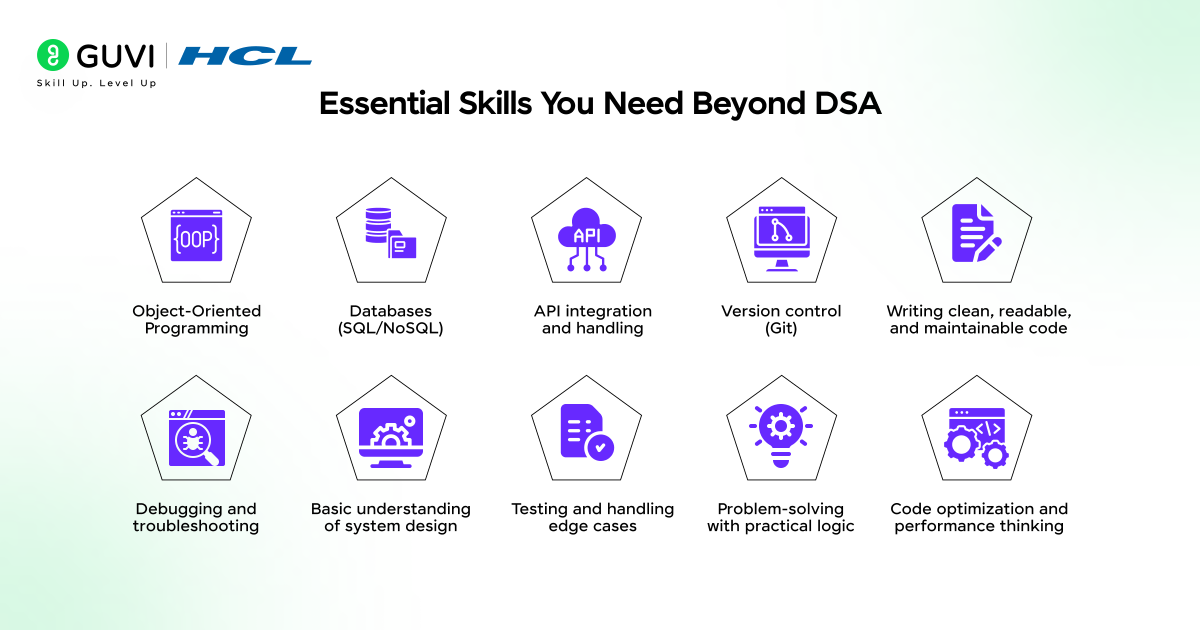
The following are the most essential skills you should have during technical interviews. These skills highlight your proficiency in handling practical problems, collaborating with others, and delivering solutions that create real impact.
1. Object-Oriented Programming (OOPS)
OOP allows you to organize your code with the help of classes, objects, and well-defined relationships. This way, your projects become manageable, extendable, and flexible. Eventually, features such as inheritance, polymorphism, and encapsulation become indispensable in a developer’s daily work.
2. Databases (SQL/NoSQL)
It is essential to know how to store, fetch, and manage data. SQL is used for structured tables, and NoSQL is for flexible or large-scale data. Knowing both will allow you to decide which database is appropriate for a project.
Also Read: NoSQL vs SQL Explained: Which One Fits Your Application?
3. API integration and handling
Almost all apps depend on some external services, and that is the reason why APIs exist. You need to understand the process of making API calls, managing the responses, and handling the errors. Proper management of APIs can make your application more stable and user-friendly.
4. Version control (Git)
Git is a tool that will allow you to keep track of the changes that you have made in your codebase and to be able to work with other people in a team in a more efficient way. If you want, you are able to go back to previous versions, rectify errors, and work with others without making a mess.
5. Writing clean, readable, and maintainable code
Writing clean code helps you and others to comprehend the project later. Using simple logic, proper naming, and fewer complicating factors not only enhances the quality but also keeps the project free of bugs. Moreover, it is beneficial in reducing the development time in the long run.
6. Debugging and troubleshooting
Debugging is a method that enables you to locate the exact reason for the problem instead of making a guess. Knowing error tracing, logging, and testing methods can be a great time-saver. It is, by far, one of the most useful and admirable developer skills.

7. Basic understanding of system design
Even the most basic concept of systems scaling, user handling, or data storing enhances your problem-solving skills. You get to know how applications communicate, share the load, and are resilient to failures. This, in turn, empowers you to come up with solutions that are not only efficient but also reliable.
8. Testing and handling edge cases
Testing is the method through which it is ensured that the implemented code is working correctly, even in less favorable situations, and not just in ideal ones. The practice of considering edge cases contributes greatly to the stability of the application as well as to the enhancement of the user’s experience.
9. Problem-solving with practical logic
Real-world problems require clear thinking rather than fancy algorithms. You simplify tasks by breaking them down into smaller steps, identifying patterns, and solving them in an efficient way. This practical approach is what most companies really look for.
10. Code optimization and performance thinking
Code optimization is what makes your app run faster and smoother. You gradually figure out how to minimize unnecessary operations, enhance memory usage, and simplify logic. Ultimately, the improved performance is what results in a better user experience and cleaner projects.
Step-by-Step Guide to Prepare for Non-LeetCode Technical Interviews
The following are the essential steps you need to follow while preparing for non-Leetcode technical interviews:
Step 1: Strengthen your fundamentals
Good fundamentals allow you to know how actual systems operate instead of just solving puzzles. Concepts like OOPS, databases, APIs, and Git are the core of user-friendly development.
Once you have these basics down to a point, you will have the necessary insight to tackle any problem and come up with solutions that are in line with real-world situations.
Step 2: Practice building small projects
Small projects allow you to get practical experience with the actual working of features. You figure out how to organize code, link components, and create something from start to finish.
Moreover, these projects enable you to adopt the developer’s thinking pattern as you handle the issues arising from the real world, e.g., validations, errors, and user flows.
Step 3: Solve practical coding problems
Real-world problems help you to use logic in handling actual tasks, rather than only theoretical algorithms. Such problems develop the habit of thinking in terms of inputs, outputs, and business requirements.
Working this way, you become better at dividing complex problems into smaller parts and writing clear, functional code during an interview.
Step 4: Improve your debugging skills
Debugging is arguably the most essential skill to have outside the programming realm since most of the time, production code will break in a way that you haven’t anticipated. The ability to track down errors and resolve them is an indication of a higher level of coding proficiency.
Moreover, it makes the interview process more pleasant, improves your speed in getting to the cause of a problem, and increases the chances of you coming up with stable solutions.
Also Read: Advanced Debugging Techniques For Full Stack Development
Step 5: Write clean, readable code
Neatly written code will basically show your thought pattern and also help to maintain the logic in your code, which is exactly what the interviewers expect. Your mental process will be demonstrated through the variable naming, indentation, and even the structure.
Good code readability will also lower the occurrences of bugs and make it easier for other team members to work with you.
Step 6: Think about performance
Performance is a measure of how fast your solution can process data and operations. A tiny change may have a substantial impact on a real system.
Interviewers prefer candidates who are always thinking of ways to save time and space and to avoid unnecessary operations, thereby demonstrating their ability to write optimized, practical code.
Step 7: Keep learning with mini-projects
Mini-projects are a great way to regularly practice your skills and also stay in touch with the actual development work. They introduce you to new patterns, tools, and methods of solving problems.
Consistent practice also results in a higher level of self-confidence, and you will have a strong portfolio that you can showcase during the interviews.
If you’re eager to explore full-stack development and build industry-level applications, join HCL GUVI’s IITM Pravartak Certified MERN Full Stack Development Course. Learn in-demand tools like Git, MongoDB, Express, React, and Node.js with guidance from industry experts. Start your tech journey today by speaking with our expert team.
Conclusion
Preparing for non-LeetCode technical interviews is all about building practical skills that match real development work. When you focus on strong fundamentals, clean coding, debugging, and clear communication, you naturally become a better problem-solver. With the right practice and mindset, you’ll be ready to handle any real-world interview challenge with confidence.
FAQs
What skills matter most in non-LeetCode interviews?
Companies mainly look for strong fundamentals, clean coding, debugging ability, and a clear explanation of your approach.
Do I still need DSA for non-LeetCode interviews?
Basic DSA helps, but you don’t need advanced algorithms. Practical coding, logic building, and system understanding matter more.
How can I practice for real-world technical questions?
Work on small features, review sample code, build mini projects, and solve practical problems involving APIs, databases, and debugging.
Success Stories














Did you enjoy this article?