


Artificial Intelligence and Machine Learning Articles
Code Interpreter with GitHub Copilot in Visual Studio Code (2026 Guide)
Building a LangChain Agent for LLM Applications in Python
Build an MCP Server: Complete MCP Tutorial for Beginners
Building Visual RAG Pipelines with Llama 3.2 Vision and Ollama: A Beginners Guide 2026


Get In Touch For Details! Request More Information

MLOps Engineer Salary and Career Insights in India [2026]
Feb 12, 2026 5 Min Read 6618 Views
(Last Updated)
Have you ever wondered what really happens after a machine learning model is built, and who makes sure it actually works in the real world? That’s where MLOps engineers come in.
They’re the people who turn experimental AI ideas into reliable, production-grade systems that companies can depend on. And here’s the thing: as more Indian companies adopt AI at scale, the demand for skilled MLOps engineers has exploded.
If you’re just starting out or already working in tech, understanding how MLOps roles are evolving and what they pay can help you plan your next move strategically. That’s why in this article, we will explore MLOps engineer salary and career insights in India. Without any delay, let’s get started!
Table of contents
- Who is an MLOps Engineer?
- Scope & Demand for MLOps Engineers in India
- MLOps Engineer Salary in India (2026) — What the numbers say
- Regional / Company-Specific Nuances
- Geography & city effects in India
- Company type: product, startup, AI/infra, service
- Domain-specific expectations
- Mobility & Switching firms
- What Pushes Your Salary Upward?
- Factors that push your salary up
- Factors that pull your salary down
- What this means for you
- Conclusion
- FAQs
- What is the average MLOps engineer salary in India in 2026?
- What does a fresher MLOps engineer earn in India?
- What is the salary range for senior/experienced MLOps engineers?
- Which factors influence (increase or decrease) MLOps salaries in India?
- Do MLOps engineers in India make more than data scientists / ML engineers?
Who is an MLOps Engineer?
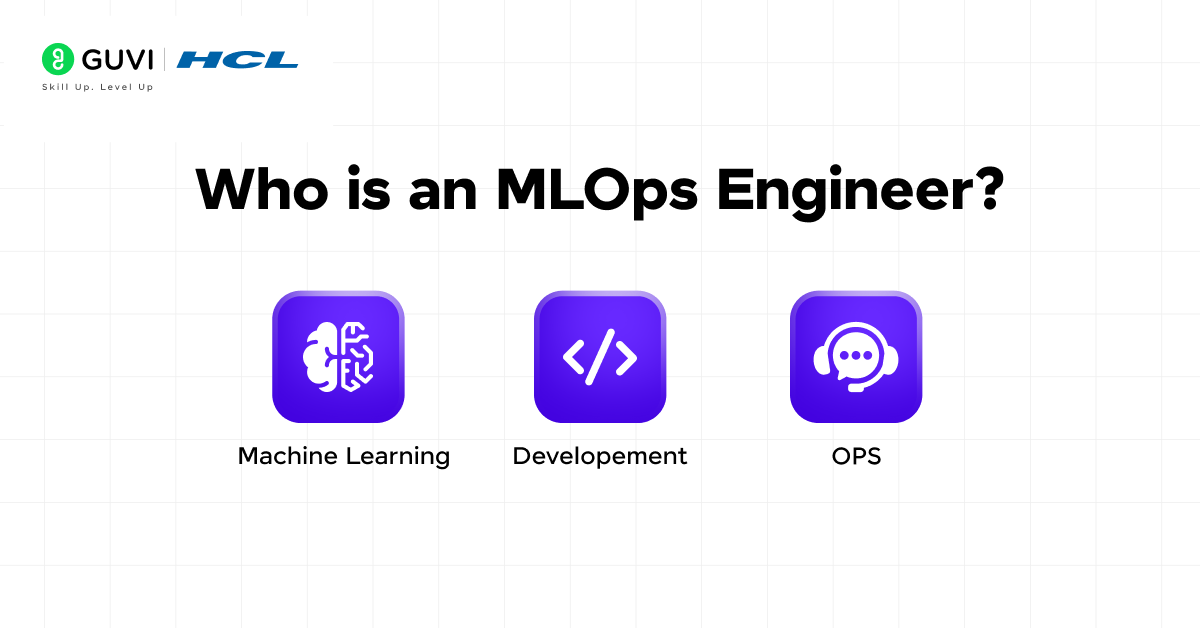
Before we dive into MLOps engineer salary, let’s align on what an MLOps engineer really does (so you know what you’re getting paid for).
- You act as the bridge between data science and production. You don’t just build models; you take models built by data scientists and make them reliable, scalable, and maintainable in real systems.
- You set up pipelines for training, validation, deployment, monitoring, rollback, versioning, patching, drift detection, reproducibility, etc.
- You manage infrastructure (on-prem, cloud, hybrid), containers, orchestration (Kubernetes, Docker), deployment frameworks (CI/CD for ML), and tooling (MLflow, Kubeflow, TFX, etc.).
- You monitor performance, handle edge cases, test for data drift, ensure model robustness, design fallback systems, and ensure that the ML system integrates cleanly with downstream software.
So the role demands a mix of ML literacy, software engineering skills, DevOps/infra understanding, and production mindset.
Scope & Demand for MLOps Engineers in India
Here’s what’s shaping the demand for MLOps talent, and why the scope is expanding fast.
- AI adoption is maturing: More companies don’t just want to experiment with Machine Learning, they want to use it, at scale. That means models need pipelines, monitoring, continuous retraining, rollback, feature stores, etc. MLOps is essential for that.
- Enterprise pressure to deliver ROI: In many organizations, AI/ML projects stall after proof-of-concept. They fail to move to production because of operational challenges. MLOps bridges that gap. As firms realize that, they’re hiring for it.
- Newer models generate repeated demand: With generative AI, dynamic models, and frequent updates, MLOps is no longer “set-and-forget.” Systems need continuous calibration, drift detection, and retraining. That’s a more sustained workload.
- Limited talent supply: There are many data scientists, but fewer engineers who know how to productionize models, maintain them, and operate them at scale. That supply-demand imbalance works in favor of skilled MLOps engineers.
- Growth of cloud, edge, hybrid deployments: As more ML infrastructure shifts to cloud or hybrid settings (on-prem + cloud), the complexity increases. You need people who can weave together infra, ML, orchestration, security, and sand calling. That adds to the need for MLOps.
Because of all these, MLOps roles are becoming viewed as core, not optional.
MLOps Engineer Salary in India (2026) — What the numbers say
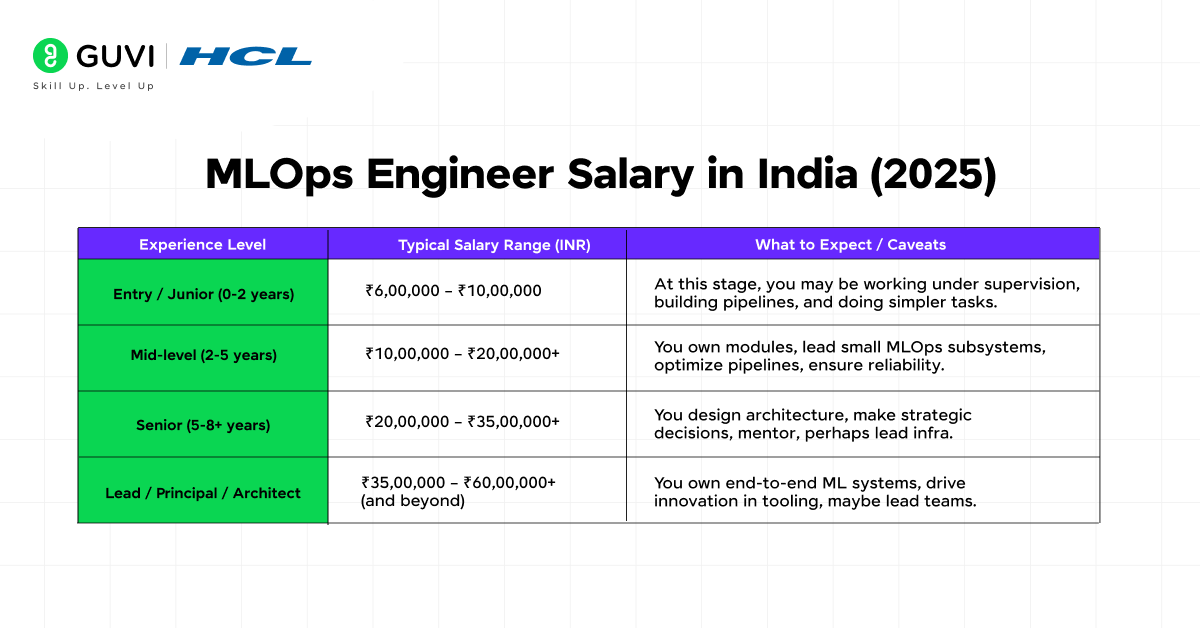
Let’s look at data, ranges, and realistic expectations. Always remember: numbers vary a lot based on many factors (company, location, complexity).
| Experience Level | Typical Salary Range* (INR yearly) | What to Expect / Caveats |
| Entry / Junior (0-2 years) | ₹6,00,000 – ₹10,00,000 | At this stage, you may be working under supervision, building pipelines, and doing simpler tasks. |
| Mid-level (2-5 years) | ₹10,00,000 – ₹20,00,000+ | You design architecture, make strategic decisions, mentor, and perhaps lead infra. |
| Senior (5-8+ years) | ₹20,00,000 – ₹35,00,000+ | You own end-to-end ML systems, drive innovation in tooling, and maybe lead teams. |
| Lead / Principal / Architect | ₹35,00,000 – ₹60,00,000+ (and beyond) | You own end-to-end ML systems, drive innovation in tooling, maybe lead teams. |
These ranges are indicative and will vary by company, region, and domain specialization.
What data supports this
- On Glassdoor, the average salary for an MLOps Engineer in India is ~ ₹16,00,000 per annum. [Glassdoor]
- Some platforms show that MLOps professionals in India now average around ₹36.7 lakh, with a wide range from ~₹21.6 lakh to very high-end figures. [6figr]
- In the domain of GenAI & MLOps, senior roles are pulling ₹58–60 lakh in certain cases. [TechGig]
These numbers show variance, and that’s key. Many factors push you toward the higher side of the range.
Did you know that senior GenAI/MLOps specialists in India are now earning on par (or more) than many cybersecurity or cloud experts? Recent reports show senior MLOps/GenAI roles crossing ₹58–60 lakh per year, outpacing many established tech domains.
Also, platforms tracking global MLOps salaries in India estimate average figures in six figures (in lakhs), which shows just how much the role is tightening between Indian and international pay scales.

Regional / Company-Specific Nuances
Even if your technical path is strong, where and for whom you work matters a lot. Here are nuances to watch out for and leverage:
Geography & city effects in India
- Tech hubs pay more: Bengaluru, Hyderabad, Pune, NCR, and Mumbai tend to pay more due to competition, cost of living, and more product firms.
- Tier-2 / tier-3 cities: You might get lower base salaries, but remote or hybrid roles can offset that. If your employer works globally, your location may matter less.
- Remote/International firms: Many companies outside India pay in dollar rates (or near-equivalent). If you’re remote for a US/EU firm, your “India salary” may be significantly higher than local norms.
Company type: product, startup, AI/infra, service
| Company Type | Nuances for growth | Cautions/tradeoffs |
| Product / AI-native firms | Service/outsourcing firms | May expect you to do more beyond your role (stretch) |
| Early-stage startups | High learning, possibility to build infrastructure from scratch, equity upside | Risk of fragmentation, lack of processes, unstable pay or burn |
| Mid/small product firms | You may need to adapt constantly, context-switching, and less continuity | Tools may be legacy, resources limited |
| More structured than startups, but possibly with limited budgets or tooling | You’ll see different clients, more variety | You may need to adapt constantly, context-switching, and have less continuity |
| Consulting / ML agencies | Exposure to many domains and clients | They often follow fixed pay bands, less depth per project, and shorter-term ownership |
Domain-specific expectations
- If the domain is regulated (healthcare, finance, defense), you’ll need compliance, audit, data privacy, and robustness, which raises the bar.
- Real-time / low-latency domains (autonomous systems, online trading) impose more constraints. They demand better architecture and thus pay more.
- High-stakes business impact (fraud, risk, critical decisioning) gives more leverage to your role.
Mobility & Switching firms
- Sometimes, leaving your current company yields a bigger boost than waiting for internal raises. But jumping too often can hurt your narrative.
- Track your projects, impact, and contributions; those will follow you when you switch.
What Pushes Your Salary Upward?
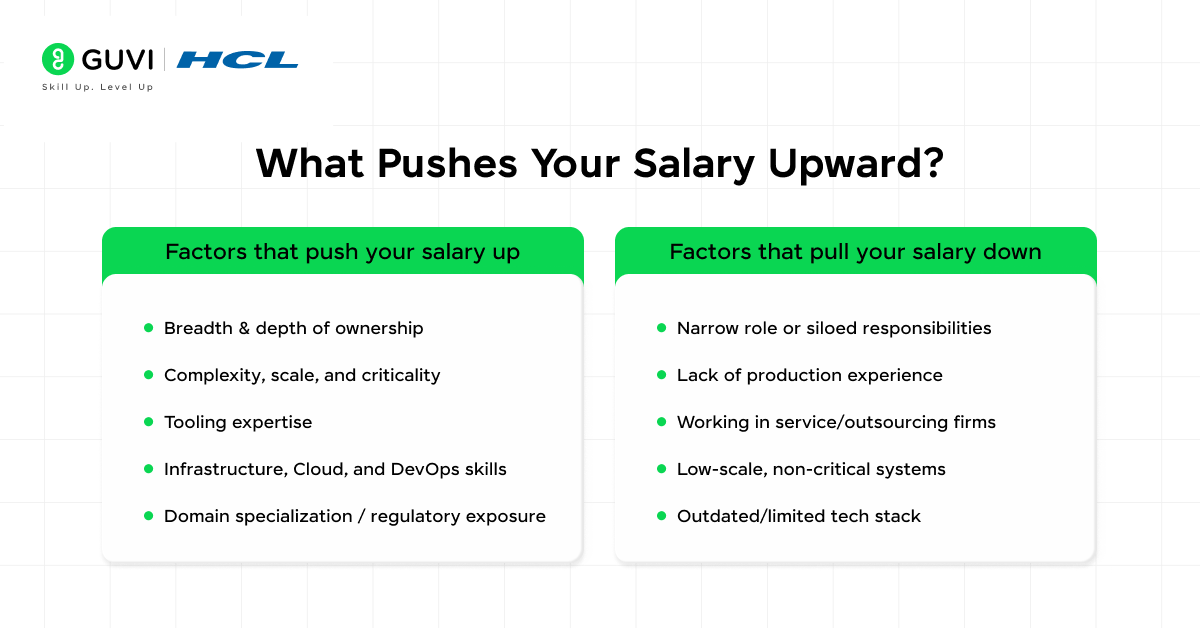
Here, let’s break out factors as levers you can influence (or at least be aware of).
Factors that push your salary up
- Breadth & depth of ownership: If you can handle the full pipeline — data ingestion → feature engineering → model training → deployment → monitoring → retraining → rollback, you’re far more valuable than someone doing just one slice.
- Complexity, scale, and criticality: Working on systems with high volume, low latency, reliability demands, or real-time constraints gives you leverage. If the ML system is mission-critical (healthcare, financial fraud detection, autonomous systems), pay will reflect that.
- Tooling expertise + emerging technologies: If you know tooling like Kubeflow, TFX, MLflow, Seldon, Feast, Airflow, etc., deeply and not just at the surface level, you command more.
- Infrastructure, Cloud, and DevOps skills: The better you are at managing infra (cloud services, containers, orchestration, networking, security), the more negotiation power you have.
- Domain specialization / regulatory exposure: If you’ve worked in regulated domains (healthcare, finance, defense) or with high-stakes models, that’s rare and valuable. Similarly, domain knowledge (say fraud modeling, recommender systems, NLP) helps.
Factors that pull your salary down
- Narrow role or siloed responsibilities: If your role is limited (e.g., only deployment, only logging, only monitoring) and you never touch upstream or downstream parts, your growth is capped.
- Lack of production experience or real-world projects: Many roles require you to show you’ve maintained models in production; academic or toy projects don’t impress as much.
- Working in service/outsourcing firms: Many service firms impose rigid salary bands; often, MLOps gets lumped under general “DevOps/infra/data roles” with less differentiation.
- Low-scale, non-critical systems: If your models are low-volume, batch-only, or non-real-time, the risk, pressure, and complexity are lower, which means lower pay.
- Outdated/limited tech stack: If you’re working with legacy tools, don’t know modern orchestration, or lack cloud & container knowledge, you’ll lose out.
What this means for you
If you’re in the early stage:
- Don’t settle for roles that let you do only modeling without operational exposure. Seek companies or teams that have real production ML workflows.
- Build portfolio projects: a small ML system deployed end-to-end with monitoring, drift detection, rollback etc. That speaks volumes.
- Upskill with cloud + container + infra + monitoring tools. Don’t just stop at “I know ML.”
If you’re mid-level already:
- Push for ownership – lead subsystems, lead infra decisions, mentor others.
- Negotiate when switching roles. Use the salary benchmarks above as reference.
- Aim for domains or companies with high growth (GenAI, finance, autonomous systems) for better leverage.
If you’re senior:
- Focus on architecture, reliability, efficiency, innovation.
- Participate in product decisions, ML roadmap, tooling choices.
- Look for leadership roles (ML infra lead, principal MLOps, head of ML platform) — that’s where pay climbs fastest.
To summarize, in India in 2026, you can realistically expect to cross the ₹20–30 lakh range by the mid-senior levels. If you reach senior or architect status in high-growth domains, ₹40–60 lakh or more is achievable.
If you’re serious about mastering machine learning and want to apply it in real-world scenarios, don’t miss the chance to enroll in HCL GUVI’s Intel & IITM Pravartak Certified Artificial Intelligence & Machine Learning course. Endorsed with Intel certification, this course adds a globally recognized credential to your resume, a powerful edge that sets you apart in the competitive AI job market.
Conclusion
In conclusion, the MLOps engineer’s role is no longer niche, it’s becoming the backbone of real-world AI systems. In India, where AI adoption is accelerating across startups, enterprises, and global tech firms, this role offers both intellectual depth and financial upside.
If you can build, deploy, monitor, and continuously improve machine learning systems, you’re already ahead of most of the market. Salaries ranging from ₹10 lakh for early-career professionals to ₹60 lakh (and beyond) for senior experts show how valuable this skillset has become.
The key is to stay curious, own the full pipeline, and treat every deployment as a chance to make AI truly work in production. That’s what separates an average engineer from a top-tier MLOps professional, and that’s where the real career growth lies.
FAQs
1. What is the average MLOps engineer salary in India in 2026?
2. What does a fresher MLOps engineer earn in India?
Freshers (0–2 years’ experience) can expect salaries in the ballpark of ₹6–10 lakhs per annum, depending on location, company, and skills.
3. What is the salary range for senior/experienced MLOps engineers?
Senior engineers (5+ years) often earn ₹20–35+ lakhs, with top roles (in big product firms or with global exposure) pushing toward ₹35–60+ lakhs.
4. Which factors influence (increase or decrease) MLOps salaries in India?
Key factors include your ownership breadth (end-to-end pipeline vs narrow role), tooling & cloud/infra skills, domain specialty, scale & criticality of systems, leadership ability, and company type (product vs service).
5. Do MLOps engineers in India make more than data scientists / ML engineers?
Often yes — if the MLOps role demands production, infrastructure, reliability, scaling, and monitoring skills. In many setups, MLOps engineers with full-stack responsibility command a premium over standard ML or data scientist roles.
Success Stories

About the Author
Lukesh S
A professional content writer who has experience in freelancing and now working as a Technical Content Writer at GUVI. Google Certified Digital Marketer. Have a sound knowledge of SQL, Data Structures and Cloud Computing.
View all posts by Lukesh S
Connect with me @













Did you enjoy this article?