


Software Automation & Testing Articles
How to Use Claude for A/B Testing Content Variations
Load Testing Your Application with k6: A Practical Introduction
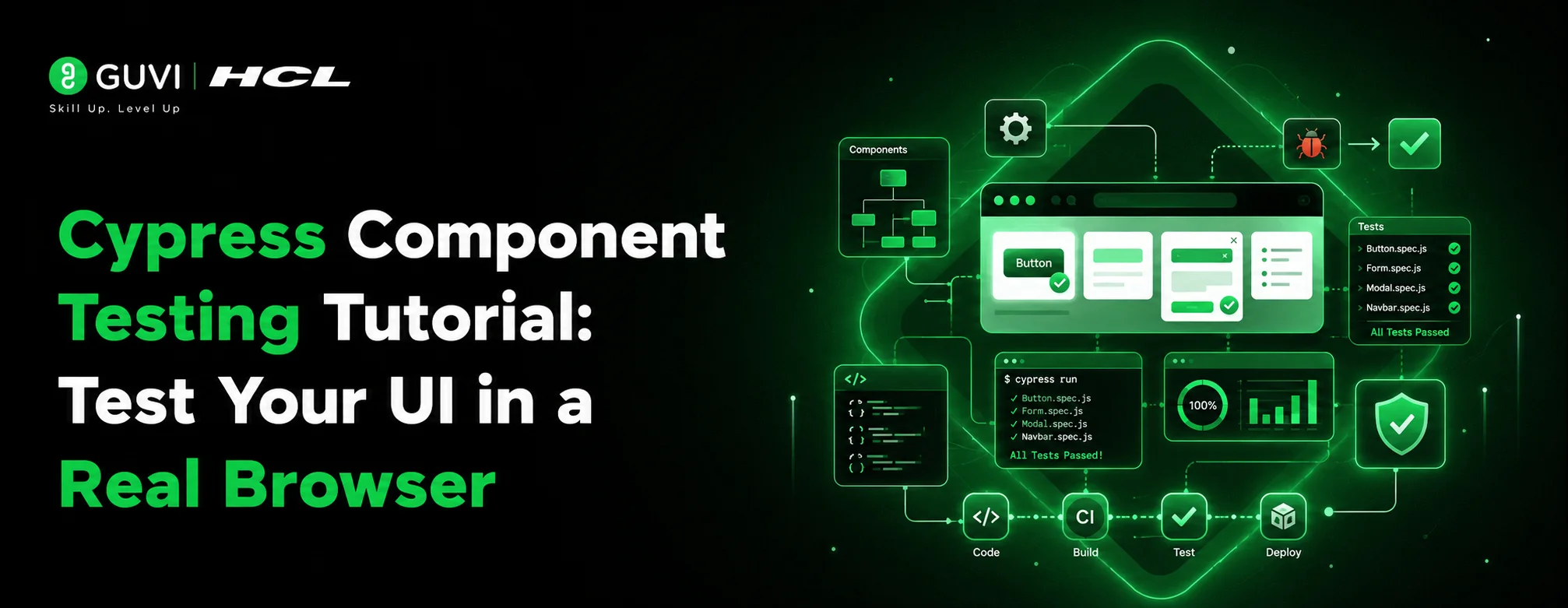
Cypress Component Testing Tutorial: Test Your UI in a Real Browser, Not a Fake One
Quality Assurance Roles and Responsibilities: 12 Essential Duties for Success


Get In Touch For Details! Request More Information
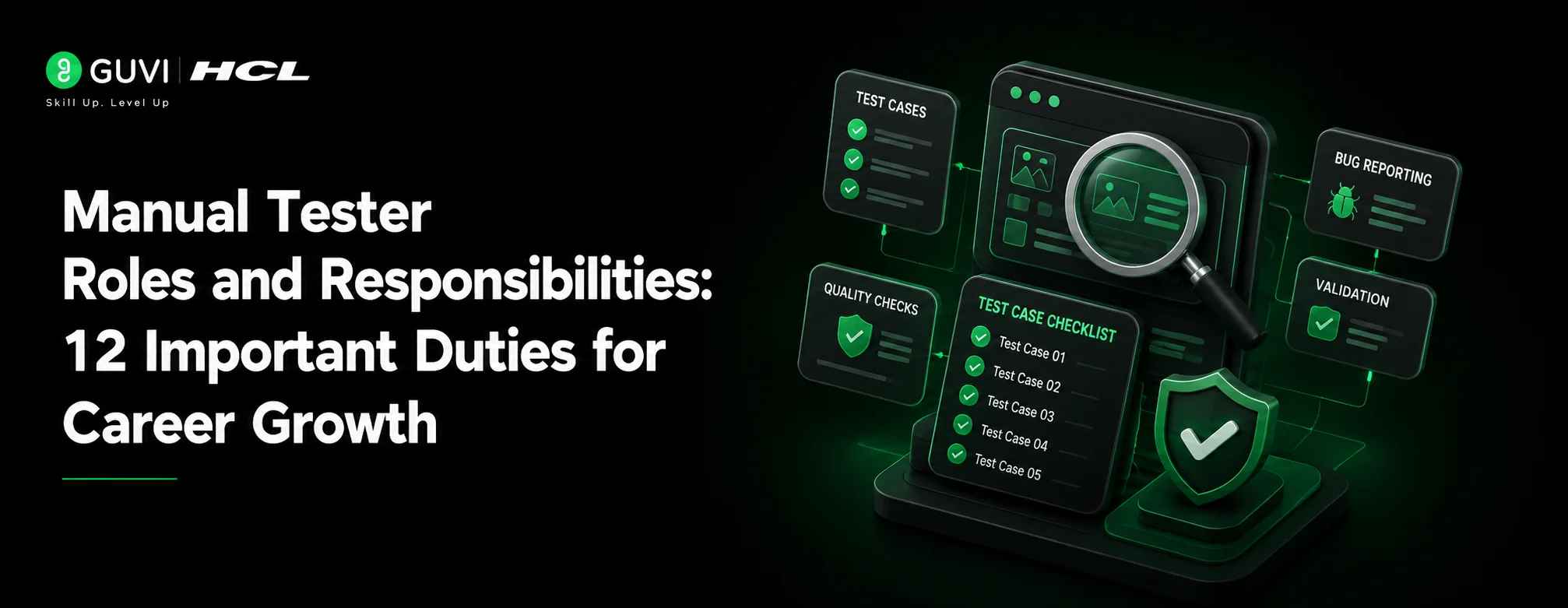
Manual Tester Roles and Responsibilities: 12 Important Duties for Career Growth
Jul 08, 2026 6 Min Read 723 Views
(Last Updated)
Table of contents
- TL;DR Summary
- What Does a Manual Tester Do?
- Manual Testing in 2026: Why It Still Matters
- Key Manual Tester Roles and Responsibilities
- Understanding Requirements
- Preparing Test Plans and Test Data
- Creating Test Scenarios and Test Cases
- Executing Test Cases Manually
- Finding and Reporting Bugs
- Retesting Fixed Issues
- Performing Regression Testing
- Supporting User Acceptance Testing
- Preparing Test Reports and Documentation
- Collaborating With Developers and Teams
- Checking User Experience and Suggesting Improvements
- A Day in the Life of a Manual Tester
- Pro Tip
- Skills That Make a Good Manual Tester
- Tools Used by Manual Testers in 2026
- Real-World Example
- Want to Become a Manual Tester? Avoid These Mistakes
- Upgrade Your Testing Career with Modern Tech Skills
- What You Should Remember
- FAQs
- What are manual tester roles and responsibilities?
- What does a manual tester do daily?
- Is manual testing a good career?
- Does manual testing require coding?
- What skills are required for manual testing?
- What is the role of a manual tester in a project?
- What are the main tasks of a manual tester?
- What is the difference between manual testing and automation testing?
- Can freshers get jobs in manual testing?
- What tools should beginner manual testers learn first?
TL;DR Summary
Manual Tester roles and responsibilities include checking software manually to find bugs before users face them. Manual testers understand requirements, write test cases, execute tests, report defects, and test features, UI, usability, functionality, basic performance, and user flows. They work closely with developers, QA leads, product teams, and business teams to improve software quality. Manual testing is still important because not every real user scenario can be fully covered through automation, so good manual testers need observation, communication, documentation, analytical thinking, and basic testing knowledge.
A manual tester roles and responsibilities may sound simple: find bugs before users do.
But the real question is: how do they find those bugs, report them clearly, and make sure the software is fixed properly?
That is where manual tester roles and responsibilities come into the picture.
And no, automation has not completely taken over manual testing.
Even in 2026, manual testers remain important because software still needs human observation, real user thinking, and careful checking before it reaches customers.
Manual testing today is not just about clicking buttons. It is about thinking like a real user, finding quality issues, and helping teams release better software.
In this blog, let’s understand manual tester roles and responsibilities in a simple way, including what they do daily, how they find bugs, what tools they use, and what skills help them do the job better.
The word “bug” became famous in computing because of a real insect.
In 1947, engineers working on the Harvard Mark II computer found a moth, a small night-flying insect similar to a butterfly, stuck inside the machine. The insect had caused a problem in the computer, so the engineers removed it and taped it into their logbook.
They called it the “first actual case of a bug being found.” Since then, the word bug became popular in computing for any error or problem in a system.
That is why manual testers today still talk about finding bugs, reporting bugs, and retesting bug fixes. The tools have changed, but the goal is still the same: find the problem before users face it.
What Does a Manual Tester Do?
A manual tester checks software manually to make sure it works the way users expect.
They use the application like a real user, try different scenarios, find bugs, and report issues before the product reaches customers.
For example, if there is a login page, a manual tester checks whether users can log in, see the right error message for a wrong password, reset the password, and reach the correct dashboard.
In simple words, a manual tester is not just “clicking around.” They carefully test features, think like users, and help the team release software that is clear, reliable, and easy to use.
Manual Testing in 2026: Why It Still Matters
Manual testing is still important in 2026 because software is not only about “working.” It should also feel easy, clear, and useful for real users.
Here’s why manual testing still matters:
- Automation can check repeated tasks, but manual testers can notice real user experience issues.
- A tool may check if a button works, but a tester can see if the button is confusing or placed badly.
- Manual testers are useful for exploratory testing, edge cases, usability checks, and new feature testing.
- In 2026, manual testers are also expected to understand Agile, Jira, basic API testing, SQL, and product behaviour.
- AI tools can help create test ideas faster, but human judgment is still needed to decide whether the product feels right.
In simple words, manual testing is not outdated. It has become more practical, user-focused, and connected to modern QA workflows.
Key Manual Tester Roles and Responsibilities
A manual tester roles and responsibilities are to check whether the software works properly, matches the requirement, and gives a smooth experience to the user.
1. Understanding Requirements
Before testing starts, one of the main manual tester roles and responsibilities is to first understand what the software or feature is expected to do.
Responsibilities:
- Read project requirements
- Understand expected software behavior
- Clarify doubts with the BA, product owner, or developer
- Identify what needs to be tested
2. Preparing Test Plans and Test Data
Manual testers may help prepare the testing scope, priorities, test data, and basic test conditions before execution starts.
Responsibilities:
- Understand testing scope
- Prepare required test data
- Identify high-priority areas
- Support test planning activities
3. Creating Test Scenarios and Test Cases
Test scenarios and test cases help testers check the software step by step without missing important flows.
Responsibilities:
- Write test scenarios
- Create detailed test cases
- Define expected results
- Prioritize high-risk test cases
4. Executing Test Cases Manually
This is where testers use the application like real users and check whether it works as expected.
Responsibilities:
- Run test cases
- Compare actual vs expected results
- Test web, mobile, or software features
- Record pass/fail status
5. Finding and Reporting Bugs
When something does not work correctly, manual testers report it clearly so developers can fix it faster.
Responsibilities:
- Identify defects
- Add clear bug titles
- Write steps to reproduce
- Attach screenshots or screen recordings
- Mention severity and priority
- Track bugs in tools like Jira or Bugzilla
6. Retesting Fixed Issues
After developers fix a bug, testers check the same issue again to confirm whether it is solved.
Responsibilities:
- Retest fixed bugs
- Check whether the issue is solved
- Reopen bugs if the issue still exists
- Update bug status
7. Performing Regression Testing
Whenever developers fix bugs or add new features, testers check whether old features are still working properly.
Responsibilities:
- Test important existing features
- Check connected workflows
- Make sure new changes did not break old functionality
8. Supporting User Acceptance Testing
Manual testers may help business users or clients check whether the software meets real business needs.
Responsibilities:
- Prepare UAT test cases
- Support business users during testing
- Track UAT issues
- Help confirm release readiness
9. Preparing Test Reports and Documentation
Manual tester’s maintain testing records so the team understands progress, defects, and release quality.
Responsibilities:
- Maintain test cases
- Update test execution status
- Prepare defect reports
- Share daily or weekly testing progress
- Document known issues
10. Collaborating With Developers and Teams
Manual testers do not work alone. They work with different teams to clarify requirements, explain bugs, and improve product quality.
They coordinate with:
- Developers
- Business analysts
- Product managers
- QA leads
- Project managers
- Clients or users, when needed
11. Checking User Experience and Suggesting Improvements
A good manual tester does not only check whether a feature works. They also check whether it feels clear, useful, and easy for real users.
Responsibilities:
- Think like a real user
- Check confusing screens
- Try unexpected inputs
- Find usability issues
- Test error messages and validations
- Suggest improvements to make the product more stable and user-friendly
In simple words, manual tester roles and responsibilities are about checking software carefully, finding issues early, and helping the team release a better product.
Manual testers often find bugs by doing things users are “not supposed to do”?
For example, entering symbols in a name field, clicking the same button many times, leaving required fields empty, refreshing during payment, or going back after submitting a form.
These small actions may look simple, but they can reveal serious issues in the software. That is why manual testing needs curiosity, patience, and real user thinking, not just test case execution.

A Day in the Life of a Manual Tester
A manual tester roles and responsibilities in a day usually moves between requirements, testing, bugs, and team updates. It may look simple from outside, but every step needs careful observation.
A typical day may look like this:
- Morning: Check assigned tasks, read requirements, and clarify doubts with the team.
- Before testing: Prepare test cases, test data, and understand the expected result.
- During testing: Use the application like a real user and check different scenarios.
- When bugs appear: Report the issue clearly with steps, screenshots, expected result, and actual result.
- After bug fixes: Retest the issue and do regression testing to make sure old features still work.
- End of the day: Update test reports, bug status, and testing progress.
In simple words, manual tester roles and responsibilities are not only about finding bugs. A manual tester helps the team understand product quality before the user experiences the product.
Pro Tip
When you report a bug, write it in a way that the developer can reproduce it without asking extra questions.
A good bug report should clearly mention:
- What you tested
- What went wrong
- Steps to reproduce
- Expected result
- Actual result
- Screenshot or screen recording
This one habit can make your work look more professional and improve the overall testing process.
Skills That Make a Good Manual Tester
- Attention to detail
- Logical thinking
- Requirement understanding
- Clear communication
- Basic technical awareness
- Patience and curiosity
- Documentation skills
- Team coordination
- Problem-solving mindset
- User-focused thinking
Tools Used by Manual Testers in 2026
- Jira
- Bugzilla
- TestRail
- Zephyr
- Postman
- Excel / Google Sheets
- Chrome DevTools
- BrowserStack
- Confluence
- Slack / Microsoft Teams
These skills are useful across IT services, product companies, SaaS, fintech, e-commerce, and other software-driven businesses.
Real-World Example
In October 2025, Amazon Web Services faced a major outage that affected many websites and apps across the internet. Reports mentioned that the issue was linked to a software bug in automation software used to manage AWS infrastructure.
This kind of example shows why software testing and quality checks matter so much. A small bug can affect not just one screen or one feature, but thousands of users and businesses.
This shows how important manual tester roles and responsibilities are. A small issue can affect user experience, business operations, and customer trust. Manual testers help reduce that risk by checking real user flows, edge cases, error messages, and important features before the software reaches users.
Read more: Times of India
Want to Become a Manual Tester? Avoid These Mistakes
Understanding manual tester roles and responsibilities also means knowing what mistakes to avoid as a beginner.
Avoid these:
- Testing without understanding requirements
- Writing unclear bug reports
- Ignoring negative test cases
- Skipping regression testing
- Thinking manual testing is only clicking buttons
- Not documenting test results properly
In short, a good manual tester thinks like a user, reports issues clearly, and helps the team release better software.
Upgrade Your Testing Career with Modern Tech Skills
Manual testing is still important, but modern testers benefit from understanding software development, AI tools, and tech workflows.
Explore HCL GUVI’s AI Software Development Course to build future-ready skills for software testing and quality-focused roles.
What You Should Remember
Manual testing is not just about checking screens or clicking buttons. It is about understanding requirements, thinking like a real user, finding issues early, and helping the team release better software.
If you want to build a strong QA career, start by understanding manual tester roles and responsibilities clearly. Once you know what a manual tester actually does, it becomes easier to learn the right skills, use the right tools, and grow in software testing.
FAQs
1. What are manual tester roles and responsibilities?
Manual testing roles and responsibilities include understanding project requirements, creating test cases, executing tests manually, finding bugs, reporting defects, retesting fixes, and ensuring the software works as expected.
2. What does a manual tester do daily?
A manual tester reviews requirements, writes or updates test cases, tests software features, reports bugs, retests fixed issues, attends team meetings, and updates testing documents.
3. Is manual testing a good career?
Yes, manual testing can be a good career, especially for beginners who want to enter software testing and QA. It also helps build a strong base before learning automation testing.
4. Does manual testing require coding?
Manual testing usually does not require coding. However, basic knowledge of databases, APIs, tools, and automation concepts can help testers grow faster in their careers.
5. What skills are required for manual testing?
Manual testers need requirement understanding, test case writing, bug reporting, attention to detail, analytical thinking, communication, documentation, and basic knowledge of testing tools.
6. What is the role of a manual tester in a project?
A manual tester checks whether the software meets business and user requirements. They test features, find defects, report issues, and help improve the overall quality of the product.
7. What are the main tasks of a manual tester?
The main tasks include requirement analysis, test planning support, test case creation, test execution, defect reporting, retesting, regression testing, and preparing test reports.
8. What is the difference between manual testing and automation testing?
Manual testing is done by testers without using automation scripts, while automation testing uses tools and scripts to run test cases automatically. Manual testing is useful for exploratory and user-focused testing.
9. Can freshers get jobs in manual testing?
Yes, freshers can get manual testing jobs by learning software testing basics, SDLC, STLC, test cases, bug reporting, defect life cycle, and common testing tools like Jira or Bugzilla.
10. What tools should beginner manual testers learn first?
Beginner manual testers can start with Jira or Bugzilla for bug tracking, Excel or Google Sheets for test cases, and Postman for basic API testing.
Success Stories

About the Author
Reemsha Khan
Always been a storyteller at heart. Now, I turn complex topics into simple, easy-to-understand stories through content. Hope you find it helpful.
View all posts by Reemsha Khan
Connect with me @













Did you enjoy this article?