


Data Structure Articles
What is an Algorithm? A Simple Guide for Beginners
Difference between Algorithm and Program: What Sets Them Apart
What Are the Characteristics of an Algorithm? Definition, Features, and Examples


Get In Touch For Details! Request More Information
Learn DSA in C++: Master Data Structure and Algorithm in C++
Oct 22, 2025 7 Min Read 2333 Views
(Last Updated)
Ever wondered why everyone keeps telling you to learn Data Structures and Algorithms (DSA) in C++ if you want to become a “real” programmer?
Now, you could learn DSA in any language. But there are good reasons why C++ is considered the best language to truly master it, and it’s not just about speed (though that’s a big part of it). C++ forces you to understand how things work under the hood.
The goal of this article isn’t to dump a list of data structures and algorithms on you. Instead, we’re going to walk through how to actually learn DSA in C++ step by step, from mindset to coding habits to real problem-solving. You’ll see how to use the STL, when to implement things yourself, how to think about complexity, and how to build the confidence to tackle harder problems over time. Without any delay, let us get started!
Table of contents
- Why Learning DSA in C++ Actually Changes How You Think
- The Real Difference: Syntax vs Problem-Solving
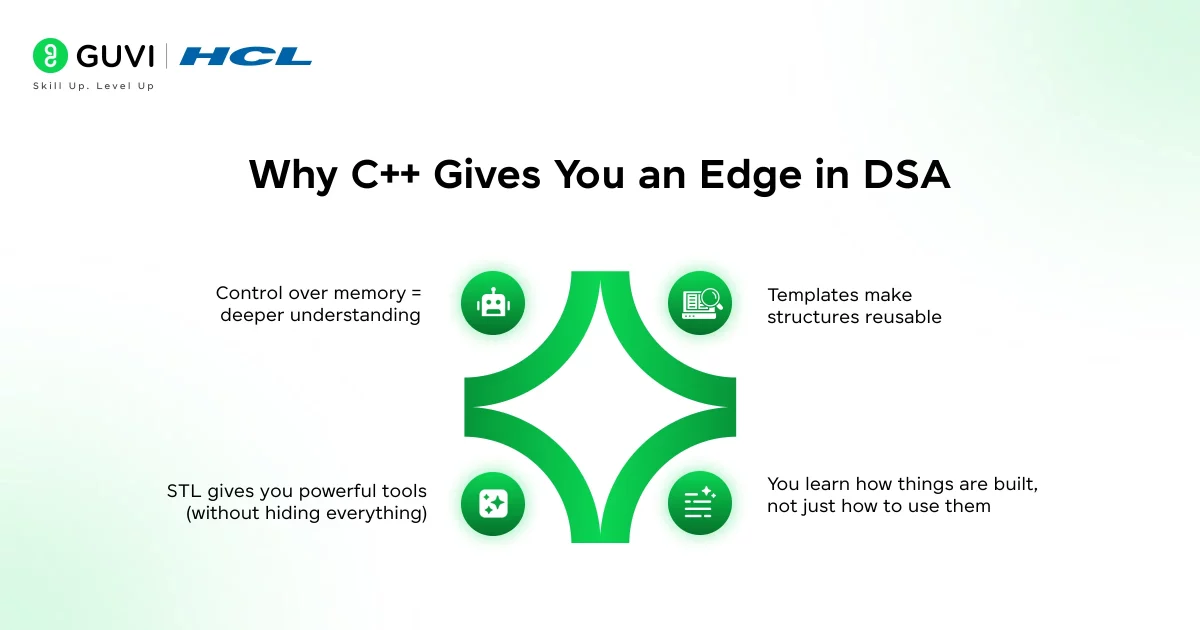
- Why C++ Gives You an Edge in DSA
- Control over memory = deeper understanding
- STL gives you powerful tools (without hiding everything)
- Templates make structures reusable
- You learn how things are built, not just how to use them
- Before You Dive Into DSA in C++: Build a Strong Foundation
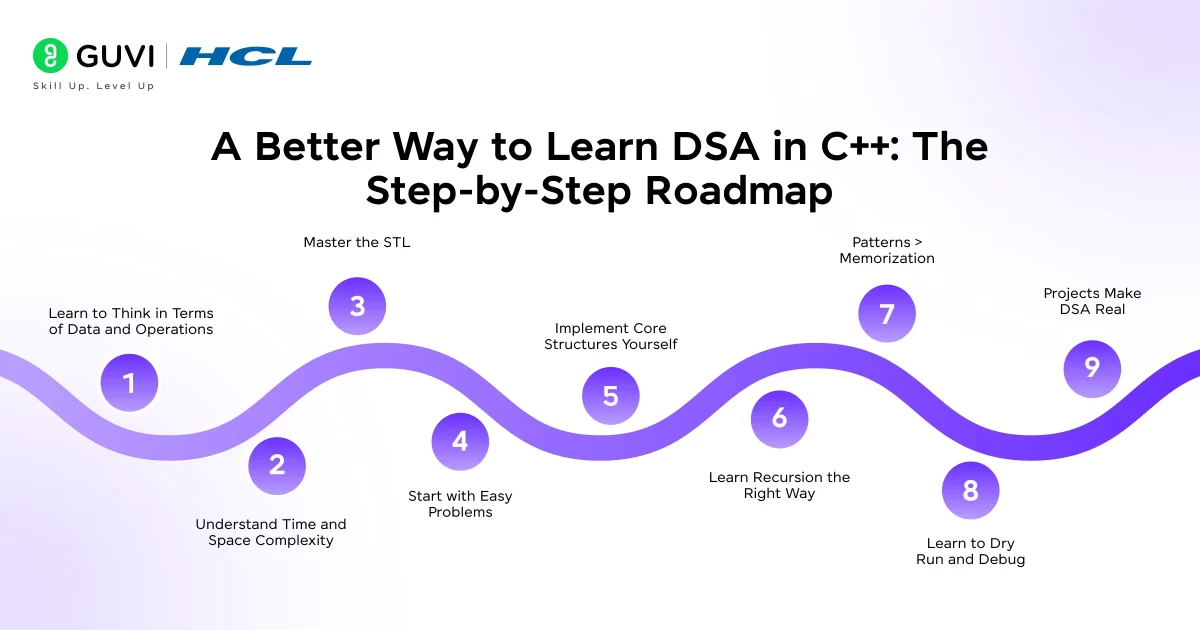
- A Better Way to Learn DSA in C++: The Step-by-Step Roadmap
- Step 1: Learn to Think in Terms of Data and Operations
- Step 2: Understand Time and Space Complexity (Without Fear)
- Step 3: Master the STL (This Saves You MONTHS)
- Step 4: Start with Easy Problems (Don’t Jump to Trees!)
- Step 5: Implement Core Structures Yourself (At Least Once)
- Step 6: Learn Recursion the Right Way
- Step 7: Patterns > Memorization
- Step 8: Learn to Dry Run and Debug (Most Underrated Skill)
- Step 9: Projects Make DSA Real
- The Importance of Memory Awareness in DSA (Why C++ Wins)
- Confidence Comes From Reps, Not Talent
- Final Advice: The Do and Don’t List
- Do:
- Don’t:
- Conclusion
- FAQs
- Is C++ good for learning DSA?
- Do I need to know C++ fully before learning DSA?
- What is the best way to start learning DSA in C++?
- How long does it take to learn DSA in C++?
- Is STL enough for DSA, or should I implement everything manually?
Why Learning DSA in C++ Actually Changes How You Think
Most beginners assume Data Structures and Algorithms = memorizing data structures and algorithms. But that’s not the point. The real purpose of DSA is to teach you how to analyze a problem, structure your data intelligently, and build efficient solutions, not just “make it work,” but make it work well.
Let’s break that down.
When you first start coding, you probably just write whatever logic comes to mind. It works for small inputs, the code runs, and you feel productive. But then reality hits: what worked fine with 10 elements becomes painfully slow with 10,000.
That’s when you realize something important: Good code isn’t just correct. Good code is efficient.
And efficiency doesn’t happen by accident. It comes from understanding two things:
- How data is stored (data structures)
- How you process that data (algorithms)
That’s it. That’s DSA.
Now, why learn DSA in C++, specifically?
Because C++ gives you the perfect environment to truly understand efficiency. Python and Java are great languages, but they hide a lot of details. C++ shows you exactly what’s happening under the hood.
It doesn’t give you training wheels. It makes you think about memory, object layout, and execution speed. And if you care about performance or systems-level thinking, that awareness becomes your superpower.
The Real Difference: Syntax vs Problem-Solving
You can write loops, functions, and classes all day and still feel stuck when facing a slightly complex problem. Why?
Because solving problems has nothing to do with typing code. It’s about thinking before coding.
Let’s say the problem is: “Find the first non-repeating character in a string.”
A syntax-level coder jumps straight into writing loops.
A problem solver pauses and asks:
- What structure helps track frequency?
- How do I access elements fast?
- How do I maintain order?
Then they choose an approach:
- Use a vector<int> or unordered_map<char, int> to count frequencies.
- Traverse the string again to find the first character with frequency 1.
That’s DSA thinking. And once you can think like this, coding becomes the easy part.
If you want a platform that actually teaches DSA in a structured, beginner-friendly way while also giving you practical coding experience, consider enrolling in HCL GUVI’s DSA for Programmers Course that is designed specifically for learners who want clarity instead of confusion. It explains concepts in simple terms and guides you from basics to advanced topics step-by-step.

Why C++ Gives You an Edge in DSA
Let’s go deeper than “C++ is fast” and talk about the real advantages.
1. Control over memory = deeper understanding
You actually see stack vs heap. You decide when to allocate and free memory. You can optimize space usage. That awareness naturally translates to better data structure decisions.
2. STL gives you powerful tools (without hiding everything)
Unlike some languages where everything is abstracted too far, C++ STL is the perfect middle ground: high-performance implementations that still feel close to the metal.
3. Templates make structures reusable
vector<int>, vector<string>, vector<CustomClass> — all the same structure. You think in patterns, not in hardcoded types. That’s how real engineers build systems.
4. You learn how things are built, not just how to use them
You can implement your own linked list or stack, AND use the STL version. Knowing both perspectives is priceless.
Before You Dive Into DSA in C++: Build a Strong Foundation
A lot of people fail at DSA because they skip this step. They jump into trees and graphs without understanding the language itself.
Make sure you are comfortable with:
- Data types and variables
- Conditionals and loops
- Functions and parameters
- Basic OOP (classes, objects)
- Pointers (even a little)
- Arrays and strings
- Recursion basics (even if it feels weird at first)
Why pointers? Pointers are the backbone of most data structures in C++. Linked lists, trees, graphs, they all rely on dynamic memory and node connections.
Think of pointers like a mental model of connections. Once pointers “click,” data structures become far less mysterious.
If you want to read more about how DSA paves the way for effective coding and its use cases, consider reading HCL GUVI’s Free Ebook: The Complete Data Structures and Algorithms Handbook, which covers the key concepts of Data Structures and Algorithms, including essential concepts, problem-solving techniques, and real MNC questions
A Better Way to Learn DSA in C++: The Step-by-Step Roadmap
Instead of learning random topics, follow this structure.
Step 1: Learn to Think in Terms of Data and Operations
Every problem involves data. The data needs to be:
- Stored
- Retrieved
- Processed
Ask yourself:
- What type of data is it?
- How often will I insert or delete?
- Do I need to search or sort it?
- Does order matter?
- Are duplicates allowed?
Just answering these questions leads you toward the right data structure before you write code. This is how professionals think.
Step 2: Understand Time and Space Complexity (Without Fear)
Complexity isn’t math. It’s intuition.
When you hear O(n), think: “Grows linearly.”
When you hear O(log n), think: “Efficient, halves each time.”
When you hear O(n²), think: “Probably too slow for big inputs.”
You don’t need to calculate exact formulas. You just need to compare and reason:
- Is this code scalable?
- Can I do better?
- What’s the bottleneck?
Complexity analysis is a compass. It tells you where to optimize.
Step 3: Master the STL (This Saves You MONTHS)
Here’s a secret most beginners miss: You don’t need to manually implement every data structure to learn DSA.
That’s what the STL is for.
Let’s look at a few powerful tools you absolutely should master:
| Structure | What it really is | When to use it |
| vector | Dynamic array | Frequent random access, resizing |
| stack | LIFO behavior | Undo operations, DFS |
| queue | FIFO behavior | Scheduling, BFS |
| deque | Double-ended queue | Push/pop from both ends |
| set | Sorted unique elements | Fast lookup + sorted |
| unordered_set | Hash set | O(1) lookup, no order |
| map | Key-value, sorted | Organized pairs |
| unordered_map | Hash map | Fast lookup by key |
| priority_queue | Heap | Get largest/smallest fast |
You don’t need to reinvent these every time. Use them. Focus on solving the problem instead of fighting the structure.
Here’s a quick example that shows why STL is so good:
#include <bits/stdc++.h>

using namespace std;

int main() {

    unordered_map<char, int> freq;

    string s = "programming";

    for(char c : s) {

        freq[c]++;

    }

    for(char c : s) {

        if(freq[c] == 1) {

            cout << "First non-repeating char: " << c;

            break;

        }

    }

}
This isn’t just simple, it’s powerful. Without STL, this would be 2–3X more code.
Step 4: Start with Easy Problems (Don’t Jump to Trees!)
You don’t need to start with graphs or dynamic programming. That’s like trying to run before you can walk. Start with fundamentals and build pattern recognition.
Begin with problems like:
- Reverse an array
- Rotate an array
- Find max/min element
- Count the frequency of elements
- Check for a palindrome string
- Remove duplicates
- Find the missing number
These problems seem basic, but they teach you:
- Iteration techniques
- Condition handling
- Edge case thinking
- Using STL containers in simple contexts
Once these feel natural, then gradually move to more structured problems.
Step 5: Implement Core Structures Yourself (At Least Once)
Even though STL is great, you should still write your own versions at least once. Why?
Because when you implement a stack or linked list by hand, you suddenly understand:
- How push/pop works internally
- How pointers link nodes
- Why performance changes with structure
- Where memory goes
Example: A simple stack using arrays
#include <iostream>

using namespace std;

class Stack {

    int arr[100];

    int top;

public:

    Stack() { top = -1; }

    void push(int x) {

        if(top == 99) {

            cout << "Stack overflow\n";

            return;

        }

        arr[++top] = x;

    }

    void pop() {

        if(top == -1) {

            cout << "Stack underflow\n";

            return;

        }

        top--;

    }

    int peek() {

        if(top == -1) {

            cout << "Stack is empty\n";

            return -1;

        }

        return arr[top];

    }

    bool empty() {

        return top == -1;

    }

};
Once you write this, using stack<int> from STL becomes intuitive. You don’t just call push(), you understand what it does.
Step 6: Learn Recursion the Right Way
A lot of people fear recursion. It feels like magic at first. But recursion is just a function calling itself with a smaller problem.
The key is to think in two parts:
- Base case: When do I stop?
- Recursive case: How do I reduce the problem?
Example: Factorial
int factorial(int n) {

    if(n == 0) return 1; // base case

    return n * factorial(n - 1); // recursive case

}
Once you understand recursion, problems like tree traversal, backtracking, and divide and conquer become much easier.
Step 7: Patterns > Memorization
You don’t need to solve 500 problems. You need to recognize patterns.
Common DSA patterns:
- Sliding window (fixed and variable)
- Two pointers
- Fast and slow pointers
- Recursion/backtracking
- Divide and conquer
- Greedy strategy
- Hashing
- Dynamic programming (later)
Each pattern applies to dozens of problems. Learn the pattern, not the exact solution.
Step 8: Learn to Dry Run and Debug (Most Underrated Skill)
Writing code is easy. Understanding why it isn’t working is the real skill.
Dry running means simulating your code manually with example input. It exposes logical flaws instantly.
Start by asking:
- What happens when the input is empty?
- What if there’s just one element?
- What about negative values?
- What if all elements are the same?
Great developers don’t magically write perfect code. They write clear code and debug smartly.
Step 9: Projects Make DSA Real
Learning theory is good. But applying DSA in small projects makes concepts stick permanently.
Try things like:
- Mini text editor with undo/redo (stack)
- Task scheduler with priority (priority_queue)
- Basic contact list (map)
- Browser history simulator (stack + queue)
You don’t need a massive application. Even small prototypes deepen understanding.
Just like how DSA performs great in C++, it also functions well with Python, and if you are curious about it read our blog – DSA with Python: Understand the Foundations of Coding
The Importance of Memory Awareness in DSA (Why C++ Wins)
Understanding memory helps you write better algorithms. C++ forces you to think about:
- Stack vs Heap storage
- Object lifetime
- Pointer vs Reference
- Shallow vs Deep copy
Example of heap allocation:
int* ptr = new int(5);

cout << *ptr;  // 5

delete ptr;    // freeing memory
Why does this matter? Because data structures like linked lists, trees, and graphs live on the heap. If you understand heap allocation, you understand these structures physically, not just theoretically.
Confidence Comes From Reps, Not Talent
Let’s be real, DSA feels hard at first. You will get stuck. You will write code that doesn’t work. You’ll overthink or underthink. Everyone goes through it.
The difference between those who master DSA and those who give up? They keep showing up.
You don’t need 6 hours a day. Even 1 hour of focused practice with the right approach is enough, every day, consistently.
Over time:
- Patterns become obvious
- Code becomes cleaner
- Solutions come faster
- Confidence grows
That’s when you know DSA is clicking.
Final Advice: The Do and Don’t List
Do:
- Build strong C++ foundations
- Understand when and why to use each data structure
- Use STL smartly
- Write your own implementations to learn deeply
- Practice dry running and debugging
- Focus on patterns, not memorization
- Build small projects
- Be consistent
Don’t:
- Blindly copy solutions
- Memorize code without understanding
- Avoid complexity analysis
- Jump straight into advanced topics
- Be afraid of mistakes
- Give up when problems feel hard (they’re supposed to!)
If you’re serious about mastering DSA in software development and want to apply it in real-world scenarios, don’t miss the chance to enroll in HCL GUVI’s IITM Pravartak and MongoDB Certified Online AI Software Development Course. Endorsed with NSDC certification, this course adds a globally recognized credential to your resume, a powerful edge that sets you apart in the competitive job market.
Conclusion
In conclusion, learning DSA in C++ is not just about acing interviews or solving competitive problems. It rewires how you think as a developer. It teaches you to approach problems thoughtfully, choose structures wisely, and write code that’s not just correct, but fast, scalable, and elegant.
C++ doesn’t handhold you. That’s why it’s the best teacher. Because once you master DSA in C++, you can pick up any other language, any framework, any technical challenge, and you’ll handle it with clarity and confidence.
FAQs
1. Is C++ good for learning DSA?
Yes. C++ is fast, gives low-level memory control, and comes with the STL, which provides built-in implementations of most data structures. It’s the most commonly used language for mastering DSA deeply.
2. Do I need to know C++ fully before learning DSA?
You don’t need to be an expert, but you should know the basics: loops, functions, arrays, pointers, and classes. As you learn DSA, your C++ skills will naturally improve.
3. What is the best way to start learning DSA in C++?
Begin with understanding time complexity and mastering STL (like vector, map, stack). Then solve simple problems and gradually move to more structured concepts like recursion and patterns.
4. How long does it take to learn DSA in C++?
With consistent practice, basics take 1–2 months. Reaching problem-solving confidence usually takes 3–6 months, depending on depth and consistency, not talent.
5. Is STL enough for DSA, or should I implement everything manually?
Use STL for problem-solving speed, but implement key structures (like stack, linked list, tree) at least once to understand how they work internally. Both approaches together give true mastery.
Success Stories

About the Author
Lukesh S
A professional content writer who has experience in freelancing and now working as a Technical Content Writer at GUVI. Google Certified Digital Marketer. Have a sound knowledge of SQL, Data Structures and Cloud Computing.
View all posts by Lukesh S
Connect with me @












Did you enjoy this article?