


Data Structure Articles
What is an Algorithm? A Simple Guide for Beginners
Difference between Algorithm and Program: What Sets Them Apart
What Are the Characteristics of an Algorithm? Definition, Features, and Examples


Get In Touch For Details! Request More Information

Importance of DSA: Why is it a “Must-Learn” for Developers?
Oct 17, 2025 6 Min Read 2213 Views
(Last Updated)
If you’ve started learning programming, you’ve probably been told more than once that “you must learn Data Structures and Algorithms.” At first, it can sound like just another academic topic or something only competitive programmers care about. You might even wonder, “If I can already write code and build small projects, why is everyone still pushing DSA so hard?”
The truth is, Data Structures and Algorithms (often called DSA) are not just another subject. They shape how you think, how you solve problems, and how efficiently you write code. They are the foundation of strong technical skills and long-term growth as a developer.
In this article, we will explore the importance of DSA, why they matter, how they impact your career, and where you can learn them effectively, especially if you’re a student just starting to get serious about development. So, without further ado, let us get started!
Table of contents
- What Are Data Structures and Algorithms?
- Why Developers Struggle Without DSA?
- Importance of DSA: Why You Can’t Ignore It (Even if You’re Not Into Competitive Programming)
- Why Companies Care So Much About DSA
- DSA Makes Learning Advanced Topics Easier
- The Myth: “I’ll Learn DSA Later”
- The Essential DSA Topics You Should Learn
- Foundational Data Structures
- Tree-Based Structures
- Graphs (basic understanding at least)
- Must-Know Algorithms
- Essential Skills
- How Much DSA Is “Enough”?
- How to Learn DSA the Right Way
- Practical Tips to Succeed in DSA
- The Real Outcome of Learning DSA
- Where to Learn DSA: Choosing the Right Platform
- Conclusion
- FAQs
- Why are data structures and algorithms important for developers?
- Can I get a job without learning data structures and algorithms?
- Is DSA only needed for competitive programming or interviews?
- What is the best way to start learning data structures and algorithms?
What Are Data Structures and Algorithms?
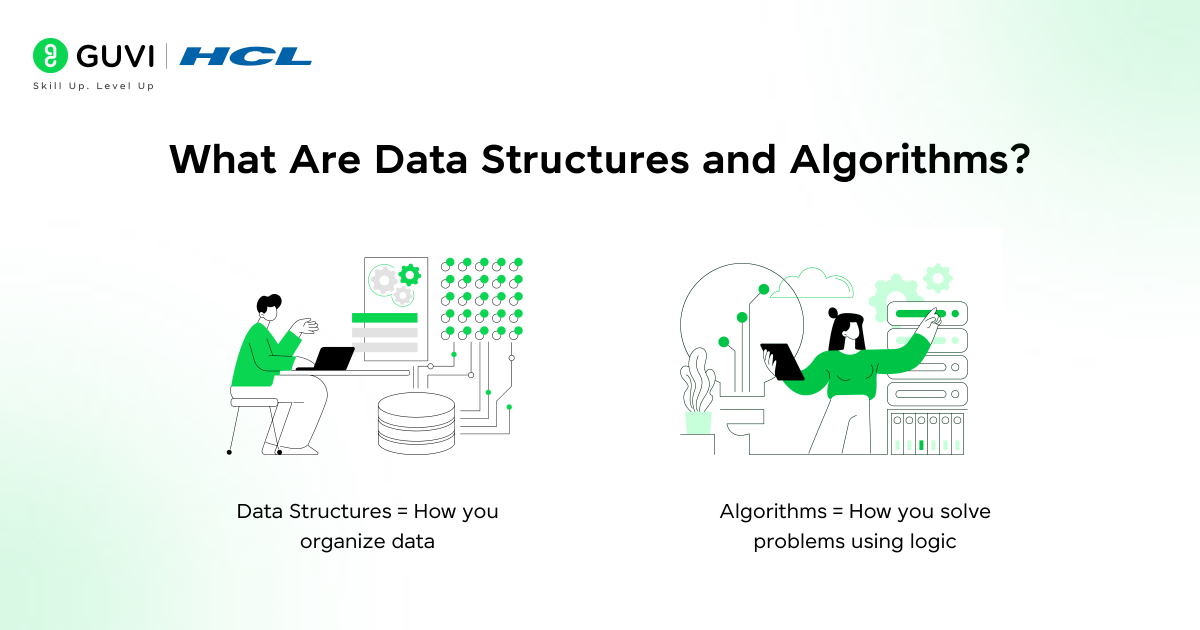
Before we talk about the importance of DSA (Data Structures and Algorithms), it’s essential to understand what they actually mean.
Data Structures are ways to organize and store data so that you can access and modify it efficiently. Each structure has strengths and weaknesses, and choosing the right one can make your code much faster and cleaner. Algorithms are step-by-step methods to solve problems using logic.
Data Structures = How you organize data
Examples:
- Arrays
- Linked Lists
- Stacks & Queues
- Trees
- Graphs
- Hash Tables
Think of them as different containers. The right container saves time and effort.
Algorithms = How you solve problems using logic
Examples:
- Sorting
- Searching
- Recursion
- Dynamic programming
- Greedy methods
- Graph traversal
Algorithms are step-by-step strategies to solve a problem efficiently.
Put simply:
Data Structures store data efficiently.
Algorithms process data efficiently.
Why Developers Struggle Without DSA?
Most beginners can write code that produces the correct result. But correctness isn’t everything. What if the input size grows? What if the program needs to respond instantly? What if memory is limited? Without DSA, you might write code that works on small examples but completely fails in real scenarios.
Even if you’re not building giant systems today, understanding and learning DSA prepares you for future complexity. It’s like learning how to think ahead instead of constantly putting out fires in your code.
Importance of DSA: Why You Can’t Ignore It (Even if You’re Not Into Competitive Programming)
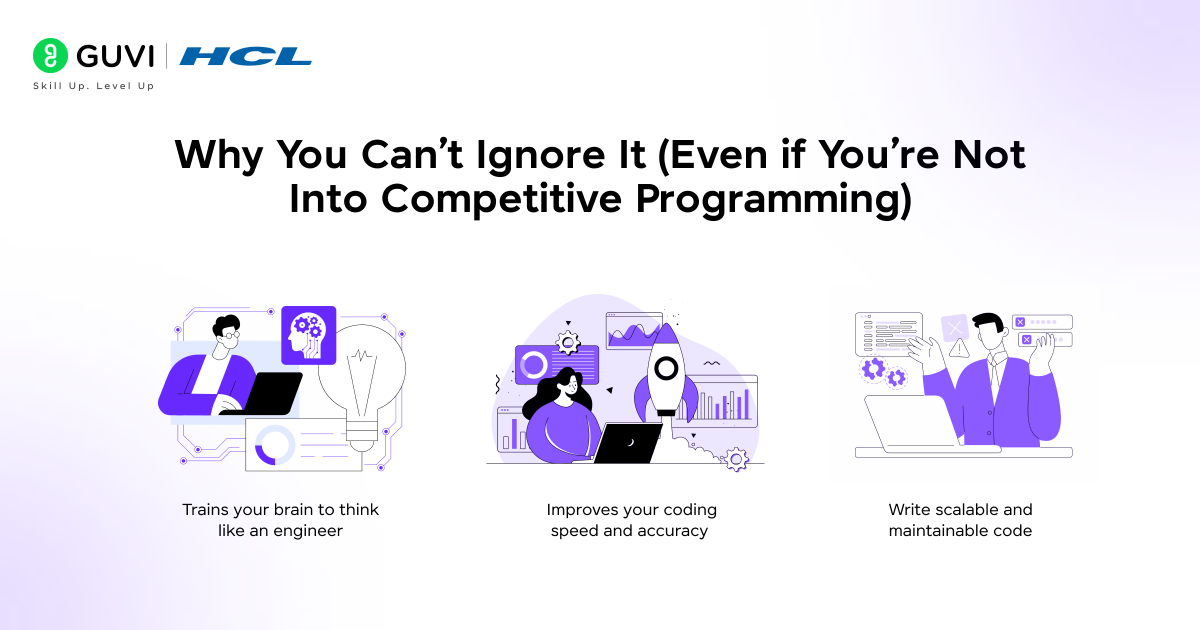
A lot of students avoid DSA because it looks intimidating or because they think it’s only useful for coding competitions or big tech interviews. While those areas do rely heavily on DSA, that’s not the only reason to learn it.
- DSA trains your brain to think like an engineer. It teaches you how to break down problems, analyze different approaches, and choose the most efficient one. When you understand DSA, you don’t just write code. You design solutions.
- It also improves your coding speed and accuracy. When you know which structure or algorithm fits a task, you don’t waste time trying random methods or searching endlessly for help. You become more confident and independent.
- Finally, DSA helps you write scalable and maintainable code. As your projects grow, performance begins to matter. A poor choice of algorithm or data structure can slow everything down. With DSA knowledge, you build systems that handle growth gracefully.

Why Companies Care So Much About DSA
Whether you’re applying for internships or full-time roles, most technical interviews include DSA questions. This is not because companies want to torture candidates. It’s because DSA reveals how you think.
- When an interviewer gives you a problem, they want to see how you analyze it, how you plan your solution, how you handle edge cases, and how you optimize your logic. Even if the job does not involve writing algorithms every day, the ability to reason under pressure is valuable.
- Companies also prefer candidates with strong fundamentals because technologies change quickly. Today, you may use React or Node.js. Tomorrow, you might have to switch to a different framework. But if you’re strong in DSA, adapting becomes much easier because the underlying logic remains the same.
If you are a college student and want to learn more about how DSA plays a vital role in your placement season, do read – Is DSA Important for Placement?
DSA Makes Learning Advanced Topics Easier
Many students try to learn advanced topics, like backend architecture, system design, AI, or performance optimization, without DSA. They quickly get stuck or feel confused because these areas silently rely on concepts like trees, graphs, hashing, recursion, and complexity analysis.
When you already understand DSA, advanced topics feel logical rather than overwhelming. You recognize patterns faster, make better decisions, and understand why certain solutions are more efficient.
In other words, DSA acts as a bridge between beginner-level programming and real-world software engineering.
The Myth: “I’ll Learn DSA Later”
One of the most common mistakes students make is postponing DSA. They start building projects or exploring frameworks, hoping to “come back to DSA later.” But later usually means “when I start applying for jobs,” which is already too late. At that stage, pressure is high, time is limited, and learning feels stressful rather than rewarding.
Starting early gives you more time to absorb concepts slowly, practice comfortably, and build confidence. You don’t need to master everything at once, you just need consistency.
If you want to read more about how DSA paves the way for effective coding and its use cases, consider reading HCL GUVI’s Free Ebook: The Complete Data Structures and Algorithms Handbook, which covers the key concepts of Data Structures and Algorithms, including essential concepts, problem-solving techniques, and real MNC questions
The Essential DSA Topics You Should Learn
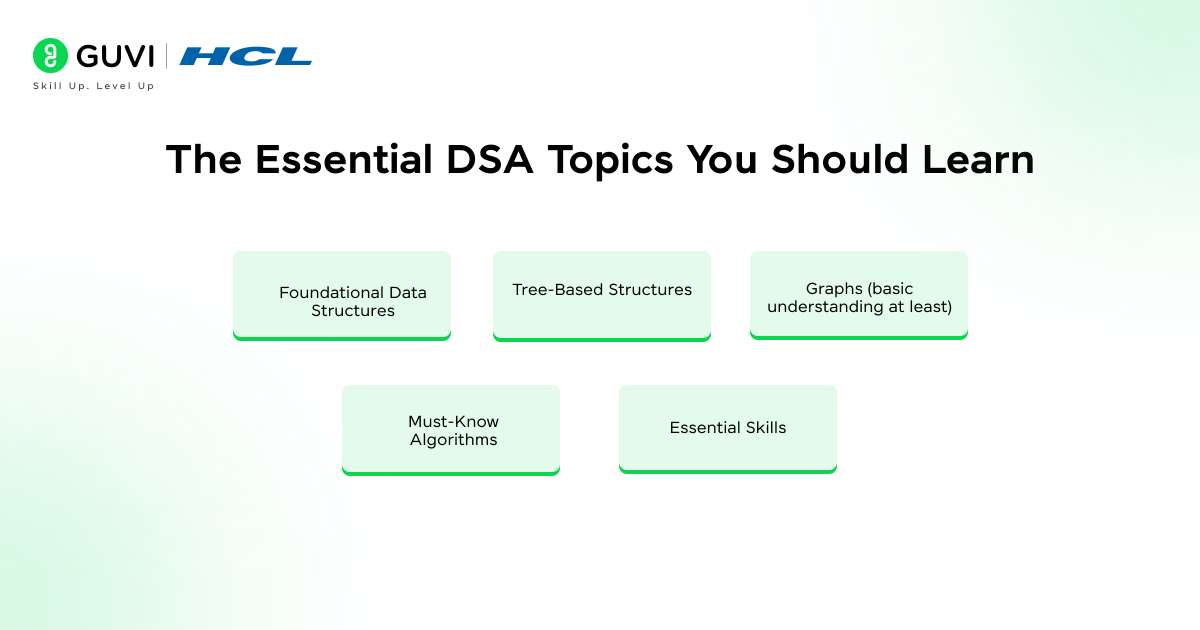
You don’t have to learn every single advanced structure to become good at DSA. What matters is a solid foundation. Here are the core areas you should focus on:
Begin with arrays and strings to understand memory layout and basic manipulation. Move on to linked lists to understand dynamic memory and node-based storage. Stacks and queues introduce you to order-based operations and are commonly used in real-world logic flows.
Hash maps (or hash sets) are crucial for fast lookups and are one of the most frequently used structures in programming. Trees teach you hierarchy and searching in sorted structures. Binary search trees help you understand ordered data and insertion/deletion logic.
You don’t need everything. Focus on these areas first:
1. Foundational Data Structures
- Arrays & Strings
- Linked Lists
- Stacks & Queues
- Hash Maps/Sets
2. Tree-Based Structures
- Binary Trees
- Binary Search Trees
- Heaps
3. Graphs (basic understanding at least)
- Representation
- BFS & DFS
4. Must-Know Algorithms
- Sorting (Bubble, Merge, Quick)
- Searching (Binary Search)
- Recursion
- Greedy approach
- Dynamic Programming (intro level)
5. Essential Skills
- Time & Space Complexity (Big-O notation)
- Problem breakdown
- Optimizing brute-force solutions
Master these, and you’re stronger than most beginners and even some juniors in the industry.
How Much DSA Is “Enough”?
You don’t need to become a competitive programming expert. Focus on mastering fundamentals deeply. Solve around 50 to 100 carefully chosen problems that cover key topics and patterns. Make sure you can explain your solutions logically and understand why your approach works.
With this level of preparation, you will be able to handle most interview questions, build efficient applications, and grow confidently in your career.
Also, learn about how much DSA is required for Full Stack Development is required?
How to Learn DSA the Right Way
Many students struggle with DSA, not because the topic is too hard, but because they use the wrong learning approach. Memorizing solutions or blindly solving random problems does not build deep understanding.
Here’s a DSA roadmap that actually works.
Step 1: Learn the concept visually or with analogies: Don’t jump into coding immediately. First, understand what the structure or algorithm does and why it exists.
Step 2: Practice coding the basics from scratch:
For each concept:
- Write it by hand (yes, really helps!)
- Implement basic functions (insert, delete, traverse, etc.)
- Don’t rely on built-in libraries at first
Step 3: Solve beginner-friendly problems: Start simple and build your confidence first before jumping into complex problems.
Example levels:
- Basic array problems
- String manipulation
- Stack/queue usage
Step 4: Move to patterns: Instead of random questions, learn problem patterns like:
- Two pointers
- Sliding window
- Recursion/backtracking
- Prefix sums
- Hashing
Suddenly, you’ll see that many questions are just variations.
Step 5: Revisit and refine: Finally, revise and revisit previous problems. Repetition is what turns short-term memory into long-term skill. Over time, you’ll start to see connections automatically.
Most coding interview problems are just basic DSA concepts disguised in different ways. You can solve many complex problems using simple patterns like two pointers or hashing. Dynamic programming sounds advanced, but it is essentially recursion with memory. The right data structure can reduce code size dramatically and improve performance instantly. DSA is not about memorizing tricks, it’s about training your mind to analyze and optimize.
Practical Tips to Succeed in DSA
Be consistent rather than intense. It’s better to study a little every day than to cram once a week. Focus on truly understanding concepts before moving to problems. Learn one topic at a time and don’t jump around. Write code from scratch instead of just reading solutions. Analyze your mistakes and debug your own code. That’s where real learning happens.
Here’s how to stay consistent:
- Use the 80/20 rule: 20% concepts = 80% results.
- One topic at a time: Don’t jump from graphs to sorting randomly. Remember, smooth is fast, so take it one step at a time.
- Learn by doing: You only truly understand after coding it rather than just memorizing it.
- Don’t fear “hard” questions: Even hard problems are built on simple ideas. Think smart instead of hard.
- Debug your own code: You learn more from mistakes than solutions, so don’t fear making mistakes; instead, learn from the solutions that arise from solving those mistakes.
- Stay patient: DSA is like going to the gym, you get stronger gradually. Don’t rush into advanced topics until your fundamentals feel solid. What matters is persistence and a strategy that works.
The Real Outcome of Learning DSA
DSA is not just about passing interviews. It changes how you think. You learn to analyze problems, break them into steps, and build efficient solutions. You become more confident in your ability to handle complexity.
You write clean, optimized, and scalable code. You understand how systems work under the hood. You adapt to new technologies faster. You stand out in interviews, contribute better in teams, and make smarter technical decisions.
In short, DSA turns you from a casual coder into a strong developer.
Where to Learn DSA: Choosing the Right Platform
There are many platforms available, but each has a different purpose. Some teach concepts well but don’t provide enough practice. Others offer practice but very little explanation. Some are overwhelming for beginners.
If you want a platform that actually teaches DSA in a structured, beginner-friendly way while also giving you practical coding experience, HCL GUVI is one of the strongest choices.
HCL GUVI’s DSA for Programmers Course is designed specifically for learners who want clarity instead of confusion. It explains concepts in simple terms and guides you from basics to advanced topics step-by-step.
If you’re serious about mastering DSA in software development and want to apply it in real-world scenarios, don’t miss the chance to enroll in HCL GUVI’s IITM Pravartak and MongoDB Certified Online AI Software Development Course. Endorsed with NSDC certification, this course adds a globally recognized credential to your resume, a powerful edge that sets you apart in the competitive job market.
Conclusion
In conclusion, if you’re serious about becoming a skilled developer, learning Data Structures and Algorithms is not optional. It is the foundation of logical thinking, problem-solving, and technical excellence. It helps you in interviews, in real-world development, in career growth, and in learning advanced concepts.
The good news is that DSA doesn’t have to be scary or confusing. When taught properly, it becomes understandable, even enjoyable. You don’t need to solve hundreds of problems or become a competitive programmer. You just need the right approach, the right guidance, and consistent practice.
FAQs
1. Why are data structures and algorithms important for developers?
Because they help you write efficient, scalable, and optimized code. They also build strong problem-solving ability, which is essential in both real-world development and technical interviews.
2. Can I get a job without learning data structures and algorithms?
You might get entry-level roles, but most good product-based and high-paying jobs expect DSA knowledge. Even in other roles, DSA helps you think logically and perform better as a developer.
3. Is DSA only needed for competitive programming or interviews?
No. DSA improves how you structure code, optimize performance, and solve problems. Interviews just happen to test it because it reflects your core technical depth.
4. What is the best way to start learning data structures and algorithms?
Start with basics like arrays, strings, and linked lists, then move to stacks, queues, trees, and algorithms. Learn concept → implement → solve simple problems → practice patterns.
Success Stories

About the Author
Lukesh S
A professional content writer who has experience in freelancing and now working as a Technical Content Writer at GUVI. Google Certified Digital Marketer. Have a sound knowledge of SQL, Data Structures and Cloud Computing.
View all posts by Lukesh S
Connect with me @










Did you enjoy this article?