


Career Articles
Capgemini Exceller Technical Assessment 2026: AI + Technical - Best Guide
Cognizant GenC Elevate Exam Pattern & Syllabus for Freshers 2026 - Best Guide
Capgemini Exceller Placement Papers and Solutions 2026 - Best Guide
How to Pass the Accenture Recruitment Process 2026/27: The Complete Guide


Get In Touch For Details! Request More Information
How to Write a Cold Email to a Recruiter (With Templates)
Sep 02, 2026 4 Min Read 443 Views
(Last Updated)
Most cold emails to recruiters get ignored. Not because the sender lacks talent, but because the email reads like a form letter that landed in the wrong inbox.
Recruiters get dozens of these a week. Some are too long. Some have no clear ask. Some forget to mention why this recruiter, at this company, for this role. A good cold email fixes all three problems in under 150 words.
This guide breaks down the exact structure that gets replies, plus five templates you can adapt today.
Table of contents
- TL;DR
- Why Most Cold Emails to Recruiters Fail?
- The Structure That Actually Works
- Subject Lines That Get Opened
- Five Cold Email Templates
- Template 1: Direct Role Inquiry
- Template 2: No Open Role, Just Networking
- Template 3: Referral Mention
- Template 4: Career Switch
- Template 5: Follow-Up
- Conclusion
- FAQs
- How long should a cold email to a recruiter be?
- Should I attach my resume or just link it?
- What if I can't find the recruiter's name?
- Is it okay to email a recruiter if there's no open role?
- How many times should I follow up if I don't hear back?
TL;DR
- Keep it under 150 words. Recruiters skim, they don’t read.
- Lead with a specific reason you’re reaching out to this person, not a generic intro.
- State your ask clearly in the first two lines.
- Attach or link your resume; don’t make them dig.
- Follow up once after 4-5 days if you hear nothing.
- Use the subject line to signal relevance, not mystery.
Why Most Cold Emails to Recruiters Fail?
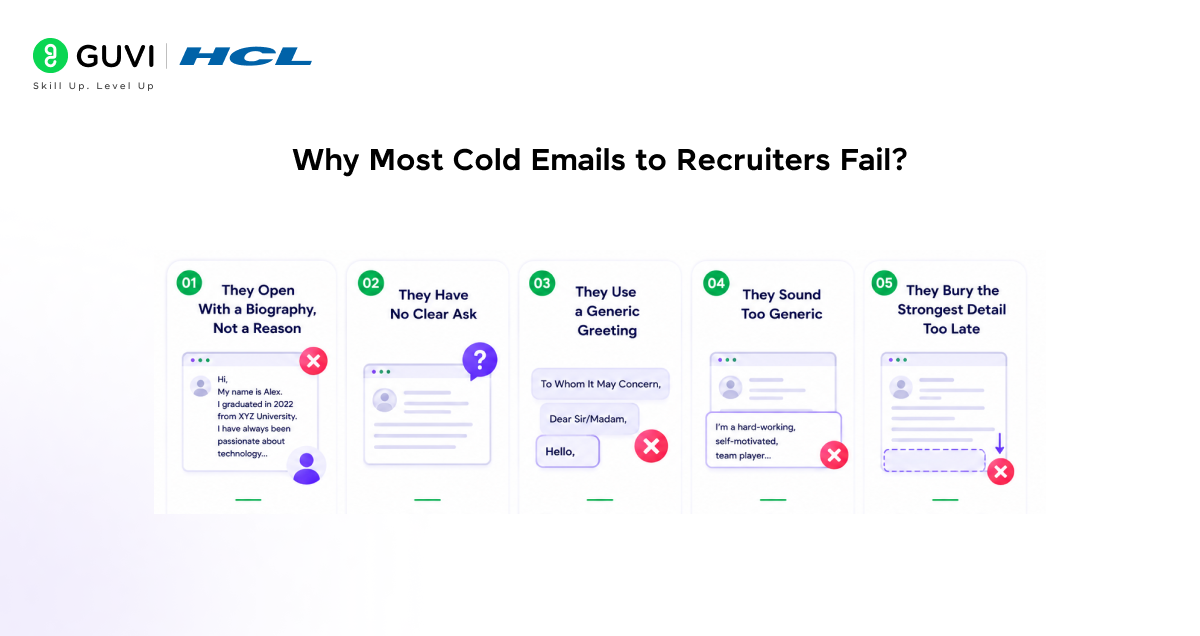
- They Open With a Biography, Not a Reason: Recruiters do not need your life story in line one. They need to know in five seconds why you are emailing them specifically.
- They Have No Clear Ask:?“I’d love to connect” is not an ask. Are you asking for a referral, a chat, feedback on fit, or a direct application review?
- They Use a Generic Greeting: Emails addressed to “Dear Recruiter” feel careless. LinkedIn and the company’s careers page can usually help you find a name in two minutes.
- They Sound Too Generic: Recruiters can tell when the same email has been sent to twenty companies. Mention the role, company, team, or a specific reason to make your outreach feel intentional.
- They Bury the Strongest Detail Too Late: Your best achievement, skill, or result should not appear in the last paragraph. Recruiters skim quickly, so the most relevant proof of fit needs to appear near the top.
Recruiters spend an average of just 6-7 seconds scanning a cold email before deciding whether to open the attachment or archive it. Your first line has to do the heavy lifting.
The Structure That Actually Works
A cold email to a recruiter has five parts, and each should be one to two sentences:
- Subject line: Specific and scannable. Mentions the role or skill, never just “Job Inquiry.”
- Opening line: Why you’re emailing this person, not a generic greeting.
- Value line: One sentence on your relevant experience or result.
- The ask: What you want them to do next.
- Sign-off: Resume attached or linked, plus a low-effort way to respond.
That’s it. No paragraph about your “passion for the industry.” No life history. Recruiters forward emails like this internally because they’re easy to act on.
Subject Lines That Get Opened
Your subject line decides whether the rest of your email gets read at all. In lead generation, the subject line works like the first filter because it tells the recruiter whether your message is relevant or worth skipping. Longer subject lines that provide specific context see a 24.6% higher response rate than short, vague ones, and including specific numbers in your subject line can boost open rates by up to 113%. So skip “Job Application” or “Quick Question.” Those tell the recruiter nothing and look exactly like the other forty emails sitting above yours.
Try these instead:
- “5 years in [skill]: Open to [Company]’s [Role] team?”
- “Referral from [mutual connection] for [Role]”
- “[Your Name]: [Specific skill] for [Team/Department]”
- “Quick note on [Company]’s [Role] opening”
Each one front-loads a number, a name, or a role, the three things a recruiter scans for first.
47% of email recipients open an email based on the subject line alone. A strong subject line can be the difference between being ignored and getting a reply.
Five Cold Email Templates
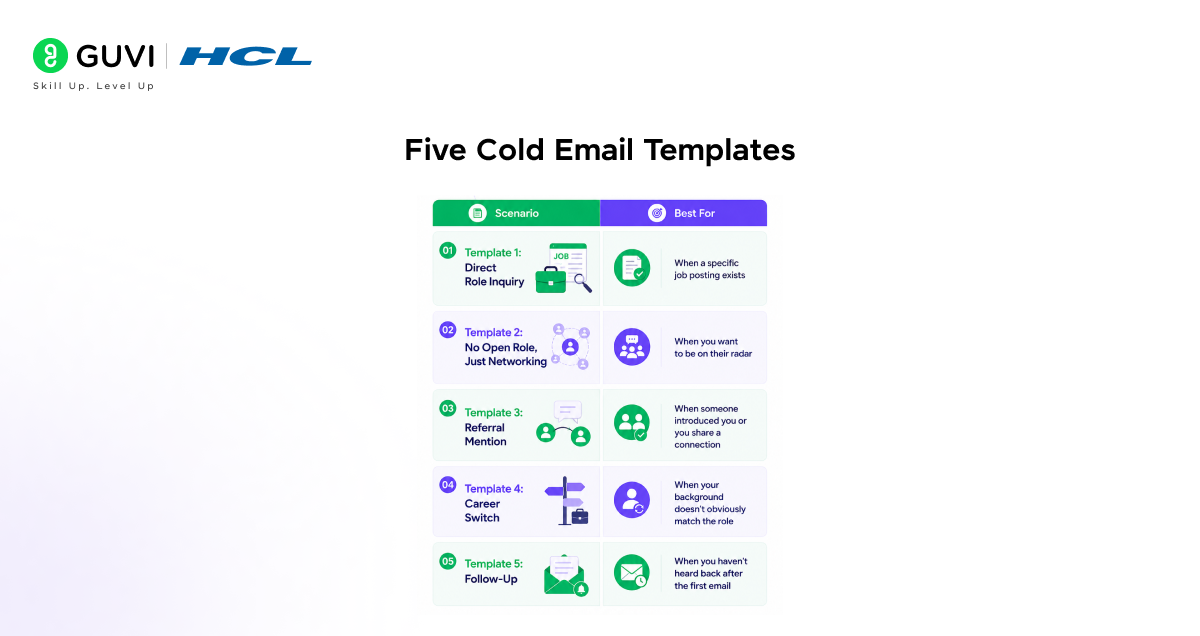
| Scenario | Best For |
| Template 1: Direct Role Inquiry | When a specific job posting exists |
| Template 2: No Open Role, Just Networking | When you want to be on their radar |
| Template 3: Referral Mention | When someone introduced you or you share a connection |
| Template 4: Career Switch | When your background doesn’t obviously match the role |
| Template 5: Follow-Up | When you haven’t heard back after the first email |
Template 1: Direct Role Inquiry
Subject: Strong fit for [Role Name] at [Company]
Hi [Recruiter Name],
I recently came across the [Role Name] opening at [Company] and it immediately stood out because of my background in [specific skill/area].
In my current/recent role, I worked on [specific achievement, project, or measurable result], which closely matches what this position seems to need.
I have applied through the careers page as well, but wanted to reach out directly in case my profile looks relevant for the team.
Would you be open to reviewing my resume or pointing me to the right person handling this role?
Thanks for your time,
[Your Name]
[LinkedIn/Portfolio link]
Template 2: No Open Role, Just Networking
Subject: Exploring future roles at [Company]
Hi [Recruiter Name],
I have been following [Company]’s work in [specific area], and your team’s growth caught my attention.
I currently work in [field/skill] and have experience in [specific achievement, project, or result]. Even though I did not see a perfect open role right now, I would love to stay on your radar for future opportunities.

Would it be okay if I shared my resume for any relevant openings that may come up?
Best,
[Your Name]
[LinkedIn/Portfolio link]
Did you know?
Keep the subject line between 36 and 50 characters. This length gives enough context without getting cut off on mobile, where many recruiters read emails.
Template 3: Referral Mention
Subject: [Mutual Connection] suggested I reach out
Hi [Recruiter Name],
[Mutual Connection] suggested I connect with you regarding opportunities at [Company], especially around the [Role/Team] side.
My background includes [specific skill/experience], and I recently worked on [specific achievement or project] that may be relevant to your team.
I would be grateful if you could review my resume or let me know if there is someone specific I should speak with.
Thanks,
[Your Name]
[LinkedIn/Portfolio link]
Template 4: Career Switch
Subject: Moving from [Old Field] to [New Field]
Hi [Recruiter Name],
I am currently transitioning from [old field] into [new field], and [Company]’s work in [specific area/product/project] really stood out to me.
My previous experience may not follow the traditional route, but it has helped me build strong skills in [transferable skill], [relevant skill], and [specific project/certification].
I would love to be considered for roles where this mix of experience could add value.
Would you be open to reviewing my resume and sharing if there is a suitable direction I should explore?
Best,
[Your Name]
[LinkedIn/Portfolio link]
Template 5: Follow-Up
Subject: Re: [Original Subject Line]
Hi [Recruiter Name],
Just following up on my earlier note regarding the [Role Name] opportunity at [Company].
I understand you may have a busy inbox, so I wanted to quickly check if my profile could be relevant for this role or any similar opening on your team.
Happy to resend my resume or share more details if useful.
Thanks again,
[Your Name]
Build industry-ready digital marketing skills with HCL GUVI’s Digital Marketing Course. Learn through a 100% online, self-paced format and earn an industry-recognised certification at an affordable fee. Get full lifetime access to course content, dedicated forum support to clear your doubts, and access to 4 gamified practice platforms to strengthen your learning through hands-on practice.
What to Do After You Hit Send
- Wait 4-5 business days before following up. Anything sooner reads as impatient. Anything later and you’ve likely fallen off their radar.
- Send one follow-up, not three. A single polite nudge is professional. Repeated follow-ups without a response usually signal the answer is no, even if unspoken.
- Connect on LinkedIn separately. Connect on LinkedIn separately. Like digital marketing, recruiter outreach works better with respectful touchpoints. A short, personalized request can reinforce your email without crowding their inbox.
Conclusion
A cold email to a recruiter does not need to sound impressive. It needs to be clear, specific, and easy to reply to. Start by saying why you are reaching out to that recruiter. Then mention your ask clearly and keep the email short enough to read on a phone. The templates above are only starting points. Add your own details, achievements, and reason for reaching out. This will make your email feel personal and easier to respond to than a generic job request.
FAQs
How long should a cold email to a recruiter be?
Aim for under 150 words. If a recruiter has to scroll to find your ask, the email is too long.
Should I attach my resume or just link it?
Either works, but attaching removes friction. If you link it, make sure the link is public and doesn’t require a login.
What if I can’t find the recruiter’s name?
Check LinkedIn, the company’s careers page, or recent job postings for a contact name before defaulting to “Hiring Team.” A named greeting consistently performs better.
Is it okay to email a recruiter if there’s no open role?
Yes. Networking-style emails that don’t ask for an immediate opening often build longer-term relationships, especially at companies you’re targeting for the future.
How many times should I follow up if I don’t hear back?
Once, after 4-5 business days. If there’s still no response, treat it as a soft no and move your energy to other opportunities.
Success Stories

About the Author
Vaishali
I'm a seasoned writer with four years of experience across technical, non-technical, and just about every genre or niche you can imagine. Adaptable and curious, I enjoy exploring new topics and making information engaging and easy to understand. Fueled by a steady stream of tea, I approach each project with creativity, reliability, and genuine enthusiasm for storytelling.
View all posts by Vaishali
Connect with me @









Did you enjoy this article?