


Career Articles
Data Analyst or Data Scientist: Which Has Better Demand for Mid-Career BPO Professionals?
BPO Workforce Management Analyst to Data Analyst: What Skills Transfer?
CFA Charterholders: Are You Missing Out on Data Science Opportunities?


Get In Touch For Details! Request More Information
How to Crack CS/IT Placements in 2026: The Ultimate Guide to Landing Your Dream Job
Sep 28, 2026 7 Min Read 5295 Views
(Last Updated)
Every placement season, brilliant coders walk out rejected, not because they can’t code, but because they never had a real strategy.
To prepare for CS/IT placements, you need strong DSA fundamentals, hands-on projects, and both on-campus and off-campus strategies working together.
This guide gives you exactly that: the platforms, the checklist, the India-specific playbook, and the mistakes to avoid, all in one place. Let’s get going.
Table of contents
- TL;DR Summary
- Understanding On-Campus vs Off-Campus Placement to Prepare for CS/IT Placements
- On-Campus vs Off-Campus: Quick Comparison
- Core Foundations to Prepare for CS/IT Placements
- Year-Wise Roadmap to Prepare for CS/IT Placements
- System Design Basics: Not Just for Senior Engineers Anymore
- Coding Practice Is a Must
- Platforms to Use to Prepare for CS/IT Placements
- How to Practice Smartly and Prepare for CS/IT Placements Efficiently
- Soft Skills, Communication & Interview Presence
- Resume Crafting & Portfolio
- Tips for a killer CS/IT placement resume:
- On-Campus Placement Preparation for CS/IT
- Typical On-Campus Flow
- Strategy to Ace On-Campus Drives
- How to Excel?
- Off-Campus Placement Preparation for CS/IT
- Where to Look to Prepare for CS/IT Placements Off-Campus
- Building Visibility While You Prepare for CS/IT Placements
- Handling the Interview Funnel
- Best Way to Prepare for CS/IT Placements in India (2026)
- Balancing Academics and Placement Prep
- Does CGPA Matter for CS/IT Placements?
- Can I Prepare for CS/IT Placements Without Prior Coding Experience?
- Checklist to Prepare for CS/IT Placements
- Mistakes to Avoid When You Prepare for CS/IT Placements
- Conclusion
- FAQs
- When should I start my placement preparation for CS/IT?
- Which programming language should I use for placements?
- Are internships important for on-campus and off-campus placements?
- How many projects should I include in my resume?
- How do I stay motivated during CS/IT placements prep?
TL;DR Summary
- What it is: getting ready to land a CS/IT job, through college placements or applying on your own
- Core foundations: DSA, core CS subjects, one programming language, problem-solving
- Timeline: 2nd year (fundamentals) → 3rd year (full DSA, first project) → final year (system design, mock interviews, company-specific prep)
- On-campus vs off-campus: less competition on-campus, more options off-campus
- Salary range: ₹3.5-8 LPA at service companies, ₹10-25+ LPA at product companies
- Avoid: starting late, weak soft skills, copied projects, giving up after rejections
Understanding On-Campus vs Off-Campus Placement to Prepare for CS/IT Placements
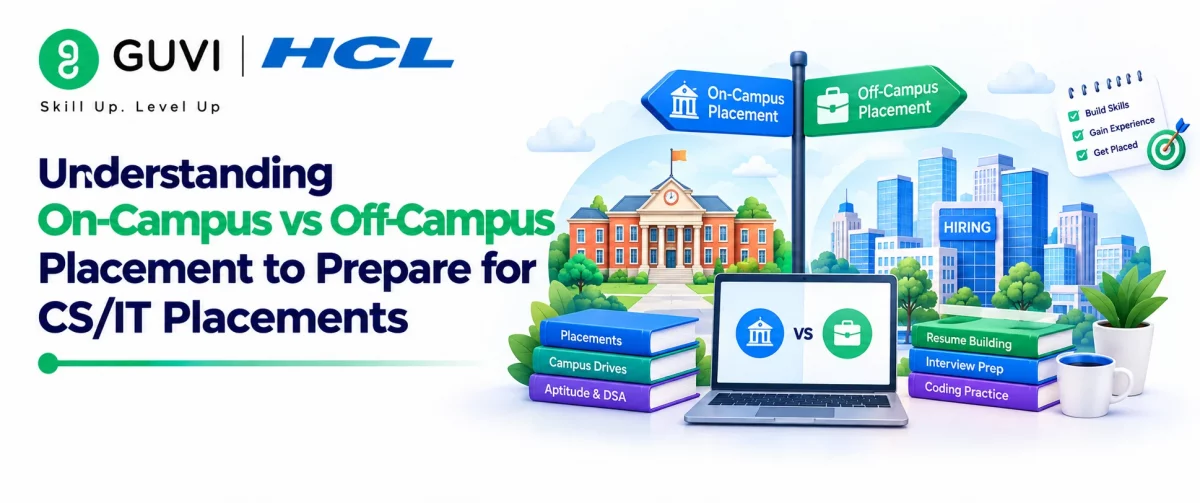
What Is On-Campus Placement? (A Key Part of How to Prepare for CS/IT Placements) – When your college invites companies to come and hire students directly, that’s called an on-campus placement. The college’s placement cell usually handles everything from contacting recruiters to fixing interview slots. Students just have to prepare and show up when the company visits.
What Is Off-Campus Placement? (The Other Half of How to Prepare for CS/IT Placements) – Off-campus placements are when you go out and look for jobs on your own instead of waiting for your college drives. You must hunt for roles on job portals, LinkedIn, company career pages, or even through someone’s referral.
On-Campus vs Off-Campus: Quick Comparison
Trying to decide where to focus your energy first as you prepare for CS/IT placements? Here’s how the two routes actually compare.
| Aspect | On-Campus Placement | Off-Campus Placement |
|---|---|---|
| Who reaches out | Companies visit your college | You apply directly to companies |
| Competition | Mostly within your own batch | Nationwide, much larger pool |
| Company variety | Limited to who visits campus | Any company, startup to MNC |
| Process control | Managed by placement cell | Managed entirely by you |
| Effort required | Show up prepared, follow the schedule | Networking, follow-ups, self-sourcing |
| Timeline | Fixed placement season | Open all year round |
| Best for | Structured, lower-effort start | Wider options, specific target companies |
No matter which route you go for, on-campus or off-campus, what really matters when you prepare for CS/IT placements is how prepared you are. A solid resume, confidence, and strong skills can make either option work in your favor.
Core Foundations to Prepare for CS/IT Placements
At the heart of preparing for CS/IT placements lies a few non-negotiables. Without these, even the best interview tricks may fail you.
- Master Data Structures & Algorithms (DSA): Arrays, linked lists, graphs, trees, and dynamic programming.
- Understand core subjects deeply: OS, DBMS, Networking, OOP, compiler principles.
- Mathematics & logical reasoning: Discrete math, probability, combinatorics, number theory.
- Programming paradigms & languages: Pick one or two (C++ / Java / Python) and stick to them.
- Problem-solving mindset: Break down problems, think of edge cases, iterate.
As you prepare for CS/IT placements, don’t just “cover the syllabus.” Get into why a data structure behaves a certain way, or why an algorithm is optimal. That depth is what interviewers probe when they say, “Explain your approach.”
Aiming for AI roles? Equip yourself with over 60 AI interview questions and answers, including topics on machine learning, deep learning, and natural language processing.
Build real-world projects using MongoDB and Generative AI tools. HCL GUVI’s AI Software Development course helps you enhance your portfolio and placement prospects.
Year-Wise Roadmap to Prepare for CS/IT Placements
Not everyone reading this is in the same year, so how you prepare for CS/IT placements shouldn’t look the same either. Here’s how to phase your prep depending on how much runway you have.
| Stage | Focus Areas | Weekly Time Commitment |
|---|---|---|
| 2nd year | Programming fundamentals, one language mastered, basic DSA (arrays, strings) | 5 to 8 hours |
| 3rd year | Full DSA (trees, graphs, DP), core subjects (OS, DBMS, Networking), first real project | 8 to 12 hours |
| Final year, 6+ months out | Advanced DSA, system design basics, 2 to 3 polished projects, resume draft | 10 to 15 hours |
| Final year, 3 months left | Mock interviews, company-specific prep, resume finalized, aptitude drills | 15+ hours |
If you’re a 2nd or 3rd year reading this and starting early to prepare for CS/IT placements, the biggest advantage you have is time. Use it to build depth instead of cramming breadth in your final semester.
System Design Basics: Not Just for Senior Engineers Anymore
A few years ago, system design questions were reserved for experienced hires. That’s changed.
Product companies like Amazon, Microsoft, and Flipkart now ask fresher candidates basic system design questions, things like how you’d design a URL shortener or a simple rate limiter.
You don’t need deep expertise, but knowing the basics (scalability, databases, caching, load balancing) can be the difference between a good and a forgettable interview.
If you’re targeting product-based roles specifically, spend a few hours on system design fundamentals alongside your DSA prep.
Coding Practice Is a Must
They say “practice makes perfect,” but to prepare for CS/IT placements, practice makes confident.
Platforms to Use to Prepare for CS/IT Placements
- Codekata
- LeetCode
- HackerRank
- Codeforces
- Kaggle (especially useful if you’re targeting AI/ML or data roles)
- InterviewBit
These let you simulate real problems, see editorials, and compare solutions.
As you prepare for CS/IT placements, don’t forget the aptitude round, it usually comes first. Sites like IndiaBix and PrepInsta focus specifically on quantitative, logical, and verbal reasoning, the exact skills tested in most on-campus aptitude tests.
Master C programming with HCL GUVI’s extensive compilation of over 40 C Programming interview questions and answers, covering fundamental to advanced concepts.
How to Practice Smartly and Prepare for CS/IT Placements Efficiently
- Build a question log (topic, difficulty, date solved).
- Solve systematically: start with easy, move to medium, progress to hard.
- Focus on patterns (sliding window, prefix sum, two pointers, backtracking).
- Always analyze time & space complexity.
- Do mock interviews (with friends, or via platforms like Pramp). Aim for at least 15 to 20 full mock tests before your placement season starts, timed and under real conditions.
Soft Skills, Communication & Interview Presence
To fully prepare for CS/IT placements, you also need to communicate well. You might write elegant code, but if you can’t explain it clearly, ouch, you’ll lose points.
- Practice verbally walking through your code.
- Use structure: “First I do this, then that, and finally this.”
- Listen well and ask clarifying questions.
- Be honest. If you don’t know something, it’s better to admit it and take a stab.
- Maintain confidence, eye contact, tone, and positivity.
Also, showcase any team projects, hackathons, or open source work when you prepare for CS/IT placements; it’s a goldmine for talking points.
A script for “Tell me about yourself”: This question opens almost every interview, yet most students who prepare for CS/IT placements still wing it. Structure your answer in three parts, and keep it to about 90 seconds: 1) who you are and what you’re studying, 2) 1 to 2 projects or experiences that show your skills, 3) what you’re looking for and why this role fits. Practice it out loud until it sounds natural, not memorized.
Resume Crafting & Portfolio
Your resume is your first handshake (first impression) when you prepare for CS/IT placements. Let’s make it firm.
Tips for a killer CS/IT placement resume:
- One page max: Recruiters skim fast.
- Projects first: Show 2 or 3 projects, with tech stack, your role, and results.
- Internships / Certifications: Relevant ones shine.
- Quantify: e.g., “Reduced query response time by 25%.”
- Portfolio / GitHub link: Make sure it’s live and well-structured.
- Proofread: No typos, clean formatting.
Looking for innovative project ideas to enhance your portfolio as you prepare for CS/IT placements? Explore HCL GUVI’s curated list of top computer science project ideas that have helped students secure job offers.
On-Campus Placement Preparation for CS/IT
Let’s zoom in on how to prepare for CS/IT placements on-campus with focused tactics.
Whether your target is a mass recruiter like TCS, Infosys, Wipro, Cognizant, or Accenture, or a product company like Amazon, Microsoft, or Flipkart, the fundamentals below apply, though product companies generally test DSA and system design more rigorously.
Typical On-Campus Flow
- Pre-Placement Talk (PPT), where the company presents the role, culture, and expectations. Pay attention here; the questions you ask can leave an impression before the tests even start.
- Aptitude/Logical/Quant test, the first hurdle in most CS/IT placements.
- Technical/Coding round.
- Interview(s) with core/domain team.
- HR/culture/behavioral round.
Strategy to Ace On-Campus Drives
- Mock aptitude tests: Set timers, simulate the pressure.
- Technical mocks in class: Ask seniors for prior questions.
- Be active in placement cell events.
- Pair up with peers: Solve and revise together.
- Prepare company-specific questions: Check recent interview experiences.
How to Excel?
- Join college placement training programs.
- Form study groups: Discuss and solve mock questions together.
- Attend pre-placement talks: They reveal what companies prioritize.
- Keep backups: Don’t rely on a single company; apply to multiple!
Build real-world projects using MongoDB and Generative AI tools. HCL GUVI’s AI Software Development course helps you enhance your portfolio and placement prospects.
Off-Campus Placement Preparation for CS/IT
When you step outside your college bubble to prepare for CS/IT placements off-campus, everything is wider, but so is the opportunity.
Where to Look to Prepare for CS/IT Placements Off-Campus
- LinkedIn: Polish profile, post your projects.
- Company career pages: Many startups post directly.
- Job portals: Naukri, Indeed, Wellfound (formerly AngelList Talent), etc.
- Referrals: Reach out to alumni, seniors.

Building Visibility While You Prepare for CS/IT Placements
- Maintain a GitHub / portfolio that’s regularly updated.
- Write blog posts about your projects.
- Contribute to open source or solve real problems.
Build end-to-end web applications with HCL GUVI’s Full-Stack Web Development Course, encompassing essential technologies like HTML, CSS, JavaScript, React, Node.js, and MongoDB.
Handling the Interview Funnel
As you prepare for CS/IT placements off-campus, expect the rounds to be more demanding, with multiple tech interviews, HR rounds, and sometimes manager rounds. Be ready to explain your project end-to-end, defend design decisions, optimize code, and speak about trade-offs.
Off-campus interviews can be lengthy. Expect:
- Online tests (coding + aptitude).
- Technical interviews (2 to 3 rounds).
- Managerial and HR interviews.
Best Way to Prepare for CS/IT Placements in India (2026)
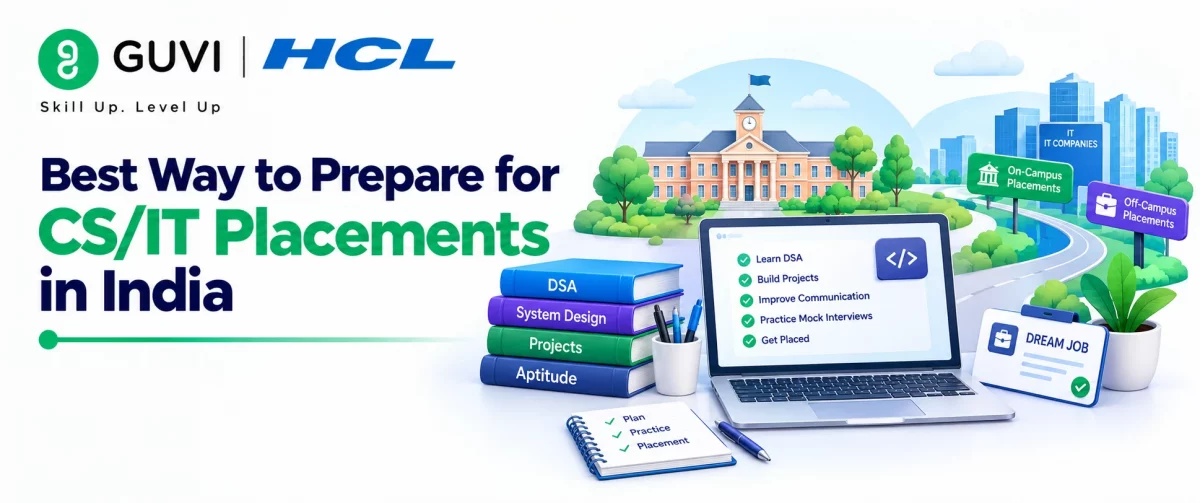
India’s placement landscape has its own rhythm, and knowing it gives you a real edge when you prepare for CS/IT placements here.
Placement season timing (important to prepare for CS/IT placements on time): Most Indian colleges run their main on-campus drives between August and December, with a second wave in January to March for companies that missed the first cycle. Starting your prep by June or July, before drives even open, puts you well ahead of classmates who start scrambling in September.
Package expectations to keep in mind as you prepare for CS/IT placements: Fresher CS/IT packages in India in 2026 typically range from around ₹3.5 LPA to ₹8 LPA at mass-recruiting service companies, with product-based companies and top-tier startups offering ₹10 LPA to ₹25+ LPA for strong DSA and project profiles.
Tier 1, 2, and 3 college reality when you prepare for CS/IT placements: Students at tier 2 and tier 3 colleges often see fewer companies visit campus, which makes off-campus preparation (LinkedIn visibility, GitHub, cold outreach) genuinely more important, not optional.
GATE as a backup path while you prepare for CS/IT placements: For CS/IT students open to PSU or higher-education routes, GATE remains a strong parallel option alongside placements, especially if core-company or research-driven roles interest you.
Where to build skills to prepare for CS/IT placements: Structured courses like HCL GUVI’s Zen Class programs (DSA, Full-Stack, AI/ML) are widely used by Indian students specifically to close the gap between classroom CS fundamentals and what interviewers at Indian product and service companies actually test.
Balancing Academics and Placement Prep
You don’t have to kill your grades to prepare for CS/IT placements well. Try this:
- Daily: 30 to 60 minutes coding.
- Alternate days: revise core subjects.
- Weekend: mock test + project work.
- Monthly: track progress, adjust weak areas.
Use time boxing (Pomodoro, time slots) to prepare for CS/IT placements sustainably, as rest matters.
Prepare for AI/ML interviews with HCL GUVI’s Intel & IITM Pravartak Certified Artificial Intelligence and Machine Learning Course, designed to give you hands-on projects and career guidance.
Does CGPA Matter for CS/IT Placements?
Short answer: it depends on the company, but it’s a question worth answering properly before you prepare for CS/IT placements too narrowly around just DSA.
Why companies use a CGPA cutoff: With thousands of applications per drive, many recruiters use CGPA as an early filter simply to bring the applicant pool down to a manageable size. It’s not usually because they believe CGPA predicts coding ability; it’s a practical shortcut.
Typical cutoffs by company type:
| Company Type | Typical CGPA Cutoff | Notes |
|---|---|---|
| Mass-recruiting service companies (TCS, Infosys, Wipro) | 6.0 to 6.5 | Cutoffs are usually applied strictly at the resume-shortlisting stage |
| Product-based companies (Amazon, Microsoft, Flipkart) | 7.0 to 7.5 | Sometimes flexible if your DSA and project profile is unusually strong |
| Startups and smaller product companies | Often no fixed cutoff | Skills and projects usually matter more than academics here |
| PSUs and GATE-based roles | Varies by exam and post | CGPA matters less; GATE score is the real gatekeeper |
If your CGPA is below your target company’s cutoff:
- Go off-campus. Off-campus applications rarely enforce the same hard CGPA filters that on-campus drives do, especially at startups.
- Lean harder on projects and GitHub. A strong, well-documented project can get you a referral or a direct interview that bypasses the resume-screening filter entirely.
- Target startups first. Many prioritize a working portfolio and problem-solving ability over your transcript.
- Consider GATE, if you’re open to it, since it opens PSU and higher-education paths that don’t weigh undergraduate CGPA the same way.
Once you clear whatever cutoff a company applies, and continue to prepare for CS/IT placements the right way, CGPA stops mattering almost entirely. From that point on, interviewers care about your DSA skills, your projects, and how clearly you explain your thinking, not the number on your transcript.
Can I Prepare for CS/IT Placements Without Prior Coding Experience?
Yes, and it happens more often than you’d think. Here’s a realistic path to prepare for CS/IT placements if you’re starting from zero.
Months 1 to 2: Programming fundamentals. Pick one language (Python is the most beginner-friendly) and get comfortable with variables, loops, functions, and basic data structures like lists and dictionaries. Resist the urge to jump into DSA before this is solid.
Months 3 to 4: Core DSA basics. Move into arrays, strings, basic recursion, and simple sorting and searching. Solve problems daily on a platform like LeetCode or HackerRank, starting with “easy” difficulty and only moving up once you’re solving those comfortably.
Months 5 to 6, one real project, a core step to prepare for CS/IT placements properly: Build something end-to-end, even something simple like a to-do app with a database, or a basic web scraper. This gives you something concrete to talk about in interviews and proves you can actually build, not just solve puzzles.
Months 7 to 9: Intermediate DSA and mock interviews. Add trees, graphs, and dynamic programming to your practice. Start doing timed mock interviews so the pressure of a real interview doesn’t catch you off guard.
What to expect as you prepare for CS/IT placements this way: progress won’t feel linear. Weeks 3 and 4 often feel like the hardest part, right after the initial excitement fades and before problems start clicking. Students who push through that stretch are usually the ones who make it to interview-ready in 6 to 9 months. Missing internships or a CS degree background doesn’t block you here; consistency does the heavy lifting.
Checklist to Prepare for CS/IT Placements
| Area | Action |
|---|---|
| DSA & Coding | Practice daily on LeetCode, HackerRank, Codeforces; focus on patterns, not just problem count |
| Core Subjects | Revise OS, DBMS, Networking, OOP |
| Aptitude | Practice quant, logical reasoning, and verbal ability |
| Resume | Projects, internships, portfolio links |
| Soft Skills | Mock interviews, verbal explanation of your code and projects |
| Networking | Active LinkedIn profile, referrals from alumni and seniors |
| Courses | HCL GUVI Zen courses for DSA, AI/ML, Full-Stack, Gen AI |
Mistakes to Avoid When You Prepare for CS/IT Placements
- Starting too late.
- Ignoring soft skills.
- Copying project code (interviewers detect that).
- Not customizing a resume per company.
- Not researching companies before the interview.
- Giving up after rejections. Resilience is key.
Conclusion
The journey to prepare for CS/IT placements, whether on-campus or off-campus, isn’t a sprint; it’s a marathon. You’ll have highs and lows, rejections and triumphs, sleepless nights, and moments of pure joy when you finally crack that dream company.
The key to prepare for CS/IT placements successfully? Start early, stay consistent, and focus on growth rather than comparison.
FAQs
When should I start my placement preparation for CS/IT?
Ideally, begin your CS/IT placements preparation at least a year before placement season. Start with DSA basics and gradually build up to mock interviews and projects.
Which programming language should I use for placements?
Stick with one – C++, Java, or Python. C++ is often preferred due to its speed and STL library.
Are internships important for on-campus and off-campus placements?
Absolutely! Internships give you real-world exposure and make your resume more credible.
How many projects should I include in my resume?
Two or three well-executed projects are better than five incomplete ones.
How do I stay motivated during CS/IT placements prep?
Set small milestones, celebrate wins, and surround yourself with supportive peers.
Success Stories

About the Author
Jebasta
I translate the language of data into stories that anyone can understand. As a writer with a data science background, I simplify analytics, AI, and decision-making so beginners and enthusiasts can confidently explore the world of data.
View all posts by Jebasta
Connect with me @















Did you enjoy this article?