


Career Articles
How I Switched from Web Developer to ML Engineer (A Web Developer's Real Story)
PHP Developer Resume: Writing Guide & Key to Landing Your Dream Job
My Frontend Developer Interview at Google: What Really Happens Behind Closed Doors
Future of Electric Vehicle Course: Fast-Track Your EV Career


Get In Touch For Details! Request More Information

Are you struggling to enhance your DSA skills despite endless hours of practice? Problem-solving is a highly sought-after skill in software development, and mastering data structures and algorithms can significantly improve your chances of excelling in technical interviews. With developers like me solving over 2500+ problems across platforms like LeetCode and CodeForces, there’s clearly a structured approach to this learning process.
Additionally, understanding which data structures to use when solving a problem can make a significant difference in your solution’s time complexity. If you’re wondering how to improve problem-solving skills effectively, the answer isn’t necessarily practicing thousands of random problems, but rather completing 70-80% of a focused list like Blind75 or Neetcode150.
This guide will walk you through practical steps to improve your DSA skills, from building a strong foundation to consistent practice strategies. You’ll learn why sticking to one programming language is crucial and which platforms offer the best variety of problems with detailed solutions and complexity analyses. Let’s begin!
Table of contents
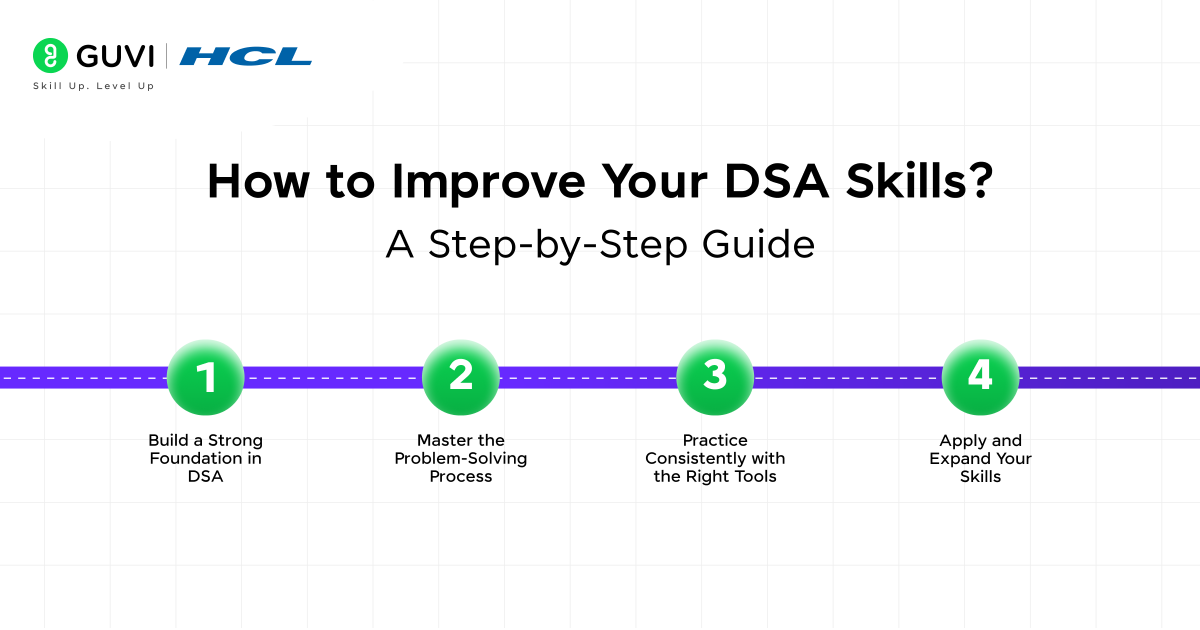
- How to Improve Your DSA Skills? A Step-by-Step Guide
- Step 1: Build a Strong Foundation in DSA
- Step 2: Master the Problem-Solving Process
- Step 3: Practice Consistently with the Right Tools
- Step 4: Apply and Expand Your Skills
- Concluding Thoughts…
- FAQs
- Q1. What is the best way to start improving my DSA skills?
- Q2. How often should I practice DSA problems?
- Q3. Are coding contests helpful for improving DSA skills?
- Q4. How can I apply DSA concepts beyond practice problems?
- Q5. What should I do when I'm stuck on a difficult DSA problem?
How to Improve Your DSA Skills? A Step-by-Step Guide
Now, we will discuss all the steps to mastering and improving your DSA skills so that you can stand confident for all kinds of interviews and exams.
Step 1: Build a Strong Foundation in DSA
Building a strong foundation is the first step in improving your DSA skills. Much like constructing a house, you need solid building blocks before tackling complex problems.
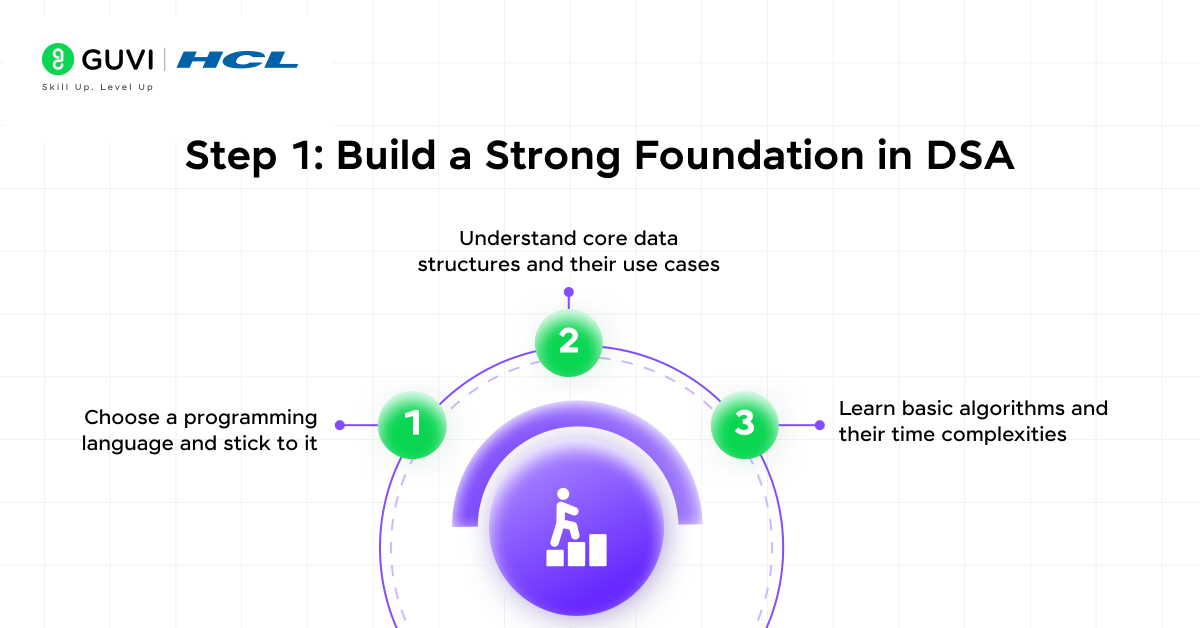
a) Choose a programming language and stick to it
One of the most common mistakes beginners make is jumping between programming languages. The truth is, logic matters more than language. However, selecting one language and mastering it will significantly accelerate your learning.
Based on your career goals, consider these options:
- Python: Offers simplified syntax and built-in data structures that help you focus on algorithmic thinking rather than complex syntax rules. About 72% of working developers use Python professionally.
- Java: Provides strong object-oriented design and automatic memory management, making it excellent for enterprise-level implementation.
- C++: Gives you direct memory access and structured programming approach, ideal for competitive programming. Over 11.6 million developers worldwide use C/C++.
- JavaScript: Supports both procedural and object-oriented approaches, perfect for web developers.
b) Understand core data structures and their use cases
Data structures determine how efficiently a program can perform tasks. Specifically, knowing when to use each structure is crucial:
- Arrays: Provide constant-time (O(1)) access to elements by index. Best for scenarios requiring frequent data reading with fewer insert/delete operations.
- Linked Lists Offer efficient insertion and deletion operations. Perfect for frequent modifications of data.
- Stacks & Queues: Follow LIFO and FIFO principles ,respectively. Useful for function calls, undo operations, and task scheduling.
- Trees & Graphs: Represent hierarchical relationships. Essential for file systems, web page structures, and social networks.
- Hash Tables: Enable fast lookups, insertions, and deletions. Widely used in databases and search engines.
c) Learn basic algorithms and their time complexities
Understanding time complexity helps you evaluate how efficient an algorithm is. Instead of measuring actual runtime, time complexity counts the number of operations needed to run an algorithm on large datasets.
Common time complexities in ascending order of efficiency:
- O(1): Constant time (accessing an array element)
- O(log n): Logarithmic time (binary search)
- O(n): Linear time (finding the lowest value in an array)
- O(n log n): Log-linear time (efficient sorting algorithms)
- O(n²): Quadratic time (nested loops like in bubble sort)
- O(2^n): Exponential time (recursive algorithms)
Furthermore, mastering these fundamentals will help you recognize patterns in problems and select the appropriate approach for each challenge.

Step 2: Master the Problem-Solving Process
Mastering problem-solving is arguably the most critical aspect of enhancing your DSA skills. Once you have your foundation, it’s time to develop a systematic approach to tackle any coding challenge.
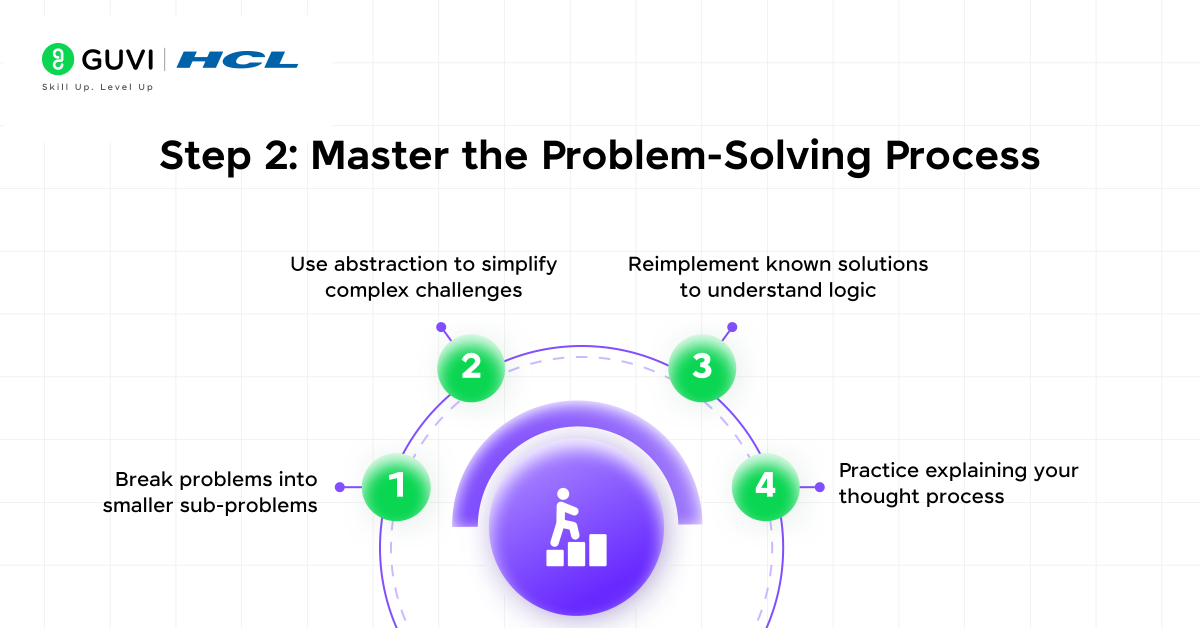
a) Break problems into smaller sub-problems
Decomposing complex problems into manageable chunks makes them less overwhelming. This technique helps identify the key steps required for a solution while improving clarity and simplifying debugging.
Start by understanding the problem thoroughly, then list out the major components needed to achieve your goal. For instance, when facing a challenging algorithm question, identify individual operations and tackle them separately.
b) Use abstraction to simplify complex challenges
Abstraction involves hiding complicated implementation details while focusing on what’s necessary. Essentially, this cognitive skill helps you think about ideas and concepts that aren’t physically present.
When solving DSA problems, abstraction allows you to recognize patterns, make connections, and understand relationships between elements. This approach helps you see the “big picture” first, consequently making it easier to develop step-by-step solutions.
c) Reimplement known solutions to understand logic
Reading and analyzing well-structured code enhances your logical thinking and introduces new problem-solving techniques. After solving a problem, examine other programmers’ solutions to expose yourself to diverse approaches and coding styles.
Moreover, always try to write the pseudocode or algorithm before implementing the actual code. This practice helps reinforce your understanding and makes recollection easier for similar problems in the future.
d) Practice explaining your thought process
Articulating your solution approach is valuable not only for interviews but also for deepening your understanding. Start by repeating the problem in your own words to confirm your grasp.
Then, explain your high-level strategy: “I’m thinking of using a HashMap to keep track of each element’s last occurrence”. Walk through examples step-by-step, explaining your reasoning throughout the process. This habit reinforces your logic and reveals gaps in your understanding.
To break away from the myths, here are a few interesting facts about Data Structures and Algorithms (DSA) in developer hiring:
1. DSA Wasn’t Always a Hiring Benchmark: Before the early 2000s, most companies didn’t use DSA-based questions in interviews. The trend gained popularity only after big tech firms began standardizing coding assessments to compare candidates globally.
2. Many Developers Never Master DSA: According to multiple developer surveys, nearly 60% of working developers claim they rarely use advanced DSA concepts in their daily roles. Instead, they rely on frameworks, APIs, and libraries for real-world problem-solving.
These facts show that while DSA remains valuable, success in tech often comes from building and delivering impactful projects—not just acing algorithm puzzles.
Step 3: Practice Consistently with the Right Tools
Consistent practice forms the cornerstone of developing exceptional DSA skills. After understanding the fundamentals and problem-solving approach, your next step involves selecting the right platforms and establishing a regular practice routine.
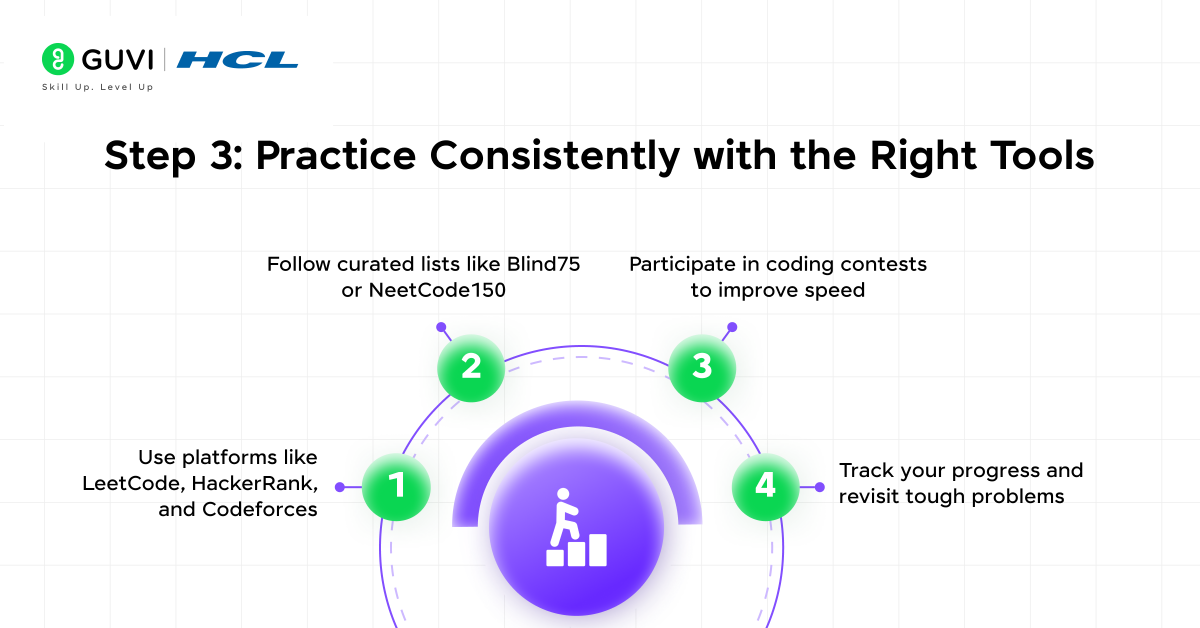
a) Use platforms like LeetCode, HackerRank, and Codeforces
Each platform offers unique advantages for improving your problem-solving skills:
- LeetCode focuses primarily on interview preparation with over 2,000+ coding problems distributed across three difficulty levels (40% Easy, 40% Medium, 20% Hard). The platform includes weekly and biweekly contests alongside detailed solution discussions.
- HackerRank provides comprehensive explanations and tutorials, making it excellent for beginners. Its interface offers helpful hints and problem explanations that guide you through challenging questions.
- Codeforces emphasizes competitive programming with multiple contests weekly. This platform helps advanced programmers develop speed and efficiency through its divisional contests (Div 1-4).
b) Follow curated lists like Blind75 or NeetCode150
Rather than solving random problems, following structured lists proves more effective. The Blind75 represents a popular collection of algorithm practice problems, whereas NeetCode150 expands upon it with 75 additional beginner-friendly challenges. These curated lists ensure you cover essential problem patterns systematically.
c) Participate in coding contests to improve speed
Contests simulate pressure situations similar to interviews. Platforms like LeetCode host weekly challenges with global leaderboards, whereas Codeforces conducts multiple contests weekly with problems arranged in increasing difficulty. Participating regularly helps improve your solving speed and builds confidence.
d) Track your progress and revisit tough problems
Monitoring your improvement journey is crucial. Several platforms offer progress tracking features that provide detailed statistics and performance metrics. Certainly, revisiting difficult problems helps reinforce concepts and identify improvement areas.
First, solve a problem independently; next, analyze other efficient solutions; finally, implement these approaches yourself.
Step 4: Apply and Expand Your Skills
Putting your DSA skills into practical application marks the difference between theoretical knowledge and true mastery. Beyond solving practice problems, expanding your horizons is essential for continuous growth.
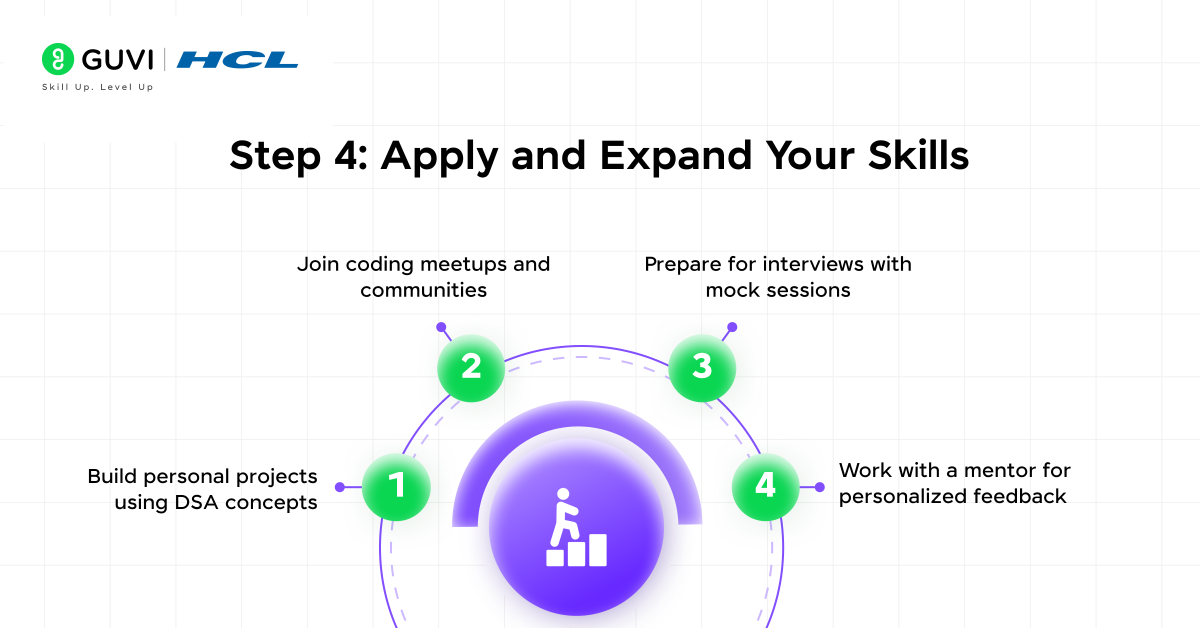
a) Build personal projects using DSA concepts
Creating real-world projects helps bridge the gap between theory and application. Throughout your learning journey, building projects showcases practical implementation while adding valuable entries to your resume. Initially, start with beginner-friendly projects like:
- To-do list applications (implementing arrays/linked lists)
- Pathfinding visualizers (applying graph algorithms)
- Autocomplete engines (utilizing tries)
b) Join coding meetups and communities
Participating in DSA meetups significantly enhances knowledge through peer interaction. Platforms like Meetup.com and Eventbrite regularly list tech events in your area. Simultaneously, Discord servers and online communities focused on 100-day coding challenges promote accountability and consistency.
c) Prepare for interviews with mock sessions
Mock interviews simulate real interview pressure, helping identify strengths and weaknesses. Platforms like Pramp offer peer-to-peer practice sessions where you alternate between interviewer and interviewee roles, providing dual-sided learning opportunities.
d) Work with a mentor for personalized feedback
Working with experienced mentors delivers tailored guidance for your specific challenges. Throughout your learning process, mentors provide structured roadmaps, clarify complex concepts, and offer industry insights that textbooks often miss.
If you’re looking to sharpen your algorithmic thinking and ace coding interviews, then HCL GUVI’s DSA Using Python Course is a great choice — from basics to expert level, with real-world practice.
For those aiming higher — becoming a full-stack software engineer with Gen-AI, consider HCL GUVI’s Professional Certificate in AI Software Development (IITM Pravartak & MongoDB): 300+ hours, live + recorded, 15+ hands-on projects.
Concluding Thoughts…
Mastering DSA skills requires a methodical approach rather than random problem-solving. First and foremost, choose one programming language and stick with it throughout your learning journey. Understanding core data structures, algorithms, and their time complexities forms the bedrock upon which you’ll build your problem-solving abilities.
Remember that becoming proficient in DSA is a marathon, not a sprint. Though the journey might seem challenging at times, each problem you solve brings you one step closer to your goal. With dedication, structured learning, and consistent practice, you’ll develop the problem-solving mindset that sets exceptional developers apart.
FAQs
Q1. What is the best way to start improving my DSA skills?
Begin by choosing a programming language and sticking to it. Then, focus on understanding core data structures, their use cases, and basic algorithms with their time complexities. This foundation will set you up for success in problem-solving.
Q2. How often should I practice DSA problems?
Consistent practice is key. Aim to solve problems regularly, ideally daily or at least several times a week. Use platforms like LeetCode, HackerRank, or Codeforces, and follow curated lists like Blind75 or NeetCode150 for structured learning.
Q3. Are coding contests helpful for improving DSA skills?
Yes, participating in coding contests can significantly improve your problem-solving speed and efficiency. They simulate pressure situations similar to technical interviews and help you gage your progress against other programmers.
Q4. How can I apply DSA concepts beyond practice problems?
Build personal projects that incorporate DSA concepts, such as a to-do list application using arrays or linked lists, or a pathfinding visualizer using graph algorithms. This practical application helps reinforce your understanding and adds value to your portfolio.
Q5. What should I do when I’m stuck on a difficult DSA problem?
When facing a challenging problem, try breaking it down into smaller sub-problems. If you’re still stuck, review the problem-solving process: understand the problem, plan your approach, implement the solution, and then review. Don’t hesitate to look at hints or solutions after giving it your best effort, but make sure to understand and implement the solution yourself afterward.
Success Stories

About the Author
Jaishree Tomar
A recent CS Graduate with a quirk for writing and coding, a Data Science and Machine Learning enthusiast trying to pave my own way with tech. I have worked as a freelancer with a UK-based Digital Marketing firm writing various tech blogs, articles, and code snippets. Now, working as a Technical Writer at GUVI writing to my heart’s content!
View all posts by Jaishree Tomar
Connect with me @

















Did you enjoy this article?