


Career Articles
Diploma vs Degree vs Certification: What Actually Matters to Employers in 2026? - Best Guide
How to Explain Job Hopping Without Sounding Unstable - Best Guide
Why Full Stack Developers Are in High Demand in 2026?
How to Choose a Skill to Learn Next Based on Your Career Goals - Best Guide 2026

Get In Touch For Details! Request More Information
How to Become a CAD Designer in India: The 4-Step Process
Jun 11, 2026 4 Min Read 8686 Views
(Last Updated)
CAD design, or computer-aided design, has shaped industries since the 1980s. Back then, it changed how engineers and designers approached their work. Fast forward to the present, CAD design has become highly integral. Advancements in cloud computing, artificial intelligence, and AR/VR have increased demand for collaborative and efficient design solutions.
So, what is CAD design? It requires specialized software to create detailed drawings, models, and blueprints for various projects. These can vary from designing cars and buildings to complex machinery and electronics.
At its core, CAD design bridges creativity with precision, enabling industries to turn their ideas into reality faster and more effectively. If you’re curious about how to become a CAD designer in India, this guide will walk you through the essential skills and steps required for this rewarding career.
Table of contents
- TL;DR Summary
- Who are CAD designers, and what do they do?
- The key responsibilities of a CAD designer include:
- How to Become a CAD Designer: 4-Step Process
- 1) Meet the basic requirements
- 2) Learn CAD software
- 3) Gain experience
- 4) Develop soft skills
- Career Scope for CAD Designers in India
- What is Driving the Demand?
- Career Opportunities Ahead
- Conclusion
- FAQs
- What qualifications do I need to become a CAD designer?
- Which software is essential for CAD designers?
- Can I become a CAD designer without a degree?
- What industries hire CAD designers?
- How long does it take to become a CAD designer?
- What skills are most important for CAD designers?
- How do I gain experience as a CAD designer?
- Why should I pursue a CAD course from HCL GUVI?
TL;DR Summary
A CAD designer uses computer-aided design software such as AutoCAD, SolidWorks, or CATIA to create precise 2D drawings and 3D models for engineering, architecture, and manufacturing projects. To become a CAD designer in India, you need a diploma or degree in a relevant engineering field, mastery of at least one CAD tool, and a portfolio of real projects. The India CAD software market is projected to reach USD 1.12 billion by 2034, making this a high-growth career with strong salary prospects across industries.
Who are CAD designers, and what do they do?
CAD designers are professionals who render concepts into detailed digital blueprints and models. Their role is recognized in the engineering, architecture, automotive, manufacturing, and entertainment industries.
CAD designers are the ones who put together all the moving parts, be it creating detailed mechanical parts or designing entire buildings. They ensure that every specification is accurate per the requirements and ready for implementation.
The key responsibilities of a CAD designer include:
- Teaming with engineers and architects to understand project requirements.
- Creating 2D and 3D designs using specialized software like AutoCAD, SolidWorks, or Revit.
- Ensuring designs meet technical guidelines and industry standards.
- Modifying and updating designs in response to feedback or new requirements.
- Preparing documentation, including technical drawings, to guide manufacturing or construction.
The ideal skills and qualifications of a CAD designer include:
- Technical skills: Mastery of CAD software is mandatory. You should be familiar with tools like CATIA, AutoCAD, or SolidWorks, which can open doors to opportunities in various industries.
- Attention to detail: You need to be eagle-eyed. Even the smallest errors in designs can lead to major issues during execution.
- Problem-solving: Unexpected challenges often arise during projects. It’s a great deal for you to be good at problem-solving.
- Education: While a degree in engineering, architecture, or a related field is helpful, you can enter the field and become a CAD designer with specialized certifications or diplomas.
Also Read: Top 50+ CAD Interview Questions And Answers [2026]
How to Become a CAD Designer: 4-Step Process
For you to become a CAD designer, here’s our 4-step process to guide you through:
1) Meet the basic requirements
- Education: You should have a diploma or bachelor’s degree in mechanical engineering, architecture, or industrial design. These programs familiarize you with important principles like drafting, design, and material science. These are the backbone of CAD design.
- Certifications: You can undergo specialized CAD certifications from reputable platforms like HCL GUVI. You benefit from targeted training in software and techniques. Such certifications enhance your skills and make your resume more credible to employers.
India’s 3D CAD software market is experiencing steady growth as industries such as manufacturing, automotive, aerospace, construction, and product design increasingly adopt digital engineering workflows. Industry reports project the market to expand significantly over the coming decade, driven by demand for advanced product development, simulation, and design collaboration tools. One of the biggest trends shaping this growth is the rise of cloud-based CAD platforms, which allow engineers and designers to access projects from anywhere, collaborate in real time, and reduce the need for expensive on-premises infrastructure. As organizations accelerate digital transformation initiatives, proficiency in modern CAD tools and cloud-enabled design workflows is becoming an increasingly valuable skill for engineering professionals.

2) Learn CAD software
Mastery of CAD software is essential to becoming a skilled CAD designer. Start with the following:
- AutoCAD: AutoCAD is widely used across industries, from architecture to mechanical design. It’s best suited for 2D drafting and 3D modeling.
- SolidWorks: SolidWorks is valued for its intuitive interface and specializes in designing mechanical parts and assemblies.
- Revit: Revit is a go-to tool for architects and structural engineers, as it simplifies building modeling and design.
- CATIA: CATIA is frequently used in aerospace and automotive design. It allows for easier handling of complex surfaces and assemblies.
3) Gain experience
Practical experience is what turns knowledge into skill. Here are some options for you to get started and test your acquired knowledge (while also getting paid for it!):
- Internships: Engineering firms, architectural studios, and manufacturing companies often list internship opportunities. Starting as an intern is the best way to get hands-on experience with real projects and professional workflows.
- Freelance projects: Platforms like Upwork and Fiverr are still a hub for good opportunities. If you want to get into drafting plans for a renovation or even designing mechanical parts, you can find good design projects to refine your skills and build a portfolio.
- Personal projects: Another option is to create your own projects to experiment with different tools and techniques. For instance, you can design a mechanical part, a building floor plan, or even a consumer product prototype. You should document your process and outcomes to showcase your abilities for bigger opportunities.
- Team-up: You can join open-source CAD projects or team with peers in related fields. Doing this will help you sharpen your skills and learn the art of collaboration and industry-standard practices.
4) Develop soft skills
- Communication: As a CAD designer, you must communicate well. You’ll explain complex designs to clients, engineers, and project teams. You must practice presenting your ideas using diagrams, reports, and digital models. The visual engagement will ensure everyone understands the project’s scope and requirements.
- Teamwork: CAD design is rarely a solo endeavor. You’ll collaborate with other professionals, such as architects, engineers, or project managers. Focus on building strong interpersonal skills and being receptive to feedback for smooth collaboration.
- Problem-solving: As a CAD designer, design challenges, tight deadlines, and unforeseen issues will be part of your job. Work on improving your problem-solving ability by taking up challenging design projects and pursuing creative solutions.
- Time management: You will manage multiple projects and consistently meet deadlines. Getting used to productivity tools like Trello or Asana can help you manage your tasks effectively while staying organized.
Career Scope for CAD Designers in India
The future of CAD design in India is growing rapidly as industries continue to adopt 3D modeling, automation, and digital engineering technologies. According to industry reports, the India 3D CAD software market was valued at around USD 555.96 million in 2025 and is projected to reach nearly USD 1.12 billion by 2034, growing at a CAGR of 8.14%.
What is Driving the Demand?
Several factors are increasing the demand for skilled CAD designers in India:
- Growth of smart manufacturing and Industry 4.0
- Expansion of India’s construction and infrastructure sector
- Increasing adoption of cloud-based CAD tools
- Rising demand for 3D product design and rapid prototyping
- Growth in industries like automotive, aerospace, and manufacturing
Reports also show that cloud-based CAD solutions accounted for nearly 62% of the Indian market in 2025, highlighting the shift toward collaborative and remote design workflows.
Career Opportunities Ahead
As companies invest more in advanced design technologies, professionals skilled in AutoCAD, SolidWorks, CATIA, and Revit can explore roles such as:
- CAD Technician
- Design Engineer
- 3D Modeler
- Product Designer
- Mechanical Draftsman
With India becoming one of the fastest-growing markets for engineering software and digital product development, CAD design offers strong long-term career opportunities across multiple industries.
Also Read: CAD Designer Salary in India 2026
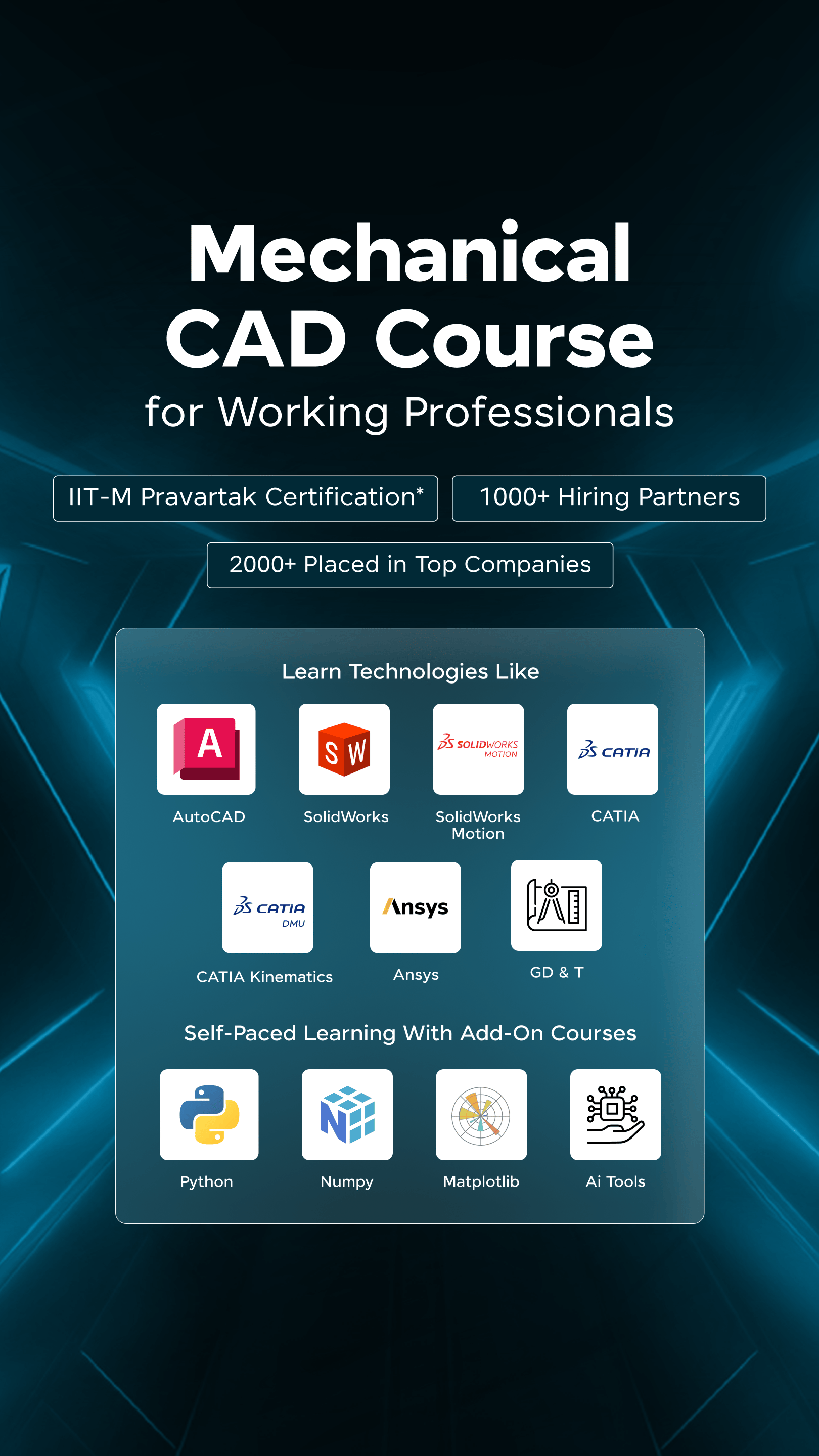
You can also choose from our self-paced short courses, such as the AutoCAD Mechanical Course, HCL GUVI, and the Autodesk-certified CAD and Revit Course, to learn specific tools and upskill.
Conclusion
If you’re exploring how to become a CAD designer, focusing on the right mix of technical knowledge, software expertise, and practical experience is essential. As industries continue to rely on digital design and precision-driven workflows, skilled CAD designers are becoming increasingly valuable across multiple industries. With the right certifications and consistent learning, you can build a stable and rewarding CAD design career in India.
FAQs
What qualifications do I need to become a CAD designer?
To become a CAD designer, you need a diploma or bachelor’s degree in mechanical engineering, architecture, or industrial design. Specialized CAD certifications can also help you enter the field.
Which software is essential for CAD designers?
CAD designers often use software like AutoCAD, SolidWorks, Revit, and CATIA. Mastering these tools is required for creating 2D and 3D designs.
Can I become a CAD designer without a degree?
Yes, you can become a CAD designer without a degree by completing specialized CAD certifications and gaining experience through internships or freelance projects.
What industries hire CAD designers?
CAD designers are in demand across engineering, architecture, automotive, aerospace, manufacturing, and entertainment industries.
How long does it take to become a CAD designer?
The time required depends on your educational background and learning pace. You can become job-ready in 6-12 months with a relevant degree and focused certification programs.
What skills are most important for CAD designers?
Technical skills in CAD software, problem-solving, attention to detail, communication, and teamwork are essential for a successful CAD design career.
How do I gain experience as a CAD designer?
You can gain experience through internships, freelance projects, personal design projects, and collaborations. Document your work in a portfolio to showcase your skills.
Why should I pursue a CAD course from HCL GUVI?
HCL GUVI offers industry-recognized CAD certifications, hands-on learning, expert-led classes, placement assistance, and flexible learning options.
Success Stories















Did you enjoy this article?