


Career Articles
Diploma vs Degree vs Certification: What Actually Matters to Employers in 2026? - Best Guide
How to Explain Job Hopping Without Sounding Unstable - Best Guide
Why Full Stack Developers Are in High Demand in 2026?
How to Choose a Skill to Learn Next Based on Your Career Goals - Best Guide 2026


Get In Touch For Details! Request More Information
How to Ask for a Raise: Scripts and Timing That Work
Jul 07, 2026 5 Min Read 148 Views
(Last Updated)
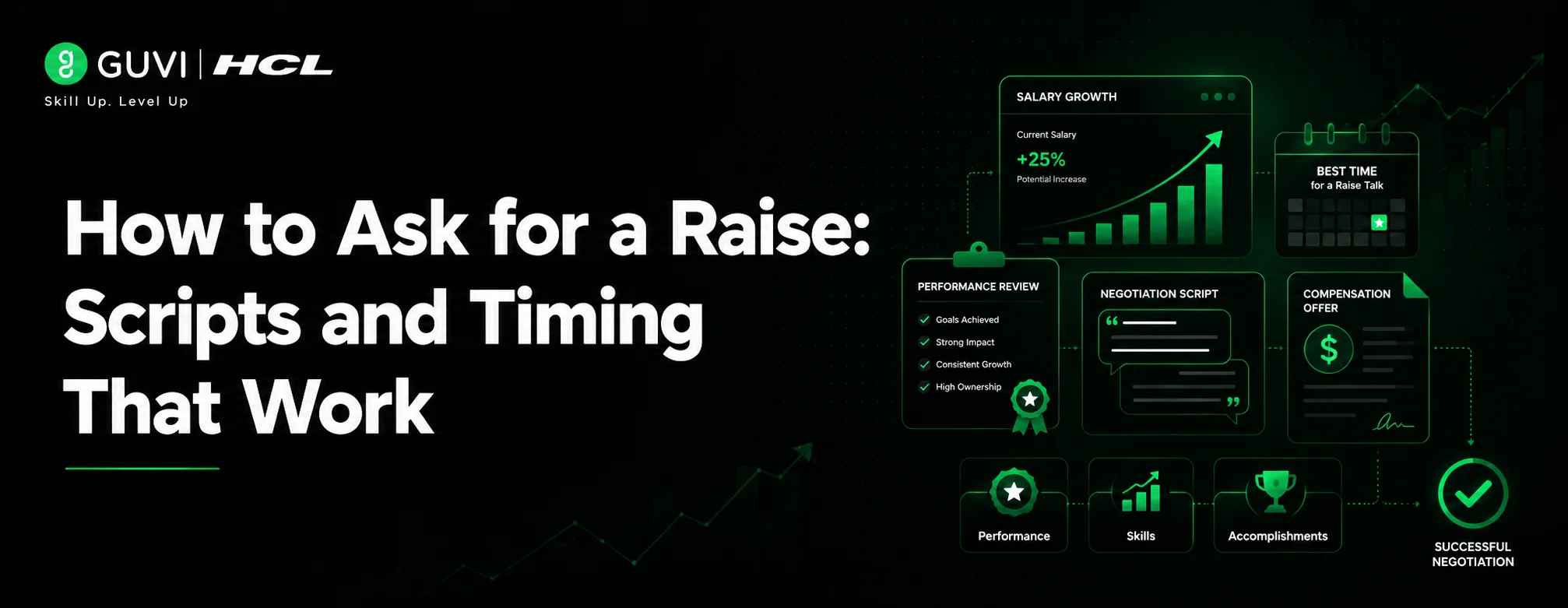
Asking for a raise can feel uncomfortable, even when you know your work deserves better pay. Many employees delay the conversation because they fear rejection, awkwardness, or sounding too demanding.
The truth is simple. A salary raise conversation works best when it is planned, evidence-backed, and timed well. You do not need to beg. You do not need to compare yourself with others. You need to show clear value, present your achievements, and ask with confidence.
This blog explains how to ask for a raise, when to ask, what to say, and which scripts work in real workplace situations.
Table of contents
- TL;DR
- Why Asking for a Raise Needs Preparation
- Best Time to Ask for a Raise
- After a Strong Performance Review
- After Completing a Major Project
- Before the Annual Budget Cycle
- After Taking More Responsibilities
- After Receiving Strong External Market Signals
- How to Prepare Before Asking for a Raise
- List Your Achievements
- Check Your Current Role Value
- Research Market Salary
- Decide Your Expected Raise
- Practice the Conversation
- What to Say If Your Manager Says “We Will Think About It”
- What to Say If Your Raise Request Is Rejected
- Common Mistakes to Avoid While Asking for a Raise
- Asking Without Proof
- Comparing Yourself With Colleagues
- Choosing the Wrong Time
- Sounding Threatening
- Being Too Vague
- Making It Emotional
- How Much Raise Should You Ask For?
- Should You Ask for a Raise Over Email or In Person?
- Follow-Up Email After Asking for a Raise
- Quick Checklist Before Asking for a Raise
- Conclusion
- FAQs
- What is the best way to ask for a raise?
- When is the best time to ask for a salary hike?
- Should I ask for a raise through email?
- What should I avoid while asking for a raise?
- What should I do if my raise request is rejected?
TL;DR
- Ask for a raise after clear achievements, not during random conversations.
- Prepare proof of your performance, impact, responsibilities, and market value.
- Use a calm and professional script instead of emotional reasoning.
- Choose the right timing, such as review season or after a major project.
- Share a clear salary expectation, but stay open to discussion.
- Avoid comparing your salary with colleagues during the conversation.
Why Asking for a Raise Needs Preparation
A raise is not only about wanting more money. It is about proving that your current contribution is worth higher compensation.
Managers usually consider business impact, performance consistency, role expansion, skill growth, and budget availability before approving a salary hike. A weak request sounds personal. A strong request sounds professional.
For example, saying “I need more salary because expenses have increased” may sound honest, but it does not prove business value.
A stronger line would be: “Over the last six months, I have taken ownership of additional responsibilities, improved delivery quality, and contributed to measurable project outcomes. I would like to discuss a salary revision that reflects this growth.”
This small change makes your request sound more professional. It shows your manager why your work deserves better pay, instead of only focusing on why you need more money.
Employees who negotiate their salary increase their lifetime earnings by an average of $1 million, yet only 37% of people negotiate consistently.
Best Time to Ask for a Raise
Timing can decide how your salary hike discussion goes. A good request at the wrong time may still get delayed.
1. After a Strong Performance Review
Performance reviews are one of the best times to ask for a raise. Your work is already being evaluated, so the salary discussion feels natural. Use this moment to connect your rating, achievements, and future contribution.
Script: “Thank you for the feedback. I am glad my work has created a positive impact. Based on my performance and the responsibilities I have handled, I would like to discuss a salary revision that matches my current contribution.”
2. After Completing a Major Project
A successful project gives you strong proof. For example, you ran a successful digital marketing campaign that increased website traffic, generated leads, improved conversions, or helped the business reach the right audience. This gives you strong proof because the result is fresh, visible, and easy to discuss.
Script: “Now that the project has been completed successfully, I wanted to discuss my growth. My role in this project included planning, execution, coordination, and quality ownership. I would like to explore a compensation revision based on this added contribution.”
3. Before the Annual Budget Cycle
Many companies plan salary budgets before official appraisal discussions. Asking early helps your manager consider your case before decisions are locked. A good time is usually one to two months before appraisal or salary revision cycles.
Script: “I understand that compensation decisions may be planned before the formal review cycle. I wanted to start this discussion early and share my achievements, expanded responsibilities, and salary expectations for your consideration.”
4. After Taking More Responsibilities
A raise becomes easier to justify when your role has grown beyond your original job description. This may include managing people, handling clients, training juniors, owning reporting, leading strategy, or taking work from a senior role.
Script: “My responsibilities have expanded meaningfully over the last few months. I am now handling tasks that go beyond my original role. I would like to discuss whether my compensation can be reviewed to reflect this increased ownership.”
Asking for a raise during a performance review boosts your odds of success by nearly 2x compared to bringing it up in a random conversation, since your manager is already evaluating your impact.

5. After Receiving Strong External Market Signals
Market value matters, especially when your skills are in demand. Employees in software development, digital marketing, content strategy, data analytics, sales, design, and product roles often see salary differences across companies. Use market research carefully. Do not sound threatening.
Script: “I have reviewed the market range for similar roles with my experience and responsibilities. Based on that, I feel there is room to align my compensation more closely with my current value and contribution.”
Advance your professional growth with HCL GUVI’s Business Communication Course. Learn workplace communication, negotiation, presentation, and interpersonal skills to communicate confidently, handle professional conversations effectively, and accelerate your career growth.
How to Prepare Before Asking for a Raise
1. List Your Achievements
Create a simple achievement document before the meeting. Keep it specific and result-based.
Include:
- Projects completed
- Targets achieved
- Revenue impact
- Cost savings
- Process improvements
- Client feedback
- Leadership tasks
- New professional skills added
- Extra responsibilities handled
A vague achievement sounds weak. A specific achievement sounds credible.
Weak: “I worked hard on content.”
Strong: “I managed SEO content for multiple clients, improved publishing quality, reduced revision cycles, and handled client-specific editorial checks independently.”
2. Check Your Current Role Value
Compare your current responsibilities with your original job description. A salary hike becomes stronger when your work has clearly expanded.
Ask yourself:
- Am I handling senior-level tasks?
- Am I managing more work than before?
- Am I solving problems independently?
- Am I improving team output?
- Am I contributing beyond assigned tasks?
These answers help you build a stronger case.
3. Research Market Salary
Use job portals, salary reports, LinkedIn jobs, recruiter discussions, social media hiring posts, and peer-level industry data to understand the market range. Do not use only one source. Salary varies by city, company size, industry, experience, and skill level.
A practical line is: “Based on my responsibilities and current market range, I believe a salary revision in the range of ₹X to ₹Y would be fair.”
4. Decide Your Expected Raise
Do not enter the discussion without a number. A manager may ask what you expect.
Prepare three numbers:
- Ideal salary
- Acceptable salary
- Minimum salary you are willing to accept
This helps you stay calm during the conversation.
5. Practice the Conversation
Salary discussions can feel stressful. Practicing your script helps you sound confident and clear. Say your points out loud. Keep your tone respectful. Avoid rushing.
What to Say If Your Manager Says “We Will Think About It”
A delayed answer is common. Do not panic. Ask for clarity and next steps.
Script: “Thank you for considering it. Could we set a timeline to revisit this discussion? I would also appreciate any feedback on what expectations I should meet for the revision.”
This keeps the conversation active.
What to Say If Your Raise Request Is Rejected
A rejection does not always mean the conversation failed. Sometimes budgets are fixed. Sometimes managers need more proof. Sometimes the timing is not right.
Ask for a growth path.
Script: “I understand. Could you help me understand what specific goals or milestones I should achieve for a salary revision in the next review cycle?”
This shows maturity. It also creates a record for the next discussion.
Common Mistakes to Avoid While Asking for a Raise
1. Asking Without Proof
A raise request should not depend only on effort. Prepare achievements, results, and examples before the meeting.
2. Comparing Yourself With Colleagues
Avoid saying, “My colleague earns more than me.” This can make the discussion uncomfortable and unprofessional.
Focus on your value, role, and market alignment.
3. Choosing the Wrong Time
Do not ask during a crisis, conflict, budget freeze, or rushed conversation. A formal meeting works better.
4. Sounding Threatening
Avoid saying, “Increase my salary or I will leave,” unless you are truly ready to exit.
A collaborative tone works better than pressure.
5. Being Too Vague
Do not say, “I want a better salary.” Mention your expected range and explain why it is fair.
6. Making It Emotional
Personal expenses are real, but salary decisions usually depend on business value. Keep the conversation professional.
How Much Raise Should You Ask For?
No fixed number works for everyone. The right raise depends on your role, experience, performance, company budget, and market salary.
A moderate raise may work when your responsibilities have grown slightly. A higher raise may be justified when your role has expanded significantly, your performance is strong, or your salary is below market range.
A good approach is to ask for a range instead of one fixed number.
Example: “Based on my current responsibilities and market range, I believe ₹8 LPA to ₹9 LPA would be a fair revision.”
This gives room for discussion.
Should You Ask for a Raise Over Email or In Person?
A salary raise should ideally be discussed in a meeting. Email is useful for requesting the meeting, sharing a summary, or following up.
Best approach:
- Send a short email asking for a discussion.
- Discuss your raise in a meeting.
- Share a follow-up email after the conversation.
This creates a professional record without making the first message too heavy.
Follow-Up Email After Asking for a Raise
Subject: Thank You for the Compensation Discussion
Hi [Manager Name],
Thank you for taking the time to discuss my compensation and growth.
As discussed, I appreciate the feedback and will continue contributing to [specific area/team/project]. I also look forward to hearing about the next steps regarding the salary revision.
Please let me know if you need any additional information from my side.
Thank you,
[Your Name]
Quick Checklist Before Asking for a Raise
Use this checklist before your salary hike discussion:
- Have I listed my achievements?
- Have I connected my work to business impact?
- Have I checked market salary ranges?
- Have I decided my expected salary range?
- Have I chosen the right timing?
- Have I prepared a clear script?
- Have I scheduled a formal discussion?
- Have I prepared for rejection or delay?
Conclusion
Asking for a raise is not about sounding demanding. It is about presenting your value clearly. The best salary hike conversations are prepared, specific, and well-timed. Share your achievements, explain your expanded responsibilities, mention your expected range, and stay professional throughout the discussion.
Even if the answer is delayed or rejected, the conversation can still help you understand your growth path. A confident employee does not wait silently forever. They prepare, ask respectfully, and build a stronger case for the next opportunity.
FAQs
What is the best way to ask for a raise?
The best way to ask for a raise is to schedule a formal meeting, present your achievements, explain your increased responsibilities, and clearly mention your expected salary range. Keep the tone respectful and professional.
When is the best time to ask for a salary hike?
The best time to ask for a salary hike is after a strong performance review, successful project, role expansion, or before the annual appraisal cycle. Avoid asking during company crises or rushed conversations.
Should I ask for a raise through email?
You can use email to request a meeting, but the main salary discussion should happen in person or on a call. A live conversation allows better explanation and negotiation.
What should I avoid while asking for a raise?
Avoid comparing yourself with colleagues, making emotional arguments, threatening to resign, or asking without proof. Focus on achievements, role growth, and market value.
What should I do if my raise request is rejected?
Ask your manager what goals, skills, or milestones you need to achieve for a future raise. Request a timeline to revisit the discussion and keep a record of your progress.
Success Stories

About the Author
Vaishali
I'm a seasoned writer with four years of experience across technical, non-technical, and just about every genre or niche you can imagine. Adaptable and curious, I enjoy exploring new topics and making information engaging and easy to understand. Fueled by a steady stream of tea, I approach each project with creativity, reliability, and genuine enthusiasm for storytelling.
View all posts by Vaishali
Connect with me @














Did you enjoy this article?