


Interview Articles
My Full Stack Developer Interview Experience: What Nobody Tells You
My Digital Marketing Interview Experience: What They Don't Tell You [2026]
How Long Does Technical Interview Preparation Take? An Expert's Reality Check
Technical QA Interview Questions: What Top Companies Really Ask in 2026


Get In Touch For Details! Request More Information
Hexaware Interview Experience Data Engineer
Mar 19, 2026 4 Min Read 438 Views
(Last Updated)
Preparing for a Data Engineer role at Hexaware can feel challenging if you’re unsure what to expect. From resume screening to technical rounds, each stage tests your skills and problem-solving abilities. Knowing the structure and common questions can give you a strong advantage.
This blog shares a complete Hexaware interview experience for a data engineer role. Whether you are a fresher stepping into the industry or an experienced professional looking to switch roles, you’ll get practical insights and tips to help you succeed.
Quick Answer
The Hexaware Data Engineer interview usually has three stages: HR screening, a technical round covering SQL, Python, and data engineering concepts, and sometimes a coding or case study round. Candidates are evaluated on both practical skills and problem-solving ability. Strong preparation in SQL, Python, and ETL workflows is essential.
Table of contents
- About Hexaware and the Data Engineer Role
- Hexaware Data Engineer Interview Rounds
- HR Screening
- Technical Round
- Coding / Case Study Round
- Preparation Tips for Hexaware Data Engineer Interview
- SQL Practice
- Python Skills
- ETL & Data Pipelines
- Big Data Tools
- 💡 Did You Know?
- Conclusion
- FAQs
- What is the selection process for Hexaware Data Engineer?
- Which skills are most important for this interview?
- Are coding questions included in the interview?
- How should I prepare for the HR round?
- Is prior experience mandatory for Hexaware Data Engineer roles?
About Hexaware and the Data Engineer Role
Hexaware is a global IT and consulting company known for delivering innovative technology solutions across industries. They focus on areas like cloud, automation, AI, and data analytics, making it an exciting place for aspiring Data Engineers.
The Data Engineer role at Hexaware involves designing, building, and maintaining data pipelines, managing large datasets, and working with tools like SQL, Python, and ETL frameworks. Candidates are expected to have strong analytical skills, practical coding ability, and a solid understanding of data workflows.
The Hexaware interview process for Data Engineers generally consists of three main rounds:
- HR Screening – assessing your background, communication, and fit with the company
- Technical Round – evaluating SQL, Python, ETL knowledge, and data engineering concepts
- Coding or Case Study Round – testing practical problem-solving and hands-on skills
This overview helps you understand the role and what the company looks for before diving into each round in detail.
Hexaware Data Engineer Interview Rounds
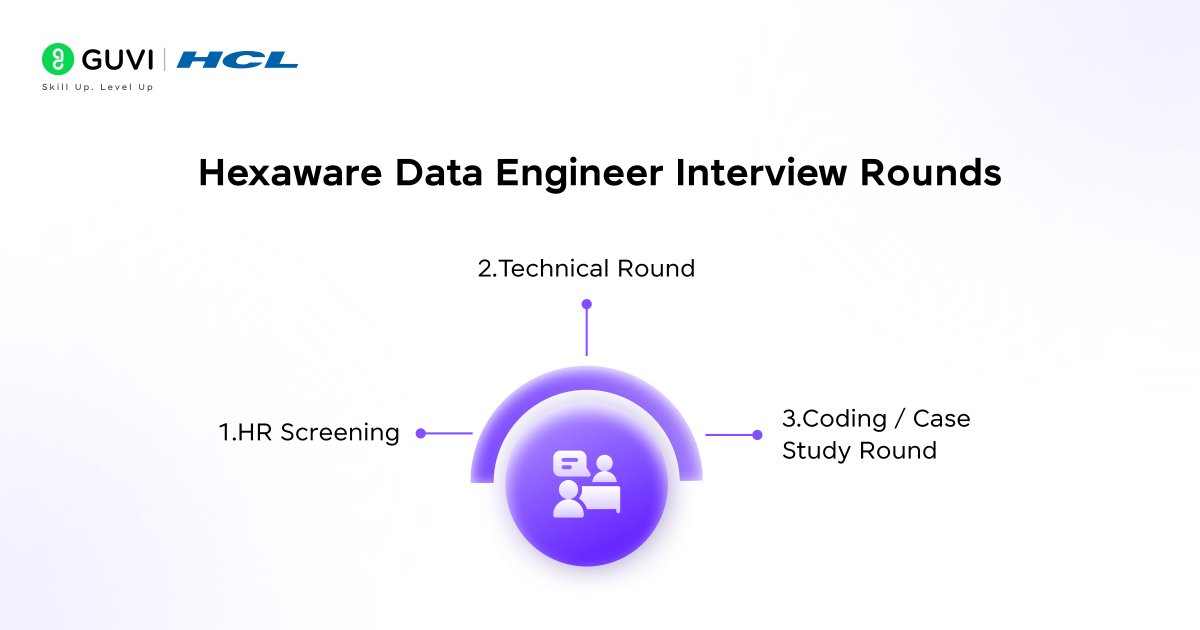
Candidates who have shared their experiences describe the Hexaware Data Engineer interview as structured yet varied depending on experience. Most people went through three main rounds, but the difficulty and focus slightly differed for freshers and experienced professionals.
1. HR Screening
For many candidates, the first HR round was friendly and conversational. One fresher mentioned that the HR mainly asked about their education, internships, and why they wanted to join Hexaware. They also asked about relocation willingness and general career goals.
An experienced candidate shared that the HR focused on previous projects, work experience, and how their skills matched the Data Engineer role. Communication and confidence played a big role in clearing this round.
Key Points:
- Background Check: Questions about education and past experience.
- Motivation: Why you want to join Hexaware.
- Communication Skills: Clear and confident answers matter.
Tip: Be honest, concise, and show enthusiasm for the company.
2. Technical Round
The technical round varied widely among candidates. One fresher said they were asked multiple SQL questions, including joins, subqueries, and finding the second-highest salary in a table. They also had to explain Python scripts used in their college projects.
Another candidate with 2 years of experience shared that the interviewer focused more on ETL pipelines and real-time data handling, asking them to explain a pipeline they had built and optimization techniques for large datasets. A few people also mentioned being asked about Big Data tools like Spark and Hadoop, depending on the profile.
Key Points:
- SQL Queries: Test on joins, subqueries, and aggregates.
- Python Skills: Basic scripts and data manipulation.
- ETL & Data Pipelines: Understanding of workflow design and optimization.
- Big Data Tools: Spark, Hadoop, Hive knowledge can be tested.
Tip: Revise core SQL, Python, and ETL concepts; be ready to explain your projects in detail.

3. Coding / Case Study Round
Some candidates faced a coding or case study round after technical questions. One fresher mentioned having to clean a sample dataset using Python and perform basic transformations. Another candidate reported being given a mini ETL task and asked to design a workflow and explain how they would handle large data efficiently.
Many candidates noted that the interviewers were not just looking for correct answers but also evaluated problem-solving approaches, clarity of thought, and explanation skills.
Key Points:
- Practical Coding: Data cleaning and transformations.
- ETL Workflow: Design and efficiency handling.
- Problem-Solving Approach: How you think and explain matters.
Tip: Focus on hands-on practice, explain your approach clearly, and don’t rush to the solution.
Preparation Tips for Hexaware Data Engineer Interview
Candidates who cleared the Hexaware Data Engineer interview often highlight that consistent hands-on practice and a clear understanding of concepts made the biggest difference. Preparing for SQL, Python, ETL, and data pipelines in a structured way can significantly improve your chances.
1. SQL Practice
Many candidates reported that SQL was the most common area tested. Focus on joins, subqueries, window functions, and aggregate queries. Practicing on real datasets helps you answer questions confidently.
Key Points:
- Joins & Subqueries: Test relational data manipulation.
- Aggregate Functions: Summarize and analyze data efficiently.
- Window Functions: Perform calculations over partitions.
Tip: Solve practical SQL problems regularly and try to optimize queries for large datasets.
2. Python Skills
Python is used for data cleaning, ETL scripting, and basic data transformations. Candidates who practiced file handling, data manipulation, and small scripts felt more confident in the technical round.
Key Points:
- Data Structures: Lists, dictionaries, sets for data processing.
- File Handling: Read/write files, parse data.
- Basic Scripting: Automate simple data tasks.
Tip: Work on small projects or datasets to showcase practical Python usage.
3. ETL & Data Pipelines
Understanding ETL processes and data pipelines is crucial. Experienced candidates often reported questions about optimizing pipelines and handling real-time or batch data.
Key Points:
- ETL Concepts: Extract, Transform, Load workflows.
- Pipeline Optimization: Efficient data flow and error handling.
- Real-Time Data Handling: Awareness of streaming vs batch processing.
Tip: Be ready to explain a pipeline you have built or a scenario of data flow optimization.
4. Big Data Tools
While not all candidates faced this, knowledge of Spark, Hadoop, Hive, or cloud platforms can be an advantage, especially for experienced profiles.
Key Points:
- Spark / Hadoop: Distributed data processing concepts.
- Hive / SQL on Big Data: Query large datasets efficiently.
- Cloud Knowledge: AWS, Azure, or GCP basics for data storage and processing.
Tip: Learn the basics and understand where these tools fit in the data engineering workflow.
Do check out HCL GUVI’s interview preparation course to prepare confidently for the Hexaware interview. It helps you strengthen technical fundamentals, practice real interview questions, and improve problem-solving and communication skills for both HR and technical rounds.
💡 Did You Know?
- Many candidates reported that problem-solving approach mattered more than just correct answers in coding or case study rounds.
- Hexaware interviewers often test real-world ETL scenarios, not just textbook questions.
- Knowledge of SQL optimization and efficient data pipelines can give candidates an edge during technical evaluation.
Conclusion
Preparing for the Hexaware Data Engineer interview can feel challenging, but with consistent practice and focus, success is within your reach. Strengthen your skills in SQL, Python, ETL, and data pipelines, and make sure to understand real-world applications of these concepts. Remember, every effort you put into preparing today brings you one step closer to clearing the interview.
Stay confident, approach each question with a clear thought process, and don’t hesitate to showcase your hands-on experience. Believe in your abilities, keep learning, and stay persistent — your dedication will pay off. Best wishes to all aspiring Data Engineers aiming to join Hexaware!
FAQs
1. What is the selection process for Hexaware Data Engineer?
It usually includes HR screening, a technical round, and sometimes a coding or case study round.
2. Which skills are most important for this interview?
SQL, Python, ETL concepts, data pipelines, and familiarity with Big Data tools like Spark or Hadoop are crucial.
3. Are coding questions included in the interview?
Yes, candidates may face coding problems or data transformation tasks using Python or SQL.
4. How should I prepare for the HR round?
Be ready to discuss your background, projects, career goals, and motivation for joining Hexaware.
5. Is prior experience mandatory for Hexaware Data Engineer roles?
No, both freshers and experienced candidates are considered, but practical knowledge and project experience are highly valued.
Success Stories

About the Author
Jebasta
I translate the language of data into stories that anyone can understand. As a writer with a data science background, I simplify analytics, AI, and decision-making so beginners and enthusiasts can confidently explore the world of data.
View all posts by Jebasta
Connect with me @













Did you enjoy this article?