


Programming Languages Articles
Why Is Python an Interpreted Language? How Python Executes Code Internally Explained
Why Java & C# Beat the Hype Cycle?


Get In Touch For Details! Request More Information

Golang and Python: A Detailed Comparison
Nov 06, 2025 6 Min Read 1894 Views
(Last Updated)
When you’re building something new, an app, an API, a data pipeline, you eventually face the question: Should I go with Python or Golang?
It’s a fair question, and not an easy one. Both languages are powerful, modern, and loved by developers for very different reasons. Python wins hearts with its simplicity and massive ecosystem, while Go earns respect for its performance and reliability.
Choosing between them isn’t just about speed or syntax; it’s about what kind of developer you are, what problems you’re solving, and how you want your code to grow with you. So, in this article, let’s break down how Golang and Python really compare, beyond the surface-level, into a much deeper sense.
Table of contents
- What are Golang and Python: An overview
- Python
- Go (Golang)
- Differences Between Golang and Python: Head-to-Head Comparison
- Real-world Example Scenarios: Pick your Language
- Scenario 1: Data science/machine learning pipeline
- Scenario 2: Microservice-based backend with many requests per second
- Scenario 3: Internal automation/scripting tools
- Scenario 4: Learning for future jobs
- How to Choose Between Golang and Python
- Conclusion
- FAQs
- Which is easier to learn, Python or Go?
- Which language is faster in terms of execution: Go or Python?
- In which scenarios should I pick Python over Go, and vice versa?
- Does the ecosystem differ much between the two languages?
- Can I use both Go and Python in my career or project stack?
What are Golang and Python: An overview
Python
Python has been around since 1991, created by Guido van Rossum, and it’s often the first language people truly enjoy learning. It’s high-level, dynamically typed, and interpreted, which means you don’t have to worry much about things like memory management or compilation before you can run your code. You just write, execute, and see results immediately.
But the real reason Python became so dominant is its readability. The syntax looks almost like plain English, so you spend less time deciphering what someone else wrote and more time thinking about the actual logic. It’s the kind of language that lets you focus on solving problems instead of wrestling with the language itself.
Go (Golang)
Now, Go or Golang has a very different story. It was born at Google around 2009, designed by a few of the same people who helped build Unix and C. Their goal wasn’t to make another all-purpose language; it was to fix the headaches developers were having at scale: long compile times, complex dependencies, and messy concurrency models.
Go is statically typed and compiled, which means you define types explicitly, and your code turns into a single binary that runs directly on your machine. That design gives Go two huge advantages: speed and simplicity. Programs run fast, and deployment is straightforward; no need to juggle environments or dependency hell.
But Go’s real claim to fame is concurrency. It was built with the modern internet in mind, where thousands of things happen at once. Instead of the heavy threading models of older languages, Go introduced lightweight “goroutines” that make writing concurrent code surprisingly simple.
If you are interested in learning Golang but are confused whether you are up for the challenge, consider reading Is Golang Easy to Learn?
Did you know that Go was designed to combine the performance of a compiled language (like C) with the productivity of a dynamic one (like Python) and that some real-world benchmarks showed Go running up to 30x faster than Python in certain tasks of concurrency and throughput
Differences Between Golang and Python: Head-to-Head Comparison
| Aspect | Python | Go (Golang) |
| Typing System | Python is dynamically typed, which means you don’t need to declare variable types explicitly. This makes coding faster and more flexible, especially for beginners or when experimenting. However, it can also lead to unexpected runtime errors because type checking happens only when the code is executed. | Go is statically typed, so every variable’s type must be known at compile time. This might feel strict at first, but it prevents a lot of hidden bugs and makes the code more predictable and maintainable, especially in large projects. |
| Compilation and Execution | Python is an interpreted language, which means the code runs line by line through an interpreter. It’s great for quick feedback during development but slower in execution speed compared to compiled languages. | Go is a compiled language, producing a single executable binary. This makes Go applications run faster and deploy more easily, no interpreter needed, no environment setup woes. You just compile and run. |
| Performance | Python prioritizes developer productivity over raw performance. It’s fast enough for most applications but not ideal for CPU-intensive or real-time workloads. If speed becomes a bottleneck, developers often use C extensions or optimize parts of the code. | Go was designed for speed and efficiency. It compiles directly to machine code and uses minimal resources, often performing close to C in benchmarks. For high-performance web services, APIs, or concurrent systems, Go is the clear winner. |
| Concurrency | Python supports concurrency through threads, asyncio, and multiprocessing, but the Global Interpreter Lock (GIL) limits true parallelism. It’s fine for I/O-bound tasks but not great for CPU-bound parallel processing. | Go was built for concurrency. Its lightweight goroutines and channel-based communication make it easy to run thousands of tasks simultaneously. For network servers, microservices, or real-time data handling, Go’s concurrency model feels natural and efficient. |
| Ease of Learning & Syntax | Python is known for its clean, human-readable syntax that almost reads like English. It’s one of the most beginner-friendly languages, ideal for those just starting out in programming or transitioning from another domain. | Go has a minimalist and straightforward syntax, but it’s stricter than Python. It doesn’t allow unused variables, and error handling is explicit. That discipline can feel tedious at first but leads to more stable, readable codebases over time. |
| Ecosystem and Libraries | Python has an enormous ecosystem. Whether you’re into web development, AI, data science, automation, or scripting, there’s probably a library for it. The community is vast, documentation is rich, and problem-solving is rarely lonely. | Go’s ecosystem is younger but focused. It’s strong in areas like cloud services, networking, DevOps tools, and backend systems. While it doesn’t match Python’s breadth, its standard library is robust and covers most practical needs without bloating the language. |
| Error Handling | Python uses exceptions for error handling, which can make code shorter but sometimes less predictable if not handled carefully. A missed exception can silently crash an app at runtime. | Go’s approach is explicit, errors are treated as values that must be checked. It might add a few extra lines of code, but it forces developers to deal with problems directly, resulting in more reliable software. |
| Development Speed | With its flexible syntax and massive library support, Python allows for rapid prototyping. You can build and test ideas quickly, making it perfect for startups, data exploration, and proof-of-concept projects. | Go takes a bit longer upfront because of its strictness and compilation steps, but it pays off in the long run with easier debugging, fewer runtime issues, and simpler deployments. It’s built for maintainability, not just speed of writing. |
| Deployment and Packaging | Python deployment can get messy. You often need to manage virtual environments, dependencies, and compatibility issues between versions. | Go makes deployment refreshingly simple. Once compiled, you get a self-contained binary that includes everything needed to run. You can drop it onto a server and execute, it’s as straightforward as it gets. |
| Community and Support | Python’s community is massive and global. Whatever your problem is, someone has probably solved it. You’ll find countless tutorials, Stack Overflow threads, and learning resources. | Go’s community is smaller but passionate. It’s heavily supported by Google and widely adopted by cloud-native and DevOps communities. You’ll find plenty of help, just not the sheer volume that Python has. |
| Use Cases | Python shines in data science, machine learning, web development, automation, and scripting. It’s the language behind tools like TensorFlow, Django, and Flask, and dominates in academic and AI research. | Go is a go-to (pun intended) for high-performance backend systems, distributed services, networking tools, and cloud infrastructure. Companies like Uber, Dropbox, and Kubernetes rely heavily on it for scalable systems. |
| Scalability and Maintainability | Python can scale, but as projects grow, dynamic typing can lead to hidden bugs and harder maintenance. Frameworks and testing can help, but discipline is key. | Go was designed with scalability in mind. Its static typing, simplicity, and concurrency support make it excellent for large, long-lived systems where reliability matters more than flexibility. |
| Learning Curve | Python’s gentle syntax and flexibility mean most people can start building real projects within days. It’s forgiving and encouraging, perfect for learning programming fundamentals. | Go is still easy to learn compared to many compiled languages, but it’s less forgiving. It expects you to write disciplined, explicit code. For beginners, it might feel rigid—but it teaches excellent programming habits. |
Python gives you the speed of development. Go gives you speed of execution. Python lets you experiment and iterate fast. Go lets you scale and deploy confidently.
If you want to read more about how Python works and its use cases, consider reading HCL GUVI’s Free Python eBook: A Beginner’s Guide to Coding & Beyond, which covers the key concepts of Python, including OOPs, File Handling, and even database connectivity.

Real-world Example Scenarios: Pick your Language
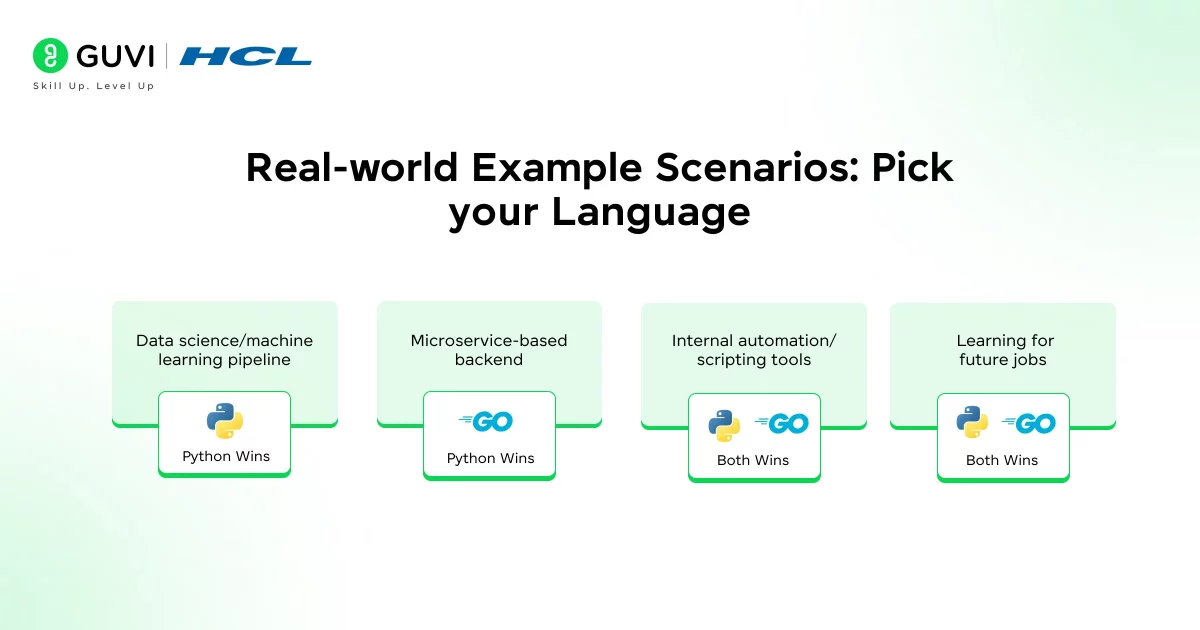
Scenario 1: Data science/machine learning pipeline
If you’re building a model, doing analytics, or working with large numeric libraries, Python is almost always the go-to. The Python ecosystem (NumPy, Pandas, scikit-learn, TensorFlow, PyTorch) is dominating. Go does have some libraries, but it is less mature in this space. So in this scenario, Python wins.
Scenario 2: Microservice-based backend with many requests per second
Imagine you have a service that must handle thousands of concurrent requests, manage resources efficiently, scale horizontally, and deployment should be simple. Here, Go’s performance and compile-to-binary deployment shine. Go would likely be the better pick.
Scenario 3: Internal automation/scripting tools
Suppose you’re automating tasks, writing CLI tools, gluing systems together. If your team already uses Python, you’ll value Python’s flexibility. But if you care about deployable binaries and minimal dependencies, then Go might appeal. Both are valid. Choose based on other factors (team skill, maintainability) more than “one is always better”.
Scenario 4: Learning for future jobs
If you’re early in your career and want to maximise opportunities, learning Python often gives you more immediate applicability (web dev, data science, scripting). Learning Go is a strong skill too, especially for backend/infrastructure roles, but demand is comparatively narrower.
If you want to learn more about Python through a structured course material, consider enrolling in HCL GUVI’s Free Self-Paced IITM Pravartak Certified Python Course that lets you start from scratch and gradually move towards the level where you can write programs to gather, clean, analyze, and visualize data.
How to Choose Between Golang and Python
Here’s a shortlist you can run through when deciding which language to pick:
- What’s your project domain?
– If you’re working in data science, scripting, quick dev → Python.
– If backend services, microservices, high-performance, concurrency → Go. - What’s your team/your skillset?
– If your team already knows Python, you’ll get faster results there.
– If you’re willing to invest in Go and the outcome justifies it (performance, maintenance), Go is worthwhile. - What are the performance/scale demands?
– High throughput, low latency, concurrency heavy → Go.
– Moderate performance, higher dev speed priority → Python. - What’s your ecosystem/library requirement?
– Do you need specialized libraries (ML, heavy analytics, etc.) → Python.
– Do you need stable, small deployable binaries, fewer dependencies → Go. - What’s your deployment & long-term maintenance strategy?
– Python is great for rapid iteration, but may incur more runtime issues.
– Go gives you compile-time guarantees, simpler binaries, and often a simpler ops path.
If you’re serious about sharpening your programming skills, whether that’s mastering Python, diving into Go, or exploring other in-demand languages, HCL GUVI’s Online Programming Courses is the perfect place to start. The courses are designed by industry experts, taught in regional languages, and focused on real-world projects that help you learn by doing, not just watching.
Conclusion
In conclusion, if you’re asking “Which should I learn or use: Golang or Python?”, the honest answer is: it depends. What you’re building, how you’re building it, who’s building it. If you’re just starting, Python might give you fewer roadblocks. If you’re designing a system that will eventually need to scale, perform, and handle concurrency, then Go is a strong contender.
Pick the language with your next project in mind, but don’t treat the decision as irreversible. You can know both. Many developers do. What matters more is understanding why you choose one over the other and being ready to revisit that choice if your needs evolve.
FAQs
1. Which is easier to learn, Python or Go?
Python is generally easier for beginners because it has a simple syntax, dynamic typing, and fewer rules. Go, while still approachable, uses static typing and stricter conventions, which might take a little more effort to get comfortable with.
2. Which language is faster in terms of execution: Go or Python?
Go usually runs significantly faster because it’s a compiled, statically-typed language built for performance and concurrency. Python is interpreted and dynamically typed, which can make it slower in CPU-intensive or highly concurrent scenarios.
3. In which scenarios should I pick Python over Go, and vice versa?
Choose Python if you’re doing rapid prototyping, automation, data science, or ML work where libraries matter more than raw speed. Choose Go if you’re building backend services, APIs, or infrastructure where performance, concurrency, and deployment simplicity are key.
4. Does the ecosystem differ much between the two languages?
Yes. Python boasts a huge, mature ecosystem across web development, data science, scripting, and more. Go’s ecosystem is smaller but very strong in cloud-native, microservices, and tooling domains. The right choice depends on what libraries and frameworks your project needs.
5. Can I use both Go and Python in my career or project stack?
Absolutely. Many teams use Python for data work or quick scripts and Go for performance-critical backend systems. Learning both gives you more flexibility and lets you pick the right tool for the job rather than feeling locked into one.
Success Stories

About the Author
Lukesh S
A professional content writer who has experience in freelancing and now working as a Technical Content Writer at GUVI. Google Certified Digital Marketer. Have a sound knowledge of SQL, Data Structures and Cloud Computing.
View all posts by Lukesh S
Connect with me @











Did you enjoy this article?