


Interview Articles
Technical Interview Questions Commonly Asked in Startups
Technical Interview vs HR Interview: 7 Key Differences
Advanced DNS Interview Questions for Senior Engineers: What to Expect in 2026
How to Handle a Technical Interview When the HR Interviewer Isn’t Technical


Get In Touch For Details! Request More Information
Exception Handling Interview Questions and Answers
Jan 19, 2026 7 Min Read 2299 Views
(Last Updated)
Have you ever seen a program crash at the worst possible moment, right when a user clicks “Submit”? Those moments remind us why exception handling is so important. Every software system faces unexpected events: missing files, network timeouts, invalid user input, or database outages. Without a structured approach to handle these issues, applications can break, frustrate users, and damage trust.
Exception handling is the safety net that keeps programs from falling apart when things go wrong. This guide covers Beginner, Intermediate, Advanced, and Scenario-Based interview questions to help you prepare thoroughly. All set to master exception handling and impress in your next interview? Read the full blog below and strengthen your preparation step by step.
Table of contents
- What is Exception Handling?
- Beginner-Level Exception Handling Interview Questions and Answers
- What is Exception Handling in Programming?
- What is the Difference Between an Error and an Exception?
- Why Do We Use Try and Except Blocks?
- What Happens If an Exception Is Not Handled?
- What Is a Finally Block and Why Is It Useful?
- What are the two main types of exceptions?
- Can You Have Multiple Except Blocks?
- What Is a Custom Exception?
- What Is the Role of Else Block in Exception Handling?
- What Are the Best Practices for Exception Handling?
- Intermediate-Level Exception Handling Interview Questions and Answers
- How Does Exception Propagation Work?
- Difference Between Throw, Throws, and Throwable in Java
- How Do You Decide Which Exceptions to Handle Locally vs Propagate Upwards?
- What Is Exception Chaining?
- Explain Try-With-Resources in Java?
- What Are Some Common Pitfalls in Exception Handling?
- How Do You Create a Custom Hierarchy of Exceptions?
- How Can You Handle Multiple Exceptions in a Single Block?
- Explain the Role of Exception Hierarchy in OOP
- Why Should We Avoid Catching Generic Exceptions?
- Advanced-Level Exception Handling Interview Questions and Answers
- How Do You Design a Global Exception Handler in Large Applications?
- What Are the Best Practices for Logging Exceptions in Production?
- How Do You Handle Exceptions in Asynchronous Code?
- Explain the Performance Impact of Using Exceptions?
- How Do You Map Exceptions to HTTP Status Codes in REST APIs?
- How Do You Handle Exceptions Across Microservices?
- What Is the Role of Circuit Breakers in Exception Handling?
- Explain the Use of Exception Wrapping in Large Codebases
- How Do You Test Exception Handling Logic?
- Why Is It Risky to Suppress Exceptions Silently?
- Scenario-Based and Practical Exception Handling Interview Questions and Answers
- How Would You Handle a Failed Database Connection Gracefully?
- You Have an API Call That Sometimes Times Out. How Do You Manage This?
- How Would You Handle Multiple Exceptions in a File Processing System?
- What Would You Do If Your Background Job Fails at Night?
- How Would You Roll Back a Transaction on Exception?
- How Do You Handle Exceptions in Multi-Threaded Programs?
- A User Uploads a Corrupted File. How Do You Respond?
- How Do You Manage Exceptions in a Payment Gateway Integration?
- You Need to Retry a Failed Operation Safely. How Do You Avoid Infinite Loops?
- How Do You Handle Exceptions in a Large Microservice System Without Losing Traceability?
- Conclusion
What is Exception Handling?
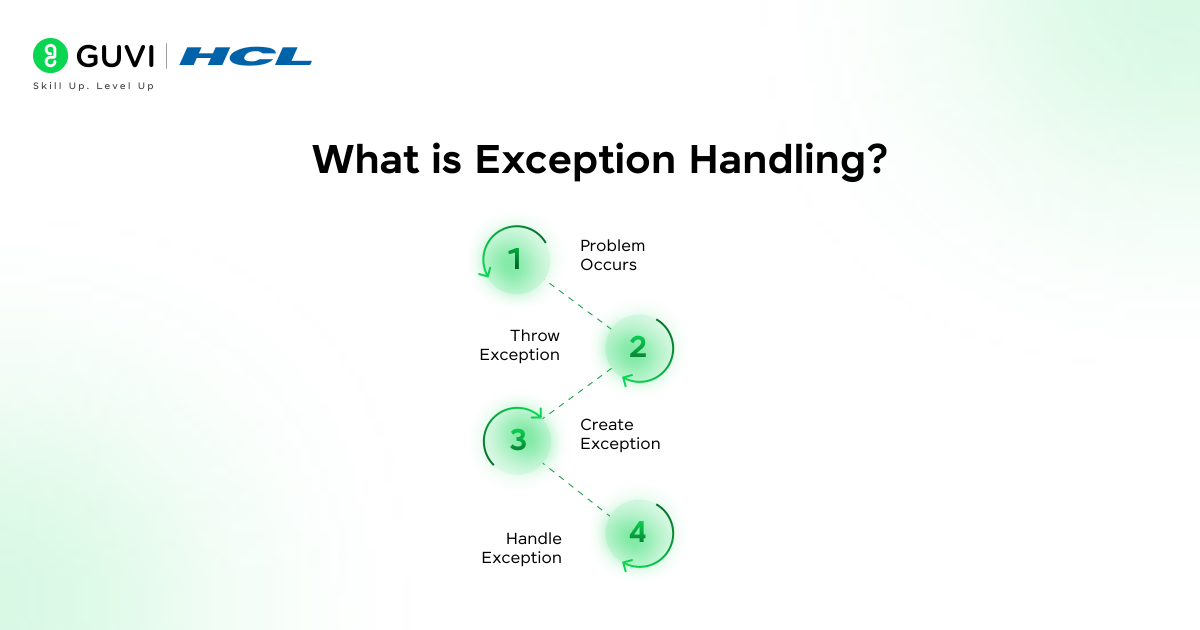
Exception handling is a structured way to manage errors that occur during program execution. It allows developers to catch problems, respond with meaningful actions, and prevent the program from stopping unexpectedly. The main goal is to separate normal logic from error-handling logic so that the code remains clear and organized.
Using constructs like try, catch, and finally blocks, a program can attempt risky operations, handle failures, and still release resources properly. This makes software more reliable and improves the overall user experience by showing helpful messages instead of crashing.
Beginner-Level Exception Handling Interview Questions and Answers
1. What is Exception Handling in Programming?
Exception handling is a way to respond to unexpected errors during program execution. It allows software developers to catch problems, show meaningful messages, and continue running the program safely. This approach prevents programs from stopping suddenly and helps create reliable software.
2. What is the Difference Between an Error and an Exception?
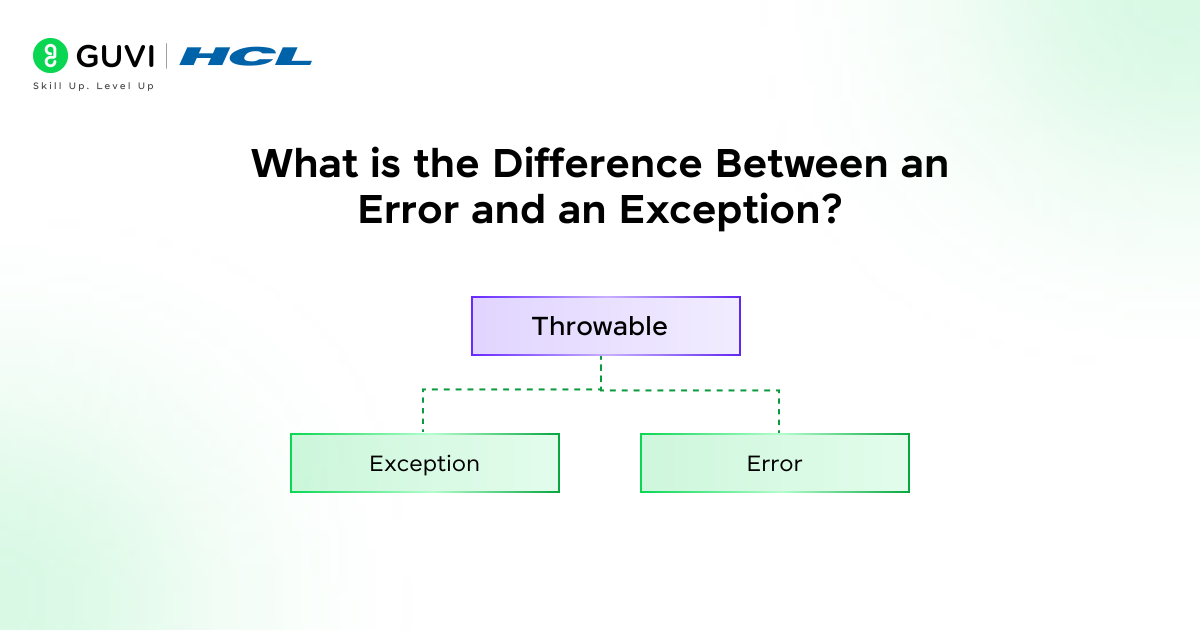
An error usually signals a problem outside the control of the program such as hardware failure or memory exhaustion. An exception signals a problem that can be handled, like trying to open a file that does not exist.
3. Why Do We Use Try and Except Blocks?
Try and except blocks help manage problems in code gracefully. The try block contains the code that might fail. The except block contains the code that runs if a problem occurs.
This process is helpful because:
- It avoids program crashes
- It allows custom messages
- It gives control over recovery actions
This combination leads to better user experience and easier debugging.
4. What Happens If an Exception Is Not Handled?
The program stops and shows a traceback message. This message contains the type of exception and where it occurred. Developers use this information to fix the problem.
5. What Is a Finally Block and Why Is It Useful?
A finally block runs whether or not an exception occurs. It is useful for closing files or releasing resources.
Example flow can be:
- Code runs in try
- If an error occurs except for running
- Finally runs after both
This creates a reliable way to clean up resources before the program moves forward.

6. What are the two main types of exceptions?
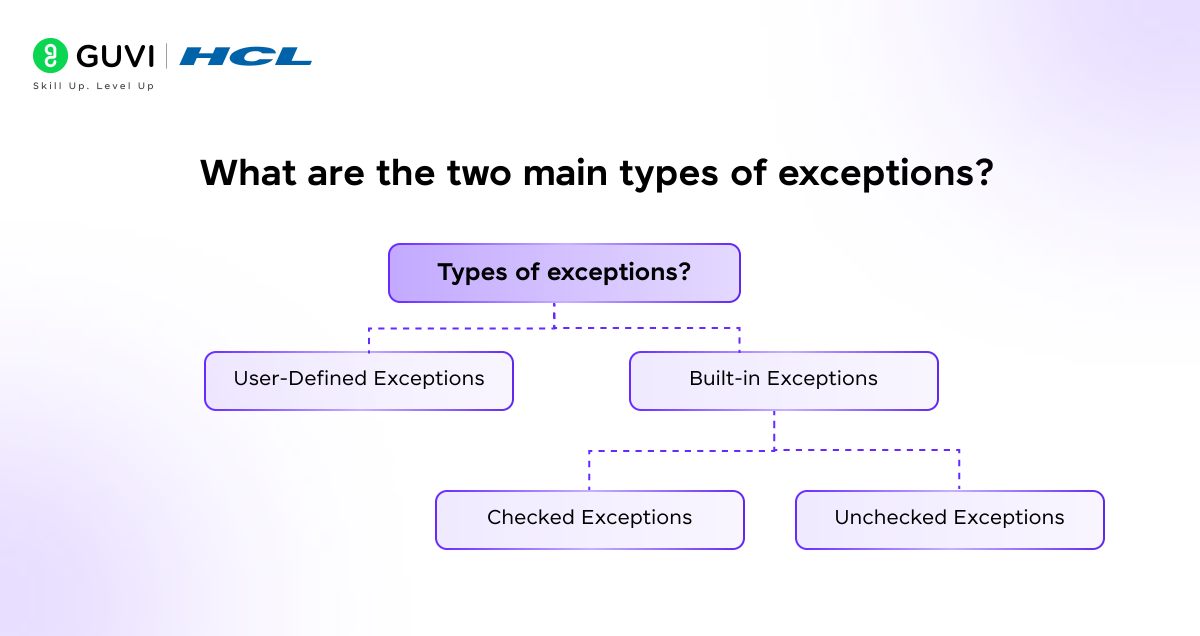
There are two main categories of exceptions:
- Built-in Exceptions: Provided by the programming language and include:
- Checked Exceptions such as IOException, SQLException, and ClassNotFoundException must be handled at compile time.
- Unchecked Exceptions such as NullPointerException, ArithmeticException, and ArrayIndexOutOfBoundsException occur at runtime.
- User-Defined Exceptions: Custom exceptions created by developers for specific needs to make error handling more descriptive.
This classification helps developers choose proper handling strategies so that programs remain stable and informative even when errors occur.
7. Can You Have Multiple Except Blocks?
Yes, you can have multiple except blocks for different exceptions. This approach is helpful if you want a different action for each type of problem.
Example:
try:
value = int(“abc”)
except ValueError:
print(“Value must be a number”)
except TypeError:
print(“Wrong type used”)
This makes your program more precise and easier to maintain.
8. What Is a Custom Exception?
A custom exception is one that a programmer creates to represent a specific situation.
Example steps to create one:
- Define a new class extending Exception
- Raise it where required
- Catch it with an except block
This helps make error messages more descriptive and improves program clarity.
9. What Is the Role of Else Block in Exception Handling?
The else block runs only if the try block does not raise an exception. It separates normal code from error handling.
This structure looks like:
try:
result = 10 / 2
except ZeroDivisionError:
print(“Cannot divide by zero”)
else:
print(“Division successful”)
This creates a clear flow and keeps code readable.
Also, Read: Mastering Exception Handling in Selenium
10. What Are the Best Practices for Exception Handling?
Some simple tips can help you write better code:
- Catch specific exceptions instead of using a generic one
- Write meaningful error messages
- Use finally to release resources
- Avoid hiding real errors
These practices lead to programs that are easier to maintain and less likely to fail silently.
Intermediate-Level Exception Handling Interview Questions and Answers
11. How Does Exception Propagation Work?
Exception propagation means an exception moves up the call stack until it is caught. If no function handles it, the program stops. This process allows higher-level functions to decide how to respond, which creates flexible control over error handling.
12. Difference Between Throw, Throws, and Throwable in Java
Throw is used to raise a single exception. Throws is used in a method signature to declare possible exceptions. Throwable is the parent class of all errors and exceptions.
| Keyword | Purpose | Example |
| throw | Raises an exception | throw new IOException() |
| throws | Declares an exception in the method signature | void read() throws IOException |
| Throwable | Parent class for exceptions and errors | catch (Throwable t) |
This distinction helps developers write clear and predictable exception handling code.
13. How Do You Decide Which Exceptions to Handle Locally vs Propagate Upwards?
Deciding where to handle an exception depends on how much context the current method has to deal with the problem. A method should handle an exception locally if it can recover or take a meaningful action, such as retrying a connection or using a fallback value. If the method cannot resolve the issue meaningfully, it is better to propagate the exception upwards to a caller that has more context.
A good strategy looks like this:
- Handle at the lowest level only when you can fix the problem
- Wrap and rethrow with additional context if higher layers need to know
- Log only once, either where handled or at the top level, to avoid duplicate logs
This approach keeps code clean and prevents suppressing important information that may be required for debugging.
14. What Is Exception Chaining?
Exception chaining allows attaching the original cause to a new exception. This helps track the root problem even after multiple layers of code handle it.
Example:
try:
open(“file.txt”)
except FileNotFoundError as e:
raise RuntimeError(“File operation failed”) from e
This approach is helpful during debugging because it shows the complete chain of causes.
15. Explain Try-With-Resources in Java?
Try-with-resources automatically closes resources such as files or database connections.
Steps to use it:
- Declare the resource inside the try parentheses
- Perform operations
- Resource closes automatically
This approach avoids resource leaks and reduces boilerplate code.
16. What Are Some Common Pitfalls in Exception Handling?
Some frequent mistakes include swallowing exceptions without logging and using generic catch blocks. Developers sometimes raise exceptions for normal control flow, which should be avoided.
Better approach:
- Log exceptions before ignoring them
- Catch specific exception types
- Use return values for normal conditions instead of raising exceptions
Following these rules leads to more reliable and understandable code.
Read: Mastering Error Handling and Logging in MERN Stack
17. How Do You Create a Custom Hierarchy of Exceptions?
Custom exception hierarchy allows grouping related problems.
Here is a simple flow:
- Create a base exception class
- Extend it for specific error types
- Catch the base class to handle all related errors
This design reduces repeated code and organizes handling logic in a structured way.
18. How Can You Handle Multiple Exceptions in a Single Block?
Languages like Python allow a single except block to handle multiple exceptions.
Example:
try:
result = int(“text”)
except (ValueError, TypeError):
print(“Invalid input or type”)
This approach reduces duplication and keeps code shorter.
19. Explain the Role of Exception Hierarchy in OOP
Exception hierarchy lets you handle groups of related errors using parent classes.
| Level | Example |
| Base Class | Exception |
| Subclass | IOError, ValueError |
| Custom | MyCustomError |
Catching the parent class allows handling all subclasses at once. This improves maintainability in large projects.
20. Why Should We Avoid Catching Generic Exceptions?
Catching a generic exception hides the real cause of the problem. It can make debugging hard and mask issues. Catch specific exceptions so that you know exactly what failed. This practice leads to better traceability and cleaner code.
Advanced-Level Exception Handling Interview Questions and Answers
21. How Do You Design a Global Exception Handler in Large Applications?
A global exception handler captures unhandled exceptions in one place and provides a uniform way to respond. In web frameworks, this often involves creating middleware or filters that wrap request execution. This approach keeps error handling consistent and prevents duplicate logic across modules.
22. What Are the Best Practices for Logging Exceptions in Production?
Logging should give a clear context without exposing sensitive data. Good practice includes:
- Log stack trace with relevant metadata
- Use error levels like INFO, WARN, ERROR
- Avoid logging sensitive user details
Proper logging helps in root cause analysis and reduces time spent diagnosing issues.
23. How Do You Handle Exceptions in Asynchronous Code?
Handling exceptions in asynchronous operations requires capturing errors from futures or callbacks.
Example in Python:
import asyncio
async def fetch_data():
raise ValueError(“Failed to fetch data”)
async def main():
try:
await fetch_data()
except ValueError as e:
print(f”Handled: {e}”)
asyncio.run(main())
This pattern ensures exceptions do not get lost and helps maintain stability in concurrent workflows.
24. Explain the Performance Impact of Using Exceptions?
Exceptions should be used for exceptional situations rather than control flow. Excessive exception handling can slow execution because raising and catching exceptions requires stack unwinding.
A better approach is to check conditions before attempting an operation if failure is expected frequently.
25. How Do You Map Exceptions to HTTP Status Codes in REST APIs?
Mapping exceptions to status codes helps communicate errors to clients clearly.
| Exception Type | Suggested Status Code |
| ValidationError | 400 Bad Request |
| UnauthorizedError | 401 Unauthorized |
| PermissionError | 403 Forbidden |
| ResourceNotFound | 404 Not Found |
| InternalServerError | 500 Internal Server Error |
This mapping creates predictable responses and simplifies error handling for API consumers.
26. How Do You Handle Exceptions Across Microservices?
In a microservice architecture, exceptions should be translated into meaningful error responses. Services communicate over APIs, so returning structured error objects with codes and messages helps client services decide the next action.
Example of good practice:
- Standardize error format (JSON with code, message)
- Include correlation ID for tracing
- Avoid exposing the internal stack trace to clients
This keeps services decoupled but still allows debugging across systems.
27. What Is the Role of Circuit Breakers in Exception Handling?
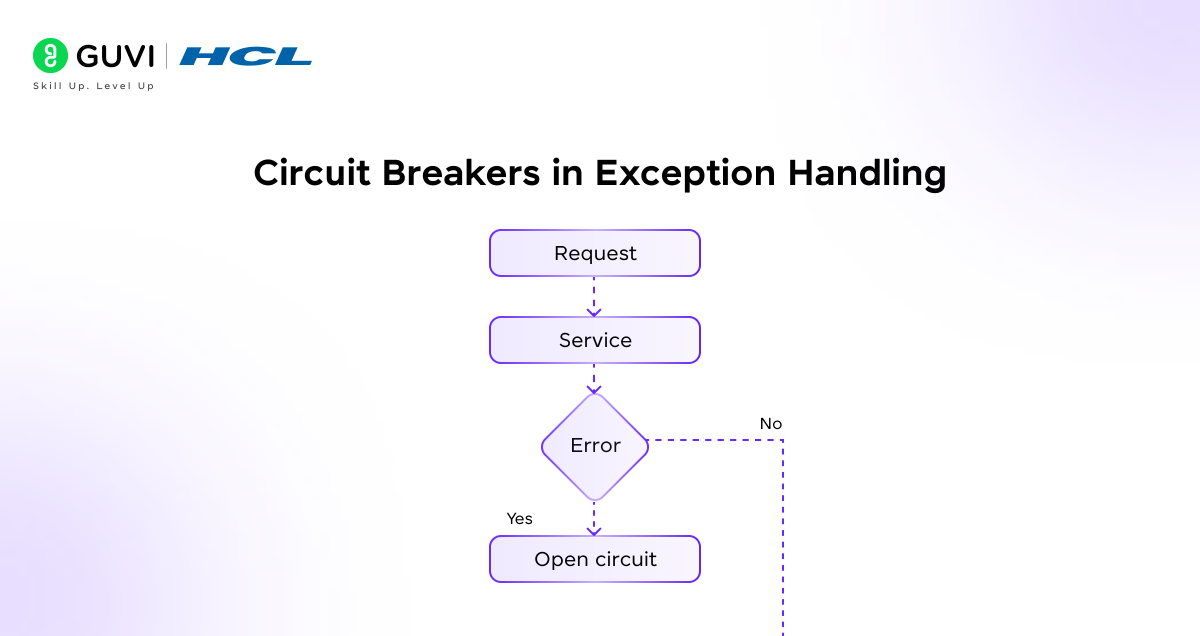
Circuit breakers stop requests from being sent to a failing service after repeated failures. They catch exceptions like timeouts and open the breaker to prevent system overload. This protects the overall system and allows time for recovery before requests are retried.
28. Explain the Use of Exception Wrapping in Large Codebases
Exception wrapping means catching a low-level exception and throwing a higher-level exception with additional context.
Example in Java:
try {
readFile();
} catch (IOException e) {
throw new DataLoadException(“Unable to load data”, e);
}
This approach preserves the original cause but adds domain-specific meaning, which helps other parts of the system respond correctly.
29. How Do You Test Exception Handling Logic?
Testing exception handling means verifying that errors are caught and that correct actions are taken.
Best approach involves:
- Using unit tests with mock objects to trigger failures
- Verifying correct logging or rethrowing
- Asserting that the recovery code runs properly
| Test Aspect | Purpose |
| Mock Failures | Trigger exceptions predictably |
| Verify Logs | Confirm errors are recorded |
| Assert Outcomes | Ensure fallback logic works |
Strong testing ensures reliability before code goes to production.
30. Why Is It Risky to Suppress Exceptions Silently?
Suppressing exceptions hides failures and makes debugging very hard. Code may appear to work, but leave data in an inconsistent state. The better practice is to log exceptions or rethrow them after adding context. This helps future developers understand what happened and take corrective action.
Scenario-Based and Practical Exception Handling Interview Questions and Answers
31. How Would You Handle a Failed Database Connection Gracefully?
A failed database connection should not crash the whole system. A good approach is to catch the exception, log it, and show a user-friendly message.
Example flow:
- Try to establish a connection
- On failure, log the error with a timestamp
- Show a message like “Service temporarily unavailable”
This approach avoids exposing database details to users and maintains security.
32. You Have an API Call That Sometimes Times Out. How Do You Manage This?
Retries with exponential backoff are a practical solution. You can wrap the API call in a try block and catch timeout exceptions. Then wait and retry a few times before failing. This reduces load spikes and gives the service a chance to recover.
33. How Would You Handle Multiple Exceptions in a File Processing System?
A file processor might face missing files and data format issues. A robust approach could be:
- Catch file-not-found separately and log it
- Catch format issues and mark the file for manual review
- Continue processing other files so the system does not stop
This ensures large batches are still completed even when some files are bad.
34. What Would You Do If Your Background Job Fails at Night?
In production, you need automatic alerts. Set up exception handling that sends an email or pushes a log to monitoring tools when a job fails.
Steps to follow:
- Catch exception in job runner
- Log details with stack trace
- Notify via email or an alerting tool
This gives the team quick visibility before users notice.
35. How Would You Roll Back a Transaction on Exception?
Transactions must stay consistent. Wrap operations in a transaction block and use try-except-finally:
try:
connection.begin()
update_database()
connection.commit()
except Exception as e:
connection.rollback()
log_error(e)
This pattern guarantees that partial updates do not leave data corrupted.
36. How Do You Handle Exceptions in Multi-Threaded Programs?
Each thread should catch its own exceptions and report them to a central error handler. Otherwise, silent thread failures may occur.
Example solution:
- Wrap thread logic in try-except
- Push errors into a shared queue
- Main thread monitors the queue and logs them
This creates visibility across parallel tasks.
37. A User Uploads a Corrupted File. How Do You Respond?
The system should validate the file format before processing. If corruption is detected:
- Catch parsing error
- Log file name and user ID
- Show a clear message like “Upload failed due to invalid format”
This helps users correct the issue and avoids unnecessary processing overhead.
38. How Do You Manage Exceptions in a Payment Gateway Integration?
Payment failures can lead to customer frustration if not handled well.
Suggested approach:
- Catch timeout or declined payment exceptions
- Store failure event with order reference
- Show a message asking the user to retry
- Do not charge the card again unless explicitly retried
This keeps financial operations safe and transparent.
39. You Need to Retry a Failed Operation Safely. How Do You Avoid Infinite Loops?
Implement a retry counter. Each attempt increments the counter until a maximum is reached. After that, log the failure and stop retrying.
This prevents resource waste and avoids flooding external systems.
40. How Do You Handle Exceptions in a Large Microservice System Without Losing Traceability?
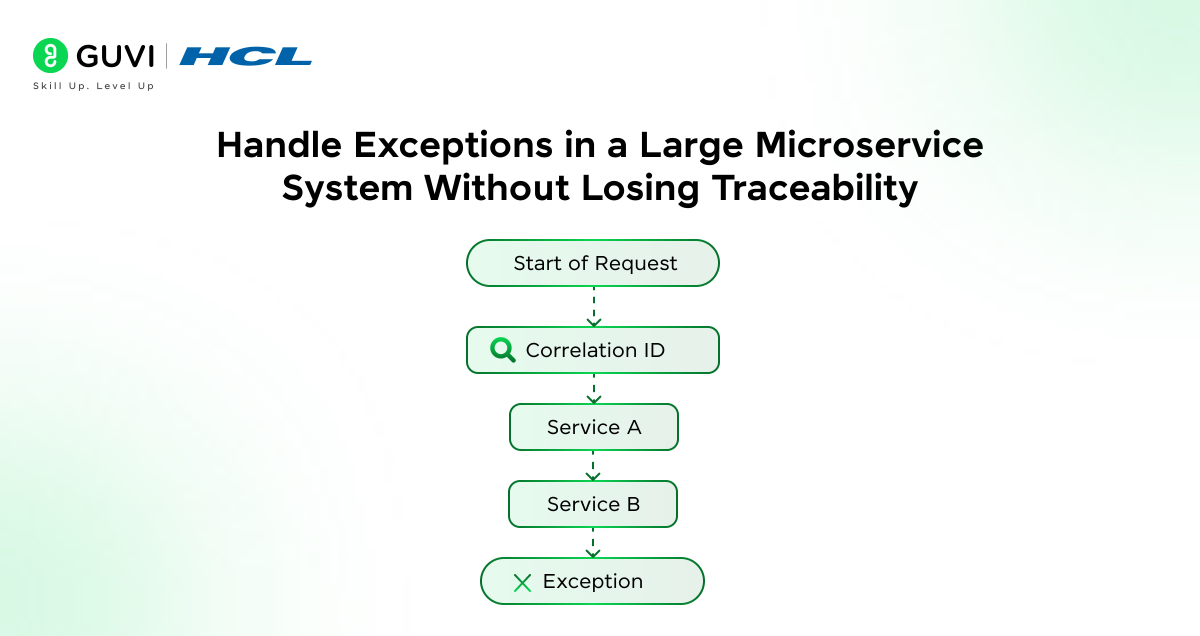
Use correlation IDs. Generate an ID at request start and pass it through all services. Log every exception with that ID. This creates a complete trace across services and makes debugging distributed errors possible.
Sharpen your software skills with hands-on mastery of exception handling and more in our AI Software Development Course. Learn best practices, error handling strategies, and real-world project experience, all designed to help you code with confidence.
Conclusion
Exception handling is a solid way to keep software stable and reliable under unexpected conditions. Learning to handle errors properly helps build applications that recover gracefully, give clear feedback, and protect data integrity.
You have now explored beginner, intermediate, advanced, and real-world scenario-based questions. These examples show how exceptions work at every level, from simple try-catch blocks to global handlers and microservice communication. The key is to stay clear, catch only what you can meaningfully address, and keep logs detailed enough for debugging. This mindset not merely improves code quality but also creates better experiences for users.
Success Stories

About the Author
Vaishali
I'm a seasoned writer with four years of experience across technical, non-technical, and just about every genre or niche you can imagine. Adaptable and curious, I enjoy exploring new topics and making information engaging and easy to understand. Fueled by a steady stream of tea, I approach each project with creativity, reliability, and genuine enthusiasm for storytelling.
View all posts by Vaishali
Connect with me @














Did you enjoy this article?