


Product Management Articles
How to Build a Product for Multiple Customer Segmentation? (Best 2026 Guide)
Product Market Fit: How to Know You’ve Found It - Best Guide
What is Product Analytics? Best & Ultimate Beginner's Guide to Understanding User Behavior
What is Product Adoption? Best Guide to Product Adoption: Meaning, Lifecycle & Metrics


Get In Touch For Details! Request More Information
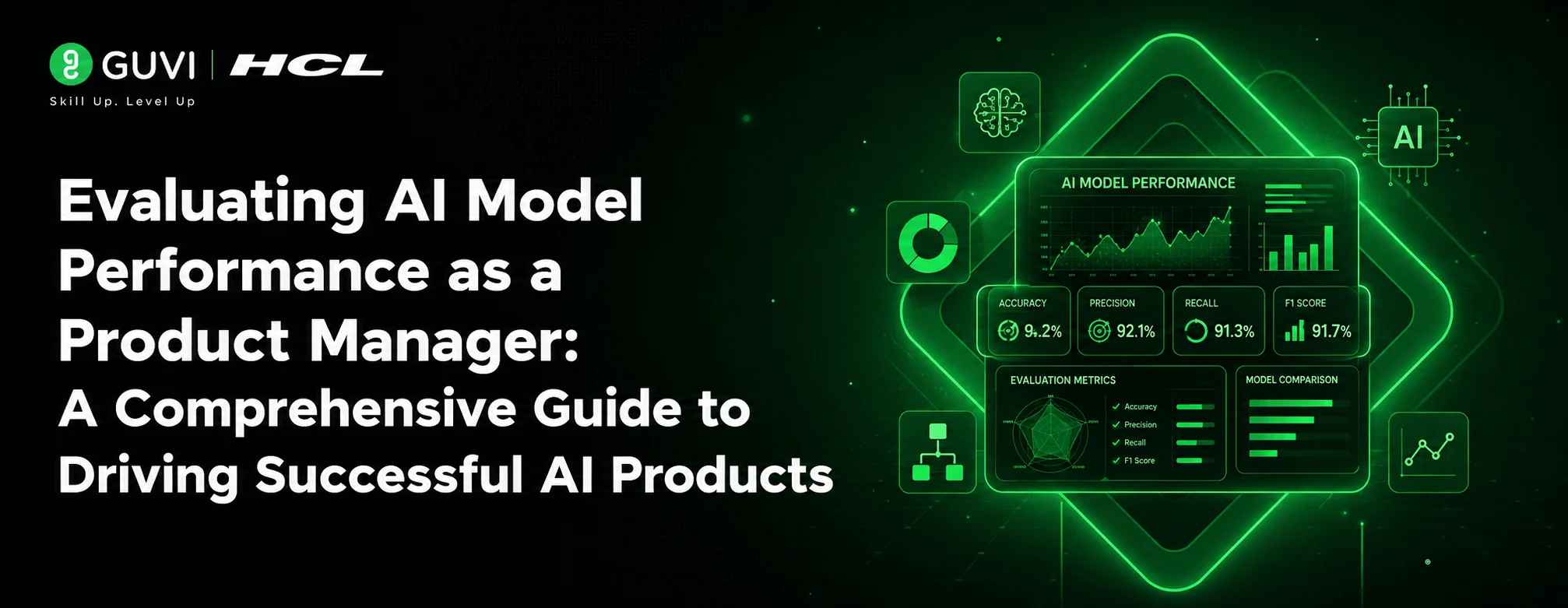
Evaluating AI Model Performance as a Product Manager: A Comprehensive Guide to Driving Successful AI Products
Aug 07, 2026 7 Min Read 36 Views
(Last Updated)
Table of contents
- TL;DR
- Introduction
- Understanding AI Model Performance: Beyond Accuracy
- What Defines AI Model Performance?
- Why AI Model Performance Matters for Product Managers
- Product Manager Mindset Framework
- Key AI Evaluation Metrics Every Product Manager Should Master
- AI Model Performance: Which Metric Should You Use?
- Understanding Classification Metrics of AI Model Performance
- What is Precision?
- Business Meaning
- Product Manager Insight
- Business Meaning
- What is F1 Score?
- Decision Box
- Beyond Binary Classification
- Understanding the Confusion Matrix
- ROC Curve and AUC
- Comparison Table: Classification Metrics
- Understanding Regression Metrics of AI Model Performance
- Example
- Best For
- Example
- Beyond Traditional Metrics
- Aligning Metrics with Business Objectives for AI Model Performance
- From Technical Metrics to Business Value
- Strategic Metric Selection Process
- Real-World Example of AI Model Performance
- Spotify's Discover Weekly Product Challenge
- Common Mistakes to Avoid When Evaluating AI Model Performance
- Overemphasizing Single Metrics
- Ignoring Data Quality Issues
- Neglecting Model Drift Monitoring
- Disregarding Ethical Considerations
- Ready to Master AI Product Management?
- Wrapping Up
- Frequently Asked Questions
- How do I know which evaluation metrics are most important for my AI product?
- What's the difference between ML model performance and AI product performance?
- How often should AI model performance be evaluated?
- Can non-technical product managers effectively evaluate AI models?
- What role does A/B testing play in AI model evaluation?
- How do I communicate AI model performance to non-technical stakeholders?
TL;DR
- As a product manager evaluating AI model performance, focus on translating technical metrics into business outcomes rather than getting lost in accuracy percentages alone
- Master essential evaluation metrics like precision and recall that directly impact your specific AI application’s success.
- Avoid common pitfalls by implementing comprehensive monitoring systems that track model drift and maintain data quality throughout the pipeline; align your evaluation approach with industry-specific requirements, whether in healthcare, financial services, or retail, to ensure compliance while maximizing business impact.
- Build collaborative relationships with data science teams through shared vocabularies that translate technical possibilities into business realities for sustainable competitive advantages.
Introduction
The rapid integration of artificial intelligence into virtually every industry has fundamentally transformed the role of product managers.
As organizations invest billions in AI initiatives, with global AI intelligence market revenues projected to exceed $539.5 billion by 2026, product managers who can effectively evaluate AI model performance are becoming invaluable assets.
Yet despite the critical importance of this skill, many product managers struggle with bridging the gap between technical evaluation metrics and business value creation.
This comprehensive guide addresses that gap by providing product managers with the frameworks, vocabulary, and practical knowledge needed to evaluate AI model performance effectively.
Understanding AI Model Performance: Beyond Accuracy
What Defines AI Model Performance?
AI model performance refers to how effectively an artificial intelligence model solves the intended business problem using measurable evaluation metrics such as accuracy, precision, recall, F1 score, ROC-AUC, MAE, RMSE, and business KPIs.
For Product Managers, AI model performance isn’t just about technical accuracy; it’s about whether the model creates real value for users and the business.
Want to understand how AI models are built before learning how they’re evaluated?
Explore our beginner-friendly guide to Machine Learning, where you’ll learn supervised learning, unsupervised learning, and how AI models make predictions.
Why AI Model Performance Matters for Product Managers
Artificial Intelligence is transforming nearly every industry from healthcare and finance to e-commerce, manufacturing, education, and customer support. As AI becomes a core part of digital products, Product Managers are increasingly responsible for making decisions about AI capabilities, performance, and customer impact.
Unlike traditional software, AI systems don’t produce perfectly deterministic outputs. Instead, they generate predictions with varying levels of confidence. This means
Product Managers must learn to evaluate uncertainty, balance trade-offs, and decide whether an AI model is “good enough” for a particular business problem.
For example:
- A fraud detection system should prioritize catching fraudulent transactions, even if it occasionally flags legitimate ones.
- A recommendation engine should maximize relevance without limiting content diversity.
- A healthcare model must minimize missed diagnoses, where the cost of a false negative can be extremely high.
These examples show that different AI products require different evaluation strategies.
More than 80% of enterprise AI projects fail to deliver expected business value, often due to poor problem definition, weak data quality, or selecting the wrong success metrics, not because of inadequate machine learning algorithms.
Product takeaway: A Product Manager’s role is to ensure AI performance is measured against business outcomes, not just technical benchmarks.
Product Manager Mindset Framework
Before reviewing any AI evaluation dashboard, ask yourself these five questions:
- What business problem is this model solving?
- Which user outcome matters most?
- Which mistake is more expensive: false positives or false negatives?
- How will this metric affect customer experience?
- Does improving this metric improve business value?
Great Product Managers don’t optimize AI for perfect scores; they optimize it for meaningful outcomes.

Key AI Evaluation Metrics Every Product Manager Should Master
Once you understand that accuracy alone isn’t enough, the next step is learning the evaluation metrics that truly determine whether an AI model delivers business value.
Every metric answers a different question.
For example:
- Is the model making correct predictions?
- Is it missing important cases?
- Is it making too many false alarms?
- Can it generalize to real-world scenarios?
- Does improving this metric improve customer experience?
As a Product Manager, you don’t need to calculate these metrics manually, but you must know when each one matters and how it affects product decisions.
AI Model Performance: Which Metric Should You Use?
| Business Scenario | Recommended Metric | Why? |
| Detecting fraud | Recall | Missing fraud is expensive |
| Spam detection | Precision | Avoid blocking genuine emails |
| Medical diagnosis | Recall and F1 Score | False negatives can be life-threatening |
| Product recommendations | Precision | Recommend relevant products |
| Sales forecasting | MAE / RMSE | Measure prediction errors accurately |
| Customer churn | ROC-AUC | Compare different prediction thresholds |
| Credit approval | Precision and Recall | Balance business risk and fairness |
Rule of Thumb: Choose the metric that reflects the cost of making the wrong prediction, not just the number of correct predictions.
Understanding Classification Metrics of AI Model Performance
Most AI products perform classification, in which the model predicts a category rather than a numerical value.
Examples include:
- Spam or Not Spam
- Fraud or Legitimate Transaction
- Customer Will Churn or Stay
- Loan Approved or Rejected
- Disease Present or Absent
For these problems, Product Managers should understand four foundational metrics.
- Precision
What is Precision?
Precision measures:
“Out of all the positive predictions the AI made, how many were actually correct?”
Formula:
Precision = True Positives ÷ (True Positives + False Positives)
Business Meaning
A high precision score means the model rarely raises false alarms.
This is important when false positives create unnecessary costs or poor user experiences.
Example
Imagine an email spam filter.
The AI marks 100 emails as spam.
- 95 actually are spam.
- 5 are important business emails.
Precision = 95%
This means users rarely lose important emails.
Best Use Cases
- Spam detection
- Content moderation
- Fake review detection
- Credit card fraud alerts
- Security monitoring
Product Manager Insight
If your users complain,
“The AI keeps flagging things that are actually fine,”
you’re probably dealing with a low precision problem.
- Recall
What is Recall?
Recall measures:
“Out of all the actual positive cases, how many did the AI successfully identify?”
Formula
Recall = True Positives ÷ (True Positives + False Negatives)
Business Meaning
Recall tells you how well the AI finds everything important.
Missing important cases can sometimes be far more damaging than raising false alarms.
Example
Suppose a fraud detection system has 1,000 fraudulent transactions.
The AI detects only 900.
Recall = 90%
The remaining 100 fraudulent transactions could result in major financial losses.
Best Use Cases
- Fraud detection
- Cancer diagnosis
- Intrusion detection
- Cybersecurity
- Risk prediction
Real-World Example
- Netflix can recommend one extra movie that users ignore without much impact.
- A hospital AI missing a cancer diagnosis, however, could have life-changing consequences. That’s why healthcare models prioritize high recall.
- F1 Score
What is F1 Score?
F1 Score balances Precision and Recall into one metric.
Instead of favoring one over the other, it measures how well both work together.
Formula
F1 = Harmonic Mean of Precision and Recall
Although the formula is mathematical, the key takeaway for Product Managers is simple:
A high F1 Score means the AI is both accurate when making positive predictions and effective at finding important cases.
When Should Product Managers Focus on F1 Score?
Use F1 Score when:
- False positives matter
- False negatives matter
- You need balanced performance
- The dataset is imbalanced
Example
Customer support ticket classification
A model should:
- Correctly categorize tickets
- Avoid sending tickets to the wrong team
- Ensure urgent tickets aren’t missed
Here, F1 Score provides a better picture than accuracy alone.
Decision Box
| If Your Goal Is… | Prioritize |
| Reduce false alarms | Precision |
| Catch everything important | Recall |
| Balance both | F1 Score |
Beyond Binary Classification
Real-world AI rarely predicts only two classes.
Instead, models often classify among many categories, such as:
- Customer intent
- Product category
- Document type
- Support ticket priority
- News topic
- Language detection
In these cases, Product Managers should also review:
- Confusion Matrix
- Macro F1
- Weighted F1
- Per-class Accuracy
Instead of relying on overall accuracy.
Understanding the Confusion Matrix
The Confusion Matrix is one of the most useful diagnostic tools for understanding why an AI model succeeds or fails. Rather than giving a single score, it shows exactly where predictions are correct and where mistakes occur.
It divides predictions into four outcomes:
| Prediction | Reality | Meaning |
| True Positive | Positive | Correct detection |
| True Negative | Negative | Correct rejection |
| False Positive | Negative | False alarm |
| False Negative | Positive | Missed detection |
Why Product Managers Should Care?
A Confusion Matrix helps answer questions like:
- Is the AI rejecting too many legitimate users?
- Is fraud slipping through?
- Is the chatbot misunderstanding customer requests?
- Which prediction errors are affecting customer experience the most?
Product Manager Insight: Most business decisions are made after reviewing the Confusion Matrix, not just the overall accuracy score.
ROC Curve and AUC
Sometimes Product Managers need to compare multiple AI models. This is where ROC Curve and AUC (Area Under the Curve) become valuable.
Rather than measuring accuracy at a single threshold, ROC evaluates model performance across many decision thresholds.
Interpretation
| AUC Score | Meaning |
| 0.50 | Random guessing |
| 0.70–0.80 | Fair |
| 0.80–0.90 | Good |
| Above 0.90 | Excellent |
However, A higher AUC doesn’t automatically mean a better product. Business context still determines which model performs best.
Comparison Table: Classification Metrics
| Metric | Measures | Best For | Limitation |
| Accuracy | Overall correctness | Balanced datasets | Misleading on imbalanced data |
| Precision | Correct positive predictions | Spam, moderation | May miss important positives |
| Recall | Positive cases detected | Healthcare, fraud | May increase false alarms |
| F1 Score | Balance of precision & recall | Most real-world AI | Doesn’t explain business cost |
| ROC-AUC | Overall ranking quality | Model comparison | Doesn’t define operating threshold |
Understanding Regression Metrics of AI Model Performance
Not all AI systems classify information. Many predict continuous numerical values instead.
Examples include:
- House prices
- Delivery time
- Revenue forecasting
- Sales prediction
- Inventory demand
- Electricity consumption
These problems require Regression Metrics.
- Mean Absolute Error (MAE)
MAE measures the average difference between predictions and actual values.
Unlike many statistical metrics, MAE is easy for Product Managers to interpret because it’s expressed in the same units as the prediction.
Example
Suppose an AI predicts apartment prices.
Actual price: ₹50,00,000
Prediction: ₹48,50,000
Error: ₹1,50,000
If the average error across all predictions is ₹1.5 lakh,
MAE = ₹1.5 lakh
Best For
- Sales forecasting
- Demand prediction
- Revenue estimation
- Delivery time prediction
- Mean Squared Error (MSE)
MSE also measures prediction error but gives greater importance to big mistakes by squaring each error before averaging.
This makes it especially useful when major prediction errors have significant business consequences.
Example
A pricing model that occasionally underestimates product prices by ₹10 lakh can have a much larger financial impact than several smaller errors.
MSE highlights these high-impact mistakes, helping teams prioritize reducing extreme prediction errors.
- Root Mean Squared Error (RMSE)
RMSE is the square root of MSE. The advantage? It converts the error back into the original unit, making it easier for Product Managers and business stakeholders to interpret.
Many organizations prefer RMSE because it balances mathematical rigor with practical readability.
- R² (R-Squared)
R² measures how much of the variation in the data the model can explain.
An R² score of 0.80 means the model explains 80% of the variability in the target outcome.
However, A high R² doesn’t always mean a model is useful in production. A model can fit historical data well while performing poorly on new, unseen data.
That’s why Product Managers should combine R² with validation metrics, business KPIs, and real-world testing before making deployment decisions.
Regression models rely heavily on clean, high-quality data.
If you’re planning a career in AI Product Management, understanding data analysis will help you interpret model performance with confidence.
Beyond Traditional Metrics
- Business Impact Metrics
Revenue generated, user retention rates, or operational efficiency improvements directly tied to model performance.
- User Experience Metrics
User satisfaction scores, task completion times, or engagement rates that reflect how well the AI enhances the user journey.
- Fairness and Bias Metrics
Measures to ensure equitable performance across different demographic groups or user segments.
Aligning Metrics with Business Objectives for AI Model Performance
From Technical Metrics to Business Value
The most technically impressive model isn’t necessarily the best choice for your product. Successful product managers translate technical performance into business outcomes that stakeholders can understand and act upon.
| Business Goal | Relevant ML Metrics | Business Translation |
| Reduce Customer Support Costs | Chatbot resolution accuracy, user satisfaction | Percentage reduction in tickets reaching human agents |
| Increase Sales Conversion | Recommendation click-through rate, precision | Revenue increase from AI-driven recommendations |
| Improve User Safety | Fraud detection recall, false positive rate | Financial losses prevented vs. legitimate transactions blocked |
Strategic Metric Selection Process
- Define Success Criteria: What business outcome indicates a successful AI implementation?
- Map to User Journeys: Where does the AI interact with users, and what metrics capture that experience?
- Balance Trade-offs: Which errors are more costly: false positives or false negatives?
- Consider Long-term Impact: How might optimizing for one metric affect others?
- Establish Baselines: What performance level represents a meaningful improvement over existing solutions?
Netflix’s recommendation algorithm drives over 80% of viewer engagement. However, they don’t solely optimize for clicks; they also measure how well recommendations match users’ long-term interests to prevent “rabbit hole” effects that might reduce overall satisfaction.
Real-World Example of AI Model Performance
Spotify’s Discover Weekly Product Challenge
Spotify’s Discover Weekly playlist is a prime example of balancing multiple AI evaluation metrics to create product value. Their recommendation system doesn’t optimize for a single metric but instead balances several:
- Engagement Rate: Percentage of recommended songs played
- Discovery Rate: Percentage of new artists discovered
- User Retention: Long-term listening behavior correlation
- Diversity Score: Variety in genres and artists recommended
By combining these metrics, Spotify ensures its AI delivers immediate user satisfaction while promoting long-term platform engagement and artist discovery, an approach that contributed to over 500 million monthly active users globally.
Product Manager Takeaway:
Multi-metric evaluation frameworks prevent optimizing for vanity metrics that don’t translate to real business value. Always consider how technical improvements connect to user behavior and business outcomes.
Wondering where AI Product Managers are most in demand? Explore the fastest-growing AI careers, required skills, salaries, and hiring trends.
Common Mistakes to Avoid When Evaluating AI Model Performance
1. Overemphasizing Single Metrics
Relying exclusively on accuracy or another single metric can lead to models that perform well statistically but poorly in practice.
For example, a medical diagnosis model with 95% accuracy might still miss critical cases if the dataset is imbalanced.
2. Ignoring Data Quality Issues
Even the best evaluation approach can’t compensate for poor training data.
Work closely with your data science team to understand data limitations and how they might impact model reliability in production environments.
3. Neglecting Model Drift Monitoring
Models degrade over time as user behavior and environmental conditions change.
Establish continuous monitoring protocols and define clear thresholds for when models require retraining or replacement.
4. Disregarding Ethical Considerations
AI model performance shouldn’t come at the expense of fairness or user privacy.
Incorporate bias detection and privacy-preserving techniques into your evaluation framework from the beginning.
Ready to Master AI Product Management?
Advance your career with HCL GUVI’s comprehensive Product Management Course, designed specifically for professionals working with AI and technology products. Gain hands-on experience with real AI projects and learn industry best practices from experts.
Wrapping Up
Evaluating AI model performance as a product manager requires balancing technical understanding with business acumen. By focusing on metrics that align with user value and business objectives rather than purely technical benchmarks, you can ensure your AI products deliver meaningful impact.
Remember that effective evaluation is an ongoing process, not a one-time activity. Continuously monitor performance, gather user feedback, and iterate on both your models and evaluation approaches to maintain competitive advantage in the rapidly evolving AI landscape.
The most successful AI product managers develop a collaborative relationship with their data science teams, combining technical insights with market understanding to make informed decisions that drive product success.
Frequently Asked Questions
1. How do I know which evaluation metrics are most important for my AI product?
Start by identifying your core business objectives and mapping them to user outcomes. Work with your data science team to determine which technical metrics best correlate with these business outcomes, and prioritize those that directly impact user experience.
2. What’s the difference between ML model performance and AI product performance?
ML model performance focuses on technical accuracy and efficiency metrics, while AI product performance encompasses the broader impact on user experience, business outcomes, and system reliability. A technically excellent model might still result in a poor product if it doesn’t solve user problems effectively.
3. How often should AI model performance be evaluated?
Continuous monitoring is ideal, with automated alerts for significant performance drops. Formal evaluations should occur whenever new data is introduced, after major product updates, and at regular intervals (typically quarterly) to ensure models remain aligned with evolving business needs.
4. Can non-technical product managers effectively evaluate AI models?
Absolutely. Focus on understanding what the metrics mean for your users and business rather than the mathematical calculations behind them. Collaborate closely with your technical team to translate technical findings into business insights.
5. What role does A/B testing play in AI model evaluation?
A/B testing is crucial for validating that improved model performance translates to better user experiences and business outcomes. It provides empirical evidence that technical improvements actually benefit your product in real-world conditions.
6. How do I communicate AI model performance to non-technical stakeholders?
Translate technical metrics into business terms using concrete examples and analogies. Focus on outcomes rather than methods, and always connect performance improvements to tangible business benefits like increased revenue, reduced costs, or enhanced user satisfaction.
Success Stories

About the Author
Hashmithaa
Hi, I’m Hashmithaa — a content writer with a love for words. Writing isn’t just what I do; it’s how I connect, communicate, and create meaning in a noisy digital world. And if my words help someone make a better decision, learn something new, or feel more confident, then I’ve done my job well.
View all posts by Hashmithaa
Connect with me @














Did you enjoy this article?