


Electric Vehicle Articles
What is Vehicle-to-Grid Technology : How EVs Can Power the Grid
What is a Battery Management System? BMS Working, Uses & EV Role
EV Battery Manufacturing Process Explained
Basics of Electric Vehicle Simulations Using ANSYS (2026 Guide)

Get In Touch For Details! Request More Information
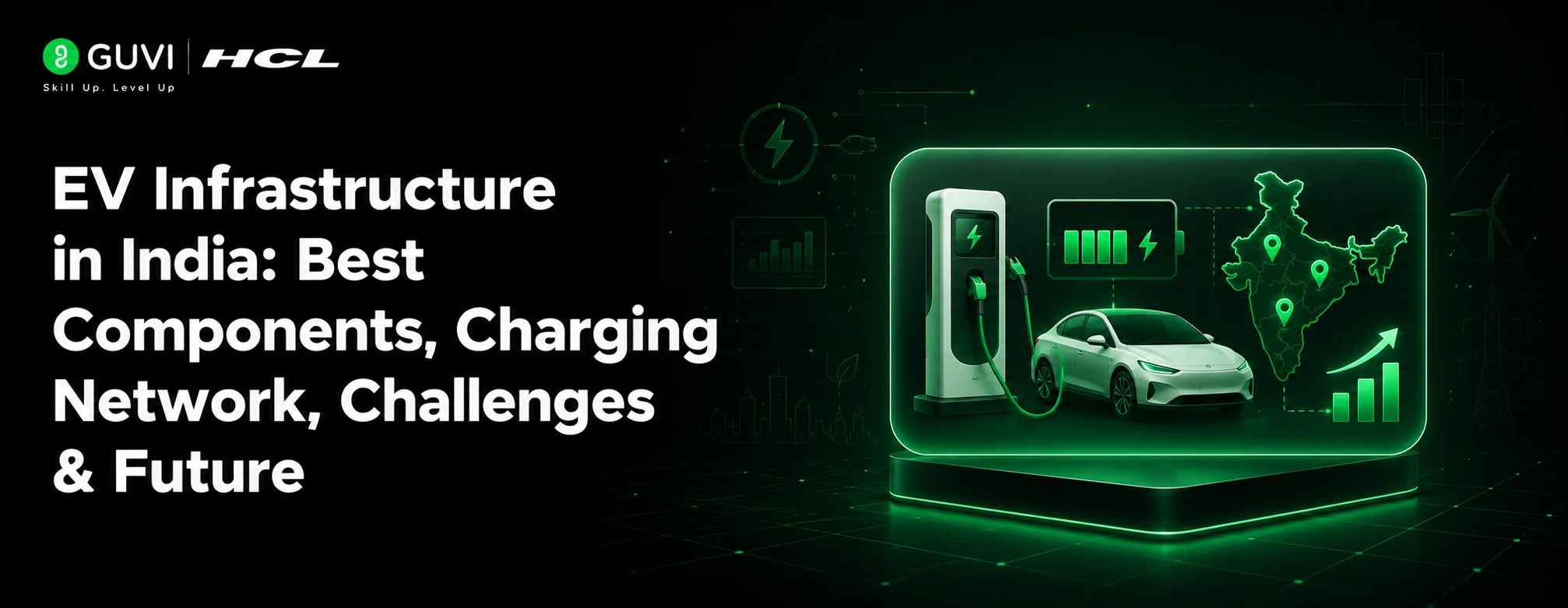
EV Infrastructure in India: Best Components, Charging Network, Challenges & Future (2026 Guide)
Jul 22, 2026 8 Min Read 465 Views
(Last Updated)
TL;DR:
- EV Infrastructure in India refers to the complete ecosystem of charging stations, power grids, battery swapping networks, software platforms, policies, and supporting technologies that enable electric vehicles to operate efficiently.
- India is rapidly expanding its EV charging infrastructure through government initiatives, private investments, and collaborations between automakers, energy companies, and startups.
- While challenges such as uneven charger distribution and grid readiness remain, the country’s EV ecosystem is expected to witness significant growth over the next decade, creating opportunities for engineers, entrepreneurs, and technology professionals.
Table of contents
- Introduction
- What is EV Infrastructure in India?
- Why is EV Infrastructure Important?
- Components of EV Infrastructure
- EV Charging Infrastructure
- Power Grid Infrastructure
- Battery Manufacturing Ecosystem
- Renewable Energy Integration
- Digital Infrastructure for EVs
- Government Initiatives Accelerating EV Infrastructure in India
- FAME India Scheme
- PM E-Drive Scheme
- State EV Policies
- Public vs Private Electric Vehicle Charging Stations
- How Does EV Infrastructure Work in India?
- Step 1: Electricity Distribution
- Step 2: Charging Station Management
- Step 3: Vehicle Authentication
- Step 4: Energy Delivery
- Step 5: Digital Monitoring
- The Current State of EV Infrastructure in India (2026)
- EV Infrastructure at a Glance
- Charger-to-EV Ratio: Why It Matters
- Types of EV Charging Infrastructure in India
- AC and DC Charger Categories
- Major Players Building the EV Charging Network in India
- Real-World Examples of EV Infrastructure in India
- Challenges Facing EV Infrastructure in India
- Uneven Charging Distribution
- Grid Capacity
- Standardization
- High Installation Costs
- Consumer Awareness
- Career Opportunities in India's EV Infrastructure Sector
- In-Demand EV Infrastructure Roles
- Skills You Need to Build a Career in EV Infrastructure
- Ready to build a career in India's EV revolution?
- Common Mistakes to Avoid When Thinking About EV Infrastructure in India
- Final Words
- Frequently Asked Questions
- What is EV Infrastructure in India?
- What is the difference between EV infrastructure and EV charging infrastructure?
- How many EV charging stations are there in India?
- Which companies are building India's EV charging network?
- What are the biggest challenges facing EV Infrastructure in India?
- What skills are required for careers in EV infrastructure?
- Why is EV infrastructure important for India?
- What is the future of EV Infrastructure in India?
Introduction
India is witnessing one of the fastest transitions toward sustainable mobility. As fuel prices continue to rise and governments push for cleaner transportation, EV Infrastructure in India has become the backbone of the country’s electric mobility revolution. Without a reliable charging network, widespread electric vehicle adoption simply cannot happen.
The good news is that India has made remarkable progress over the last few years. Government initiatives such as the FAME scheme, state-level EV policies, and increasing private-sector investment have accelerated the development of EV charging infrastructure across highways, cities, commercial complexes, workplaces, and residential communities.
For an engineering student, an aspiring EV professional simply curious about the future of transportation, understanding India’s EV ecosystem will help you appreciate where the industry is headed and where the career opportunities lie.
What is EV Infrastructure in India?
EV Infrastructure in India is the network of physical, digital, and electrical systems that support electric vehicles.
It includes electric vehicle charging stations, charging equipment, battery-swapping facilities, power distribution systems, software platforms, payment systems, and government regulations that enable EVs to be charged safely and efficiently.
Unlike conventional fuel stations, EV infrastructure relies heavily on electricity distribution, smart energy management, and digital connectivity to provide a seamless charging experience.
Today, India’s EV ecosystem includes:
- Public charging stations
- Home charging solutions
- Workplace charging
- Fast-charging corridors
- Battery swapping stations
- Renewable energy integration
- Smart charging software
- Grid management systems
These components work together to support millions of electric vehicles expected to hit Indian roads over the coming years.
India aims to significantly increase public charging availability under the PM E-Drive initiative and various state EV policies. Industry estimates indicate that the country will require several hundred thousand public charging points during this decade to support projected EV adoption.
Why is EV Infrastructure Important?
Electric vehicles are only as convenient as the charging facilities available around them. Building a robust EV charging network is essential for increasing consumer confidence and reducing “range anxiety”, the fear that an EV may run out of charge before reaching a charging station.
A strong EV infrastructure offers multiple benefits:
- Faster EV adoption
- Reduced dependence on fossil fuels
- Lower carbon emissions
- Improved urban air quality
- Greater energy security
- New employment opportunities
- Growth in manufacturing and electronics sectors
For businesses, charging stations are also becoming a new revenue stream, attracting customers to malls, hotels, restaurants, office parks, and residential societies.
Components of EV Infrastructure
A modern EV infrastructure is much more than simply installing chargers. It consists of interconnected technologies working together.
| Component | Purpose | Examples |
| EV Charging Infrastructure | Charges electric vehicles | Public chargers, home chargers, DC fast chargers |
| Power Grid Infrastructure | Delivers electrical power | DISCOMs, substations, transformers |
| Battery Ecosystem | Stores energy | Lithium-ion batteries, battery swapping |
| Renewable Energy | Enables clean charging | Solar charging stations, wind-powered charging |
| Digital Infrastructure | Manages charging | Mobile apps, IoT platforms, payment gateways |
| Government Policies | Accelerates adoption | PM E-Drive, FAME, State EV Policies |
Each of these components plays an equally important role in creating a reliable and scalable EV ecosystem.
EV Charging Infrastructure
When most people think about EV infrastructure, they think of charging stations and for good reason. EV charging infrastructure is the most visible part of the ecosystem.
It includes:
- Home charging systems
- Apartment charging facilities
- Workplace charging
- Public charging stations
- Highway fast-charging corridors
- Fleet charging depots
- Battery swapping stations
The expansion of electric vehicle charging stations is helping reduce range anxiety and making EV ownership more practical across India.
Charging infrastructure is expected to grow significantly over the coming years as both public and private organizations invest in expanding the national EV charging network.
Power Grid Infrastructure
Every charging station ultimately depends on India’s electricity network.
Power grid infrastructure includes:
- Transmission lines
- Distribution transformers
- Smart meters
- Substations
- Distribution companies (DISCOMs)
- Load balancing systems
As EV adoption increases, electricity demand will also rise. This requires utilities to modernize grid infrastructure through smart grids, real-time monitoring, and demand-response technologies.
A stronger electricity grid ensures that fast chargers can operate reliably without overloading local power networks.
Battery Manufacturing Ecosystem
Batteries account for a significant portion of an EV’s overall cost and performance. Developing domestic battery manufacturing has therefore become a strategic priority for India.
The battery ecosystem includes:
- Lithium-ion cell manufacturing
- Battery pack assembly
- Battery Management Systems (BMS)
- Battery recycling
- Battery swapping technologies
- Energy storage systems
Government initiatives such as the Production Linked Incentive (PLI) scheme are encouraging investments in Advanced Chemistry Cell (ACC) manufacturing, helping India reduce its dependence on imported battery components.
As battery technology evolves, improvements in energy density, charging speed, safety, and lifecycle will further strengthen the country’s EV ecosystem.
Want to understand the technology powering every electric vehicle? Batteries are the heart of an EV, influencing its range, charging speed, and overall performance. Explore our detailed guide on Electric Vehicle Battery Technology to learn how modern EV batteries work and why they’re transforming the automotive industry.
Renewable Energy Integration
The environmental benefits of EVs increase significantly when charging is powered by renewable energy.
Renewable energy integration includes:
- Solar-powered charging stations
- Wind-powered charging hubs
- Rooftop solar installations
- Battery Energy Storage Systems (BESS)
- Smart energy management
Many organizations are already combining solar generation with EV charging to reduce operating costs while minimizing carbon emissions.
In the future, renewable-powered charging stations will become an increasingly important component of EV Infrastructure in India.
Digital Infrastructure for EVs
Modern EV infrastructure extends beyond hardware. Software platforms and digital technologies make charging more convenient, efficient, and reliable.
Digital infrastructure includes:
- Charging station locator apps
- Online payment systems
- IoT-enabled chargers
- Fleet management software
- Remote charger monitoring
- Predictive maintenance
- Cloud-based charging platforms
These technologies help operators manage charging stations, monitor energy consumption, process payments, and improve customer experience.
As artificial intelligence and IoT continue to evolve, digital platforms will play an even greater role in optimizing India’s EV charging network.
EV infrastructure is only one part of the larger electric mobility ecosystem. To understand how batteries, motors, controllers, power electronics, and charging systems work together inside an electric vehicle, read our complete guide to Electric Vehicle Technology and Components.
Modern EV charging stations are increasingly becoming smart energy hubs. Many chargers can communicate with cloud platforms, monitor electricity demand in real time, process digital payments, and even schedule charging during off-peak hours to reduce stress on the power grid.
Government Initiatives Accelerating EV Infrastructure in India
Government policies play a crucial role in expanding EV Infrastructure in India.
FAME India Scheme
The Faster Adoption and Manufacturing of Electric Vehicles (FAME) scheme incentivizes EV adoption and supports charging infrastructure deployment.
PM E-Drive Scheme
The PM Electric Drive Revolution in Innovative Vehicle Enhancement (PM E-Drive) initiative focuses on accelerating electric mobility through support for charging infrastructure, public transport electrification, and clean mobility solutions.
State EV Policies
Several states, including Maharashtra, Tamil Nadu, Karnataka, Gujarat, Delhi, and Telangana, offer incentives for setting up electric vehicle charging stations, manufacturing facilities, and EV-related businesses.
Tamil Nadu has emerged as one of India’s leading EV manufacturing hubs, attracting global investments in electric vehicles, battery manufacturing, and electronics production.
Public vs Private Electric Vehicle Charging Stations
| Feature | Public Charging Stations | Private Charging Stations |
| Accessibility | Open to everyone | Limited to owner or organization |
| Installation Cost | High | Moderate |
| Charging Speed | AC & DC Fast Charging | Mostly AC Charging |
| Best For | Highways, cities, commercial areas | Homes, apartments, offices |
| Waiting Time | Possible during peak hours | Usually minimal |
| Revenue Generation | Yes | Primarily convenience |
How Does EV Infrastructure Work in India?
The EV charging infrastructure follows a coordinated process involving electricity providers, charging operators, software platforms, and EV users.
Step 1: Electricity Distribution
Electricity is supplied through the local power grid operated by state distribution companies.
Step 2: Charging Station Management
Charge Point Operators (CPOs) manage charging stations by monitoring equipment, ensuring uptime, processing payments, and handling maintenance.
Step 3: Vehicle Authentication
Users locate nearby electric vehicle charging stations through mobile applications, authenticate using QR codes, RFID cards, or apps, and initiate charging.
Step 4: Energy Delivery
The charger communicates with the vehicle’s Battery Management System (BMS) to deliver electricity safely while regulating voltage, current, and charging speed.
Step 5: Digital Monitoring
Cloud-based platforms continuously monitor charger health, energy consumption, user payments, and maintenance schedules, improving the overall efficiency of the EV charging network.
The Current State of EV Infrastructure in India (2026)
India’s electric mobility ecosystem has evolved significantly over the last few years. While the country has made substantial progress in deploying EV infrastructure, the pace of EV adoption still exceeds the availability of charging facilities in many regions.
The government, energy companies, automotive manufacturers, and charging network operators are investing heavily to bridge this gap. Their combined efforts are helping India build a more accessible, reliable, and scalable EV Infrastructure in India.
EV Infrastructure at a Glance
| Infrastructure Area | Current Status (2026) |
| Public Charging Stations | 27,000+ installed across India |
| Operational Chargers | 22,000+ |
| Fast Charging Corridors | Expanding across major national highways |
| States with Dedicated EV Policies | 25+ |
| Battery Manufacturing | Multiple ACC Gigafactories under development |
| Leading Charging Operators | Tata Power, Statiq, ChargeZone, Jio-bp Pulse, Ather Grid |
Although these numbers continue to grow, experts believe India will need over one million public charging points by 2030 to support projected EV adoption.

Charger-to-EV Ratio: Why It Matters
One of the biggest indicators of infrastructure readiness is the charger-to-EV ratio.
As EV registrations continue to increase, the number of charging stations must grow proportionately. A low charger-to-vehicle ratio can result in:
- Longer waiting times
- Increased range anxiety
- Reduced charger availability
- Lower consumer confidence
Improving this ratio remains one of the biggest priorities for policymakers and charging network operators.
The Observer Research Foundation projects that hitting India’s 30 percent EV penetration target by 2030 will require roughly 1.32 million public charging stations, more than 40 times the number installed today.
Types of EV Charging Infrastructure in India
Not every charger does the same job. The EV charging infrastructure in India spans four broad categories, each suited to a different use case.
AC and DC Charger Categories
- AC Slow (Bharat AC-001): 3.3 kW, used mainly for two and three-wheelers and overnight home charging.
- AC Fast (Type 2): 7 to 22 kW, common at offices, apartments, and malls.
- DC Fast (CCS2): 25 to 60 kW, the standard for highway stops and quick top-ups for cars.
- DC Ultra-Fast: 100 to 350 kW, still limited in India but growing along premium highway corridors.
| Charger Type | Power Output | Typical Use Case | Approx. Charge Time |
| AC Slow | 3.3 kW | Two/three-wheelers, home | 4-8 hours |
| AC Fast | 7-22 kW | Office, mall, apartment | 2-4 hours |
| DC Fast | 25-60 kW | Highway, cars | 40-60 minutes |
| DC Ultra-Fast | 100-350 kW | Premium highway corridors | 15-25 minutes |
Only about 8,000 of India’s operational public chargers are DC fast chargers today.
The rest are AC units, which work fine for overnight or workplace charging but are impractical for a highway road trip, which is exactly why DC fast charging is the segment receiving the most government subsidy right now.
Major Players Building the EV Charging Network in India
India’s EV charging network is expanding through collaborations between government agencies, oil marketing companies, automobile manufacturers, utilities, and startups.
Some notable players include:
- Tata Power EZ Charge
- Statiq
- ChargeZone
- Ather Grid
- Jio-bp Pulse
- HPCL
- BPCL
- Indian Oil Corporation (IOCL)
- ABB India
- Delta Electronics
These organizations are deploying charging stations across highways, metro cities, shopping malls, corporate campuses, and residential complexes to improve charging accessibility.
Real-World Examples of EV Infrastructure in India
- Tata Power EZ Charge is currently the largest network in India with over 6,500+ charging points and the widest national footprint, particularly strong for Tata EV owners.
- Jio-bp Pulse has scaled aggressively too, growing from roughly 1,300 to more than 5,000 charging points within a year.
- Multi-brand networks like ChargeZone and Statiq have focused on Tier 2 city coverage and payment reliability, filling gaps that single-OEM networks tend to leave behind.
- Uttar Pradesh, Karnataka, Maharashtra, and Tamil Nadu together account for the largest share of total installations nationally, largely because of strong EV adoption and supportive state policy in these regions.
Challenges Facing EV Infrastructure in India
Despite rapid progress, several challenges continue to affect the growth of India’s EV ecosystem.
Uneven Charging Distribution
Urban regions have significantly more charging stations than Tier-2, Tier-3 cities, and rural areas.
Grid Capacity
Large-scale fast charging increases electricity demand, requiring stronger distribution infrastructure and smart grid technologies.
Standardization
Different charging connectors and communication protocols can create compatibility issues across vehicle brands.
High Installation Costs
DC fast chargers involve considerable investment in hardware, transformers, installation, and maintenance.
Consumer Awareness
Many potential EV buyers remain unfamiliar with charging options, battery health, and charging costs.
There is no universal plug-and-charge standard in India yet. NITI Aayog has been pushing for adoption of the global ISO 15118 standard, which would let EV owners start a charging session automatically when they plug in, without scanning a QR code or opening a separate app.
Career Opportunities in India’s EV Infrastructure Sector
The buildout of EV charging infrastructure is creating jobs well beyond the auto industry itself.
The Ministry of Skill Development and Entrepreneurship estimates the EV sector could create around 1 crore (10 million) direct jobs by 2030, with roughly five indirect jobs generated for every direct one.
In-Demand EV Infrastructure Roles
- Charging Station Design Engineer: designs fast-charging hardware and station layouts.
- Grid Integration Specialist: manages the load-charging stations placed on the power grid.
- EV Design Engineer: designs vehicle architecture, integrating battery, powertrain, and thermal systems.
- Power Electronics Engineer: designs inverters, DC-DC converters, and onboard chargers.
- Network Operations Specialist: manages the software backend of charging networks, including apps and payments.
Wondering where these opportunities can take you? Explore the growing career opportunities in the electric vehicle industry to understand the most in-demand job roles, required skills, salary trends, and future growth prospects.
Skills You Need to Build a Career in EV Infrastructure
Employers hiring for these roles typically look for a mix of core engineering and applied skills:
- High-voltage electrical fundamentals,
- Battery management systems (BMS),
- Power electronics,
- CAD tools such as CATIA or SolidWorks,
- MATLAB/Simulink for controls and simulation,
- Increasingly, embedded software
- IoT skills for smart charging networks.
If you are starting, picking one track, such as charging hardware, grid integration, or vehicle design, and building a portfolio project around it is far more effective than trying to learn every EV-adjacent skill at once.
If you’re planning to enter this industry, having a structured learning path can make all the difference. Here’s a step-by-step guide to becoming an EV engineer, covering essential skills, certifications, and a career roadmap.
Ready to build a career in India’s EV revolution?
The EV Design & Electric Vehicle Course by HCL GUVI is built for engineering freshers and early-career professionals who want hands-on training in EV design, battery systems, and charging infrastructure fundamentals, backed by placement support tailored to India’s fastest-growing mobility sector.
Common Mistakes to Avoid When Thinking About EV Infrastructure in India
- Assuming charger count alone signals readiness. A city with hundreds of chargers can still have poor availability if a large share are non-functional AC units rather than reliable DC fast chargers.
- Ignoring the charger-to-EV ratio. Headline installation numbers look impressive in isolation, but the ratio against actual EV registrations is the metric that matters for planning.
- Relying on a single charging app. With over 15 major apps in use and no universal plug-and-charge standard yet, depending on just one network increases the risk of getting stranded.
- Overlooking residential charging barriers. Housing societies without clear EV charging policies remain a common and underestimated obstacle for prospective EV buyers in Tier 1 and Tier 2 cities alike.
- Treating EV infrastructure careers as purely mechanical. Modern roles increasingly demand software, IoT, and grid-systems knowledge alongside traditional automotive engineering skills.
Final Words
EV infrastructure in India has moved from a policy talking point to a fast-scaling, funded national project, with public charging stations growing nearly six-fold since 2022.
The gap between installed capacity and actual EV demand is real, and reliability issues are still common, but the direction is clear: government programs like PM E-DRIVE, aggressive private network expansion, and building-code reforms are steadily closing that gap.
For engineers and early-career professionals, this buildout phase is also one of the biggest job-creating windows in Indian mobility right now, spanning charging hardware, grid integration, and vehicle design.
Frequently Asked Questions
1. What is EV Infrastructure in India?
EV Infrastructure in India includes charging stations, power grids, battery manufacturing, software platforms, renewable energy integration, and government policies that support electric mobility.
2. What is the difference between EV infrastructure and EV charging infrastructure?
EV charging infrastructure refers only to charging facilities, whereas EV infrastructure includes the entire ecosystem, including batteries, electricity networks, digital technologies, and policies.
3. How many EV charging stations are there in India?
India has over 27,000 public charging stations, and this number continues to grow through government and private investments.
4. Which companies are building India’s EV charging network?
Major players include Tata Power EZ Charge, Statiq, ChargeZone, Jio-bp Pulse, Ather Grid, Indian Oil, BPCL, and HPCL.
5. What are the biggest challenges facing EV Infrastructure in India?
Key challenges include limited charging coverage, grid modernization, battery supply chains, high infrastructure costs, and standardization.
6. What skills are required for careers in EV infrastructure?
Electrical engineering, battery technology, power electronics, embedded systems, CAD, IoT, renewable energy, and charging systems are among the most in-demand skills.
7. Why is EV infrastructure important for India?
A robust EV infrastructure supports clean mobility, reduces fossil fuel dependence, creates employment, strengthens domestic manufacturing, and accelerates electric vehicle adoption.
8. What is the future of EV Infrastructure in India?
Future developments include AI-powered charging, Vehicle-to-Grid (V2G), wireless charging, battery swapping, renewable-powered charging stations, and smart energy management.
Success Stories

About the Author
Hashmithaa
Hi, I’m Hashmithaa — a content writer with a love for words. Writing isn’t just what I do; it’s how I connect, communicate, and create meaning in a noisy digital world. And if my words help someone make a better decision, learn something new, or feel more confident, then I’ve done my job well.
View all posts by Hashmithaa
Connect with me @







Did you enjoy this article?