


Artificial Intelligence and Machine Learning Articles
What Is Hugging Face? A Complete Guide for Beginners
ML Engineer Interview Experience: What Nobody Tells You About FAANG Interviews
How I Got Hired: My AI Engineer Interview Experience at FAANG [2026]


Get In Touch For Details! Request More Information
Do You Need a Master’s or PhD for a Career in AI/ML ?
Feb 24, 2026 8 Min Read 1413 Views
(Last Updated)
Choosing the right path in AI and ML can often feel confusing, especially when many learners are unsure about the AI/ML master’s requirements for building a strong career in AI/ML. As companies rapidly adopt AI solutions, hiring trends now focus more on real skills, hands-on projects, and problem-solving abilities than traditional academic degrees. This shift makes it important to understand what employers truly expect in 2026.
This blog helps you understand if you need a master’s for AI, do you need phd for machine learning, and how the AI career path without a higher degree works in the real world. It is useful for beginners, career switchers, working professionals, and anyone exploring ml engineer education requirements, AI degree vs skills, and ML jobs qualifications 2026, before planning their learning journey.
Quick Answer
You do not need a master’s or PhD for most AI and ML jobs because companies prioritise practical skills, strong projects, and real problem-solving ability. A master’s can help if you want structured learning or faster career credibility. A PhD is mainly required only for deep research roles, advanced model development, or positions in academic and scientific labs.
Table of contents
- Understanding The Need For Degrees In AI/ML
- Why Employer Expectations Vary
- Roles That Commonly Require Advanced Degrees
- Roles Where Practical Skills Dominate
- How A Master’s Helps (And When It’s Overkill)
- Benefits Of A Master’s For AI And ML Careers
- Tradeoffs And Limitations Of Pursuing A Master’s For AI
- When To Choose A Master’s For AI Career Growth
- When A PhD Is The Right Choice
- Research And Academic Roles
- Industry Research Labs That Value PhDs
- When A PhD Is Overkill
- Building Career in AI/ML Without An Advanced Degree
- Core Fundamentals To Master
- Project Roadmap (Portfolio Targets)
- Tools And Practices Recruiters Expect
- Interview Readiness: What Hiring Teams Look For
- Upskilling Pathways And Timeframes
- 💡 Did You Know?
- Conclusion
- FAQs
- Can I get an AI job with only a bachelor’s degree?
- Will a Master’s speed up my AI career?
- Is a PhD required to work on state-of-the-art models?
- What is the fastest practical way to start?
- Which skills should I highlight on my resume?
Understanding The Need For Degrees In AI/ML
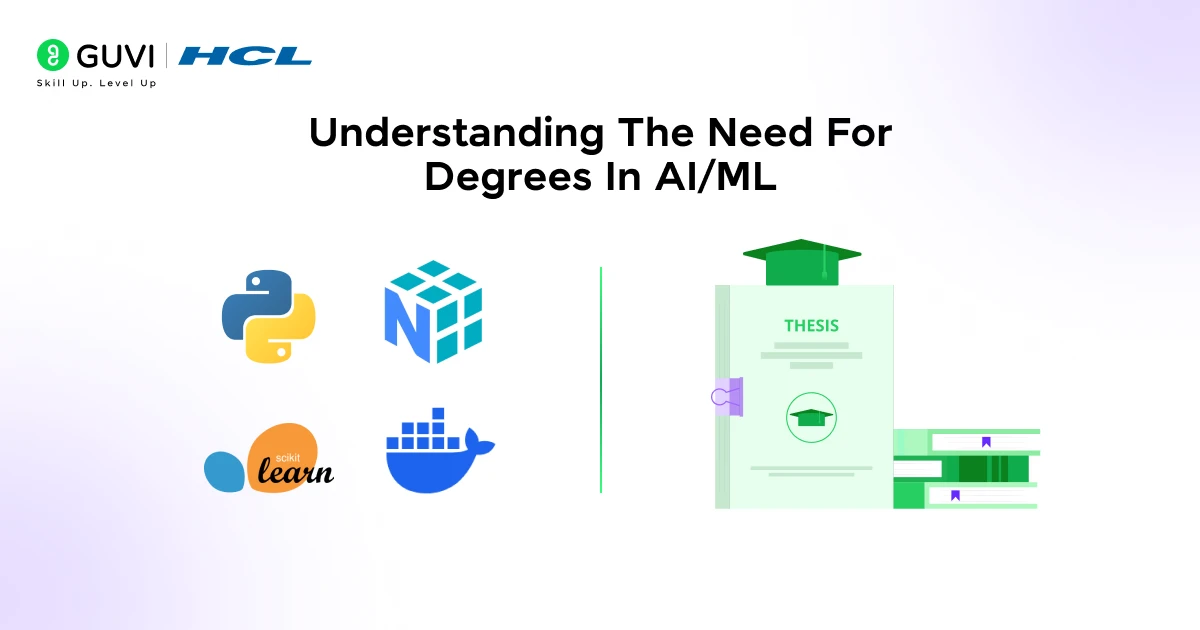
Deciding whether to pursue a master’s or PhD in AI and ML becomes easier when you clearly understand how different companies evaluate talent. Hiring expectations vary across product teams, research teams, and fast-growing startups, which is why many learners feel unsure about the AI ML master’s requirement and how it influences their career path. By knowing what skills matter for applied roles and what qualifications matter for research roles, you can confidently choose a learning approach that supports long-term growth.
1. Why Employer Expectations Vary
Employer expectations differ because AI and ML roles are not uniform. Product-focused teams want engineers who can ship features, optimise models, and solve real business problems. Research-oriented teams look for people with strong theoretical knowledge who can develop new algorithms or contribute to scientific papers. This difference creates unique requirements for each career path and influences whether you need advanced education or only strong practical skills.
Key points:
- Product teams care about practical execution, model deployment, and hands-on problem solving.
- Research teams value theoretical depth, originality, and advanced experimentation.
Startups focus on speed, adaptability, and skill-driven results. - Large companies may offer separate applied and research tracks with different qualification expectations.
Takeaway:
Understanding these differences helps you decide whether you need a master’s for AI or whether real project experience is enough for your chosen role.
2. Roles That Commonly Require Advanced Degrees
Certain positions within AI and ML demand extensive theoretical knowledge and structured academic training. These roles often involve designing new algorithms, publishing research papers, working with mathematical foundations, or building prototypes for long-term innovation. For such work, companies sometimes expect a master’s or even a PhD, especially when scientific accuracy and deep experimentation are essential.
Key points:
- Research scientist jobs often require strong mathematical and research backgrounds.
- Specialised R&D teams in healthcare, robotics, biotech, or autonomous systems prefer candidates with advanced study.
- Roles requiring deep theory, regulatory domain knowledge, or advanced experimentation may value higher education.
- PhD requirements are more common in pure research labs and academic-industry collaboration centres.
Takeaway:
A PhD is not required for most AI or ML jobs, but it remains important for advanced research roles where you need a PhD for machine learning becomes a genuine consideration.

3. Roles Where Practical Skills Dominate
Most growing AI and ML opportunities fall under applied, engineering, or product-driven categories where practical skills matter more than degrees. These positions focus on building ML pipelines, deploying models, optimising inference, managing data workflows, and delivering measurable product outcomes. For these career paths, employers emphasise real projects, hands-on experience, and demonstrated ability to solve problems in production environments.
Key points:
- ML engineer and data scientist roles prioritize implementation, deployment, and system-level understanding.
- Applied AI jobs focus on pipelines, monitoring, integrations, and performance optimisation.
- Many companies hire based on portfolio strength, GitHub projects, internships, and problem-solving tests.
- These positions align closely with the AI career path without a higher degree trend seen in the 2026 hiring landscape.
Takeaway:
If your goal is to work as an applied engineer, practical skill-building and strong projects can outweigh traditional degrees in the ML industry hiring trends.
How A Master’s Helps (And When It’s Overkill)

A Master’s degree in AI and ML can provide structured learning and credibility, but it is not always necessary for every career path. Many learners wonder about AI ML master’s requirements, whether a Master’s is needed for applied roles, and how it compares to learning through self-study or projects. Understanding when a Master’s adds value and when it may be unnecessary helps learners make informed decisions and plan their ai career roadmap without a higher degree effectively.
1. Benefits Of A Master’s For AI And ML Careers
A Master’s program provides a comprehensive foundation in AI and ML theory and practical applications. It is especially helpful for learners transitioning from non-technical backgrounds or those who want structured exposure to advanced concepts. By completing a Master’s, candidates gain experience with machine learning algorithms, optimisation techniques, and model evaluation, which can improve job-market readiness and confidence.
Key points:
- Structured curriculum covering statistics, optimization, machine learning algorithms, and deep learning concepts.
- Mentorship and guided projects with real-world datasets.
- Access to research-grade tools and academic datasets.
- Helps build credibility for job applications, especially for those without a computer science background.
Takeaway:
A Master’s program accelerates skill development and deepens understanding of AI and ML concepts, making it a strong choice for learners seeking structured guidance in their career path.
2. Tradeoffs And Limitations Of Pursuing A Master’s For AI
While a Master’s degree provides advantages, there are tradeoffs to consider for those evaluating AI ML master’s requirements or an AI career without a Master’s. Programs are time-intensive, often expensive, and sometimes focus more on theory than production-level skills, which are crucial for applied roles in the industry.
Key points:
- Significant investment of time and money compared to self-study or bootcamps.
- May not cover production deployment, MLOps, or system reliability in depth.
- Limited end-to-end project experience for hands-on roles.
- Entry into the workforce may be delayed compared to practical learning paths.
Takeaway:
While valuable for theory and structured learning, a Master’s may be overkill for learners whose goal is applied AI roles where practical skills, projects, and problem-solving are more important than formal degrees.
3. When To Choose A Master’s For AI Career Growth
Deciding to pursue a Master’s depends on individual goals, prior experience, and target roles. A Master’s is beneficial for learners looking to transition from non-technical fields, enhance their credibility, or combine coursework with internships to gain a balanced mix of theory and practical skills.
Key points:
• Suitable for transitioning from non-technical or unrelated backgrounds into AI and ML.
• Helpful if job postings explicitly require a Master’s credential.
• Supports combining coursework with internships or research projects for practical experience.
• Provides structured exposure to advanced concepts not easily learned through self-study or bootcamps.
Takeaway:
A Master’s is valuable when it aligns with career objectives or fills knowledge gaps, but for many applied roles, hands-on projects and real-world experience can be equally effective in building a strong career.
When A PhD Is The Right Choice

A PhD is ideal for learners who want to focus on research, create new algorithms, or push the boundaries of AI and ML theory. It is most relevant for those targeting academic roles or advanced industry research labs, rather than applied engineering positions. Understanding when a PhD adds value helps learners decide if pursuing one aligns with their ai career roadmap without higher degree or ml engineer education requirements.
1. Research And Academic Roles
PhD programs prepare candidates to lead research projects, design experiments, and contribute to scientific publications. These roles involve theoretical proofs, benchmarking new models, and collaboration with academic and industrial teams. A PhD equips learners with the skills to solve novel problems and produce original contributions in AI and ML.
Key points:
- Design and conduct experiments, publish research papers, and lead long-term studies.
- Work includes theoretical proofs, benchmarking, and presenting at conferences.
- Collaboration with academic and industrial research teams is common.
- Strong focus on originality and pushing AI knowledge forward.
Takeaway:
A PhD is essential for roles where research, publications, and advanced algorithm design are the primary responsibilities.
2. Industry Research Labs That Value PhDs
Certain industry labs require deep specialization and theoretical expertise. These teams focus on creating state-of-the-art models, improving algorithms, or exploring novel learning paradigms. PhD holders are often preferred in these roles because publication experience and research rigour are considered key metrics of performance.
Key points:
- Labs working on cutting-edge model design and AI theory prioritize PhD candidates.
- Teams focus on algorithmic improvements, new architectures, or novel learning approaches.
- Publication records and research contributions are important for performance evaluation.
- PhDs bring structured research skills and advanced problem-solving capabilities.
Takeaway:
A PhD is valuable in industry research labs where innovation, advanced theory, and publications are central to success.
3. When A PhD Is Overkill
A PhD is not necessary for most applied AI and ML roles, such as ML engineering, product AI, or MLOps. For learners focused on practical projects, fast industry entry, and measurable outcomes, investing time in hands-on experience, projects, and internships is often more effective than pursuing a research degree.
Key points:
- Overkill for product engineering, applied AI, or MLOps roles.
- Can delay entry into the workforce compared to hands-on skill-building routes.
- Practical experience, portfolios, and projects often outweigh a PhD for applied roles.
- Focus on measurable results and applied problem-solving if research is not your goal.
Takeaway:
A PhD should only be pursued if your career goals involve research or theoretical innovation; otherwise, practical experience and applied projects are more efficient for building an AI career.
Building Career in AI/ML Without An Advanced Degree
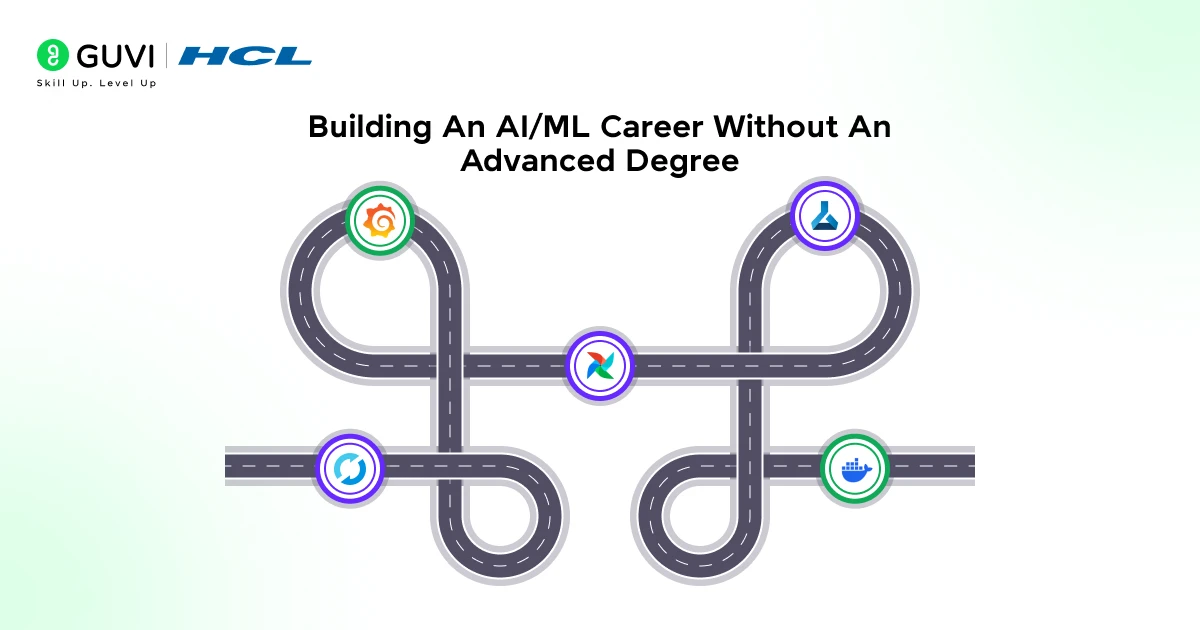
Many learners achieve successful AI and ML careers without pursuing a Master’s or PhD. In today’s industry, hiring teams value hands-on skills, project experience, and the ability to solve real-world problems. Understanding core fundamentals, building a strong portfolio, and using the right tools can help learners follow an AI career path without a higher degree or meet ML engineer education requirements for 2026 roles.
1. Core Fundamentals To Master
A strong foundation in mathematics, programming, and machine learning concepts is essential for building a career without an advanced degree. Mastery of these fundamentals allows candidates to design models effectively, understand performance metrics, and solve real-world problems that recruiters care about.
Key points:
- Mathematics: linear algebra, probability, statistics, and optimization.
- Programming: Python and libraries such as NumPy, pandas, PyTorch, or TensorFlow.
- Machine Learning Concepts: supervised and unsupervised learning, evaluation metrics, and model selection.
- Understanding of data preprocessing, feature engineering, and algorithmic thinking.
Tips and Advice:
Mastering these fundamentals is crucial for building a strong foundation, even if you are pursuing an ai career without master’s or formal higher education.
2. Project Roadmap (Portfolio Targets)
Building a strong AI/ML portfolio is essential for demonstrating practical skills and applying theoretical knowledge. Following a clear roadmap helps learners progress systematically, ensuring recruiters see both depth and breadth in your capabilities, even without a Master’s or PhD.
Key points:
Step 1: Learn and Experiment – Start with small datasets, understand basic ML models, and experiment with different algorithms.
Step 2: Build End-to-End Projects – Collect and preprocess data, train models, evaluate performance, and deploy a simple application or API.
Step 3: Include Production-Like Systems – Create at least one project that simulates a real-world environment, such as a containerised model or API integration.
Step 4: Document Your Work – Keep clear records of experiments, hyperparameters, challenges, and lessons learned for each project.
Step 5: Showcase Your Portfolio – Publish projects on GitHub or a personal portfolio site, demonstrating both practical skills and problem-solving ability.
Tips and Advice:
Follow this roadmap step by step to gradually build your skills and credibility. Focus on creating projects that solve real problems, document your process carefully, and highlight your end-to-end capabilities to stand out to recruiters.
3. Tools And Practices Recruiters Expect
Beyond core skills and projects, recruiters look for candidates who can implement ML solutions in real-world environments. Familiarity with industry-standard tools, workflows, and deployment practices demonstrates practical readiness and aligns with ml industry hiring trends.
Tools and practices
MLOps Tools –DVC, MLflow, Kubeflow for model versioning and pipeline management
CI/CD and Automation – Jenkins, GitHub Actions, GitLab CI for automated testing and deployment
Monitoring and Observability – Prometheus, Grafana, Sentry for tracking model performance and reliability
Data Engineering Tools – Apache Airflow, Prefect, dbt for workflow automation and data pipelines
Cloud Platforms and APIs – AWS SageMaker, GCP AI Platform, Azure ML, REST APIs for deployment
Containerization and Virtualization – Docker, Kubernetes for scalable and reproducible model deployment
Documentation and Communication – clear explanation of model choice, evaluation metrics, and business impact
Tips and Advice:
Learn and practice these tools to demonstrate end-to-end practical competence. Show how you build, deploy, monitor, and explain models effectively, which can make a Master’s or PhD optional while meeting ml engineer education requirements and recruiter expectations.
Interview Readiness: What Hiring Teams Look For
AI and ML interviews assess technical skills, practical experience, and communication. Hiring teams look for candidates who can solve problems, implement solutions, and align their work with business or product goals. Focusing on these essential skills helps you meet recruiter expectations and improve your chances of landing a role.
Key points:
- Technical Skills – coding, algorithm design, ML fundamentals, problem decomposition, metrics interpretation.
- Product and Impact Skills – model alignment with business goals, performance optimization, and ROI measurement.
- Data Skills – data preprocessing, feature engineering, understanding pipelines, handling missing or unstructured data.
- Tools and Deployment Skills – MLOps basics, CI/CD, version control, cloud platforms, containerization.
- Communication and Collaboration Skills – explaining complex ideas, project storytelling, and working with cross-functional teams.
- Analytical Thinking & Problem Solving – troubleshooting, debugging, hypothesis testing, interpreting results correctly.
- Learning Agility – ability to pick up new tools, frameworks, or algorithms quickly, and adapt to evolving industry trends.
Tips and Advice:
Focus on demonstrating practical skills through projects, highlighting measurable business impact, and practice explaining your approach clearly. Show your ability to collaborate with teams, solve problems methodically, and adapt quickly to new tools and frameworks to strengthen your AI and ML career readiness.
Upskilling Pathways And Timeframes
AI and ML careers can be built through multiple learning pathways depending on your timeline, budget, and career goals. Whether you aim to follow an AI career roadmap without a higher degree, meet ML engineer education requirements, or decide on an AI ML master’s degree, choosing the right route helps you progress efficiently and strategically.
Key points:
- Self-Learning Path – online courses, hands-on projects, open-source contribution, replicating papers, and portfolio building.
- Bootcamps And Nanodegrees – industry-focused skills, mentorship, practical pipelines, interview prep, real-world projects.
- Combining Study With Work Experience – part-time Master’s or employer-sponsored learning, internships, applying ML in the domain, networking, continuous skill upgrading.
- Online Communities and Peer Learning – AI/ML forums, study groups, Kaggle competitions, peer code reviews.
- Specialised Certifications – vendor-specific or domain-focused certifications to strengthen credentials.
- Hybrid Approaches – combining self-learning, bootcamps, and work experience for faster skill acquisition and portfolio building.
Tips and Advice:
Choose a pathway that aligns with your AI career without a master’s or an AI career roadmap without a higher degree. Focus on hands-on projects, participate in competitions, earn certifications where relevant, and combine multiple learning methods to meet ML engineer education requirements and ml industry hiring trends efficiently.
Do check out the AI & Machine Learning Course with IIT-M Pravartak Certification, which is a strong fit for learners who want structured guidance without needing a Master’s or PhD. It helps you build core ML skills, hands-on projects, and deployment experience which is perfect for anyone choosing the skills-first pathway instead of higher academic degrees.
💡 Did You Know?
- Gabriel Petersson, a high school dropout, taught himself machine learning using tools like ChatGPT and became a research scientist on the OpenAI Sora team despite not having a PhD. (Business Insider)
- Zach Yadegari built a successful AI tech company generating millions in revenue before age 18, even after being rejected by elite universities. (The Times of India)
- Sudalai Rajkumar, a Kaggle Grandmaster and respected AI practitioner, gained worldwide recognition through competition success and real-world AI work rather than relying solely on advanced academic degrees.
Conclusion
Advanced degrees, like a Master’s or PhD, can provide structured depth and research opportunities, but they are not mandatory for most AI and ML careers. Employers increasingly value practical skills, hands-on project experience, and the ability to deliver measurable outcomes over formal education. Understanding your career goals helps you decide whether a degree or a skills-focused path is the right choice.
To take this knowledge to the next level, focus on building end-to-end projects, mastering MLOps, contributing to open-source or Kaggle competitions, and staying updated with industry trends. Combining these practical experiences with targeted learning accelerates your ai career roadmap without a higher degree and strengthens your profile for ML jobs in 2026 and beyond.
FAQs
1. Can I get an AI job with only a bachelor’s degree?
Yes. Many companies hire candidates with a bachelor’s degree, provided they have strong practical projects and interview performance.
2. Will a Master’s speed up my AI career?
A Master’s can accelerate learning, provide mentorship, and improve credibility for certain roles, but it is not strictly necessary for applied positions.
3. Is a PhD required to work on state-of-the-art models?
A PhD helps in research settings, but engineers in industry can also implement and adapt state-of-the-art models without one.
4. What is the fastest practical way to start?
Build end-to-end projects, contribute to open-source, and target internships or junior roles that allow on-the-job learning.
5. Which skills should I highlight on my resume?
Emphasize project outcomes, workflow knowledge (data handling and deployment), and measurable improvements from your work.
Success Stories

About the Author
Jebasta
I translate the language of data into stories that anyone can understand. As a writer with a data science background, I simplify analytics, AI, and decision-making so beginners and enthusiasts can confidently explore the world of data.
View all posts by Jebasta
Connect with me @










Did you enjoy this article?