


Software Development Articles
My Google SDE Interview Experience: From Rejection to Selection [2026 Success Story]
Apple Interview Experience for Software Developers: What to Expect
Decoding Differences between Network OS and Distributed OS
Operating System Examples: Top OS Types, Features, and Uses Explained


Get In Touch For Details! Request More Information
Difference Between Software Development and Programming: What Sets Them Apart?
Oct 03, 2025 6 Min Read 1082 Views
(Last Updated)
Most of us have a common misunderstanding that software development and software programming are equivalent, but this is not our fault. Due to our frequent habit of expressing things colloquially, we often interchange these two terms. However, in reality, they are different yet related. Before delving deep into what these two terminologies really mean and how they differ from each other, let’s have a surface-level idea about them.
Think of a software application or a website; the functionalities and features (filters, search bar, visual layout, navigational flow, etc.) through which end users or customers interact and perform digital actions are designed and developed by an individual. These virtual components are created with programming, whereas development is the process of building this entire software platform from scratch to final deployment.
In simple terms, software programming is a subset of software development. To deduce it further, think of the add to cart functionality in an e-commerce app. Here, this particular logical element has been programmed using a language, while the complete online store has been developed.
Before attempting to understand the difference between software development and programming, let’s take a glance at what they truly represent.
Table of contents
- What is Software Development?
- Types of Software Development
- What is Software Programming?
- Types of Software Programming
- Difference between Software Development and Programming
- Scope
- Area of Focus
- Team Involvement
- Outcome
- Problem-Solving Approach
- Skills Requirements
- Roles and Responsibilities
- A Brief on the Salaries of Software Programmers and Software Developers in India
- Conclusion
- FAQs
- Which is better, software development or programming, from a career perspective?
- Can a software programmer become a software developer?
- Is programming knowledge mandatory for becoming a software developer?
What is Software Development?
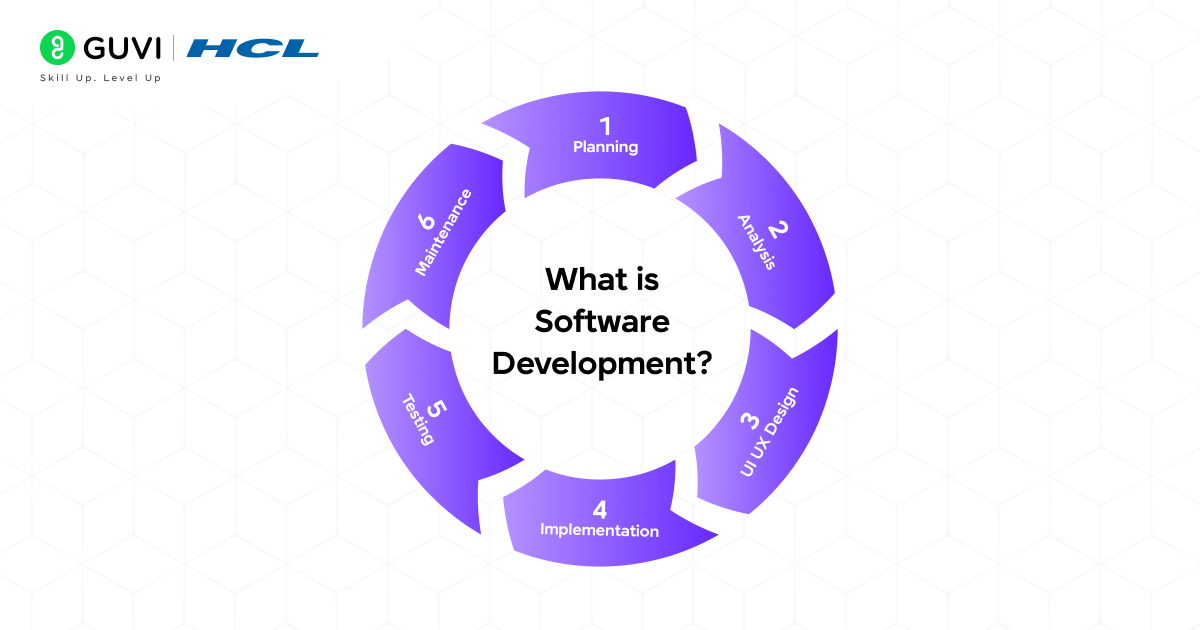
Software development is the comprehensive process of crafting and transforming a business idea or any real-world issue into a fully functional end-to-end virtual tool or a software product. The ultimate goal of software development is to deliver efficient and productive systems and applications that effortlessly align with the needs and requirements of end customers and business entities (big corporations, startups, micro and medium enterprises).
Designing and developing a cutting-edge software streamlines the operational activities, prevents redundant tasks, and also facilitates automating the monotonous workflow.
Full-fledged software development undergoes a sequential flow of technical phases, which includes project ideation, planning, input analysis, design, code execution, testing, product launch, and maintenance. This whole process is collectively known as the Software Development Life Cycle (SDLC).
Types of Software Development
These are the most widely adopted and popular software development types:
- Web Development: Designing and developing user-friendly websites and web applications that are responsive across all screen sizes, as well as highly optimized for a smooth user experience.
- Mobile App Development: Creating powerful and visually appealing applications for mobile devices such as smartphones and tablets (Android/iOS).
- Cloud Development: Developing software tools and applications that run smoothly on a cloud-native environment to automate and simplify various development routines without any hindrance from hardware malfunctions.
- Game Development: Develop creative and interactive games that originate from a concept. This process involves creating a real-world simulation by blending programming, design patterns, audio, story plot, and attention-grabbing user interfaces.
- AI & ML Development: Artificial Intelligence and Machine Learning development focuses on building innovative software models that are trained on extensive and accurate data sets to learn, predict, recommend, and automate tasks.
What is Software Programming?
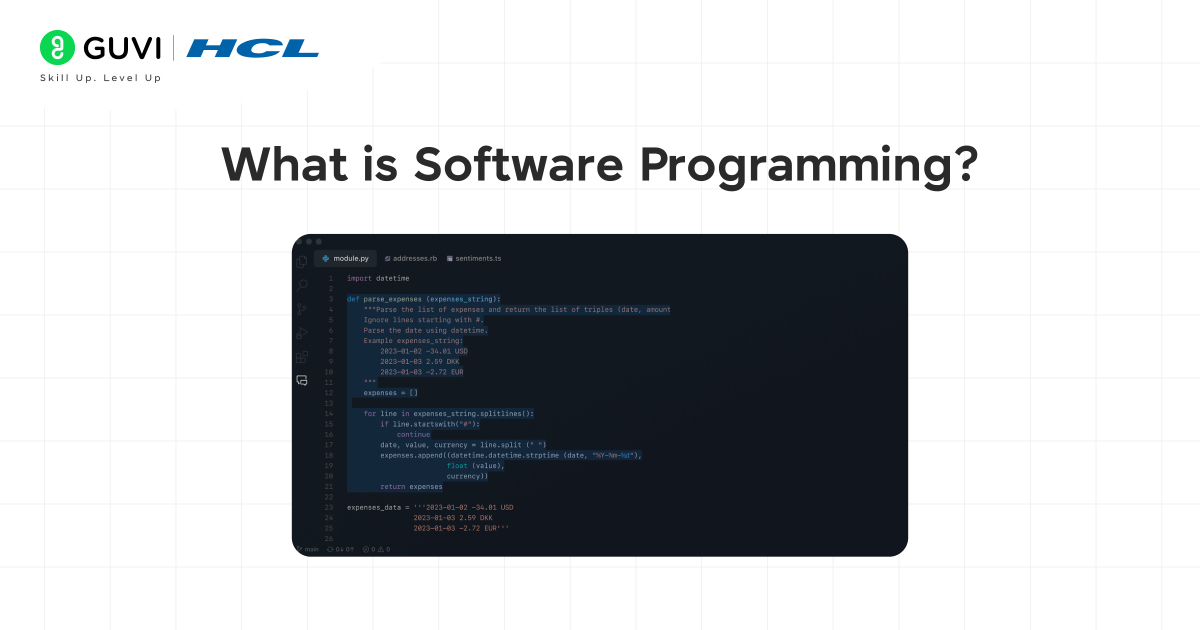
Software programming is the procedure of writing programs of code to provide a set of instructions to the computer systems or applications for performing specific tasks. These instructions are written in programming languages such as Java, Python, C, and C++.
Programming is basically something that interprets or translates human ideas into machine code so that the computer will easily understand them and perform the required piece of work. This process involves writing language scripts and running multiple test cases to ensure they work correctly, debugging the errors, and incorporating best coding practices for performance optimization.
To excel in this skill requires critical thinking, logical reasoning, and a strong command of the application domain and relevant code libraries.

Types of Software Programming
The following are the most implemented software programming methods:
- Object-Oriented Programming: In this style of programming, the entire codebase is organized into objects that act as replicas for real-world entities with several properties and behaviours attached to them. This method ensures resusability and modularity, due to which managing the development process becomes easier.
- Procedural Programming: It is a step-by-step methodology of writing code where the set of commands and instructions is defined, and in accordance with it, functions are utilized to organize the necessary tasks.
- Functional Programming: This is a way of programming that is very declarative in nature, as it primarily focuses on choosing the tasks that need to be solved. In this specific approach, pure functions are used to build system software.
- Scripting Programming: This path is purely based on creating and writing scripts with languages for automating repetitive tasks, along with establishing connections between multiple software tools and software operating together.
- Logical Programming: This programming style is typically employed when developing AI-based software products. Here, based on specific logic circuits, the whole programming flow is decided upon, and the system figures out the most optimal solution.
Difference between Software Development and Programming
Now that we have understood both software development and programming, let’s emphasize the key differences between them.
1. Scope

- Programming is limited to only writing and executing pieces of code and instructions in any specific language (C, C++, Java, Python, etc.) to solve certain types of problems.
- Software development, on the other hand, has much broader applications as it involves the full spectrum of creating a product, starting from information gathering and analysis, planning, designing, development, testing, and regular maintenance services.
2. Area of Focus
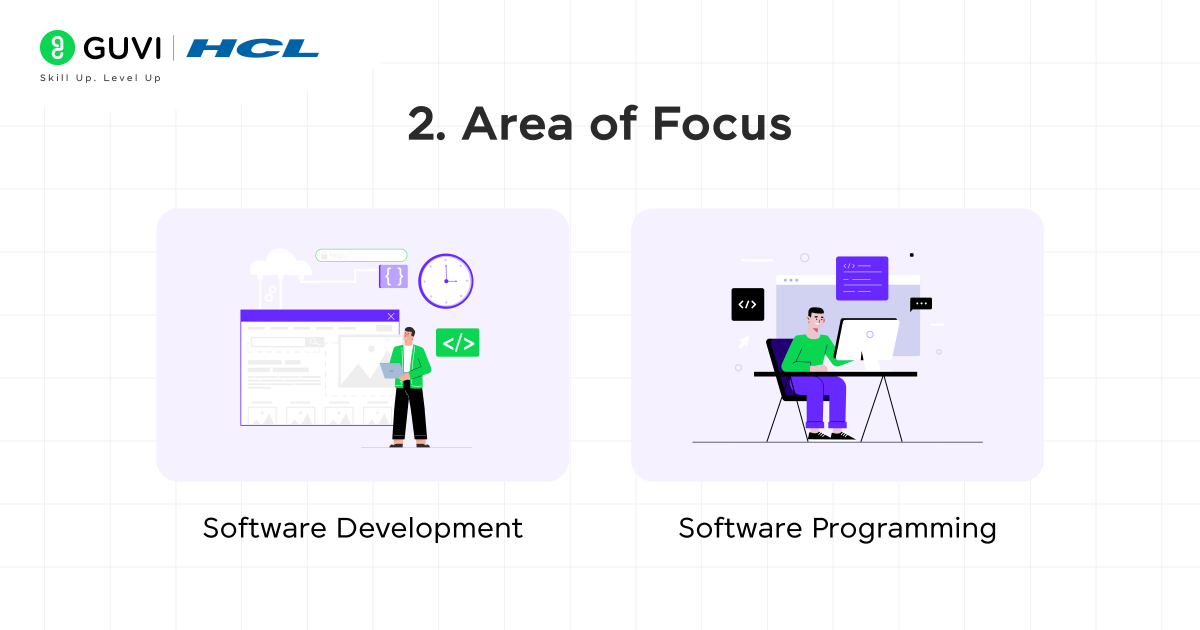
- Programming is concentrated on technicality, which means it deals with solving complex and advanced problems with the most optimal code, along with maintaining the best space and time complexity possible for that solution. In other words, it involves writing effective scripts with minimal or no errors to ensure the running and memory performance.
- However, software development focuses on the entire development lifecycle to ensure that the final product launch addresses real business issues and simplifies complex processes that often confuse end customers. In simple terms, they make sure the overall software product is reliable and of high quality.
3. Team Involvement
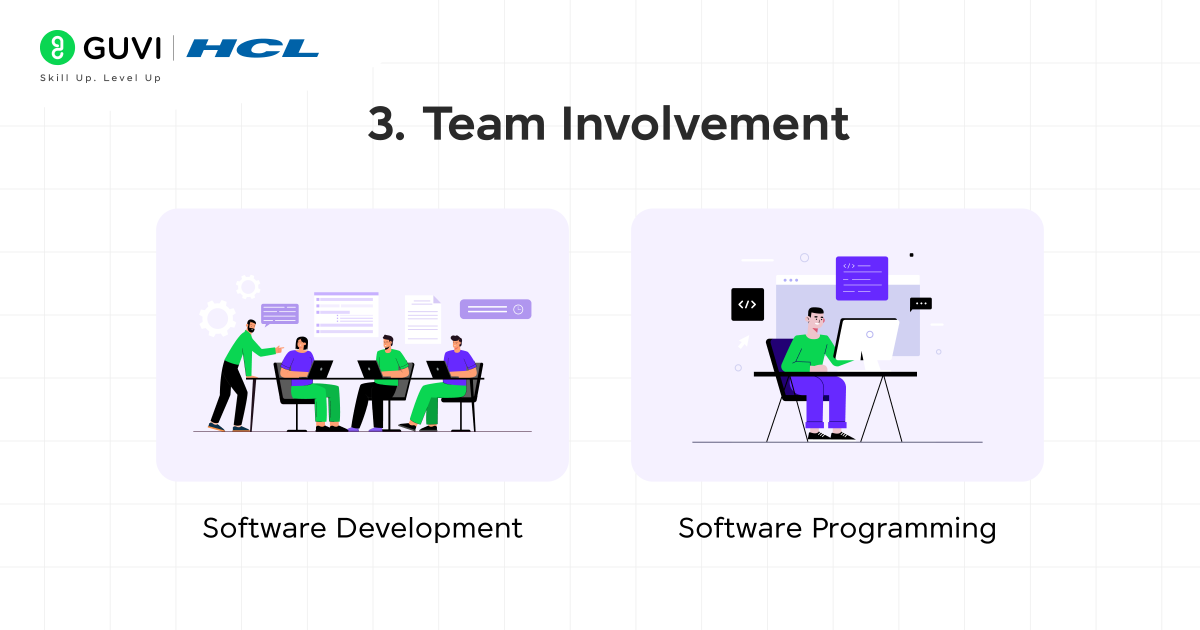
- Programming tasks can be performed by a single individual who will be responsible for solving different kinds of complex problems through coding. The primary responsibility of a programmer is to create the most efficient and sound algorithm that optimizes specific business elements, such as a login system, and the fetching of relevant data when users trigger any events.
- The software development process is a wide extension of programming logic; it is much deeper than just coding. In the majority of cases, it requires a team of developers, testers, engineering managers, designers, and even stakeholders while building a scalable and highly secure application. For better comprehension, we can say it is a collaborative process where professionals from different tech domains work closely together through the exchange of ideas and feedback.
4. Outcome
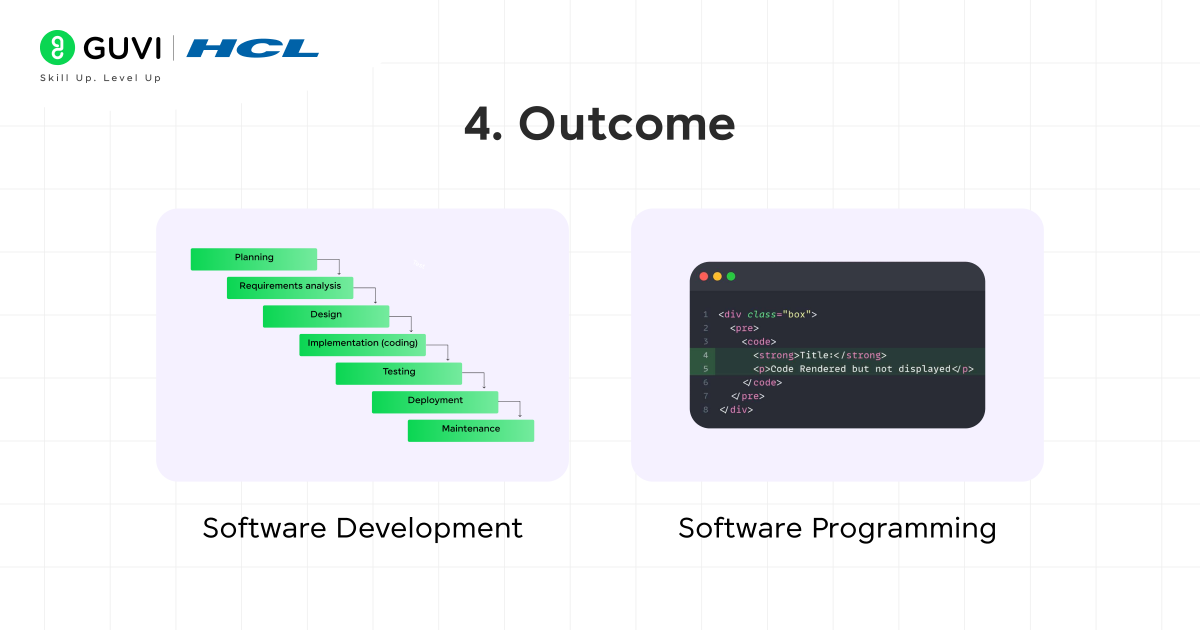
- The programming outcome is a functional piece of code that performs a set of instructions. It may be written for automatic memory caching or calculating mathematical problems. The programming outputs are like Legos (building blocks), but when integrated with other technical specifications, they generate a workable product.
- In contrast, the outcome of the software development process combines all aspects of product development, from integrating code components to designing and testing, along with enhancing the overall usability and experience.
5. Problem-Solving Approach
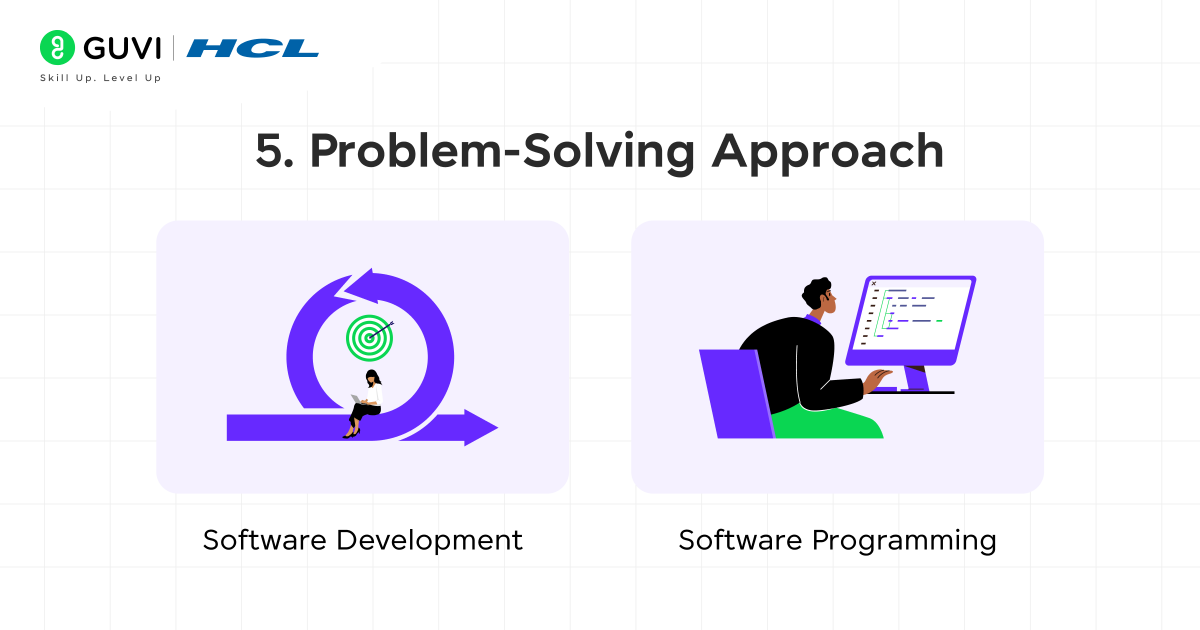
- The programmers approach the functional problems from a pure technical perspective, where they prioritize the algorithm logic for completing the computational assignments.
- Whereas the developers have a much broader vision for addressing problems, they analyze business issues, plan the development methodology, design a robust architecture to enable data flow, and then proceed with core development execution to meet the client’s and end-user’s needs and requirements.
Skills Requirements
For Software Development
- Robust coding and programming language for implementing complex features effectively.
- The ability to plan the working mechanism of multiple software components to ensure scalability and maintainability of the systems.
- Developers must have the proficiency to break down complex requirements into small, manageable modules and logical solutions.
- Apart from technical expertise, having a knack for organizing development timelines, coordinating teams, and meeting the scheduled timelines is an essential skill to have.
- Project management capability through effective collaboration and communication with designers, testers, and business stakeholders to deliver top-notch software products.
- Should have a competency in identifying security loopholes and areas of improvement, and fix them with the best solution possible.
For Software Programming
- Strong fundamentals in popular programming languages like Python, Java, JavaScript, C, C++, etc. In-depth knowledge of using the best data structures and algorithms (DSA) to solve advanced computational problems.
- Strong debugging and troubleshooting skills to identify and resolve errors and high-risk bugs that could compromise code efficiency.
- Problem-solving skill is a must for simplifying problem solutions into gradual steps.
- A habit of writing code that is readable, maintainable, and optimized is essential.
- Understanding of the most basic software concepts and principles like variables, loops, data types, conditional statements, functions, modularity, DRY (don’t repeat yourself), encapsulation, and the SOLID principle.
Roles and Responsibilities
Software Developers
- Analyze user needs and design complete, reliable software solutions.
- Plan, design, and structure the overall software architecture.
- Write, test, and integrate code into the entire system.
- Collaborate with teams (designers, testers, managers) for successful projects.
- Maintain, update, and improve software after official deployment.
Software Programmers
- Write clean, efficient, and functional source code.
- Translate designs and requirements into working applications.
- Debug and fix critical errors in code.
- Optimize code for higher speed and performance.
- Implement algorithms and logic to solve computational problems.
A Brief on the Salaries of Software Programmers and Software Developers in India
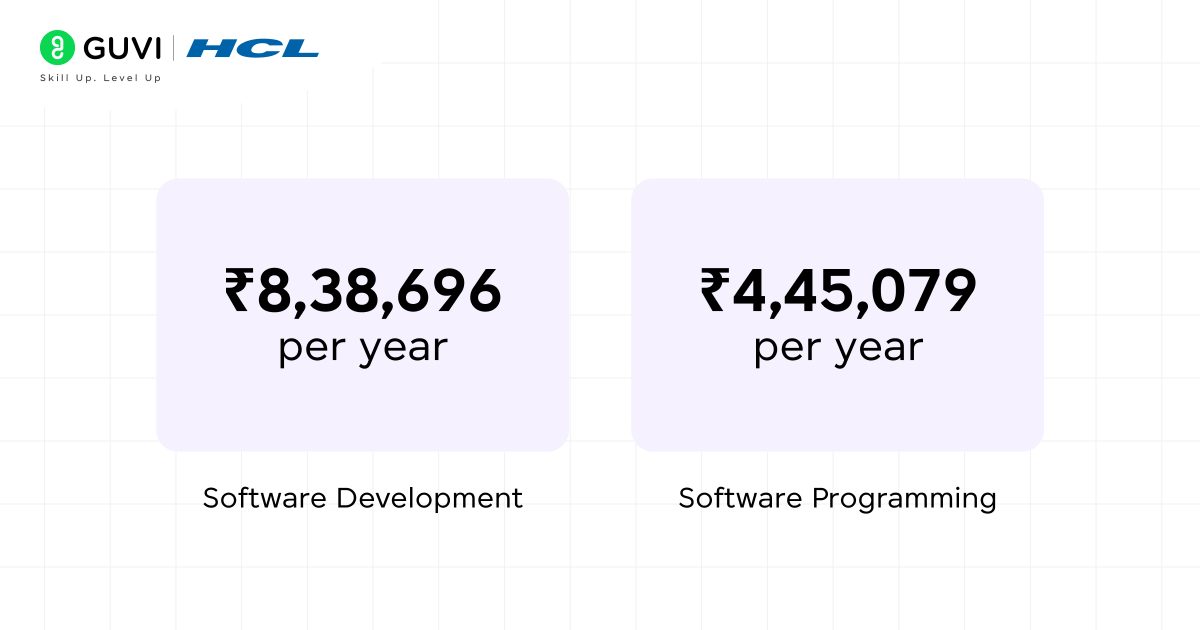
The salary of software developers and programmers in India varies significantly. The reason behind this difference in salary levels lies in various factors such as locations, the kind of tech role you are associated with (for example, roles could be of Frontend Developer, Mobile App developers, DevOps Engineer, and Programmer profiles like System Programmer, Functional Game Programmer, Database Programmer).
But if we have to speak based on numbers and figures, then the average base salary of a software engineer in India is ₹8,38,696 per year.
The average salary of entry-level software developers and programmers is ₹2,28,141 per year, while for the mid-level engineers it is ₹4,45,079 per year.
On the other hand, for senior and principal tech roles, the average annual salaries are ₹12,65,945 and ₹16,22,838 per annum, respectively.
Reference Source Site: https://www.levels.fyi/t/software-engineer/locations/india
Many people confuse software developers and programmers, but they are not the same. Programmers mainly focus on writing and debugging code, while developers take charge of the entire software lifecycle, including planning, design, coding, testing, and maintenance. In fact, in many companies, programmers often work under developers as part of bigger project teams.
This is because development is a broader role that goes beyond coding to include architecture, project management, and user experience. That’s why it’s often said that programming is a subset of software development, and developers typically earn higher salaries due to their broader responsibilities and leadership roles.
In this era, where the IT (information technology) job market, especially in India, is so competitive, if you aspire to crack any top product-based companies or the best software startups, you need to have a proven track record of working on real-world projects. And to transform this ambition into success, enroll yourself in HCL GUVI’s IITM Pravartak and MongoDB Certified AI Software Development Course.
Conclusion
In conclusion, while software development and software programming are closely related, they are not identical. Programming is the activity of writing effective and error-free code to solve specific technical problems. At the same time, software development covers the entire development lifecycle process of building a serviceable virtual product. Development involves a blend of both technical and strategic approaches, whereas programming concentrates only on technicality.
Understanding this vivid distinction is crucial for candidates and individuals who are looking to build a career in IT, as it highlights the essential details attached to both terms. If you are someone who thrives on curiosity and wants to explore the full-length process of producing something, then Software development is the ideal choice for you. If you are very specific about solving technical problems, then software programming is the option you should opt for.
FAQs
Which is better, software development or programming, from a career perspective?
Starting with software programming is a suitable career path, as it allows you to develop strong coding skills. Still, in the long run, software development is better as it helps you achieve higher salaries and gain a deeper understanding of serving clients across various industries.
Can a software programmer become a software developer?
Yes, a software programmer can become a software developer—it’s challenging but achievable with dedication, learning software design, mastering the development lifecycle, collaborating with teams, and gaining hands-on project experience.
Is programming knowledge mandatory for becoming a software developer?
Yes, it is absolutely necessary to be a good programmer before entering into software development because a strong logical mind is the core need for gaining an understanding of software architecture, testing, and project management.
Success Stories













Did you enjoy this article?