TL;DR Summary
Short Answer: Prioritise practical DevOps training to develop hands-on skills and understand real-world workflows. Choose certification to validate your knowledge and demonstrate expertise in specific tools and platforms. Combining both can strengthen your technical profile and career prospects.
- DevOps certifications validate knowledge of cloud platforms, automation, CI/CD and industry practices.
- Practical training helps you apply DevOps tools, configure pipelines and troubleshoot deployment issues.
- Employers may consider certifications during screening but also assess technical skills through interviews and practical evaluations.
- Your experience, project work and ability to solve real-world problems matter when demonstrating DevOps proficiency.
Who this comparison is for: Fresh graduates, working IT professionals and career switchers deciding whether to prioritise DevOps certification or practical training for career growth.
Why Does This Comparison Matter in 2026?
The 2026 Linux Foundation State of Tech Talent Report found that 93% of organizations consider hands-on experience important when assessing technical candidates, while 87% value portfolios and previous IT project work. Certifications also matter, with 76% of organizations considering them important.
Similarly, Pearson’s 2026 Value of IT Certification Employer Report found that 78% of organizations investing in employee upskilling choose certification programmes.
These findings show that employers value both practical abilities and verified knowledge. For aspiring DevOps engineers, the strongest approach is to gain hands-on experience through projects and use relevant certifications to validate their skills.
What Is DevOps Certification vs Practical Training?
A DevOps certification validates knowledge of tools, platforms and industry practices through an exam.
It demonstrates understanding of DevOps concepts and cloud technologies.

Advanced AI Cloud Computing & DevOps Programme
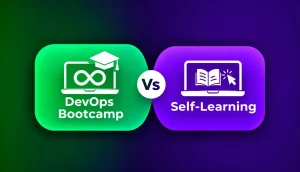
DevOps Certification vs Practical Training — Side-by-Side Comparison
| Criteria | DevOps Certification | Practical Training | Winner |
|---|---|---|---|
| Learning structure | Follows a defined syllabus and exam objectives | Focuses on guided exercises and real-world tasks | Certification |
| Learning focus | Covers concepts, tools and platform-specific knowledge | Develops skills through tool usage and implementation | Practical Training |
| Assessment | Evaluates knowledge through certification exams | Evaluates ability through assignments and projects | Practical Training |
| Tool familiarity | Tests knowledge of specific DevOps platforms and tools | Builds experience using Git, Docker and Jenkins | Practical Training |
| CI/CD knowledge | Tests understanding of pipeline concepts and practices | Involves creating and managing CI/CD pipelines | Practical Training |
| Infrastructure management | Covers infrastructure as code and cloud concepts | Provides experience configuring infrastructure using tools | Practical Training |
| Troubleshooting | May assess problem-solving through exam scenarios | Involves identifying and resolving technical issues | Practical Training |
| Industry recognition | Provides a recognised credential from a certification body | Demonstrates applied skills through completed work | Certification |
| Career value | Helps validate knowledge during recruitment | Helps demonstrate technical ability during interviews | Practical Training |
| Best for | Professionals seeking formal validation of their expertise | Learners seeking hands-on DevOps experience | Practical Training |
DevOps Certification vs Practical Training: What Should You Prioritize?
Answer 3 questions to find your best starting point.
What is your current level of DevOps knowledge?
Consider your experience with DevOps tools, workflows and projects.
What do you want to achieve through DevOps learning?
Choose the outcome that matters most for your next career step.
Which area do you find most challenging?
Identify the technical area where you need the most improvement.
How Certification and Practical Training Prepare You for DevOps Responsibilities
Both learning approaches can help you understand DevOps, but they prepare you for technical responsibilities in different ways.
- Knowledge validation: Certifications assess your understanding of specific platforms, tools and DevOps practices. Practical training shows how well you can apply that knowledge.
- Technical execution: Certification preparation helps you understand concepts and exam scenarios, while practical exercises involve configuring tools and completing technical tasks.
- Problem-solving: Certification exams may test troubleshooting knowledge, whereas practical training gives you opportunities to investigate errors and resolve implementation issues.
Looking to strengthen your DevOps career prospects? HCL GUVI’s AI Cloud Computing & DevOps Programme combines expert-led training, hands-on projects and career-focused learning to help you build industry-relevant skills.
How Certification and Practical Training Address Real-World DevOps Tasks
| DevOps Certification | Practical Training |
|---|---|
| Understand continuous integration and delivery principles. | Configure pipelines to automate application builds and deployments. |
| Demonstrate knowledge of infrastructure as code concepts. | Create and manage infrastructure using Terraform. |
| Understand containerisation and orchestration concepts. | Build Docker containers and deploy applications using Kubernetes. |
| Learn monitoring, logging and incident management practices. | Configure monitoring tools and investigate application failures. |
DevOps Certification vs Practical Training for Freshers
Freshers need hands-on experience to understand how DevOps tools work together.
- Learning priorities: Linux, Git, networking and basic scripting.
- Practical experience: Build projects using Docker, Jenkins and CI/CD pipelines.
- Career preparation: Create a portfolio demonstrating technical skills.
Consider certification after developing these fundamentals.
DevOps Certification vs Practical Training for Working Professionals
Professionals with relevant technical experience can use certifications to demonstrate platform expertise.
- Specialisation: Choose AWS, Azure or Google Cloud credentials.
- Knowledge validation: Prepare for assessments covering automation, security and infrastructure.
- Career preparation: Highlight relevant certifications when applying for specialised roles.
Use practical training when moving into unfamiliar technologies.
DevOps Certification vs Practical Training for Career Switchers
Career switchers need demonstrable technical skills to support their transition.
- Transferable skills: Build on existing IT, networking or development knowledge.
- Technical learning: Practise infrastructure management and deployment automation.
- Project evidence: Create applications that demonstrate deployment and troubleshooting.
Pursue certification once you have established the necessary technical foundation.
Salary and Career Growth
DevOps career growth depends on experience, technical expertise and the complexity of responsibilities.
Potential career paths include:
- DevOps Engineer
- Cloud Engineer
- Site Reliability Engineer
- Platform Engineer
- DevSecOps Engineer
Developing expertise in cloud architecture, Kubernetes, automation and security can support progression into specialised roles. Certifications and project experience can strengthen your professional profile.
Advanced AI Cloud Computing & DevOps Programme
Recommendation — What Should You Prioritise?
Choose practical training if:
- You are new to DevOps.
- You need project experience.
- You are transitioning into a technical role.
Choose certification if:
- You already have relevant experience.
- You want to validate platform expertise.
- Your target role requires a recognised credential.
Choose both if: You want practical capabilities alongside formal recognition.
DevOps Certification vs Practical Training: What Should You Prioritize?
Answer 3 questions to find your best starting point.
What is your current level of DevOps knowledge?
Consider your experience with DevOps tools, workflows and projects.
What do you want to achieve through DevOps learning?
Choose the outcome that matters most for your next career step.
Which area do you find most challenging?
Identify the technical area where you need the most improvement.
Conclusion
Practical training helps develop implementation skills, while certification validates technical knowledge. Beginners and career switchers can start with projects, whereas experienced professionals may prioritise relevant credentials. Choose according to your current capabilities and career goals.
Frequently Asked Questions
1. Is practical DevOps training better for beginners?
Yes. It helps beginners understand tools, workflows and infrastructure through hands-on exercises.
2. Can I get a DevOps job with certification alone?
Certification helps validate knowledge, but employers may also assess projects, experience and technical skills.
3. Which DevOps certification should I pursue first?
Consider AWS, Microsoft Azure or Google Cloud certifications based on your target role and experience.
4. Do DevOps certifications include practical assessments?
Some do. The Certified Kubernetes Administrator (CKA), for example, uses a performance-based practical examination.
5. How many projects should I complete before certification?
There is no fixed number. Focus on projects involving CI/CD, infrastructure automation and container deployment.
6. Can practical training help experienced IT professionals?
Yes. It helps professionals develop skills in cloud automation, Kubernetes and continuous delivery.
7. Should I complete training before taking a DevOps certification exam?
Beginners can benefit from practical training first. Experienced professionals can prepare using official exam objectives.