


Artificial Intelligence and Machine Learning Articles
Simulated Annealing Algorithm Explained
Isolation Forest for Anomaly Detection


Get In Touch For Details! Request More Information
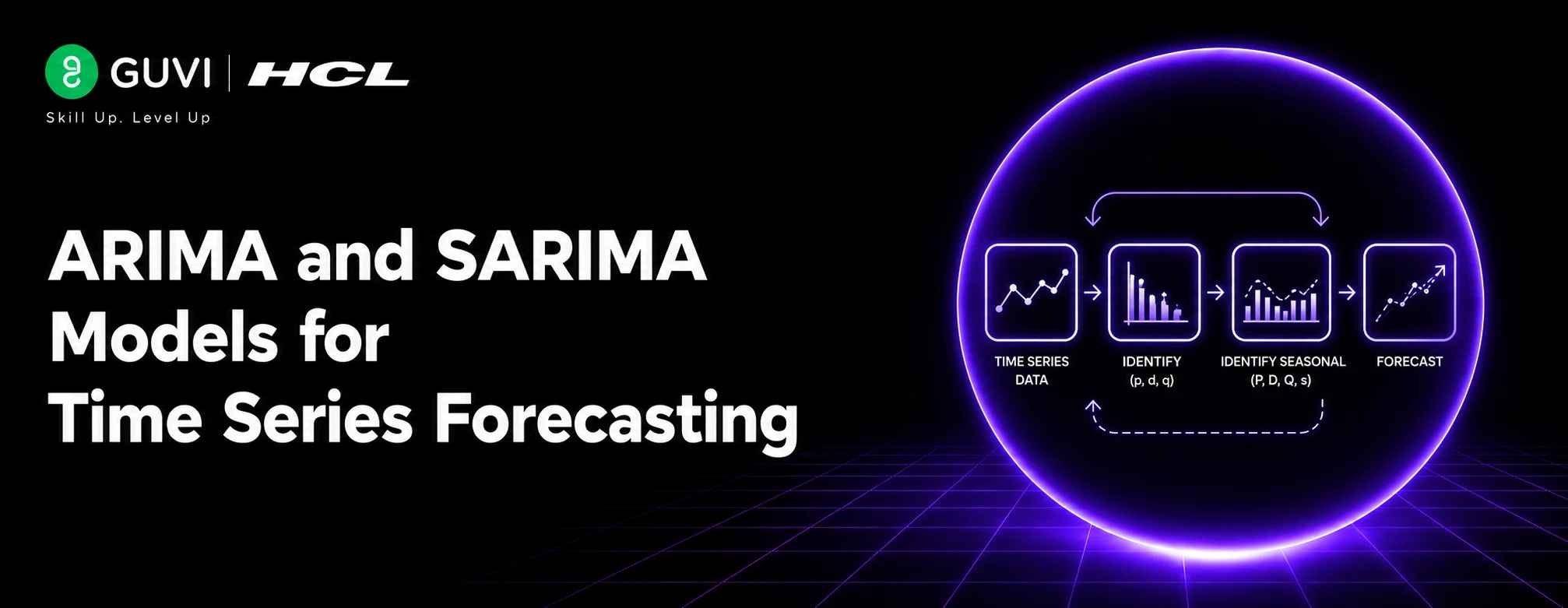
ARIMA and SARIMA Models for Time Series Forecasting
Aug 28, 2026 3 Min Read 61 Views
(Last Updated)
Forecasting future trends helps businesses make informed decisions about inventory, sales, finance, and operations. Among the most widely used statistical forecasting techniques are ARIMA and SARIMA Models, both designed to analyze historical time series data and predict future values. While ARIMA works well for non-seasonal data, SARIMA extends its capabilities by modeling seasonal patterns. This guide explains ARIMA and SARIMA Models in simple terms, their differences, applications, and when to use each approach.
Table of contents
- TL;DR Summary
- Why Time Series Forecasting Matters
- What is ARIMA?
- What is SARIMA?
- ARIMA vs SARIMA
- Use ARIMA When
- Use SARIMA When
- Common Applications of ARIMA and SARIMA
- Retail
- Finance
- Manufacturing
- Energy
- Transportation
- Benefits of ARIMA and SARIMA Models
- Accurate Forecasting
- Easy Interpretation
- Broad Business Applications
- Strong Baseline Models
- When Should You Use ARIMA or SARIMA?
- Use ARIMA For
- Use SARIMA For
- Applications You Can Build with ARIMA and SARIMA
- Business Intelligence
- Finance
- Retail
- Manufacturing
- Limitations of ARIMA and SARIMA
- Best Practices
- Conclusion
- FAQs
- What is ARIMA?
- What is SARIMA?
- What is the difference between ARIMA and SARIMA?
- When should I use ARIMA?
- Can ARIMA and SARIMA predict future sales?
- Are ARIMA and SARIMA machine learning algorithms?
- Why are ARIMA and SARIMA important?
TL;DR Summary
- ARIMA forecasts non-seasonal time series data.
- SARIMA extends ARIMA by modeling seasonality.
- Both models identify patterns from historical observations.
- Time series forecasting supports business planning.
- Model selection depends on data characteristics.
Direct Answer
| ARIMA and SARIMA Models are statistical methods used for time series forecasting. ARIMA predicts future values using historical trends in non-seasonal data, while SARIMA extends ARIMA by incorporating seasonal patterns. Both models help businesses forecast demand, sales, inventory, and financial trends, making them valuable tools for predictive analytics and data-driven decision-making. |
Why Time Series Forecasting Matters
Organizations rely on forecasting to anticipate future outcomes and optimize business operations. Accurate predictions help reduce uncertainty and improve planning.
Benefits include:
- Better demand forecasting
- Improved inventory planning
- Smarter financial decisions
- Efficient resource allocation
- Reduced operational risks
- Better business forecasting
What is ARIMA?
ARIMA (AutoRegressive Integrated Moving Average) is a statistical forecasting model designed for non-seasonal time series data.
It combines three components:
- Autoregression (AR): Uses previous observations to predict future values.
- Integration (I): Removes trends through differencing to make data stationary.
- Moving Average (MA): Uses previous forecasting errors to improve predictions.
ARIMA performs well when historical data follows consistent patterns without strong seasonality.
Learners can develop practical forecasting skills through HCL GUVI’s Artificial Intelligence and Machine Learning Course.
What is SARIMA?
SARIMA (Seasonal AutoRegressive Integrated Moving Average) extends ARIMA by incorporating seasonal behavior.
In addition to ARIMA components, SARIMA models repeating seasonal cycles such as:
- Monthly sales
- Quarterly revenue
- Weekly website traffic
- Annual demand patterns
This makes SARIMA more suitable for datasets containing predictable seasonal fluctuations.
ARIMA vs SARIMA
Understanding the difference between these forecasting models helps analysts choose the right approach.
Use ARIMA When
- Data has no seasonality.
- Trends can be stabilized through differencing.
- Historical observations follow consistent patterns.
Use SARIMA When
- Data contains repeating seasonal cycles.
- Forecasts depend on monthly, quarterly, or yearly patterns.
- Seasonal behavior influences future predictions.
Common Applications of ARIMA and SARIMA
Retail
- Sales forecasting
- Inventory planning
- Demand prediction
Finance
- Revenue forecasting
- Stock trend analysis
- Budget planning
Manufacturing
- Production forecasting
- Capacity planning
- Supply chain optimization
Energy
- Electricity demand forecasting
- Consumption prediction
- Resource planning
Transportation
- Passenger demand forecasting
- Traffic analysis
- Fleet planning
Benefits of ARIMA and SARIMA Models
These forecasting techniques remain popular because they are reliable, interpretable, and computationally efficient.
Accurate Forecasting
They identify historical trends to generate future predictions.
Easy Interpretation
Statistical components provide greater transparency than many black-box AI models.
Broad Business Applications
They support forecasting across finance, retail, healthcare, logistics, manufacturing, and energy.
Strong Baseline Models
ARIMA and SARIMA often serve as benchmark forecasting models before applying advanced machine learning techniques.
Professionals interested in predictive analytics, forecasting models, machine learning, and business intelligence can strengthen their expertise through HCL GUVI’s Artificial Intelligence and Machine Learning Course.
When Should You Use ARIMA or SARIMA?
Both forecasting models are widely used for time-series prediction, but selecting the right model depends on your data’s characteristics.
Use ARIMA For
ARIMA works well when historical data has trends but does not contain recurring seasonal patterns.
Common examples include:
- Daily stock prices
- Production output
- Economic indicators
- Business expenses
- Equipment monitoring
Use SARIMA For
SARIMA performs better when the dataset contains predictable seasonal cycles.
Common examples include:
- Monthly sales forecasting
- Holiday demand prediction
- Electricity consumption
- Hotel bookings
- Website traffic trends
Before applying advanced deep learning models, many data scientists first build ARIMA or SARIMA models as baseline forecasting solutions. Their simplicity, interpretability, and strong statistical foundation make them valuable benchmarks for evaluating more complex forecasting algorithms.

Applications You Can Build with ARIMA and SARIMA
These forecasting models support numerous real-world business applications.
Business Intelligence
- Sales forecasting
- Revenue prediction
- Business planning
- Demand forecasting
- Budget forecasting
Finance
- Stock trend analysis
- Cash flow forecasting
- Financial planning
- Market trend prediction
- Risk forecasting
Retail
- Inventory forecasting
- Seasonal demand prediction
- Customer traffic forecasting
- Promotion planning
- Supply chain optimization
Manufacturing
- Production scheduling
- Capacity planning
- Equipment demand forecasting
- Inventory optimization
- Supply forecasting
The HCL GUVI’s Artificial Intelligence eBook introduces the fundamentals of generative AI, machine learning, prompt engineering, and intelligent automation. It helps learners understand forecasting techniques, predictive analytics, business intelligence, and practical AI applications across multiple industries.
Limitations of ARIMA and SARIMA
Although both models are highly effective for statistical forecasting, they have certain limitations.
Limitations include:
- Depend on historical data quality.
- Require stationary data or differencing.
- Limited performance on highly nonlinear relationships.
- Sensitive to incorrect parameter selection.
- May underperform compared to advanced deep learning models for highly complex datasets.
Understanding these limitations helps practitioners choose the appropriate forecasting technique for each problem.
Warning: Forecast accuracy depends on data quality, correct preprocessing, parameter tuning, and continuous model evaluation. Always analyze trends, seasonality, and stationarity before selecting ARIMA or SARIMA. Validate forecasts using historical test data and compare multiple forecasting models before deploying them for business-critical decision-making.
Best Practices
- Visualize time series before modeling.
- Check for stationarity before training.
- Identify seasonal patterns carefully.
- Split data into training and testing sets.
- Compare ARIMA and SARIMA performance.
- Monitor forecast accuracy regularly.
- Retrain models as new data becomes available.
Conclusion
ARIMA and SARIMA Models remain reliable techniques for time series forecasting, helping organizations predict future trends using historical data. ARIMA performs well on non-seasonal datasets, while SARIMA effectively models recurring seasonal patterns. Understanding when to apply each model enables analysts to improve forecasting accuracy, support business planning, and build dependable predictive analytics solutions across multiple industries.
FAQs
1. What is ARIMA?
ARIMA (AutoRegressive Integrated Moving Average) is a statistical forecasting model that predicts future values from non-seasonal historical time series data using autoregression, differencing, and moving averages.
2. What is SARIMA?
SARIMA (Seasonal AutoRegressive Integrated Moving Average) extends ARIMA by modeling recurring seasonal patterns, making it suitable for forecasting data with monthly, quarterly, or yearly cycles.
3. What is the difference between ARIMA and SARIMA?
ARIMA is designed for non-seasonal time series, whereas SARIMA incorporates additional seasonal components to forecast data with repeating seasonal behavior.
4. When should I use ARIMA?
Use ARIMA when your dataset contains trends but lacks significant seasonal patterns, such as production output, expenses, or financial indicators.
5. Can ARIMA and SARIMA predict future sales?
Yes. Both models are commonly used for sales forecasting, demand prediction, inventory planning, revenue forecasting, and other business forecasting applications.
6. Are ARIMA and SARIMA machine learning algorithms?
No. ARIMA and SARIMA are classical statistical forecasting models rather than machine learning algorithms, although they are frequently used alongside machine learning techniques in predictive analytics.
7. Why are ARIMA and SARIMA important?
ARIMA and SARIMA Models help organizations forecast future demand, identify trends, optimize business planning, improve inventory management, and make data-driven decisions using historical time series data.
Success Stories

About the Author
HCL GUVI
This article was selected and published as part of the HCL GUVI AI Blogathon 2026, an initiative designed to encourage students, AI enthusiasts, and aspiring tech writers to simplify complex AI concepts through impactful technical content. The contest recognized high-quality, original, and insightful AI-focused blogs, with selected authors receiving publication opportunities on the HCL GUVI blog platform along with official author credits and recognition.
View all posts by HCL GUVI
Connect with me @







Did you enjoy this article?