


Interview Articles
My Full Stack Developer Interview Experience: What Nobody Tells You
My Digital Marketing Interview Experience: What They Don't Tell You [2026]
How Long Does Technical Interview Preparation Take? An Expert's Reality Check
Technical QA Interview Questions: What Top Companies Really Ask in 2026


Get In Touch For Details! Request More Information
Apple Interview Experience for Software Developers: What to Expect
Mar 18, 2026 3 Min Read 528 Views
(Last Updated)
Have you ever imagined what it is like to crack one of the most challenging problems in the technology realm? The interview process at Apple challenges software developers to reason quickly, create on the fly, and demonstrate their abilities in crisis situations. It is not so much about writing code, but demonstrating how you solve problems, structure systems, and work in a high-performance workplace.
In this blog, we will walk through the Apple interview experience to help you understand what the process is really like. Coding rounds are brutal, system design interviews are tough, whereas technical interviews are a combination of both; you will have a clear understanding of what is to be expected and how to prepare.
To succeed in software developer interviews at Apple and become one of the few to pass, this guide provides the map.
Quick Answer:
The Apple interview experience is intense and highly technical, focusing mainly on coding, algorithms, and system design. Candidates also face behavioral questions to assess problem-solving and team collaboration skills.
Table of contents
- Why Apple Interview Experience Is Different
- Apple Interview Rounds: Walkthrough
- Round 1: Coding & Algorithm Round
- Round 2: Advanced Coding / Complex Problem-Solving Round
- Round 3: System Design Round
- Round 4: Role-Specific Technical Challenges
- Round 5: Behavioral & Collaboration Assessment
- Essential Preparation Tips for Cracking Apple Interviews
- Conclusion
- FAQs
- What makes Apple interviews harder than other tech companies?
- Will I get real‑world coding problems in the Apple interview?
- Do I need to prepare beyond coding practice?
Why Apple Interview Experience Is Different
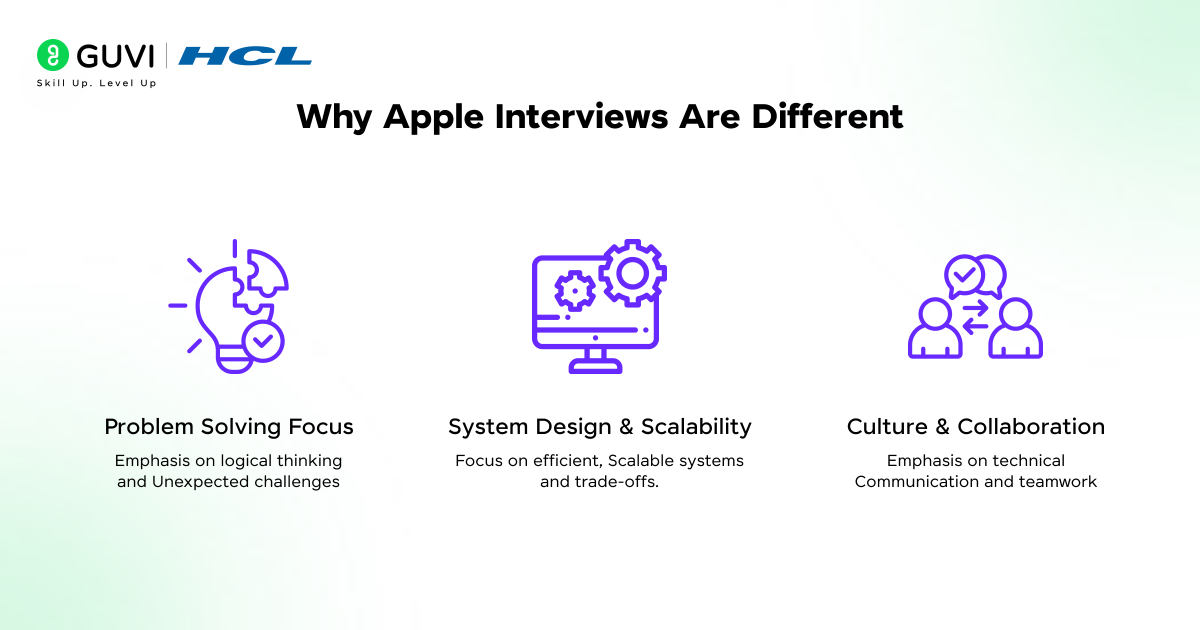
The interviews at Apple are unique as they are based on solving problems and thinking as an engineer, as opposed to syntax code. The applicants are also tested in terms of their capacities to approach the problem logically, and maximize the solution to them and deal with those challenges that are not expected, which is the way Apple engineers go to work every day.
The other reason is Apple’s focus on the design and scalability of systems. Even in the case of junior positions, interviewers would want to know whether you can develop systems that are efficient and have knowledge of trade-offs, something that is not common in most interviews in other companies.
Finally, Apple cares about culture and collaboration, but in a technical way. They seek out developers who can convey their ideas easily, collaborate in groups, and handle the fast-paced, high-standard environment of Apple. It is this combination of technical profundity and problem-solving attitude that makes Apple interviews really unique.
For Example:
One of the questions a candidate may receive is to optimize a search algorithm for millions of items, which requires seeing how well they can handle efficient solutions to complex problems under limitations.
Apple Interview Rounds: Walkthrough
This is a detailed overview of Apple’s interview process for software developers.
These rounds aim to see your skill in code, problem-solving aptitude, system design skills, and technical teamwork. Each stage has what to expect, as shown below.
Round 1: Coding & Algorithm Round
The round is more about your basic programming, data structure, and algorithm. As part of the interview, you will be asked to solve problems in real-time, which may be based on a coding platform or a whiteboard, depending on the format of the interview. Common problems are arrays, strings, trees, and graph problems.
This round is to determine the ability to write clean, efficient code under pressure. Apple would like to make sure that a candidate is well-grounded in problem-solving and algorithmic thinking, which are essential in everyday engineering activity.
What is required:
- Use effective algorithms to avoid pitfalls.
- Crack puzzles in computer science.
- Be able to think logically and handle errors.

Round 2: Advanced Coding / Complex Problem-Solving Round
This round is a test of your skills in handling more difficult coding problems, which may involve many steps or more complicated data structures. Issues can also be a combination of algorithms and optimization methods, and need to be analyzed.
This is to test your higher capacity to think and solve problems, as well as your code efficiency. Apple is seeking those developers who are able to deal with real-world issues that extend beyond basic code writing, such as scalability and performance.
What is required:
- Solve code multi-step or optimization-intensive problems.
- Take advantage of complex data types (graphs, heaps, hash maps).
- Code optimization: Speed and memory.
Round 3: System Design Round
During this round, you will have to design systems or software architecture, such as the development of a messaging system, a cache, or an API. It is concerned with high-level thinking, scalability, and maintainability in system design.
The aim is to find out how you think of large-scale software and system architecture. Apple wants engineers who will develop reliable and scalable systems, keeping in mind the trade-offs and real-life conditions.
What is required:
- Develop flexible and efficient systems.
- Elaborate architecture, components, and data flow.
- Talk about trade-offs, optimizations.
Round 4: Role-Specific Technical Challenges
This round includes tasks specific to the role you’re applying for, such as iOS/Android development, backend APIs, or machine learning implementation. The problems are specific in order to challenge the skills that you will be practically involved in the job.
It is to determine the technical capabilities of the job that you are in. Apple desires to have candidates with practical skills so that they can be useful on the first day.
What is required:
- Deal with job-related issues directly.
- Write functional code using real-world applications.
- Demonstrate aptitude for applicable tools and frameworks.
Round 5: Behavioral & Collaboration Assessment
Though predominantly technical, communication, teamwork, and problem-solving styles are also assessed in this round. You can talk about previous projects, how you deal with challenges, or discuss how you reasoned why you did that in the past.
This is done with the aim of being able to fit into the Apple culture and work well within teams. Teamwork and effective communication are essential at Apple; engineers are allowed to work on complicated projects in teams.
What is required:
- Describe your technical choices and line of thinking.
- Show skills in teamwork and collaboration.
- Speak about problem-solving decisively.
Essential Preparation Tips for Cracking Apple Interviews
Here are the essential preparation tips you need to crack Apple interviews successfully:
- Problem-solving algorithms and master data science models to solve problems not only properly.
- Practice coding is a challenging field that deals with clarity, optimization, and thinking promptly.
- Know the concepts of system design, but know how to argue about trade-offs and scalability choices.
- Examine role-specific technologies in conjunction with relating them to problem-solving in the real world.
- Learn to think about finding solutions to problems and be calm, curious, and flexible in case of a difficult question.
- Get used to clearly explaining how you think, including technical and team thinking.
Note:
“Tradeoff” means decisions in which improving one aspect of a system comes at the cost of another.
HCL GUVI’s Interview Preparation Course gives you a clear, practical roadmap to master interviews, sharpen communication, and stand out to recruiters. Enroll now and take the next step toward your dream job.
Conclusion
The interviews at Apple are not about finding solutions to problems, but are about thinking like an Apple engineer. Every round checks how you can reduce complexity, make intelligent trade-offs, and justify your thoughts. It takes technical skill and an inquisitive, adaptable attitude to succeed, as you can design solutions and work in a team under stress.
FAQs
What makes Apple interviews harder than other tech companies?
Apple focuses on problem-solving, optimization, and real-world system design, testing not just coding skills but also how you think and approach complex challenges.
Will I get real‑world coding problems in the Apple interview?
Yes, the questions reflect real engineering challenges that test efficiency and scalability.
Do I need to prepare beyond coding practice?
Absolutely, understanding system design and trade-offs, and explaining your approach clearly, are also crucial.
Success Stories













Did you enjoy this article?